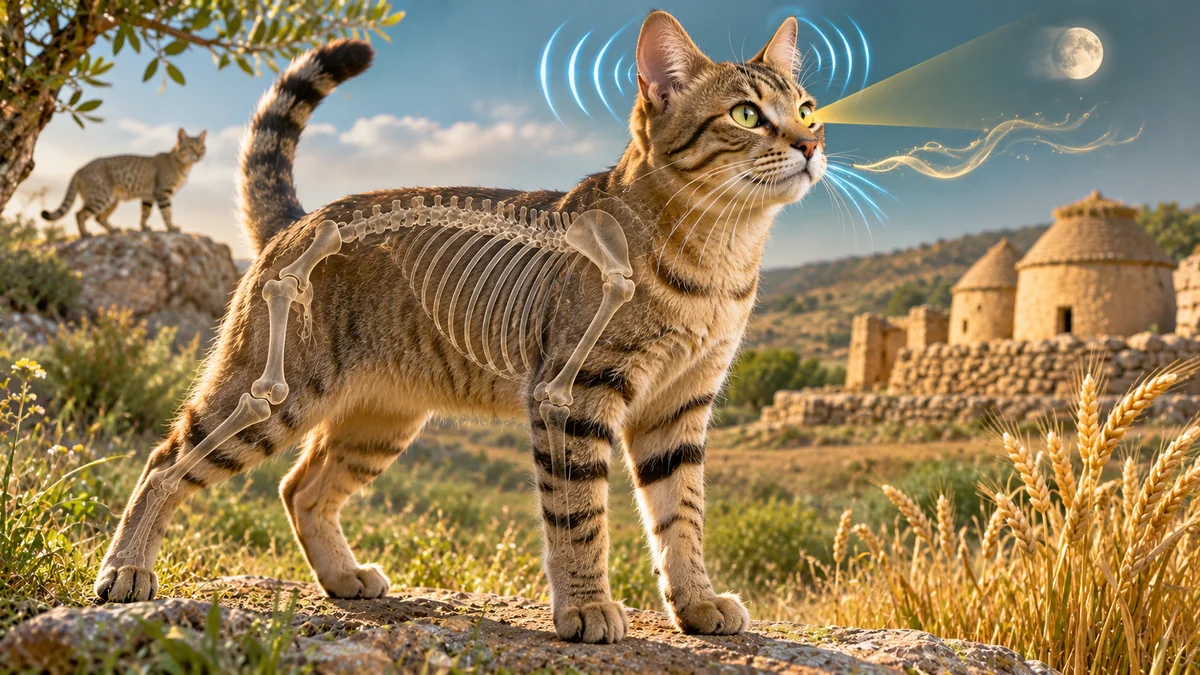
Cat biology explains how domestic cats are built, how their senses help them hunt and explore, how they communicate, and how a long relationship with humans shaped their evolution. The domestic cat, Felis catus, is a small mammalian carnivore in the family Felidae. It is related to African wildcats, yet modern house cats are not simply wildcats that learned to live indoors: their history includes human association, population movement, selection and genetic mixing.
A cat's flexible spine, muscular hindlimbs, retractable claws and specialised teeth help it climb, jump and capture small prey. Its whiskers register touch; its ears detect high-frequency sounds; its eyes are effective in dim light; and scent is important for navigating the environment and interacting with other cats. Cats are also obligate carnivores, with nutritional requirements that differ substantially from those of dogs and humans.
Cat domestication is more complicated than many timelines suggest. Archaeologists found evidence of a close human–cat association in Cyprus around 9,500 years ago, but a major Science study published in November 2025 analysed 87 ancient and modern cat genomes and concluded that domestic cats likely arrived in Europe from North Africa around 2,000 years ago, rather than travelling with the first European farmers as previously proposed. These observations answer different questions: early interaction with wildcats is not proof that the same modern domestic lineage had already spread everywhere. See the 2025 genomic study and research on early human–cat association .
Cat biology: essential facts at a glance
| Topic | Key biological fact |
|---|---|
| Scientific name | Felis catus; sometimes classified as Felis silvestris catus |
| Classification | Mammal; order Carnivora; family Felidae |
| Locomotion | Digitigrade, walking mainly on the toes; flexible spine, agile joints and powerful muscles |
| Teeth | Usually 26 temporary kitten teeth and 30 permanent adult teeth |
| Claws | Usually retractile, important for climbing, gripping and hunting |
| Diet | Obligate carnivore requiring nutrients such as taurine and preformed vitamin A |
| Special senses | Low-light vision, sensitive high-frequency hearing, olfaction and tactile whiskers |
| Behaviour | Predatory play, scent marking, social flexibility and contextual body language |
| Reproduction | Placental mammal; pregnancy typically around nine weeks |
| Domestication evidence | Human–cat association in Cyprus about 9,500 years ago; revised genomic evidence for European domestic cats arriving around 2,000 years ago |
These characteristics describe the species broadly, not every individual. Domestic cats vary in body size, coat length, behaviour and health, while most share the same core feline anatomy. For the wider biological context, see SuperEducational's guide to vertebrates, invertebrates and animal classification .
1. Cat anatomy: the skeleton and flexible spine
Cats have a vertebrate skeleton made up of the skull, spinal column, rib cage, pelvis, shoulder region and four limbs. Their vertebrae protect the spinal cord, while the rib cage protects the heart and lungs. Muscles, tendons and joints work with the nervous system to support fast changes of direction, stretching, jumping and climbing.
The feline backbone is notably flexible, especially in the regions involved in bending during running and pouncing. Cats have long hindlimb muscles and joints capable of powerful extension, helping them launch short jumps. Their shoulder structure also permits considerable movement of the forelimbs. Yet flexibility is not the same as an unlimited ability to twist safely; falls and high jumps can still cause serious injuries.
Cats are digitigrade, meaning that they normally walk on their toes rather than planting a human-like whole foot on the ground. Paw pads cushion impact and provide sensory information. Most cats have five toes on each forepaw, including a dewclaw, and four on each hindpaw; polydactyly can produce additional toes. Cat claws are normally drawn back when not being used, which helps keep them sharp. The Merck Veterinary Manual's physical description of cats explains these features.
Why can cats land on their feet?
A falling cat may use its righting reflex: information from the inner ear, eyes and body-position sensors guides rapid changes in body orientation. The cat can rotate parts of its body relative to one another without requiring a solid surface to push against. This ability develops as kittens mature, but it is not a guarantee against injury or death. Cats can be seriously hurt in falls, particularly from windows and balconies, so secure screens and safe home design remain important.
2. Teeth, tongue and digestion: built for meat
A typical kitten has 26 deciduous teeth, later replaced by 30 permanent adult teeth. Adult dentition usually consists of 12 incisors, four canine teeth, ten premolars and four molars. The prominent canines help grasp prey, while specialised shearing teeth—particularly the carnassials—slice through food. Cats are not designed to grind large quantities of fibrous plant matter in the same way as herbivores. The Merck Veterinary Manual's dental guide confirms the tooth counts.
A cat's tongue bears backward-pointing, keratinised papillae that feel rough like a fine brush. They help remove loose hair and debris during grooming and assist in handling food. Swallowed hair can sometimes accumulate into hairballs, but repeated vomiting should not automatically be dismissed as normal grooming behaviour.
The stomach, intestines, liver and pancreas cooperate to digest and absorb food. Cats are obligate carnivores because they have metabolic needs traditionally met through animal-derived nutrients. Essential requirements include taurine, adequate arginine, preformed vitamin A, arachidonic acid and sufficient protein. Unlike dogs, cats cannot safely rely on an improvised diet merely because it contains vegetables, grains or an occasional protein treat. Merck's veterinary nutrition overview and the ISFM consensus review on feline nutrition explain these specialised needs.
A commercially formulated, complete and balanced feline diet appropriate to the cat's life stage is a common evidence-based option. Any unusual feeding plan, particularly one excluding animal-derived ingredients, demands professional formulation and monitoring; deficiencies can cause serious harm. Milk is not essential for adult cats, and some have trouble digesting lactose.
3. Cat vision: why are cats good at seeing in dim light?
Cats are highly capable in low-light conditions, an adaptation useful for a predator that is often active around dawn and dusk. Their retinas contain light-sensitive rod cells, and many cats have a reflective layer behind the retina called the tapetum lucidum. It redirects some light through photoreceptors, contributing to low-light sensitivity and the familiar appearance of glowing eyes in certain lighting.
But cats cannot see in complete darkness; their eyes still need some light. Their vision also differs from human vision in sharp detail and colour processing. Cats possess colour-sensitive cone cells, so it is inaccurate to say they see only black and white. Their colour discrimination is less extensive than that of a typical human, while movement detection and low-light vision are especially important. Merck's physical description notes that cats can see substantially better than people in dim lighting, not that darkness becomes magically visible.
Do cats have night vision?
“Night vision” is a useful everyday expression for their sensitivity in dim light, but it should not be confused with infrared cameras or perfect sight without illumination. Like all visual systems, feline vision trades off several abilities. Cats combine vision with hearing, smell and whisker feedback to navigate their surroundings.
4. How does a cat's hearing work?
Cat ears can rotate to help localise sounds. Sound waves move through the outer ear and middle ear to the cochlea, where specialised hair cells convert mechanical vibrations into electrical signalling that passes along the auditory nerve. Cats can hear many higher-frequency sounds than humans, a capacity useful for detecting the faint calls and movements of small prey.
The direction and timing of incoming sounds help the nervous system locate their source. A cat that suddenly swivels both ears may be investigating an unfamiliar sound rather than ignoring its owner. Hearing ability can change with age, illness and injury; not every cat has the same auditory sensitivity. The International Cat Care guide to feline senses describes the importance of mobile ears and sound localisation.
Because high-frequency hearing can make sudden or loud noise distressing, humane environments should limit unnecessary noise, provide hiding spaces and allow cats control over their exposure to unfamiliar situations.
5. Smell, whiskers and the cat's sensory world
Smell is important for identifying places, food, individuals and social information. Molecules reach the olfactory epithelium in the nose, where sensory neurons respond to chemical features. The brain interprets patterns of activity that help distinguish familiar from unfamiliar odours. Cats also use an accessory chemosensory system, often associated with the vomeronasal organ, for certain chemical cues. A cat may sometimes show a flehmen response, raising the upper lip or holding the mouth partly open when investigating particular scents.
Cat whiskers, or vibrissae, are specialised tactile hairs rooted in follicles associated with abundant sensory nerve endings. They help register contact and movement close to the face. Whiskers do not measure every doorway with perfect accuracy or function as supernatural radar. They provide additional signals that the brain combines with ordinary touch, sight and body-position information. Avoid cutting whiskers for cosmetic reasons because doing so removes part of this sensory input.
Smell is also central to communication. Face rubbing, scratching and some forms of urine marking can deposit scent-related information. A cat rubbing its cheeks on furniture may be maintaining a familiar scent environment rather than claiming legal ownership of every object. The AAFP/ISFM feline environmental guidelines explain how scent and familiarity influence welfare.
6. Hunting behaviour and why cats play
Domestic cats retain many elements of small-felid predatory behaviour. A typical hunting sequence can involve orientation, stalking, approaching, chasing, pouncing, gripping and biting. The exact sequence varies with the prey, situation and individual. A cat does not have to be hungry to pursue a moving object: predatory motivation can exist alongside a regular feeding schedule.
Play frequently imitates parts of these movements. Kittens practise stalking, batting, jumping and coordination through interaction with objects and other cats. Adults may also benefit from controlled play that involves searching, chasing and catching safe toys. Predictable opportunities for play, rest and retreat help satisfy behavioural needs.
Object play should not involve encouraging a cat to attack bare hands or feet, and string-like toys should be put away when unsupervised because swallowing them can be dangerous. Safe, supervised play is a better teaching tool than introducing live prey to demonstrate hunting. The Merck Veterinary Manual's social-behaviour reference explains how predatory behaviour and play overlap.
7. Cat body language: ears, eyes, tail and posture
A cat communicates through its whole body, not a single tail movement or sound. Ears held forward may accompany interest or alertness, while flattened or rotated ears can indicate discomfort or fear depending on context. A freely moving, relaxed body is different from a stiff crouch, tense facial muscles, a rapidly moving tail and attempts to hide.
An upright tail can often accompany a friendly greeting, but it is not an infallible sign. A swishing or twitching tail can signal arousal, focus or irritation; the surrounding posture helps explain which. Similarly, an exposed belly does not always mean the cat wants its stomach touched. A cat may simply feel safe enough to rest in that position.
The slow blink is an especially interesting case of cat–human communication. In controlled experiments published in Scientific Reports in 2020, cats responded to human slow-blinking interactions in ways associated with greater approach or eye narrowing. This suggests slow blinking can form part of positive interaction, but it does not prove a blink carries one fixed sentence such as “I love you.” Read the original slow-blink study .
Hissing, growling or withdrawing should generally be treated as signals to stop, allow space and evaluate the situation—not as invitations to force more handling. The 2022 cat-friendly veterinary guidelines recommend approaching cats according to their body language and preference for voluntary interaction.
8. Why do cats purr, meow and knead?
Purring is a familiar feline sound associated with rhythmic vibration in the laryngeal system. It often occurs during comfortable social interaction, but cats may also purr while stressed, unwell or in pain. Therefore, purring alone is not proof of happiness or good health. Researchers are still investigating details of the physical and neural mechanisms underlying the sound. A 2025 acoustics study discusses variability in meows and purrs.
Meowing is especially prominent in communication between many domestic cats and people, though individual cats vary. A meow can occur during greeting, anticipation, solicitation or distress; sound and context matter more than simplistic translation charts. Chirps, trills, growls and hisses add to a varied vocal repertoire.
Kneading—alternately pressing the forepaws against a soft surface—resembles movements kittens use while nursing and may continue in adulthood during relaxed or affiliative situations. But not every cat kneads, and a cat's behaviour should be interpreted alongside its posture, environment and health.
9. Are cats solitary or social animals?
Domestic cats can hunt alone yet still form social relationships with humans and other cats. Some live in loose social groups where food and suitable resources are available; others prefer more distance or respond negatively to unfamiliar cats. Their social flexibility depends on early experience, relatedness, personality, available space and the context in which they meet.
This means not every cat wants a feline companion. Adding another cat to a home can be stressful if space, hiding places and essential resources are limited. Shared homes may work best with multiple well-separated feeding and drinking locations, resting places, scratching areas and litter trays. The 2024 AAFP intercat-tension guidelines stress the diversity of feline social behaviour rather than one universal household rule.
Feline territoriality is better understood as behaviour connected with resource use and familiar places than as a desire to dominate people. Cats can learn through consequences and rewards, and positive reinforcement can be used to teach skills without intimidation or physical punishment.
10. Where did domestic cats come from?
Domestic cats derive primarily from the African wildcat lineage, commonly called Felis lybica (or the African/Near Eastern wildcat in older classifications). Unlike most modern dog breeds, many house cats still resemble small wildcats in overall body form and behaviour. One traditional theory proposes that wildcats were drawn to rodents around early farming settlements and gradually became tolerant of people.
Archaeology gives evidence of relationships between humans and cats long before the modern pet industry. At Shillourokambos, Cyprus, a cat was buried near a human in an archaeological context dating to approximately 9,500 years ago. Because cats were not native to the island, their presence suggests human transport and an early special relationship. However, this burial alone does not prove that the animal belonged to the same fully domestic genetic population as today's house cats. See the 2004 report on early taming in Cyprus and later archaeological discussion.
What did the November 2025 DNA study change?
A study in Science, published on 27 November 2025, used 87 ancient and modern genomes to re-examine feline ancestry in Europe. The researchers concluded that the lineages ancestral to the domestic cats of Europe spread there around 2,000 years ago, probably from North Africa, instead of being introduced by the first Neolithic farmers. Earlier European cat remains that had been viewed as evidence of domestic cats could instead represent wildcats or mixtures of wildcat lineages. The paper is available in full text ; LMU Munich's research explanation outlines its implications.
The study does not mean nobody interacted with cats before the Roman period, or that the Cyprus burial never happened. Rather, it distinguishes a very early human–cat relationship from the genetic origins and spread of today's domestic populations. Earlier work had given more weight to a Near Eastern dispersal linked to farming and a later Egyptian contribution. The newer whole-genome evidence has revised that picture, but exactly when and where all stages of domestication occurred remains open to further ancient-DNA sampling.
11. How did living with humans change cats?
Human association likely favoured, over generations, some forms of tolerance for people and settlement environments. Cats benefited from opportunities to hunt rodents around food stores, while people sometimes benefited from pest control and companionship. The relationship was not necessarily planned as a single breeding experiment.
Later selective breeding created cats with varied coats and builds, but many house cats have mixed ancestry. Breed alone does not determine personality; early experience, health and environment also matter.
Some selected physical traits may carry welfare costs. Very flat-faced cats, for instance, can have breathing or eye problems; other inherited conditions vary by lineage. Responsible breeding and care prioritise breathing, mobility, vision and general well-being over extreme appearance.
12. Cat reproduction, kitten development and lifespan
Female cats are placental mammals that produce live kittens and nourish them with milk. Pregnancy commonly lasts approximately 63–65 days, with variation according to how conception is dated. Kittens are born dependent and undergo rapid changes in mobility, hearing, sight and social responses during early development.
Gentle, positive experiences during early life can help kittens become more comfortable with people and normal environments. Rough handling, fear or overwhelming exposure can have lasting effects. A 2021 feline life-stage guideline discusses the role of play and early experiences. Veterinary preventive care, parasite control and appropriate nutrition are important throughout life.
Cat lifespan varies with genetics, living conditions, diet, injury risks and access to healthcare. Indoor safety, enrichment and preventive veterinary care can reduce some hazards, but a single lifespan number does not describe every domestic cat. For a wider exploration of why animals differ in longevity, see SuperEducational's biology of animal longevity .
13. Responsible cat care and the needs of a feline predator
Good cat welfare means meeting physical and behavioural needs. This includes complete and balanced nutrition, clean water, safe resting places, scratching surfaces, suitable litter facilities, opportunities to climb and hide, and interactive play. Predictability and the ability to withdraw from unwanted contact can reduce stress.
Scratching is normal: it helps cats maintain claws, stretch and leave visual or scent-related marks. Rather than punishing the behaviour, provide appropriate scratching surfaces and position them where the cat naturally wants to scratch. Declawing is not ordinary nail trimming; it removes part of the toes and carries welfare concerns. The Merck Veterinary Manual recommends meeting scratching needs rather than preventing normal behaviour through harmful methods.
Outdoor stimulation must be balanced with injury, disease and wildlife risks. Secure catios and indoor enrichment can help. Sudden appetite, litter-box, grooming or behaviour changes warrant veterinary attention.
14. Cat biology compared with dog biology
Dogs and cats are both carnivoran mammals, but their biology and domestication histories are not interchangeable.
| Feature | Domestic cat | Domestic dog |
|---|---|---|
| Family | Felidae | Canidae |
| Adult teeth | Usually 30 | Usually 42 |
| Nutrition | Obligate carnivore with specialised nutrient requirements | Nutritionally adaptable omnivore with carnivorous ancestry |
| Claws | Typically retractile | Generally not retractile |
| Communication | Rich body-language, scent and vocal communication | Rich body-language, scent and vocal communication |
| Domestication history | African wildcat ancestry; 2025 DNA revises timeline of European spread | Ancient wolf ancestry; distinct population history |
SuperEducational also has a separately scheduled companion guide, Dog Biology: Anatomy, Senses, Behaviour and Domestication. It should be linked here once its public URL is verified, so readers can study the differences without confusing the two species.
Safe classroom activities for learning cat biology
| Activity | Safe method | Learning objective |
|---|---|---|
| Cat skeleton | Label skull, vertebrae, ribs, pelvis and limb bones on a printed veterinary diagram. | Understand vertebrate anatomy and digitigrade movement. |
| Cat vs dog dentition | Compare images of 30 adult cat teeth and 42 adult dog teeth without opening a living animal's mouth. | Compare carnivoran teeth and feeding adaptations. |
| Sensory systems | Discuss photographs of whiskers, mobile ears and tapetum-related eyeshine. | Identify the different kinds of stimuli receptors detect. |
| Feline body language | Review photos of relaxed, alert and defensive postures; consider full context. | Avoid interpreting a single ear or tail gesture in isolation. |
| Domestication timeline | Plot the 9,500-year-old Cyprus association against the approximately 2,000-year-old European dispersal reported in 2025. | Distinguish archaeology, ancient DNA and evidence of different events. |
These activities require no animal restraint, deliberate noise exposure or live predation. If a live cat is present, participation should be voluntary, supervised and compatible with its well-being. Classroom observations are not veterinary diagnoses.
Common myths about cats
| Claim | What the evidence shows |
|---|---|
| “Cats can see in total darkness.” | Cats see well in low light but still need light. |
| “Cats only see black and white.” | They have colour vision, though it differs from typical human trichromatic vision. |
| “Purring always means happiness.” | Purring also occurs in situations involving stress or discomfort. |
| “Cats never form social bonds.” | They can form relationships with people and other cats, but social preferences vary. |
| “Cats can safely eat anything a dog eats.” | Cats have specific obligate-carnivore nutritional requirements. |
| “A falling cat cannot get hurt.” | The righting reflex does not eliminate injury risk. |
| “Domestic cats were definitely brought to Europe by Neolithic farmers.” | A 2025 genome study supports a much later domestic-cat dispersal from North Africa. |
| “The 9,500-year-old Cyprus cat proves today's modern domestic breed existed then.” | It documents early human–cat association, not that specific genetic conclusion. |
Frequently asked questions
What is the scientific name of the domestic cat?
The domestic cat is usually called Felis catus. Some classifications use Felis silvestris catus. Both place domestic cats among the small felids closely related to wildcats.
How many teeth does a cat have?
A typical adult cat has 30 permanent teeth, while a kitten has 26 temporary teeth before replacement.
Are cats obligate carnivores?
Yes. They require particular nutrients, including adequate taurine, arginine, preformed vitamin A and arachidonic acid. Their nutritional needs differ from those of dogs or humans.
Can cats really see in the dark?
They are highly sensitive in dim light, but cannot see in complete darkness. Their retinas and tapetum lucidum support low-light vision.
What are cat whiskers for?
Whiskers are tactile sensory hairs that help cats detect contact and subtle movement near their faces. They contribute to environmental awareness alongside sight and hearing.
Why do cats purr?
Purring occurs during several emotional and physiological states, including comfort and sometimes distress. A purr should be interpreted in context, not treated as automatic proof of happiness.
Are cats nocturnal?
Cats are often described as crepuscular, meaning active around dawn and dusk, but domestic cats can adjust their activity to food availability, people and the environment. They are not all active exclusively at night.
Where were cats first domesticated?
Domestic cats derive from African wildcat ancestry, but the exact date and place of domestication are still being investigated. A close human–cat association existed in Cyprus around 9,500 years ago; November 2025 genomic evidence suggests that today's European domestic-cat ancestry arrived from North Africa around 2,000 years ago.
What is the difference between a cat and a dog biologically?
Cats are felids with generally retractable claws, 30 adult teeth and obligate-carnivore nutritional needs. Dogs are canids, usually have 42 adult teeth and possess different digestive, sensory and domestication adaptations.
Conclusion: understanding the domestic cat
Cat biology is the story of an agile mammalian predator that now lives in close association with people. Its flexible skeleton, claws, specialised teeth and meat-based nutritional requirements reflect feline evolution. Its eyes, ears, nose and whiskers provide the information needed for hunting and exploring; its vocalisations, scent signals and body language support communication. Cats can form social bonds while retaining distinct individual preferences and behavioural needs.
The history of cat domestication is equally revealing. The ancient Cyprus burial demonstrates an early association with humans, while the 2025 ancient-genome study indicates that the modern domestic cats of Europe spread from North Africa only around two millennia ago. Scientific conclusions improve as better evidence appears. By separating anatomy, behaviour, archaeology and genetics, we gain a more accurate picture of one of humanity's most familiar animal companions.
References and further reading
- De Martino et al., Science (2025) — The Dispersal of Domestic Cats from North Africa to Europe Around 2,000 Years Ago .
- LMU Munich (2025) — Domestic Cats Arrived in Europe Only 2,000 Years Ago .
- Vigne et al., Science (2004) — Early Taming of the Cat in Cyprus .
- PNAS (2020) — Cats as Predators and Early Domesticates in Ancient Human Landscapes .
- Nature Ecology & Evolution (2017) — The Palaeogenetics of Cat Dispersal in the Ancient World .
- Merck Veterinary Manual — Physical Description of Cats .
- Merck Veterinary Manual — Dental Development of Cats .
- Merck Veterinary Manual — Overview of Nutrition in Small Animals .
- ISFM — Consensus Guidelines on Management of the Inappetent Hospitalised Cat .
- AAFP/ISFM — Feline Environmental Needs Guidelines .
- Scientific Reports (2020) — The Role of Cat Eye Narrowing in Cat–Human Communication .
- AAFP/ISFM (2022) — Cat-Friendly Veterinary Interaction Guidelines .
- AAFP (2024) — Intercat Tension Guidelines .
- Merck Veterinary Manual — Social Behaviour of Cats .
- Scientific Reports (2025) — Individual Information in Cat Meows and Purrs .
- AAHA/AAFP (2021) — Feline Life Stage Guidelines .
- International Cat Care — Cat-Friendly Veterinary Care and Feline Senses .