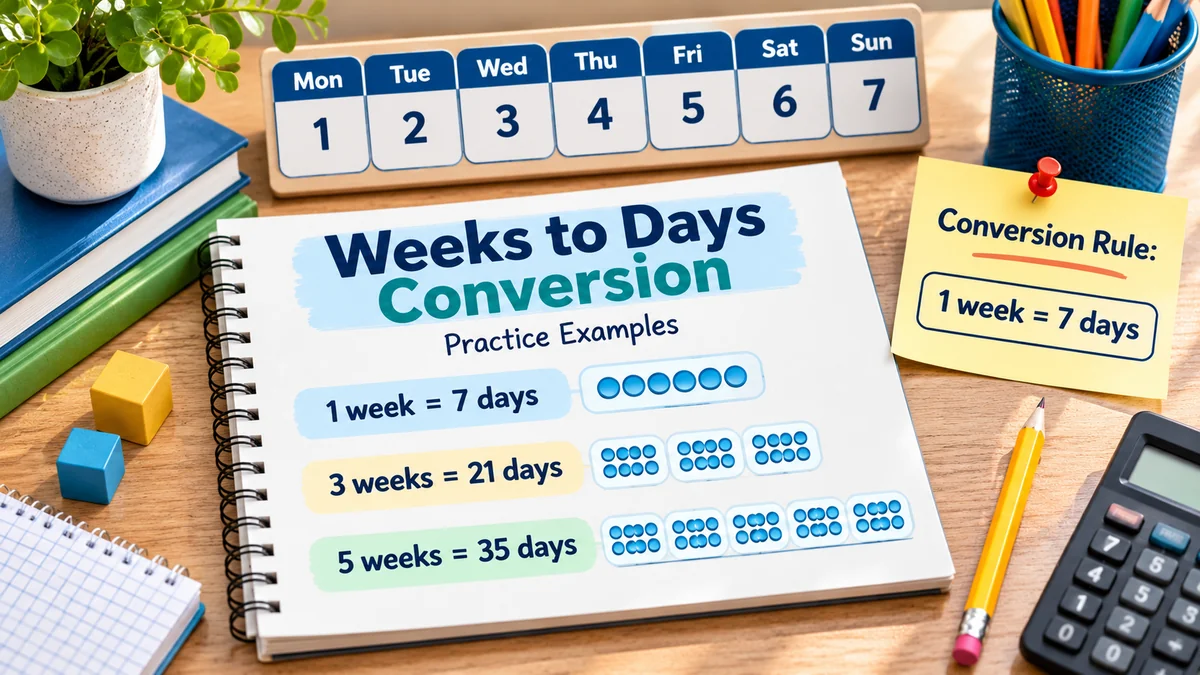
Weeks to days conversion is simple: multiply the number of weeks by seven. One week contains seven days, so three weeks contain 3 × 7 = 21 days, and ten weeks contain 10 × 7 = 70 days. To convert back from days to weeks, divide by seven. The same rule works for whole numbers, fractions, decimals and most everyday time problems, provided you are counting calendar days rather than school days or working days.
This student-friendly lesson introduces the formula, explains why it works, provides a ready-reference chart and walks through examples before offering 20 original practice problems with worked answers. You can use it for homework, revision, classroom teaching or checking how long a real-world activity lasts.
The one rule to remember: 1 week = 7 days
Monday, Tuesday, Wednesday, Thursday, Friday, Saturday and Sunday make up one seven-day week. If an activity lasts a certain number of complete weeks, each week contributes seven days to its duration. The conversion is therefore an example of multiplication by a constant:
Number of days = number of weeks × 7.
For example, 4 weeks = 4 × 7 = 28 days. In an OpenStax Prealgebra 2e lesson on systems of measurement , one week is explicitly treated as seven days, and time conversions are explained using equivalent units and multiplication factors.
To reverse the conversion, divide: number of weeks = number of days ÷ 7. Thus 35 days ÷ 7 = 5 weeks.
How to convert weeks to days, step by step
- Find the number of weeks. Read the question carefully. Is it 3 weeks, 3½ weeks or 3 weeks and 2 days?
- Multiply the weeks by seven. For 6 weeks, calculate 6 × 7 = 42.
- Add any separate extra days. For 6 weeks and 2 days, calculate (6 × 7) + 2 = 44 days.
- Write the unit and check your answer. The result is in days. Because a week is longer than a day, the numerical value should increase when you convert whole weeks to days.
There is a useful visual method for beginners: draw seven squares for each week. Three rows of seven squares give 7 + 7 + 7 = 21 days. As students grow more comfortable, they can replace repeated addition with the seven-times table.
Weeks to days conversion chart
Use this table to check common whole-week conversions. All entries count seven-day calendar weeks.
| Weeks | Days | Calculation |
|---|---|---|
| 0 | 0 | 0 × 7 |
| 1 | 7 | 1 × 7 |
| 2 | 14 | 2 × 7 |
| 3 | 21 | 3 × 7 |
| 4 | 28 | 4 × 7 |
| 5 | 35 | 5 × 7 |
| 6 | 42 | 6 × 7 |
| 8 | 56 | 8 × 7 |
| 10 | 70 | 10 × 7 |
| 12 | 84 | 12 × 7 |
| 20 | 140 | 20 × 7 |
| 26 | 182 | 26 × 7 |
| 52 | 364 | 52 × 7 |
Important: 52 weeks equals 364 days, whereas a normal calendar year has 365 days and a leap year has 366. In other words, 52 weeks is not precisely one Gregorian calendar year. The distinction matters when working with exact dates, but it does not change the seven-day conversion rule.
Worked examples for beginners
Example 1: Convert 3 weeks to days
Multiply the weeks by 7: 3 × 7 = 21. Answer: 21 days. Check by counting three groups of seven: 7 + 7 + 7 = 21.
Example 2: Convert 8 weeks to days
Use the formula: 8 × 7 = 56. Answer: 56 days. Because 8 weeks is longer than 3 weeks, 56 is sensibly larger than 21.
Example 3: Convert 4 weeks and 3 days
First convert the complete weeks: 4 × 7 = 28 days. Then add the remaining 3 days: 28 + 3 = 31 days.
Example 4: Convert 1½ weeks to days
One and a half weeks equals 1.5 weeks. Multiply: 1.5 × 7 = 10.5 days. Half a day is 12 hours, so the same duration can be described as 10 days and 12 hours. Do not round the answer to 11 days unless the question asks for whole-day rounding.
Example 5: Convert 45 days into weeks and days
This is the reverse process. Divide: 45 ÷ 7 = 6 remainder 3, because 6 × 7 = 42 and 45 − 42 = 3. Answer: 6 weeks and 3 days.
How to handle fractions and decimal weeks
The seven-day rule works with fractions. For example, ½ week = ½ × 7 = 3.5 days, and ¼ week = ¼ × 7 = 1.75 days. The latter is one full day plus 0.75 day, which is 18 hours.
For a mixed number such as 2¼ weeks, change it into 2.25 or calculate in parts: (2 × 7) + (¼ × 7) = 14 + 1.75 = 15.75 days, or 15 days and 18 hours. These results are exact durations, not rounded calendar-day counts.
A helpful mathematical technique is dimensional analysis, which uses the fraction 7 days / 1 week. Multiplying 2.25 weeks by that fraction cancels the unit “weeks” and leaves “days”. OpenStax Elementary Algebra 2e demonstrates this method for chained unit conversions.
How to convert days back into weeks
To convert days into whole weeks and a remainder, divide by seven and stop before rounding. For example, 100 days ÷ 7 = 14 remainder 2, so 100 days is 14 weeks and 2 days. If the question requests a decimal instead, 100 ÷ 7 ≈ 14.2857 weeks.
These are two different but compatible forms of the same duration. A classroom answer usually favours “14 weeks and 2 days” when the question asks for whole weeks and leftover days; a calculator or scientific worksheet may prefer decimal weeks.
Real-life word problems: school, holidays and projects
School project
A class has five weeks to complete a science project. How many calendar days is that? 5 × 7 = 35 days. If the class meets only Monday through Friday, there are typically 5 × 5 = 25 scheduled weekdays during five complete weeks, before holidays and school closures. These are different answers to different questions.
Holiday countdown
A family travels in three weeks and four days. Their waiting period is (3 × 7) + 4 = 25 days. The phrase “three weeks and four days” means a combined duration, not that four days should be multiplied by seven.
Reading challenge
A learner plans to read every day for eight weeks. That is 8 × 7 = 56 calendar days. If they read only on weekdays, their target may instead be 40 reading days across eight complete Monday-to-Sunday weeks.
For younger children learning time and numerical grouping, the activities in SuperEducational's maths activities for preschoolers provide additional hands-on learning ideas.
Practice worksheet: 20 weeks-to-days questions
Try these without looking at the answer key. Start with whole weeks, then tackle mixed time amounts and word problems. Write the calculation and unit for every answer.
Level 1: whole-week conversions
- How many days are in 2 weeks?
- How many days are in 4 weeks?
- Convert 7 weeks into days.
- Convert 9 weeks into days.
- How many days are in 12 weeks?
- Convert 0 weeks into days.
- Convert 15 weeks into days.
- How many days are in 20 weeks?
Level 2: mixed amounts, fractions and reverse conversions
- Convert 3 weeks and 2 days into days.
- Convert 5 weeks and 6 days into days.
- Express 1.5 weeks in days, without rounding.
- How many days are in a quarter of a week?
- Convert 44 days to full weeks and remaining days.
- Convert 79 days to full weeks and remaining days.
Level 3: application and reasoning
- A sports camp lasts 8 complete weeks and is open Monday through Friday. Find (a) calendar days and (b) scheduled camp days, ignoring holidays.
- A student has 6 weeks and 3 days until an exam. How many days remain?
- One project lasts 4 weeks and another lasts 9 days. What is their combined duration in days if completed consecutively?
- A training course lasts 28 days. How many complete weeks is that?
- A science experiment lasts 3.5 weeks. Give the exact duration in days and hours.
- A club meets five days per week for 14 complete weeks. Find (a) possible meeting days and (b) total calendar days covered.
Answer key with worked solutions
| Question | Working | Answer |
|---|---|---|
| 1 | 2 × 7 | 14 days |
| 2 | 4 × 7 | 28 days |
| 3 | 7 × 7 | 49 days |
| 4 | 9 × 7 | 63 days |
| 5 | 12 × 7 | 84 days |
| 6 | 0 × 7 | 0 days |
| 7 | 15 × 7 | 105 days |
| 8 | 20 × 7 | 140 days |
| 9 | (3 × 7) + 2 | 23 days |
| 10 | (5 × 7) + 6 | 41 days |
| 11 | 1.5 × 7 | 10.5 days, or 10 days 12 hours |
| 12 | 0.25 × 7 | 1.75 days, or 1 day 18 hours |
| 13 | 44 = (6 × 7) + 2 | 6 weeks 2 days |
| 14 | 79 = (11 × 7) + 2 | 11 weeks 2 days |
| 15 | 8 × 7; 8 × 5 | (a) 56 calendar days; (b) 40 camp days |
| 16 | (6 × 7) + 3 | 45 days |
| 17 | (4 × 7) + 9 | 37 days |
| 18 | 28 ÷ 7 | 4 weeks |
| 19 | 3.5 × 7 | 24.5 days, or 24 days 12 hours |
| 20 | 14 × 5; 14 × 7 | (a) 70 meeting days; (b) 98 calendar days |
Check question 15 and question 20 carefully. A normal week is seven days, whereas a scheduled five-day school or club week contains five days of attendance. The problem must tell you which quantity to count.
Five mistakes students commonly make
- Dividing instead of multiplying. For weeks to days, multiply by seven; for days to weeks, divide by seven. A quick check is that five weeks cannot be fewer than five days.
- Using five rather than seven for every week. Five may describe school or work attendance, but a whole calendar week always includes seven days.
- Forgetting extra days. Four weeks and two days equals (4 × 7) + 2 = 30 days, not 28.
- Rounding too early. Two and a half weeks is 17.5 days, not automatically 18 days. Round only when the question requires it.
- Confusing durations with date counting. Seven elapsed days after a Monday takes you to the following Monday. If you count both starting and ending dates inclusively, you count eight calendar dates. Timeanddate.com's date duration tool includes an option to count the end date, reflecting this distinction.
Study tips: how to master the conversion quickly
Memorise the first ten multiples of seven, then extend the pattern by adding 7. Use a number line or seven-day calendar when starting out. Check inverse calculations: if 11 weeks becomes 77 days, 77 ÷ 7 should return 11 weeks. Keep your units written beside the numbers, and explain the meaning of the answer rather than reporting a bare figure.
For teachers, a useful mini-assessment is to give three questions in sequence: “6 weeks in days”, “6 weeks and 2 days in days”, and “44 days in weeks and days”. These measure multiplication, addition and the reverse operation without changing the core concept.
Frequently asked questions about weeks to days conversion
How do I convert weeks to days?
Multiply the number of weeks by 7. For example, 6 weeks × 7 = 42 days.
How many days are in 10 weeks?
10 × 7 = 70 days.
How many days are in 40 weeks?
40 × 7 = 280 days. This is a duration conversion; medical or pregnancy dating is a separate clinical matter and should follow professional advice.
How many days are in 52 weeks?
52 × 7 = 364 days. A common Gregorian calendar year contains 365 days; a leap year contains 366.
How many weeks are in 100 days?
100 ÷ 7 gives 14 complete weeks and 2 days, or approximately 14.29 weeks as a decimal.
Are weekends included when converting weeks into days?
Yes. Ordinary week-to-day conversions use all seven calendar days. Excluding weekends creates a different question about working days or school days.
Does a leap year change the formula?
No. Every week still contains seven days. Leap years change the number of days in a calendar year, not the value of one week.
Conclusion
The core of weeks to days conversion is an exact and reusable fact: one week equals seven days. Multiply weeks by seven to get days, add any extra days, and divide by seven when working backwards. Fractions and decimals follow the same rule, while school days, workdays and date-inclusive counting require special attention.
Work through the 20 exercises, check the solutions and retry any you missed. Once the seven-times table and the difference between calendar days and attendance days are clear, most weeks-to-days questions become quick, reliable calculations.