Anaconda vs reticulated python: which is longer or heavier? The reticulated python (Malayopython reticulatus) is the longest living snake species; the green anaconda (traditionally Eunectes murinus) is the heaviest. They are both powerful, nonvenomous constrictors, but their body shapes are different: reticulated pythons can achieve extraordinary length, while green anacondas are especially broad and heavy. The answer changes depending on whether you measure length, mass or girth.
Two Guinness records help clarify the length question. A wild reticulated python named Ibu Baron was measured in Indonesia at 7.22 metres (23 ft 8 in) and 96.5 kilograms on 18 January 2026. The captive reticulated python Medusa was measured at 7.67 metres (25 ft 2 in) and 158.8 kilograms in 2011. For anacondas, London’s Natural History Museum cites an exceptional reported mass of approximately 227 kilograms (500 lb), but that figure is not the weight of an average adult or necessarily a specimen documented under the same standards as those Guinness length records. See the 2026 wild record , captive record and Natural History Museum comparison .
This guide compares the two species directly: their anatomy, geographic ranges, habitats, hunting, reproduction, conservation and the quality of giant-snake evidence. It also explains why one snake can be longer while another weighs more.
Anaconda vs reticulated python: side-by-side facts
| Feature | Green anaconda | Reticulated python |
|---|---|---|
| Size title | Heaviest living snake species | Longest living snake species |
| Classification | Boa family, Boidae; traditional scientific name Eunectes murinus | Python family, Pythonidae; Malayopython reticulatus |
| Native region | South America’s tropical watersheds and wetlands | South and Southeast Asia |
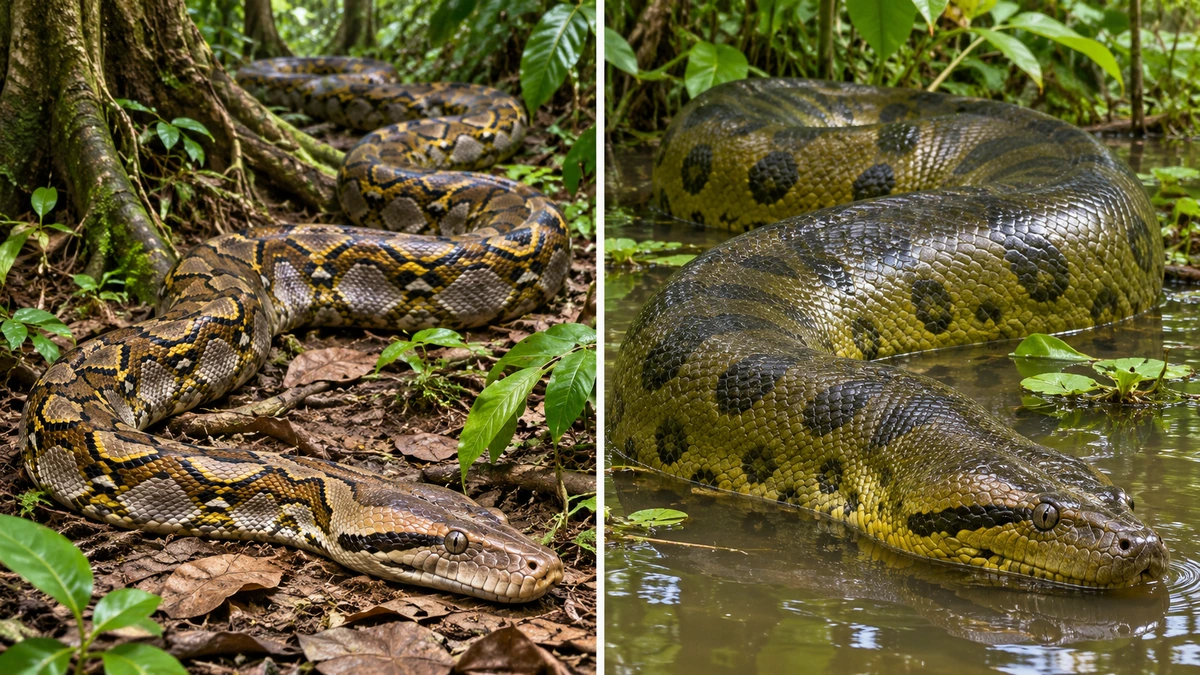
| Typical appearance | Broad, olive-green body with dark rounded blotches | Longer, relatively slender body with golden, brown and black net-like scales |
| Habitat | Slow rivers, swamps, marshes and flooded grasslands | Forests, river margins, vegetation and other warm habitats |
| Movement | Strongly aquatic; also moves on land | Climbs and swims; also travels on land |
| Hunting | Ambush and muscular constriction | Ambush and muscular constriction |
| Venomous? | No | No |
| Reproduction | Live young | Eggs |
| Sex differences | Females can be dramatically larger than males | Females tend to grow larger than males |
This comparison refers specifically to the green anaconda, the huge South American snake most people mean when they say “anaconda”. Other anacondas exist, and the proposed division of green anacondas into northern and southern species remains scientifically disputed. San Diego Zoo and its python overview provide further background.
1. Which snake is longer?
The reticulated python is longer at the species level. Large females may exceed six metres and exceptional specimens have passed seven metres under modern verification. Many adults are much smaller. Therefore, “reticulated pythons grow to seven metres” should not be misread as a normal or guaranteed adult length.
Ibu Baron is especially important because she represents a documented wild specimen, not merely an old story. She was discovered in the Maros region of Sulawesi, Indonesia, in late 2025, and measured on 18 January 2026 at 7.22 m. Guinness recorded a mass of 96.5 kg. Its contemporary report explains the documentation behind her record.
The best-known captive record belongs to Medusa, measured at 7.67 m in Kansas City on 12 October 2011. This is 0.45 m longer than Ibu Baron’s recorded length, but the snakes belong to separate wild and captive categories. Guinness also recorded Medusa at 158.8 kg.
Green anacondas can become exceptionally long, yet the verified evidence does not put them ahead of reticulated pythons for the longest living species. Guinness describes mature female green anacondas commonly around 3–5 metres, although individuals vary and rare reports claim much greater lengths. A small python can of course be shorter than a big anaconda: the title is a comparison of the species’ extreme sizes, not an automatic rule for every individual. Guinness’s longest-species entry gives context for historical and contemporary records.
2. Which snake is heavier?
The green anaconda is the heaviest living snake species. Its body has unusually substantial girth. A mature female can have far greater cross-sectional bulk than a reticulated python of comparable length. The Natural History Museum and San Diego Zoo cite an exceptional recorded maximum of about 227 kg (500 lb).
The source and category matter. The 227-kg figure is an extreme, reported maximum, not a measurement of the typical adult. It should not be placed in a chart as though it represented every large green anaconda or had exactly the same documentation as Ibu Baron’s recent record. Guinness notes that mature females are frequently substantially smaller—often approximately 30–70 kg, according to its species account—while rare reports describe much larger specimens. Read its heavyweight overview .
A particular huge reticulated python may outweigh a smaller anaconda. Medusa, for instance, weighed far more than many ordinary anacondas. This is why the precise statement is “green anaconda: heaviest species and greatest potential mass”, not “every anaconda is heavier than every python”. Sex, body condition, recent feeding and reproductive state make an individual comparison less predictable.
3. Why can a shorter anaconda weigh more?
Length tells us how far a snake extends from its snout to the tip of its tail. Mass tells us how much matter its body contains. A long, narrow animal need not outweigh a shorter, very thick one. The key variable is body volume, which depends on girth as well as length.
As a teaching example, a cylinder’s volume is π × radius² × length. If two imaginary cylinders had identical length and density, but one had twice the radius, the thicker cylinder would have four times the volume. This is illustrative geometry, not a validated formula for estimating snake weight. Real snakes have tapering tails, variable muscle and fat distributions, unequal diameters along their bodies, and bodies that change with meals and reproduction.
The green anaconda’s robust build therefore explains how it can outweigh an even longer reticulated python. A photograph can be misleading: an animal positioned close to the camera may look enormous, while the visible part of a coiled body tells us little about its full length. Scientific records need separate measurements of total length and actual mass.
4. What are the visible differences between the two snakes?
Reticulated pythons have an intricate network of dark, golden and tan markings, which explains the word reticulated. Their bodies are very elongated and relatively slender compared with a comparably massive anaconda. They can move through forest vegetation, climb and swim. The distinctive pattern helps camouflage the snake amid leaf litter and shifting light.
Green anacondas usually have olive or greenish scales with large dark round or oval spots. Their torsos are heavy and thick. Eyes and nostrils are positioned toward the upper part of the head, useful when the snake is partly submerged. Despite their aquatic adaptations, they can move on land and are not restricted to water every moment of their lives.
Neither body pattern guarantees age or size. Juveniles are smaller, and the appearance of an individual depends partly on lighting, local variation and condition. For accurate wildlife identification, body shape, pattern and geography are more helpful together than a claimed length alone.
5. Where do anacondas and reticulated pythons live?
The green anaconda’s South American wetlands
The green anaconda is associated with tropical South America, including the Amazon and Orinoco systems and other river basins. It favours shallow, slow-moving water, flooded grassland, marshes and wetland edges. Those environments provide concealment and access to aquatic or semi-aquatic prey. The Smithsonian National Zoo describes the species’ wetland ecology.
The reticulated python’s Asian habitats
The reticulated python naturally inhabits parts of South and Southeast Asia, notably Indonesia, the Malay region and surrounding areas. It uses forest and river-edge environments and may occur near human-modified landscapes. It is an able swimmer and can also climb, so the label “land snake” should not be taken too literally. San Diego Zoo’s python guide discusses the broader adaptability of python habitats.
These snakes are not native neighbours. A documentary or fictional scene suggesting that anacondas and reticulated pythons regularly compete in one rainforest is misleading: their natural ranges are on different continents.
6. Which is the better swimmer?
Both are capable of moving through water, but the green anaconda is more strongly associated with aquatic life. The thick body of a large anaconda can be supported by water, which helps explain why rivers and flooded habitats are so important to its ecology. Anacondas can hunt, rest and travel while partly submerged.
Reticulated pythons also swim effectively and occur in places with many waterways and islands. They can move on land and use vegetation as well. Saying that anacondas swim while pythons cannot is wrong. The meaningful distinction is one of relative ecological specialisation, not an absolute ability possessed by only one species.
Never approach or enter a waterway simply to photograph or test the abilities of a large wild snake. Observational wildlife science should not put people or animals at risk.
7. What do they eat, and how do they hunt?
Both snakes are ambush predators and nonvenomous constrictors. Reticulated pythons take a variety of prey, often birds and mammals, depending on their size and habitat. Green anacondas take animals associated with wetlands, including fish, water birds, turtles and mammals such as capybaras. A particularly large snake can handle larger prey, but viral photos often create a distorted impression that giant prey is a normal meal.
When subduing prey, constrictors use strong coils. The old explanation that they merely crush bones or slowly suffocate prey does not capture the full process. Research has shown that constriction can rapidly disrupt blood circulation, an important mechanism in killing prey. See the Smithsonian’s background on boa constrictors . The details of an individual hunt depend on prey size and circumstances.
Neither animal has a venom-injecting system. But nonvenomous does not mean safe to handle: their teeth, strength and reactions can injure a person. A large wild snake should be left to trained wildlife professionals.
8. Do pythons and anacondas reproduce differently?
Yes. Reticulated pythons, like other members of the python family, lay eggs. Female pythons can guard or coil around their clutches. Green anacondas, members of the boa family, give birth to live young after development inside the female. The San Diego Zoo explains this difference in basic reproductive biology.
Females can also be substantially larger than males in both species, especially in the green anaconda. Scientists call this sexual size dimorphism. Because female body mass can change with reproductive condition, and all snakes vary with age and feeding, a record should note as much information as possible about an individual animal.
The two species also belong to different families: Boidae for the green anaconda and Pythonidae for the reticulated python. They are both reptiles and vertebrates but are not the same kind of snake. For a basic introduction to these classifications, see SuperEducational’s Animal Classification: Vertebrates, Invertebrates and the Main Animal Groups .
9. Is the northern green anaconda a separate species?
In 2024, researchers proposed dividing green anacondas into northern and southern lineages and introduced the name Eunectes akayima for a northern group. The claim generated widespread attention, but later specialists questioned both the genetic reasoning and aspects of how the proposed name was introduced. Therefore the split should not be presented as unanimously accepted.
The original paper in Diversity and a critical assessment in the Zoological Journal of the Linnean Society explain opposing interpretations. This guide uses “green anaconda” as the familiar heavyweight comparison and Eunectes murinus for the traditional species concept, while noting that the taxonomy has been debated.
A taxonomic announcement is not a new size measurement. Even if researchers ultimately recognise separate green-anaconda species, their lengths and weights still need reliable records.
10. Why are stories of nine- or ten-metre snakes difficult to verify?
Historical reports of extremely long pythons and anacondas exist, but reported size and verified size are not the same. Some old accounts were based on visual estimates, stretched skins, uncertain measuring methods or incomplete written descriptions. A dramatic photograph without a calibrated scale can also make an ordinary large snake look impossibly long.
For living snakes, the measurement should identify whether it is total length, from snout to tail tip, or a different anatomical measure. Mass should come from a suitable calibrated scale, with the weight of any container subtracted. Recording date, location, identity and animal condition improves the reliability of the result.
Ibu Baron’s 7.22-metre measurement and Medusa’s 7.67-metre measurement provide named, dated, documented examples. The Guinness longest-species record distinguishes such evidence from historical accounts of even greater lengths. It would be wrong to claim that a larger snake could never be discovered, but a newer anecdote should not replace a verified record without equivalent or better documentation.
11. Which snake is more dangerous?
There is no useful scientific reason to stage a battle or decide which species would “win”. Both are large, strong, wild predators, and handling either without training is dangerous. Some very large pythons have been associated with serious human incidents, while popular films exaggerate the frequency with which anacondas attack people. Their natural prey normally consists of other animals in their ecosystems.
If a large snake is encountered, keep your distance, do not provoke or restrain it, and contact appropriate wildlife authorities or professional handlers if it presents a risk to people or pets. Never attempt to rescue a trapped animal by pulling on its body or entering deep water. The goal is to protect both public safety and wildlife.
12. Why do the two species matter to their ecosystems?
Large constrictors are predators within tropical food webs. They feed on other animals and, in turn, interact with competitors, humans and environmental changes. Both species can face local threats from habitat alteration, fear-driven killing and trade. The San Diego Zoo discusses threats to anacondas, while a Norwegian scientific assessment examines the sustainability of international python trade.
A species may be widespread without every local population being secure. Responsible conservation relies on habitat protection, lawful trade monitoring and accurate public information—not on inventing enormous measurements to make an animal seem more important.
Classroom activity: compare real measurements fairly
Students can analyse size without approaching any snake. Use the following figures as a lesson in measurement, evidence and fair comparison.
| Example | Length | Mass | Evidence category |
|---|---|---|---|
| Ibu Baron, reticulated python, 2026 | 7.22 m | 96.5 kg | Documented wild individual |
| Medusa, reticulated python, 2011 | 7.67 m | 158.8 kg | Documented captive individual |
| Exceptional green anaconda | No directly matched length supplied here | 227 kg cited by museum sources | Exceptional reported maximum with different documentation |
First, draw a two-bar length chart for the two measured pythons. Their difference is 7.67 − 7.22 = 0.45 m. Next, compare their masses without assuming the length difference caused the weight difference: they are different animals living under different conditions. Finally, place the anaconda’s exceptional mass in a separately labelled comparison because the table does not provide a matched, equally documented length-and-mass record for that specimen.
Discussion questions: Why is a species record different from a typical adult size? How would pregnancy or a large recent meal change mass? Why do photographers need scale markers? What does a record holder tell us about the rest of a population?
Common myths: anaconda versus python
| Myth | Science-based correction |
|---|---|
| “The green anaconda is always the longest snake.” | Reticulated pythons are the longest living species. |
| “Every anaconda outweighs every python.” | Individuals differ; green anacondas have the higher extreme mass reputation. |
| “A longer animal must be heavier.” | Mass also depends strongly on body girth and condition. |
| “Pythons cannot swim.” | Reticulated pythons swim well; anacondas are more strongly aquatic. |
| “Anacondas and reticulated pythons are native to the same jungle.” | Anacondas are South American; reticulated pythons are Asian. |
| “Both snakes lay eggs.” | Pythons lay eggs; anacondas bear live young. |
| “Both kill prey with venom.” | Both are nonvenomous constrictors. |
| “The northern green-anaconda split is settled.” | Its taxonomic proposal has been challenged. |
Frequently asked questions
Which is bigger, a green anaconda or a reticulated python?
The green anaconda is typically described as the heavier, bulkier giant. The reticulated python wins the comparison for maximum documented length. Always specify whether “bigger” means longer or heavier.
What is the record length of a reticulated python?
Guinness lists Medusa at 7.67 m for the captive record, measured in 2011, and Ibu Baron at 7.22 m for its verified wild-snake category, measured on 18 January 2026.
How heavy can a green anaconda become?
London’s Natural History Museum cites an exceptional recorded maximum of about 227 kg (500 lb). This is not a normal adult mass, and the evidence for old extreme reports may differ from documentation of modern records.
Can a python be heavier than an anaconda?
Yes. A particular very large python can outweigh a smaller anaconda. Species-level comparisons describe the animals’ body forms and observed size extremes, not every possible pair of individuals.
Do both species swim?
Yes. Green anacondas are highly aquatic, while reticulated pythons can swim as well as move through vegetation and on land.
Do anacondas and reticulated pythons lay eggs?
Reticulated pythons lay eggs. Green anacondas give birth to live young. This is one of their clearest biological differences.
Are either anaconda or reticulated python venomous?
No. They are nonvenomous constrictors, although both are capable of inflicting serious injury and should never be handled casually.
Which species would win in a fight?
There is no meaningful universal answer. Outcome would depend on size and circumstances, and forcing a confrontation would be harmful and dangerous. These species live on different continents in the wild.
Is the northern green anaconda a newly confirmed species?
A separate northern species was proposed in 2024, but other researchers challenged aspects of the proposal and its naming. The classification should be treated as disputed rather than settled.
Conclusion: longer does not necessarily mean heavier
The anaconda vs reticulated python question has two correct answers: the reticulated python is the longest living snake species, while the green anaconda is the heaviest. Reticulated pythons Ibu Baron and Medusa provide exceptional documented length examples, whereas the immense girth of a female green anaconda explains its heavyweight reputation.
Their different continents, habitats, patterns and reproductive strategies make them more interesting than a simple ranking. Good science separates species-level potential from individual records, measured length from reported mass, and verified evidence from folklore. Above all, these impressive predators deserve informed and safe observation rather than sensationalised competition.
References and further reading
- Guinness World Records — Longest Wild Snake Specimen .
- Guinness World Records — Ibu Baron, 2026 .
- Guinness World Records — Longest Snake in Captivity .
- Guinness World Records — Longest Species of Snake .
- Guinness World Records — Heaviest Species of Snake .
- Natural History Museum — What Is the Biggest Snake in the World? .
- San Diego Zoo Wildlife Alliance — Anaconda .
- San Diego Zoo Wildlife Alliance — Python .
- Smithsonian National Zoo — Green Anaconda .
- Smithsonian National Zoo — Boa Constrictor .
- Diversity — Disentangling the Anacondas (2024) .
- Zoological Journal of the Linnean Society — How Not to Describe a Species (2024) .
- Norwegian Scientific Committee — Trade in Pythons: Risk Assessment .