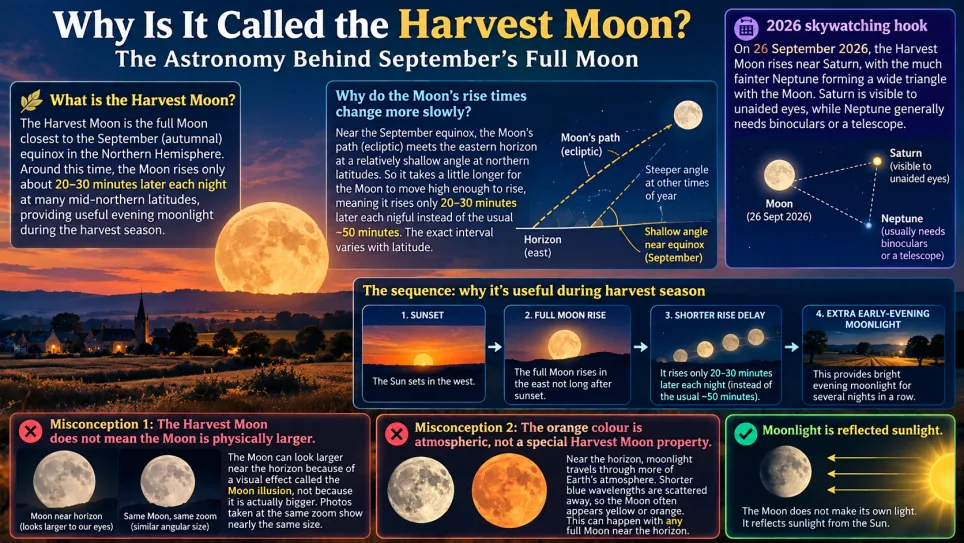
The Harvest Moon is one of the best-known full Moons of the year, but the name is often misunderstood. It does not describe a Moon that is physically larger, brighter or more orange than every other full Moon. Instead, the name is mainly connected with timing and geometry: around the September equinox in the Northern Hemisphere, the Moon can rise at unusually similar times on several successive evenings.
That pattern historically provided useful early-evening moonlight during harvest season. It also gives us a good way to learn about the Moon's orbit, the ecliptic, the horizon, atmospheric scattering and even a famous visual illusion.
What exactly is the Harvest Moon?
The Harvest Moon is traditionally the full Moon closest to the September equinox. Because the lunar cycle does not line up perfectly with the calendar, the Harvest Moon can occur in September or, in some years, in early October.
In 2026, NASA identifies the full Moon on 26 September as the Harvest Moon. The September equinox occurred on 22 September, so this full Moon falls only a few days later.
The name is historically associated with Northern Hemisphere autumn. In the Southern Hemisphere, the September equinox marks the beginning of spring, so the seasonal geometry and cultural context differ.
Why does a full Moon rise around sunset?
A full Moon occurs when Earth is roughly between the Sun and Moon. From our viewpoint, the side of the Moon facing Earth is almost fully illuminated by sunlight.
Because the full Moon is approximately opposite the Sun in the sky, it typically rises in the east around the time the Sun is setting in the west. It then remains visible through much of the night and sets around sunrise.
This is why a bright full Moon can provide useful illumination during the early evening.
Why are Harvest Moon rise times special?
On average, the Moon rises roughly 50 minutes later each day. That happens because the Moon moves eastward in its orbit around Earth, so Earth must rotate a little farther each day before the Moon appears above the horizon.
But the amount of delay is not constant. Around the autumn equinox at many northern latitudes, the Moon's path across the sky meets the eastern evening horizon at a relatively shallow angle.
That geometry means the Moon does not need to move very far upward relative to the horizon from one evening to the next. As a result, successive moonrises can be much closer together than usual. At some mid-northern locations, the delay may be only around 20–30 minutes for several evenings, although the exact interval depends strongly on latitude and date.
What is the ecliptic?
The ecliptic is the apparent path that the Sun follows across the sky over the course of a year. The Moon's orbit is tilted only a few degrees relative to this plane, so the Moon also stays fairly close to the ecliptic.
The angle at which the ecliptic meets the horizon changes with both season and latitude. Around Northern Hemisphere autumn evenings, that angle is relatively shallow in the east. Around spring evenings, it is steeper.
This seasonal change in geometry is the key reason the Harvest Moon is associated with unusually small differences in moonrise time.
Why did that matter to farmers?
Before electric lighting, bright moonlight could extend the useful working day. Around harvest season, the full Moon rose near sunset and continued rising at fairly similar times on following evenings.
That created several nights in a row with relatively dependable early-evening moonlight. The effect was useful enough to become embedded in agricultural tradition and eventually in the name "Harvest Moon".
The Moon did not somehow become brighter because crops were being harvested. The usefulness came from when it rose.
Does the Harvest Moon always rise at the same time everywhere?
No. Moonrise time depends strongly on your location.
Latitude is especially important. The angle between the Moon's path and the horizon changes with latitude, so the Harvest Moon effect is more pronounced in some places than others.
Local horizon features also matter. Hills, buildings and trees can delay when you actually see the Moon after its mathematically calculated rise time.
For precise rise and set times, astronomers use location-specific calculations rather than one universal timetable.
Why can the Harvest Moon look enormous near the horizon?
A rising full Moon often appears much larger than the same Moon later in the night. This is known as the Moon illusion.
NASA notes that the effect is psychological rather than a real magnification caused by the atmosphere. If you photograph the Moon near the horizon and again when it is high in the sky using the same camera and zoom setting, its horizontal angular diameter is essentially the same.
The exact cause of the Moon illusion is still debated. One explanation is that our visual system interprets the Moon differently when it appears next to familiar landscape objects such as trees, buildings and hills.
Is the Moon actually closer when it is on the horizon?
No. In fact, from an observer on Earth's surface, the Moon is slightly farther away when it is on the horizon than when it is overhead because of Earth's curvature.
So the giant-looking horizon Moon is not evidence that it suddenly moved closer to Earth.
Why does the Harvest Moon often look orange?
The orange or yellow colour is a real atmospheric effect, but it is not unique to the Harvest Moon.
When the Moon is low in the sky, its light travels through a longer path in Earth's atmosphere before reaching your eyes. Shorter blue wavelengths are scattered more efficiently, leaving a greater proportion of yellow, orange and red light travelling directly towards you.
The same basic physics helps explain colourful sunrises and sunsets. Dust, smoke or pollution can intensify the effect.
Does the Moon make its own light?
No. Moonlight is reflected sunlight.
The Moon's surface reflects only a fraction of the sunlight that reaches it. A full Moon looks bright because the sunlit hemisphere is facing almost directly towards Earth, not because the Moon is generating visible light of its own.
What makes the September 2026 Harvest Moon interesting?
NASA's September 2026 skywatching guide highlights an additional observing opportunity. On 26 September, the Harvest Moon rises near Saturn, while much fainter Neptune forms a broad triangle with the Moon and Saturn.
Saturn is bright enough to see with the unaided eye under normal conditions. Neptune, at around magnitude 8, is too faint for unaided viewing and usually requires binoculars or a telescope, ideally under a dark sky.
This is a good reminder that the Moon can be used as a sky marker. Its position changes night by night, allowing observers to use it to locate planets, bright stars and constellations.
How to observe the Harvest Moon
You do not need specialised equipment to enjoy the Harvest Moon.
- Find your local moonrise time. Use a reliable astronomy service for your location.
- Choose an eastern horizon. A clear view without tall buildings or hills makes the rising Moon easier to see.
- Arrive before moonrise. The Moon can be most dramatic while the sky still contains twilight colour.
- Compare several evenings. Record the time you first see the Moon each night and notice how the delay changes.
- Test the Moon illusion. Photograph the Moon using the same zoom near the horizon and later when it is high in the sky.
- Look for Saturn. In September 2026, Saturn is near the Harvest Moon and visible without optical aid.
A simple experiment: measure the Moon illusion
The Moon illusion can become a small observational science project.
Use a camera or phone with a fixed zoom setting. Photograph the Moon shortly after it rises. Later in the same evening, photograph it again when it is much higher in the sky without changing the zoom.
Compare the Moon's width in pixels. It should be almost the same horizontally, even though the low Moon may have looked dramatically larger to your eyes.
This experiment illustrates an important scientific idea: perception can be powerful, but measurement helps us test what is physically happening.
Common misconceptions
“Harvest Moon means the Moon is bigger than normal.”
No. The name is mainly related to seasonal moonrise timing. A Harvest Moon can coincide with a Moon that is relatively near or far from Earth, but those are separate effects.
“The atmosphere magnifies the Moon near the horizon.”
No. NASA's photographic tests show that the Moon's horizontal angular width remains essentially unchanged. Atmospheric refraction can actually squash the low Moon slightly in the vertical direction.
“Only a Harvest Moon can look orange.”
No. Any Moon can appear yellow, orange or red when it is low in the sky because its light passes through more atmosphere.
“The Harvest Moon rises at exactly the same time every night.”
No. It still rises later from night to night. The important point is that, around the autumn equinox at many northern latitudes, the delay can be smaller than usual.
“Harvest Moon is just another name for a supermoon.”
No. A supermoon refers informally to a full Moon occurring relatively near perigee, the closest part of its orbit to Earth. Harvest Moon refers to the full Moon nearest the autumn equinox. The two concepts can occasionally coincide, but they describe different things.
Key takeaways
- The Harvest Moon is the full Moon closest to the September equinox in the traditional Northern Hemisphere naming system.
- A full Moon rises around sunset because it lies roughly opposite the Sun in the sky.
- Near the Northern Hemisphere autumn equinox, the Moon's path meets the eastern horizon at a shallow angle, reducing the night-to-night change in moonrise time at many northern latitudes.
- The historically useful feature was dependable early-evening moonlight, not an unusually bright or physically larger Moon.
- The giant-looking horizon Moon is an optical illusion created by human perception.
- The Moon's orange colour near the horizon comes from atmospheric scattering and can happen with any Moon.
- On 26 September 2026, NASA says the Harvest Moon rises near Saturn, with faint Neptune also nearby.
Frequently asked questions
When is the Harvest Moon in 2026?
NASA identifies the full Moon on 26 September 2026 as the Harvest Moon.
Why is it called the Harvest Moon?
The name comes from the useful early-evening moonlight available around harvest season, especially because successive moonrise times can be closer together than usual.
Can the Harvest Moon occur in October?
Yes. Because the lunar cycle and calendar do not line up exactly, the full Moon closest to the September equinox can sometimes fall in early October.
Why does the Moon rise later every day?
The Moon moves eastward in its orbit around Earth, so Earth must rotate a little farther each day before the Moon reaches the eastern horizon.
Why does the Moon look orange when it rises?
Low-altitude moonlight travels through more atmosphere. More blue light is scattered away, leaving proportionally more yellow, orange and red wavelengths reaching the observer.
Can I see Neptune next to the Harvest Moon with my eyes?
No. NASA's September 2026 guide says Neptune is around magnitude 8, too faint for unaided vision. Binoculars or a telescope are generally required.
Authoritative references
- NASA Science, What's Up: September 2026 Skywatching Tips from NASA.
- NASA Earth Observatory, Earth from the Moon: A Different Perspective on the Harvest Moon.
- NASA Science, The Moon Illusion: Why Does the Moon Look So Big Sometimes?.
- NASA Science, Photographing the Moon Illusion.
- U.S. Naval Observatory Astronomical Applications Department, Moon rise/set calculation services.