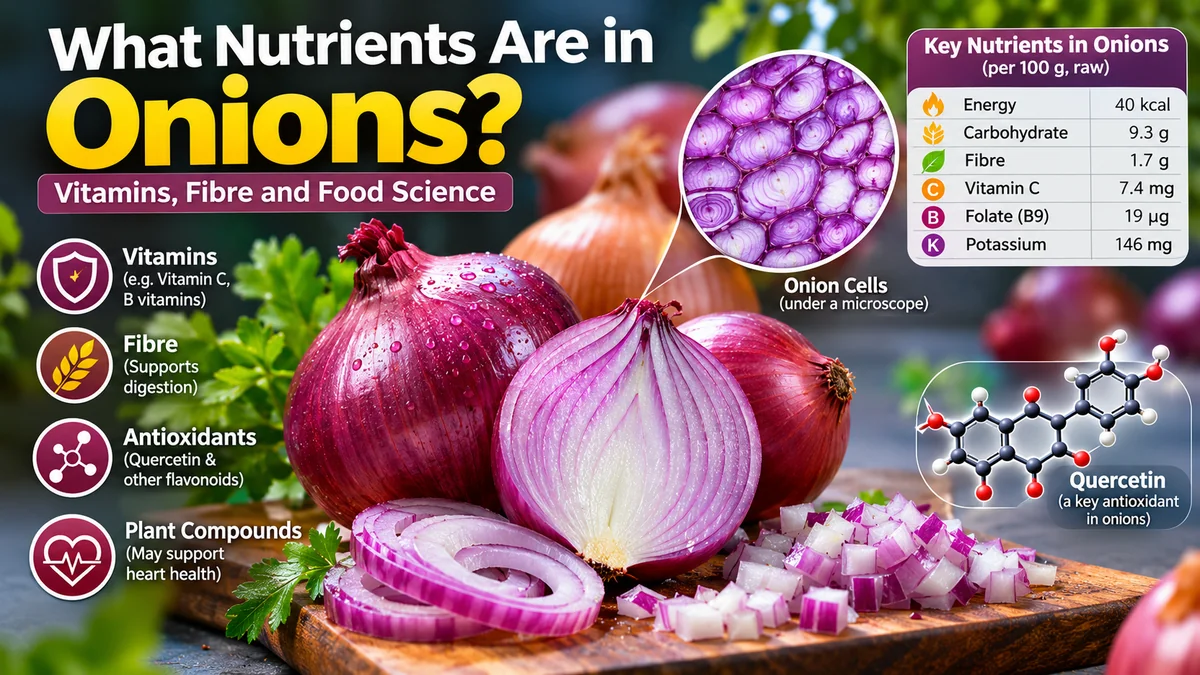
What nutrients are in onions? Raw onions provide carbohydrates, a modest amount of dietary fibre, vitamin C, vitamin B6, folate and potassium, alongside plant compounds such as quercetin and sulfur-containing substances. A typical reference portion of 100 grams of raw onion supplies roughly 40 calories, 9.3 g carbohydrate, 1.7 g fibre, 7.4 mg vitamin C and 146 mg potassium. That makes onions a useful vegetable in a varied diet—not a concentrated source of every vitamin or a cure for disease.
Onions (Allium cepa) are eaten in stews, soups, sauces, salads, sandwiches and many West African dishes. Their popularity comes largely from flavour, aroma and versatility. Yet the chemistry behind their sweetness, pungency and tear-producing effect is also a fascinating lesson in food science.
This guide uses standard reference values for generic raw onions reported in the US Department of Agriculture (USDA) FoodData Central legacy dataset, food-science research and guidance from the Monash University FODMAP team . Actual composition changes with onion variety, growing conditions, portion size and preparation.
Onion nutrition facts: what is in 100 grams?
The following figures are approximate values for 100 g of edible raw onion, rather than values for all onion varieties or prepared dishes. To compare a smaller portion, multiply the values by the portion's weight in grams and divide by 100.
| Nutrient | Approximate amount per 100 g raw onion | Why it matters |
|---|---|---|
| Energy | 40 kcal | Food energy |
| Water | 89.1 g | Contributes to a high-water-content vegetable |
| Total carbohydrate | 9.3 g | Includes sugars and fibre |
| Total sugars | 4.2 g | Contributes to sweetness |
| Dietary fibre | 1.7 g | Supports normal digestive function as part of the diet |
| Protein | 1.1 g | A small contribution, not a protein-rich food |
| Total fat | 0.1 g | Very low in fat when no oil is added |
| Vitamin C | 7.4 mg | Needed for collagen formation and normal immune function |
| Vitamin B6 | 0.12 mg | Supports numerous enzyme reactions |
| Folate (vitamin B9) | 19 micrograms | Required for DNA synthesis and cell division |
| Potassium | 146 mg | Helps normal nerve and muscle function |
| Calcium | 23 mg | Small contribution to total dietary calcium |
Source and interpretation: figures are rounded from the USDA's standard reference entry for raw onions, commonly listed as FoodData Central SR Legacy item 170000 (older nutrient database number 11282). A 100 g reference amount is useful for comparisons; it is not a recommendation to eat that much onion at a meal. Nutrient tables may differ for yellow onions, sweet onions and other cultivars. The USDA FoodData Central database is the primary resource for selecting a specific food record, while the USDA-derived raw onion record shows these legacy reference values in a browsable table.
Which vitamins are found in onions?
Vitamin C: an important nutrient, but onions are not a top source
Onions contain vitamin C, also known as ascorbic acid. According to the US National Institutes of Health, vitamin C is required for collagen production, assists normal immune function and works as an antioxidant within the body. However, 7.4 mg per 100 g is a relatively modest quantity compared with many other vegetables and fruits. See the NIH Office of Dietary Supplements vitamin C fact sheet .
Vitamin C is sensitive to heat and can dissolve in cooking water. A bowl of soup containing onions does not necessarily retain the same vitamin C concentration as the raw onions from which it was prepared. Other ingredients also contribute to the final nutrient total.
Vitamin B6: a small contribution to metabolism
Raw onions supply approximately 0.12 mg of vitamin B6 per 100 g. This family of compounds helps enzymes participate in protein metabolism and many other biological processes. The quantity is helpful as part of dietary variety, but eating onions alone will not reliably meet a person's daily vitamin B6 needs.
Folate (vitamin B9): necessary for cell division
Folate is essential for DNA synthesis and normal cell division. Generic raw onions contain roughly 19 micrograms per 100 g in the legacy USDA reference. Onions therefore contribute a little folate to meals, but they should not replace folate-rich foods or any prescribed folic-acid supplementation, including during pregnancy.
Do onions contain vitamins A, D, E or K?
Onions are not usually regarded as significant sources of vitamins A, D or E. Their vitamin K contribution is also small in commonly cited raw-onion reference entries. A vegetable can still add flavour and dietary variety without being especially rich in every micronutrient.
What minerals are in onions?
Potassium is one of the more recognisable minerals in onion nutrient tables. A 100 g reference portion contains about 146 mg. Potassium is involved in normal cell function, nerve signalling and muscle contraction. Onions also contain smaller quantities of calcium, magnesium, phosphorus and trace minerals. The amounts do not turn onion into a substitute for a balanced collection of mineral-rich foods.
Unlike foods with substantial added salt, raw onions naturally contain little sodium. The sodium content of an onion-based recipe, though, can change considerably when stock cubes, seasoning mixtures, canned ingredients or table salt are added. Reading the recipe or food label matters more than assuming every onion dish is low in sodium.
Do onions contain fibre and prebiotics?
Yes. Standard raw-onion nutrient data lists around 1.7 g of dietary fibre per 100 g. Dietary fibre includes components that are not digested in the same way as ordinary starches and sugars. Fibre from vegetables, whole grains, legumes, fruits and other foods contributes to overall digestive health.
Onions also contain fructans, chains of fructose units. Some fructans can be fermented by gut microorganisms, which is one reason they are sometimes discussed as prebiotic carbohydrates. But their presence does not mean onions will make everyone feel better. Fermentation may produce gas, abdominal discomfort or bloating in sensitive people.
The Monash University FODMAP food guidance identifies onion and garlic as vegetables rich in fructans, a group of fermentable carbohydrates that can aggravate symptoms in some people with irritable bowel syndrome (IBS). People with persistent digestive symptoms should seek appropriate professional advice instead of adopting an unnecessarily restrictive diet based on a single article.
Food science: why onions taste sharp, sweet and savoury
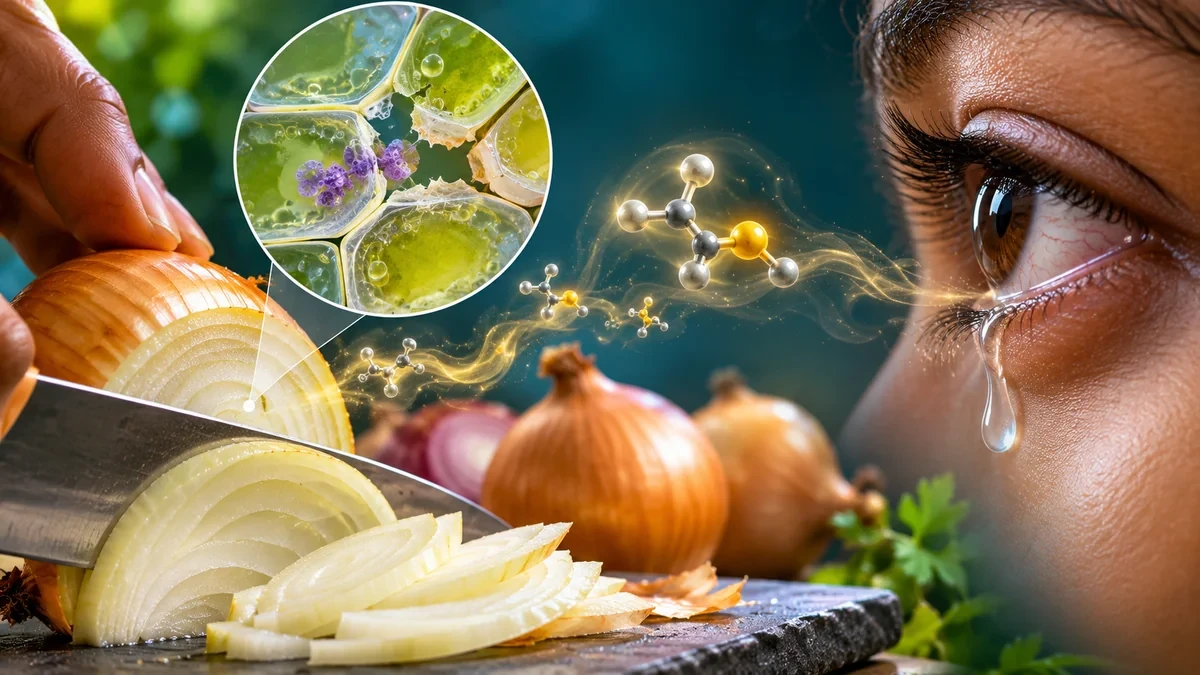
Onions are chemically interesting because their flavour changes when plant tissue is damaged and when heat is applied. Intact onion cells help keep certain precursors and enzymes apart. Slicing or crushing the onion disrupts those cells, enabling chemical reactions that produce characteristic volatile sulfur compounds. The type and concentration of these substances contribute to onion aroma and pungency.
Why do onions make your eyes water?
When an onion is cut, enzymes act on sulfur-containing precursors. An enzyme known as lachrymatory factor synthase helps form a volatile compound called propanethial S-oxide. When it reaches the eyes, it can cause irritation and tearing. Researchers described the enzyme's role in a paper published in Nature , and later biochemical work investigated the mechanism in more detail.
Using a sharp knife, reducing unnecessary crushing and improving ventilation can make preparation more comfortable, although none guarantees completely tear-free chopping. Onion-induced tears are a result of chemistry, not evidence of nutritional strength.
Why do onions become sweeter when cooked?
Raw onions may taste intensely sharp because volatile sulfur compounds dominate the experience. Heating changes those compounds and softens cell structures, allowing the onion's naturally occurring sugars to become more noticeable. During slow cooking, evaporation concentrates flavour; under sufficiently hot conditions, browning reactions also develop deeper aromas. Adding sugar is not required for cooked onion to taste sweeter.
Cooking method matters. Gently softened onions, deeply browned onions, onion soup and deep-fried onion rings are nutritionally different preparations because they may contain different amounts of oil, water, salt or other ingredients.
What are quercetin and other plant compounds in onions?
In addition to essential nutrients, onions contain flavonoids and organosulfur compounds. Quercetin and related compounds are among the best-studied onion flavonoids. Red onions may also provide anthocyanin pigments that contribute to their colour, while the exact phytochemical profile depends on variety, growing conditions and which parts of the onion are eaten.
A scientific review of onion compounds describes quercetin derivatives and sulfur-containing compounds as important constituents of the plant. That is a chemistry finding, not proof that eating onions prevents cancer, reverses diabetes or treats heart disease. Laboratory evidence, observational associations and clinical health outcomes are different kinds of evidence. Readers should be wary of exaggerated claims based on the presence of a single antioxidant. See Recent Advances in Bioactive Compounds, Health Functions, and Safety Concerns of Onion .
Even the word “antioxidant” needs context: researchers can measure chemical antioxidant activity in test-tube systems, but that result alone does not establish a particular benefit in humans eating a normal serving.
Raw onions versus cooked onions: which has more nutrients?
Neither is universally “better.” Raw onions avoid heat-related changes and can add a crisp texture to salads. Cooked onions may be easier to incorporate into meals and often have a milder flavour. Processing can change the amount of water, micronutrients and phytochemicals in the food. Comparing 100 g raw onion with 100 g cooked onion can be misleading because cooking changes its water weight.
| Preparation | Food-science consideration | Practical takeaway |
|---|---|---|
| Raw, sliced | No cooking heat; strong sulfur aroma | Useful in salads and garnishes where tolerated |
| Steamed or gently sautéed | Texture softens; some compounds change | Use modest added oil if that fits the meal |
| Boiled in soup | Water-soluble substances may move into the cooking liquid | Eating the broth may retain compounds otherwise discarded |
| Roasted or caramelised | Water loss and browning change flavour | Watch added fats, salt and sweeteners |
| Deep-fried or battered | Coatings and absorbed oil may substantially raise energy content | Do not equate onion rings with plain onion |
A 2021 research paper, Influence of Cooking Methods on Onion Phenolic Compounds Bioaccessibility , compared several preparation methods and found that flavonoid changes depended on the method and onion variety, with boiling causing substantial losses of some compounds into water under its experimental conditions. Such experiments help explain food chemistry but should not be converted into a universal rule that everyone must eat onion raw.
Are red, white and yellow onions nutritionally different?
They can differ in taste, pigment composition and measured nutrient content, but colour alone does not determine whether an onion is “healthier.” Red onions contain coloured pigments, yellow onions are frequently used for general cooking and white onions are chosen for their flavour in many recipes. Sweet onions are cultivars with distinct flavour characteristics; the perception of sweetness is affected by both sugars and pungent sulfur compounds.
For most people, the best practical decision is to choose varieties that suit a recipe and are affordable, fresh and enjoyable. If you need a precise nutrient calculation for a clinical diet or food-labeling project, use the database entry for the exact variety and preparation rather than the generic raw-onion figures in this guide.
How much nutrition does half an onion provide?
Onions vary greatly in size. Instead of assuming that “half an onion” is a standard serving, weigh the edible portion if precision is important. For a 50 g raw-onion portion, half the 100 g reference amount gives approximately:
- 20 kcal
- 4.7 g carbohydrate
- 0.85 g fibre
- 3.7 mg vitamin C
- 73 mg potassium
These are scaled estimates, not laboratory measurements of an individual onion. A small amount used to flavour a pot of beans or stew contributes less than a generous portion eaten as a vegetable side dish. Nutrient intake should be judged across the whole meal and overall diet.
Can onions cause problems for some people?
Most people can enjoy onions as part of a varied diet. However, sensitivities exist. The fructans in onion can trigger symptoms in some people with IBS, even when the food is otherwise nutritious. Some people may also experience heartburn or discomfort after particular onion-containing meals. True food allergy is a separate issue that requires appropriate medical evaluation.
Cooking does not automatically make onions low in fructans. If you have a diagnosed digestive condition, follow advice tailored to your circumstances rather than assuming that raw and cooked onions are interchangeable. Any advice about allergies, elimination diets or medical treatment should come from a qualified healthcare professional.
How to use onions in nutritious everyday meals
Onion works best as part of a meal containing a broader range of nutrients. Add chopped onion to beans and lentils for fibre and protein from the legumes; use it with tomatoes, leafy greens and other vegetables in sauces; or cook it gently in a fish, egg or vegetable dish. A mixed dish is more nutritionally complete than onion alone.
In Nigerian cooking, onion is commonly used to build flavour in soups, jollof rice, stews and vegetable sauces. The nutritional quality of those dishes depends on the entire recipe, including oil, sodium, added vegetables, whole grains and protein-rich ingredients. Onion makes a valuable flavour contribution without needing to be presented as a miracle food.
For a related plant-food comparison, see SuperEducational's guide to bean sprouts, nutrition and food safety . While the two foods have different nutritional profiles, comparing vegetables is a useful way to understand why dietary diversity matters.
Frequently asked questions about onion nutrients
Are onions a good source of vitamin C?
They provide vitamin C, but about 7.4 mg per 100 g of generic raw onion is a modest amount. Other fruits and vegetables can contribute substantially more. Onions are useful as one ingredient in a varied diet.
Do onions contain iron?
Yes, but ordinary raw onions contain only a small amount. They should not be relied upon as a main iron source or as treatment for iron deficiency.
Do onions have protein?
Yes—about 1.1 g per 100 g raw onion in the reference dataset—but onions are not protein-rich foods.
Is eating onion every day necessary?
No. Onions can fit well into daily meals if you enjoy and tolerate them, but there is no requirement to eat them every day to be healthy.
Does cooking destroy all the nutrients in onions?
No. Some nutrients and phytochemicals change or move into cooking liquids, while other food components remain. The final result depends on preparation, temperature, time and the complete dish.
Are onion antioxidants proven to prevent disease?
Onions contain compounds with biological activity, but their presence does not prove that eating onion alone prevents or cures a specific disease. Claims about clinical outcomes require high-quality human evidence.
Conclusion: what nutrients are in onions?
Onions are mostly water, with modest amounts of carbohydrate, fibre, vitamin C, vitamin B6, folate and potassium. Their flavonoids and sulfur chemistry add scientific interest and help explain their colour, aroma and characteristic flavour. They are best understood as a versatile vegetable that improves the taste and diversity of meals, not as a replacement for other nutritious foods or medical care.
The most useful approach is simple: eat onions in whatever preparation you enjoy and tolerate, vary the other vegetables and proteins in your meals, and interpret nutrition claims using evidence rather than exaggerated health promises.
References and data sources
- USDA FoodData Central: US food-composition database (raw onions, SR Legacy reference 170000).
- USDA-derived nutrient table: raw onions .
- NIH Office of Dietary Supplements: Vitamin C .
- Monash University: High- and low-FODMAP foods .
- Plant biochemistry: an onion enzyme that makes the eyes water .
- Recent advances in onion bioactive compounds .
- Influence of cooking methods on onion phenolic compounds bioaccessibility .