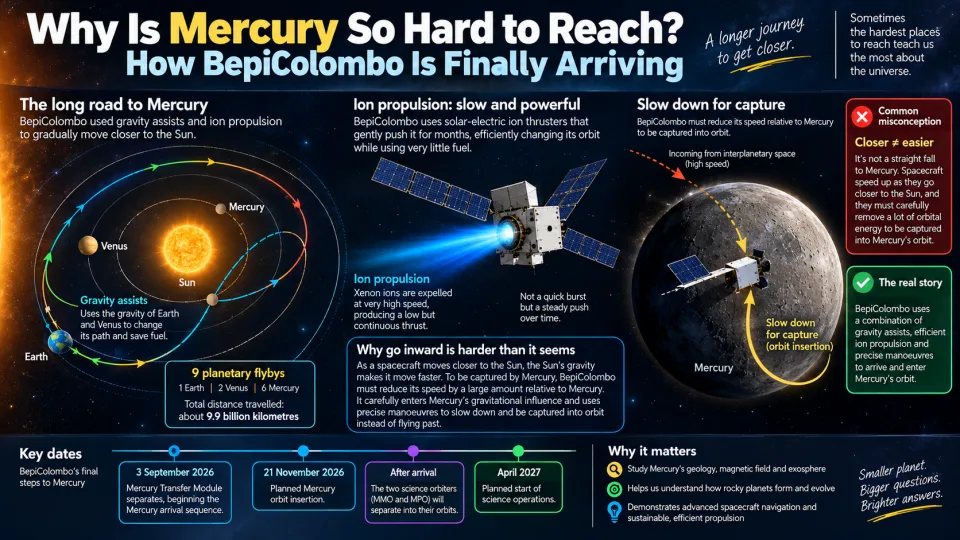
Mercury is the closest planet to the Sun, and at first glance it may seem that reaching it should be straightforward: point a spacecraft sunwards and let gravity do the rest. In orbital mechanics, however, getting closer to the Sun is not the same as getting into orbit around Mercury.
The ESA/JAXA BepiColombo mission makes that distinction unusually clear. After nearly eight years in space, 9.9 billion kilometres of travel and nine planetary flybys, its Mercury Transfer Module separated successfully on 3 September 2026. The two science orbiters are now preparing for Mercury orbit insertion on 21 November 2026.
The key idea: a spacecraft already moves around the Sun
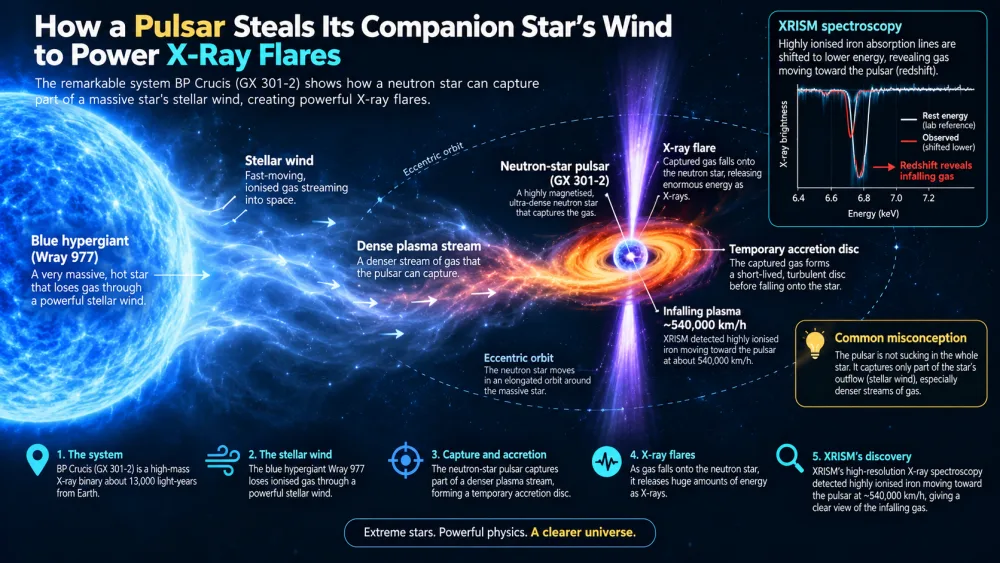
Earth and everything launched from it are already travelling around the Sun at roughly Earth's orbital speed. A spacecraft bound for Mercury cannot simply cancel that sideways motion for free. To move onto a smaller orbit around the Sun, it must reduce its heliocentric orbital energy and reshape its trajectory.
As the spacecraft falls deeper into the Sun's gravitational well, it also speeds up. That creates the central challenge: when it reaches Mercury's neighbourhood, it must have the right position and a sufficiently small velocity relative to Mercury for the planet to capture it into orbit. Otherwise it simply flies past.
Why not use one enormous rocket burn?
A large change in velocity requires propellant, and propellant itself has mass that must be accelerated. Carrying enough chemical propellant to make every required change directly would make the mission much heavier and more difficult to launch.
BepiColombo therefore used a combination of gravity assists and solar-electric propulsion. This lets nature and efficient low-thrust engines do much of the orbital reshaping over time.
How gravity assists help
A gravity assist is not simply a planet “pulling” a spacecraft towards its destination. The spacecraft enters a planet's moving gravitational field, follows a curved path and leaves with its velocity relative to the Sun altered. Mission designers choose the geometry so the encounter changes the spacecraft's direction and orbital energy in a useful way.
BepiColombo completed nine planetary flybys: one of Earth, two of Venus and six of Mercury. These encounters progressively brought its solar orbit closer to Mercury's and helped reduce the amount of propellant needed.
What ion propulsion contributes
During the interplanetary cruise, BepiColombo's Mercury Transfer Module supplied solar-electric propulsion. Its ion thrusters used electrical energy to accelerate charged particles to very high exhaust speeds. The thrust is small compared with a chemical rocket, but it can be applied efficiently for long periods.
Think of the difference this way: a chemical engine is like a powerful short push, while an ion engine is like a gentle push maintained for weeks or months. In space, where there is no road friction to stop the accumulated effect, that continuous small acceleration can produce a substantial change in velocity.
What happened in September 2026?
On 3 September, ESA confirmed that the Mercury Transfer Module had separated from the spacecraft stack. That module had carried the two science orbiters across the inner Solar System and supplied power and solar-electric propulsion during the cruise.
The remaining stack contains ESA's Mercury Planetary Orbiter (MPO) and JAXA's Mercury Magnetospheric Orbiter, Mio. ESA's current arrival timeline calls for the stacked orbiters to enter Mercury orbit on 21 November 2026. Mio is then due to separate on 9–10 December. MPO will continue manoeuvring towards its final orbit, with the main science phase scheduled to begin in April 2027. Exact operational dates can change.
Why send two orbiters?
Mercury is a small rocky planet with an unusually large metallic core, a magnetic field and an extremely thin exosphere rather than a dense atmosphere. Studying it from two complementary spacecraft lets scientists investigate the planet itself and its surrounding magnetic and particle environment at the same time.
MPO carries instruments for studying Mercury's surface, composition, interior and environment. Mio concentrates on the magnetosphere, plasma, particles, waves and dust around the planet. Together, their measurements can help scientists test ideas about how Mercury formed and how a planet so close to the Sun has evolved.
Common misconception: “closer means easier”
Distance alone does not determine how difficult a destination is. Spaceflight is governed by trajectories, orbital energy, relative velocity, propulsion capability and the gravity of the bodies involved. A destination can be geographically closer yet require a much more complicated sequence of manoeuvres.
This is why a journey to Mercury can take years and billions of kilometres even though Mercury's orbit lies inside Earth's. The long looping route is not wasted distance; it is a carefully engineered way of arriving with the right energy and velocity.
A simple analogy
Imagine two runners moving around a circular track. You want to move from an outer lane to a much smaller inner track while matching another runner already racing there. Cutting diagonally towards the centre is not enough: your speed and direction must also match the new track. Planetary missions face a three-dimensional, gravitational version of that problem.
Key takeaways
- Going towards the Sun does not automatically make Mercury easy to reach.
- A spacecraft must change its orbit around the Sun and arrive with a manageable speed relative to Mercury.
- BepiColombo used nine planetary flybys to reshape its trajectory while conserving propellant.
- Solar-electric ion propulsion provided efficient low thrust over long periods during the cruise.
- The transfer module separated successfully on 3 September 2026; Mercury orbit insertion is planned for 21 November 2026.
- ESA's MPO and JAXA's Mio will study Mercury and its space environment from complementary orbits.
Frequently asked questions
Why does a spacecraft speed up as it approaches the Sun?
Gravitational potential energy is converted into kinetic energy as an object falls deeper into the Sun's gravitational field. Mission designers must account for that increased speed when planning an inner-Solar-System trajectory.
Does a gravity assist provide free energy?
Not in the absolute sense. The spacecraft exchanges a tiny amount of momentum with the planet. Because a planet is enormously more massive, the change in the planet's motion is immeasurably small for practical purposes, while the spacecraft can receive a useful change in velocity and direction.
Is ion propulsion more powerful than a chemical rocket?
No. Ion thrusters generally produce much less instantaneous thrust. Their advantage is efficiency: they can accelerate propellant to very high exhaust speeds and operate for long periods.
When will BepiColombo start doing science at Mercury?
ESA's current timeline places Mercury orbit insertion on 21 November 2026, separation of MPO and Mio on 9–10 December, and the start of the main science phase in April 2027.
Authoritative references
Mission facts and dates in this explainer are based on the European Space Agency's BepiColombo arrival updates, mission factsheet and operations material. BepiColombo is a joint ESA/JAXA mission.