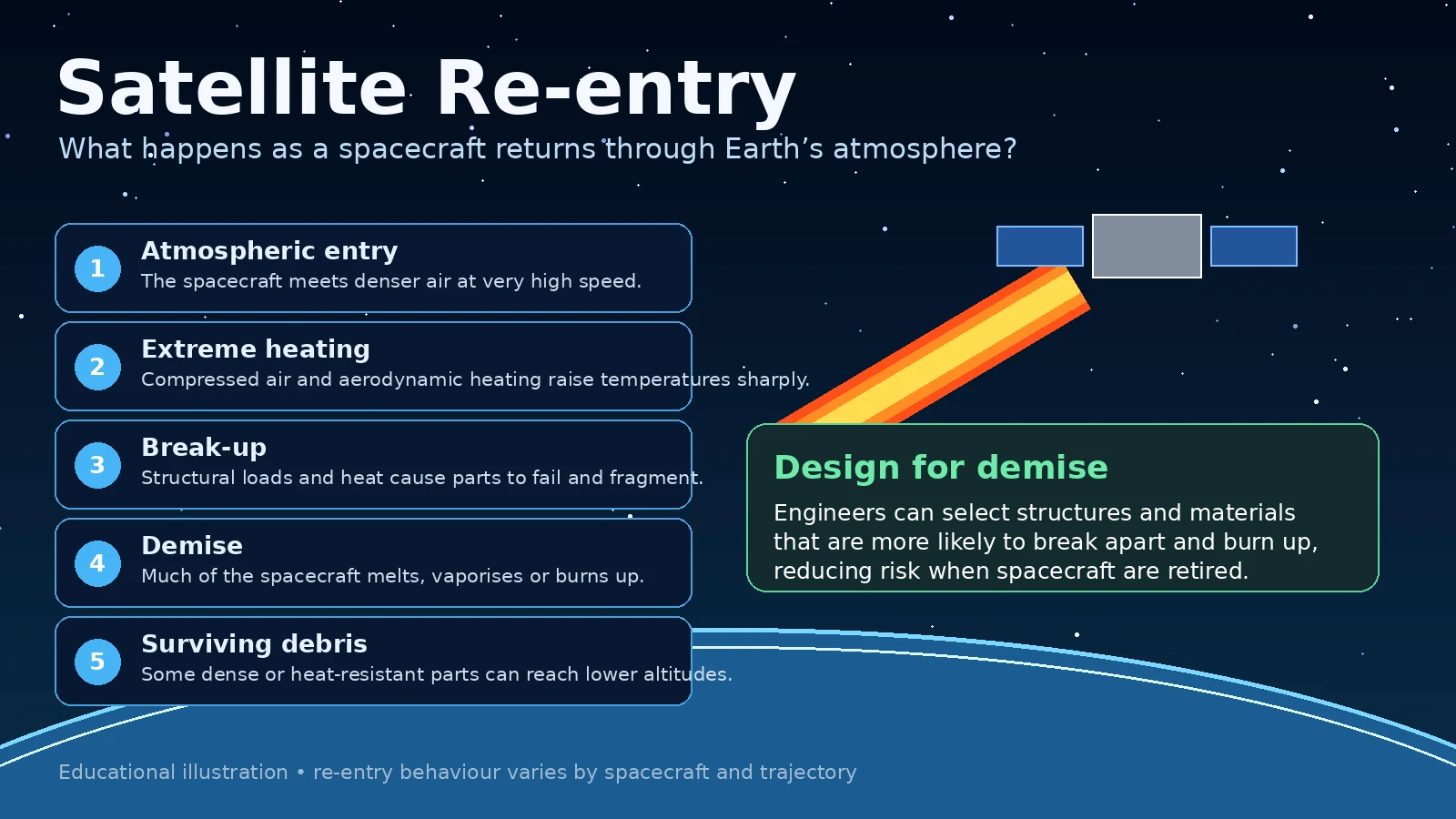
A satellite returning from orbit does not simply fall through the sky intact. At orbital speeds, its encounter with increasingly dense air produces extreme aerodynamic forces and heating. Components can melt, vaporise and break apart before any surviving fragments reach lower altitudes.
ESA’s final Cluster spacecraft re-entries in 2026 gave scientists an unusual chance to observe this destructive process directly and improve models used to design safer spacecraft.
Why does re-entry become so hot?
A spacecraft entering denser layers of the atmosphere at several kilometres per second violently compresses the air ahead of it. That compressed gas becomes extremely hot, while aerodynamic forces and heat are transferred to the vehicle. This is more accurate than the common shorthand that re-entry heating is simply caused by “friction”.
What happens to the spacecraft?
As heating and mechanical loads increase, exposed structures weaken. Solar arrays and other external components can fail first; joints break, materials melt or vaporise, and the vehicle fragments. The exact sequence depends on its shape, materials, construction and trajectory.
Does everything burn up?
No. Many components are destroyed, but dense or heat-resistant parts can sometimes survive. That is why controlled or targeted disposal over remote ocean areas and “design for demise” are important safety strategies.
What did ESA learn from Cluster?
ESA deliberately targeted the final Cluster spacecraft, Samba and Tango, for remote South Pacific re-entries. An airborne observation campaign successfully tracked both events with 29 of 30 instruments aboard the aircraft. The observations add to a unique dataset showing how real spacecraft fragment under conditions that cannot be reproduced completely in ground laboratories.
What is design for demise?
Engineers can choose structures and materials that are more likely to break apart and burn up during re-entry. Better predictive models help them estimate which components could survive and reduce risk to people, property and the environment.
Common misconception
Misconception: satellites burn because they rub against the air like hands rubbing together. Reality: high-speed atmospheric compression and complex aerodynamic heating dominate the process.
Key takeaways
- Re-entry exposes spacecraft to extreme heating and mechanical loads.
- Spacecraft progressively fragment, melt and vaporise, although some components may survive.
- Real observations improve models that laboratories cannot fully reproduce.
- Design for demise can reduce ground risk from future spacecraft.
FAQs
Can engineers predict exactly where every fragment lands?
No. Models estimate breakup and risk, but atmospheric conditions, structural behaviour and other uncertainties limit exact predictions.
Why observe re-entry from an aircraft?
An aircraft can position specialised instruments near a predicted remote re-entry corridor while remaining at a safe distance.