
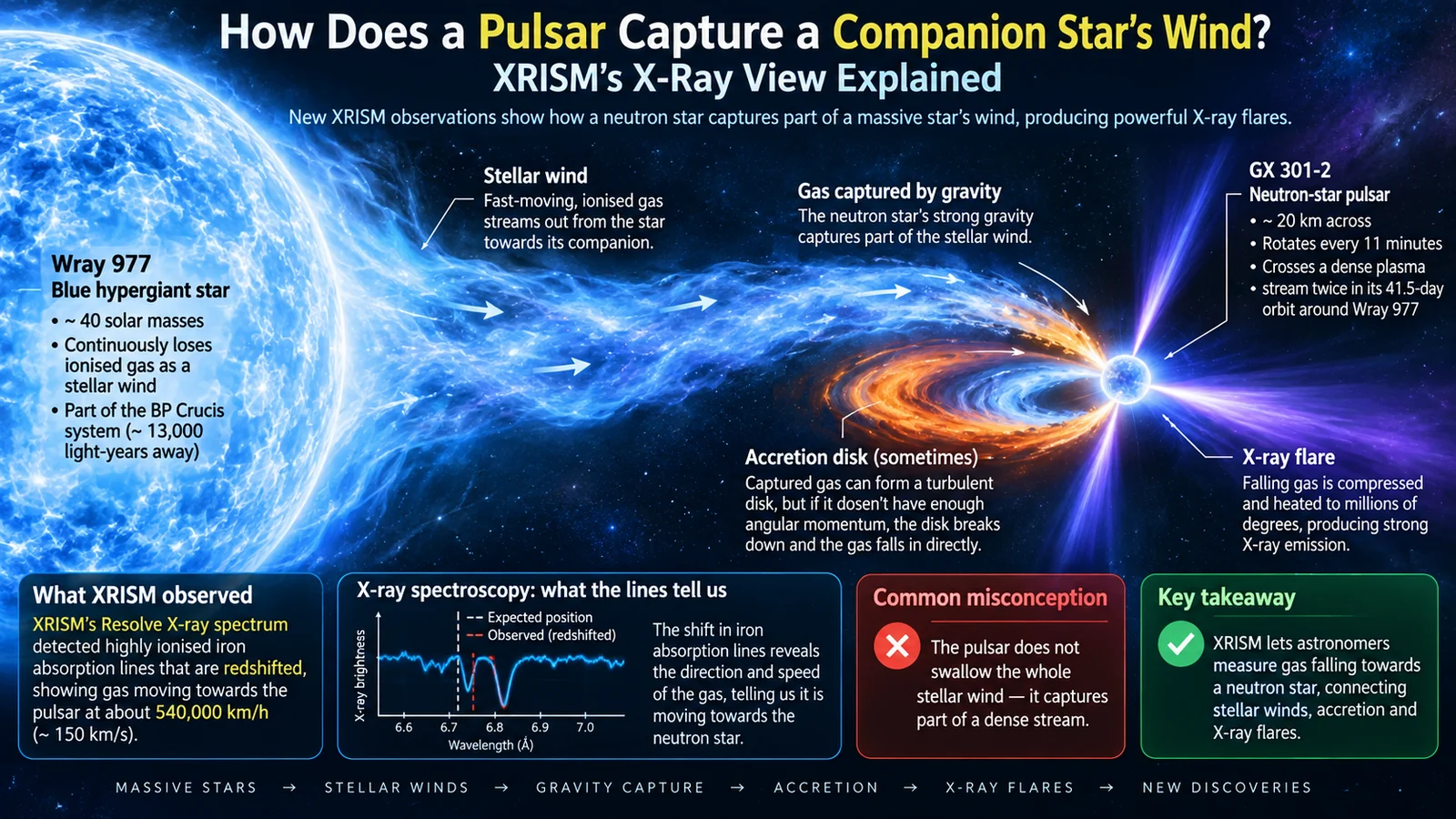
Stars do not always keep all of their gas. Very massive stars can drive powerful stellar winds that continuously carry ionised material into space. In a close binary system, some of that escaping gas can be captured by a compact companion such as a neutron star.
The NASA-JAXA XRISM mission has now given astronomers an unusually direct view of that process in the high-mass X-ray binary BP Crucis. Its measurements show gas from the blue hypergiant Wray 977 moving towards the neutron-star pulsar GX 301-2 and powering strong X-ray flares.
What is BP Crucis?
BP Crucis lies about 13,000 light-years away in the constellation Crux. Its primary star, Wray 977, is a blue hypergiant with roughly 40 times the Sun’s mass. The star is so hot and luminous that ionised gas continually streams away from it as a stellar wind.
Its companion, GX 301-2, is a neutron star: the extremely dense remnant left after a massive star exploded. It is only about 20 kilometres across, yet it contains more than the Sun’s mass. It rotates once every 11 minutes, sweeping an X-ray beam across space and therefore behaving as a pulsar.
How can the pulsar capture gas that is already flowing away?
The stellar wind is not a rigid shell moving uniformly in every direction. Wray 977 also produces an especially dense stream of plasma. As GX 301-2 moves through this stream, the neutron star’s strong gravity bends the trajectories of nearby gas particles. Some of that material becomes gravitationally bound and falls towards the neutron star.
This process is called wind-fed accretion. The pulsar does not capture the whole stellar wind; it intercepts only a fraction of the outflow that passes close enough for gravity to redirect it.
Why does captured gas produce X-rays?
As gas falls into the neutron star’s deep gravitational field, gravitational potential energy is converted into kinetic energy and then heat. Close to the neutron star, the plasma becomes extremely hot. Matter interacting with the neutron star and its magnetic environment can therefore radiate strongly at X-ray wavelengths.
GX 301-2 produces strong X-ray flares twice during its 41.5-day orbit as it crosses the dense plasma stream. The strongest flares occur where the stream is denser.
Does the gas always form an accretion disc?
No. One of the most useful lessons from BP Crucis is that accretion can change rapidly. Astronomers think that when the pulsar first enters the stream, captured gas can form a thick, turbulent accretion disc. Material spirals inward and heats as it loses orbital energy.
Deeper in the stream, however, the incoming gas may not carry enough angular momentum to sustain the disc. The disc can break down, allowing plasma to fall more directly towards the neutron star. Near the end of the crossing, a messy disc can briefly reform, even with the opposite direction of rotation. The pulsar takes about four days to pass through the stream.
What did XRISM actually measure?
XRISM observed BP Crucis on 1 February 2025 for about 16 hours near the end of one of its stronger flares. Its Resolve instrument recorded a high-resolution X-ray spectrum containing absorption lines from highly ionised iron.
Those iron lines appeared at lower energies than their laboratory positions. This redshift reveals motion along our line of sight. In the geometry of the observation, the shift showed that the plasma was moving towards the pulsar. The measured displacement corresponds to a speed of about 540,000 kilometres per hour.
How does X-ray spectroscopy reveal motion?
Atoms and ions absorb or emit X-rays at characteristic energies. If the gas is moving relative to the observer, those spectral features shift because of the Doppler effect. By comparing the observed position of a line with its laboratory position, astronomers can estimate the gas’s line-of-sight velocity.
Spectroscopy can also reveal which elements and ionisation states are present. That means a single spectrum can help researchers investigate the gas’s composition, physical conditions and motion.
A simple analogy
Imagine standing beside a fast-moving river with a powerful drain near the bank. Most of the water keeps flowing downstream, but water that passes close enough to the drain is diverted towards it. The stellar wind is the river; the neutron star’s gravity plays the role of the drain. Unlike the analogy, however, the captured gas becomes extraordinarily hot as it approaches the compact star and can emit intense X-rays.
Common misconception
Misconception: the pulsar swallows the entire stellar wind. Reality: Wray 977 continuously loses gas in many directions. GX 301-2 captures only part of a denser stream when its orbit carries it through the right region.
Why this observation matters
Wind-fed accretion is important in many high-mass X-ray binaries, but the gas flow close to a neutron star is difficult to observe directly. XRISM’s high-resolution spectrum provides a clearer connection between the companion star’s outflow, the motion of gas near the compact object and the resulting X-ray flare.
That gives astronomers a better laboratory for testing models of stellar winds, accretion, angular momentum and the behaviour of matter in extreme gravitational and magnetic environments.
Key takeaways
- Wray 977 loses ionised gas through a powerful stellar wind and a denser plasma stream.
- Neutron-star pulsar GX 301-2 captures only part of that material through gravity.
- The captured gas can form a temporary turbulent accretion disc, then switch to more direct infall.
- XRISM detected redshifted iron absorption lines showing plasma moving towards the pulsar at about 540,000 km/h.
- High-resolution X-ray spectroscopy lets astronomers measure the motion and physical state of otherwise invisible hot gas.
FAQs
What is a pulsar?
A pulsar is a rotating neutron star whose radiation beams sweep through space. If a beam crosses Earth, astronomers detect regular pulses.
What is stellar wind?
Stellar wind is a flow of gas and charged particles escaping from a star. Massive, luminous stars can drive especially strong winds.
Why does GX 301-2 flare twice per orbit?
Its 41.5-day orbit carries it through a dense plasma stream twice, allowing it to capture more material and produce stronger X-ray emission.
Did XRISM see the gas falling directly onto the surface?
XRISM measured spectral evidence that plasma near the neutron star was moving towards it. The observation constrains the accretion flow, while the detailed geometry is interpreted with physical models.