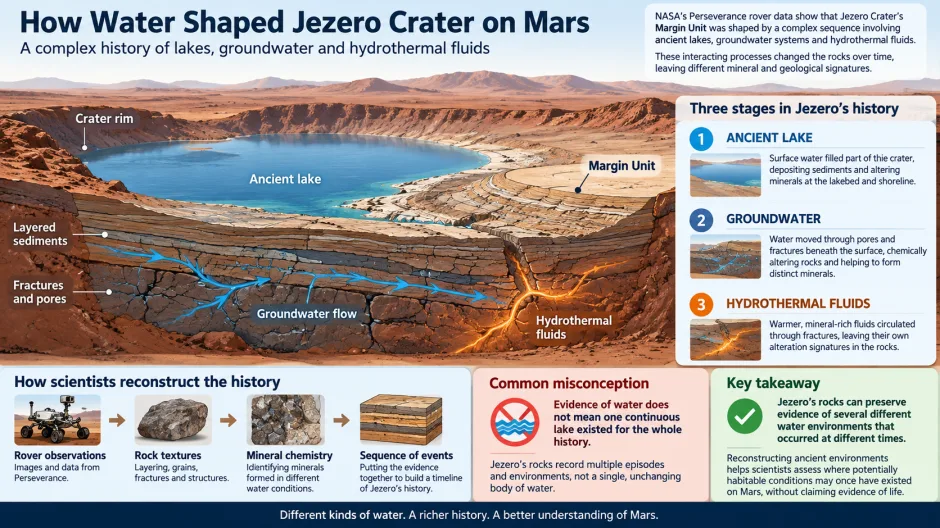
Jezero Crater is famous for evidence that it once held a lake, but the rocks examined by NASA's Perseverance rover tell a more complicated story. Water did not necessarily act in one place, in one way or at one time. Surface water, groundwater and warmer fluids moving through rock can each alter minerals and textures, leaving clues that planetary geologists can use to reconstruct a sequence of environments.
Why did scientists choose Jezero Crater?
Jezero contains a well-preserved ancient river delta and other geological features consistent with past water activity. That made it a valuable landing site for investigating Mars's geological history and environments that may once have been habitable. Evidence of potentially habitable conditions is not evidence that life actually existed there.
Stage 1: surface water and an ancient lake
When liquid water occupies a basin, rivers and lakes can transport, sort and deposit sediment. Water can also react chemically with minerals. Layering, grain relationships and mineral composition therefore preserve information about conditions when sediment accumulated or rocks were altered.
Stage 2: groundwater moves below the surface
Water can continue changing rocks even when there is no lake above them. Groundwater travels through pores, cracks and fractures. As it moves, it can dissolve some substances and precipitate others. Mineral-filled fractures can therefore record fluids that passed through rock after the rock itself formed.
Stage 3: hydrothermal fluids add heat and chemistry
Hydrothermal fluids are water-rich fluids heated by geological processes. Their temperature and dissolved chemicals can produce mineral assemblages different from those formed under cooler surface conditions. Finding such alteration does not by itself prove a particular heat source; scientists compare mineral chemistry, textures and geological context before interpreting the environment.
What is the Margin Unit?
Perseverance has investigated rocks around Jezero's crater margin, including material known as the Margin Unit. NASA/JPL reporting in September 2026 describes evidence indicating that these rocks experienced a complex history involving lake, groundwater and hydrothermal processes. The important lesson is that one rock unit can preserve overprinting from several stages of water-rock interaction.
How can a rover reconstruct events that happened billions of years ago?
Scientists combine several kinds of evidence. Rover cameras reveal layers, grains, veins and contacts between rock units. Spectrometers identify minerals and chemical elements. The position of each observation provides geological context. Researchers then ask which event must have happened first: for example, a mineral vein cutting across an older rock generally formed after that rock.
Why mineral chemistry matters
Minerals form and change under particular ranges of temperature, acidity, water availability and chemical composition. No single mineral is usually a complete environmental history. Groups of minerals, their textures and their relationships to surrounding rocks provide stronger constraints.
A common misconception: water evidence means one long-lived lake
Finding several signs of water does not mean Jezero was continuously filled by one lake throughout its history. A lake can disappear, groundwater can circulate later, and chemically distinct fluids can pass through fractures still later. Geologists therefore distinguish separate episodes rather than combining every water-related clue into a single event.
What does this tell us about habitability?
Different water environments matter because liquid water, useful chemical ingredients and energy sources are among the factors scientists consider when assessing past habitability. Hydrothermal systems on Earth, for example, can support distinctive ecosystems. But geological evidence for water or potentially habitable conditions on Mars should not be described as evidence of past life unless biological evidence is independently established.
How to read a planetary-geology claim
Ask what was directly measured, what geological process could produce the observation, whether other explanations are possible, and how several independent observations fit together. This separates rover measurements from the scientific interpretation built from them.
Key takeaways
- Jezero Crater preserves evidence of multiple kinds of water-rock interaction.
- Lake water can deposit sediments and alter minerals at or near the surface.
- Groundwater can move through pores and fractures and change rocks after their formation.
- Hydrothermal fluids can leave mineral and chemical signatures of warmer water-rock interaction.
- Scientists reconstruct the sequence by combining rock textures, mineral chemistry and geological relationships.
- Evidence of water and potential habitability is not evidence of life.
Frequently asked questions
Did Jezero Crater definitely contain a lake?
Multiple geological observations, including its ancient delta, support the interpretation that Jezero hosted a lake in Mars's past.
Is groundwater the same as a lake?
No. Lake water is surface water occupying a basin, whereas groundwater moves through subsurface pores and fractures.
What makes a fluid hydrothermal?
Hydrothermal fluids are heated water-rich fluids that circulate through geological materials and can drive characteristic chemical alteration.
Why are fractures important?
Fractures provide pathways for fluids. Minerals deposited inside them can preserve evidence of fluid movement that occurred after the host rock formed.
Has Perseverance found life on Mars?
No confirmed discovery of life follows simply from these water-related geological observations. The findings help scientists reconstruct environments and evaluate past habitability.