Where does a planet end and a star begin? The answer is more complicated than simply drawing a line on a mass scale.
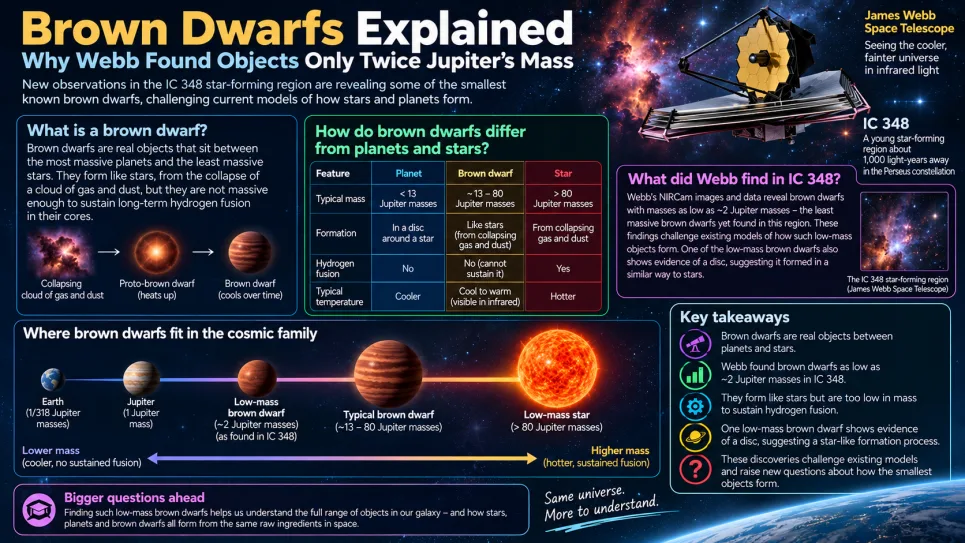
In September 2026, astronomers using the James Webb Space Telescope reported exceptionally low-mass brown dwarfs in the young star-forming region IC 348. Some have estimated masses of only about twice the mass of Jupiter. That is remarkable because brown dwarfs are generally understood to form in a star-like way, through the collapse of gas and dust, yet these objects have masses that sound much more like giant planets.
The discovery gives astronomers a natural laboratory for a fundamental question: how small can an object become if it forms like a star?
What is a brown dwarf?
A brown dwarf is an astronomical object with too little mass to sustain the ordinary hydrogen fusion that powers stars such as the Sun.
It is tempting to call brown dwarfs “failed stars”, but that phrase can hide important details. Brown dwarfs are a real class of objects with their own atmospheres, chemistry, temperatures and evolutionary histories. They can form through the collapse and fragmentation of molecular clouds in a process broadly resembling star formation.
After formation, a brown dwarf contracts and cools. Some brown dwarfs can fuse deuterium for a period if they are massive enough, but they do not maintain the long-term hydrogen fusion characteristic of main-sequence stars.
Why are they difficult to classify?
Planets and brown dwarfs can overlap in mass. That means mass alone does not always tell astronomers how an object formed.
A giant planet normally forms in a disc of material surrounding a young star, through processes such as core accretion or gravitational instability in the disc. A brown dwarf can form more like a star: a region of a molecular cloud collapses under gravity and becomes an independent object.
Two bodies can therefore have similar masses while having very different formation histories.
What did Webb find in IC 348?
IC 348 is a young star-forming region in the Perseus molecular cloud, roughly 1,000 light-years from Earth. Because its population is young, it is a useful place to study objects before billions of years of cooling make the smallest brown dwarfs even fainter.
NASA and ESA reported that Webb observations have identified brown dwarfs in IC 348 with estimated masses down to around two Jupiter masses. These are among the least massive brown dwarfs identified in the region.
Two Jupiter masses correspond to only about 0.2% of the Sun's mass. An object that light forming through a star-like collapse challenges models that attempt to explain the minimum mass at which clouds can fragment and form independent objects.
Why does the minimum mass matter?
Stars form when cold molecular gas becomes gravitationally unstable, collapses and fragments. But fragmentation cannot necessarily continue to arbitrarily small scales. Temperature, density, radiation and other physical processes influence whether a collapsing piece of gas can separate into an independent object.
Finding very low-mass brown dwarfs gives scientists observations against which they can test those theoretical limits.
If nature routinely creates independent objects of only a few Jupiter masses through star-like collapse, then models of star formation must successfully explain how that happens.
How can Webb see such faint objects?
Brown dwarfs are much cooler than ordinary stars and become fainter as they age. Much of their useful radiation emerges at infrared wavelengths.
Webb was designed for infrared astronomy. Its sensitivity allows researchers to detect faint, cool objects that are difficult to study at visible wavelengths.
Imaging can identify promising candidates, but spectroscopy is especially important. A spectrum separates light according to wavelength, revealing patterns caused by molecules and atoms in an object's atmosphere. Those patterns help researchers estimate properties such as temperature and assess whether a candidate behaves like a young brown dwarf.
Why spectroscopy matters
A faint point of light in an image does not automatically tell an astronomer what the object is. A distant background source, a low-mass star and a nearby cool brown dwarf can sometimes require additional measurements to distinguish.
Webb's instruments allow researchers to examine infrared spectra. Comparing observed spectra with atmospheric and evolutionary models helps scientists estimate temperatures and masses and determine whether candidates are consistent with membership in the young cluster.
Mass estimates for young brown dwarfs are model-dependent, so scientists treat the numbers as estimates rather than direct weighings.
The surprising disc
One particularly interesting low-mass object in the Webb study shows evidence associated with a circumstellar—or, more generally, circum-object—disc.
Discs are important because they are natural by-products of star formation. As a cloud collapses, conservation of angular momentum causes material to settle into a rotating disc around the central object.
Discs are also where planets can form. If an object with only a few Jupiter masses possesses a disc, astronomers can ask an extraordinary question: could an object with planet-like mass itself host the ingredients from which even smaller companions form?
The observation does not prove that planets will form around it. It shows why the boundary between star and planet formation is scientifically rich rather than merely semantic.
Planet-mass does not automatically mean planet
This is the most important misconception to avoid.
Calling something “planetary mass” describes its mass range; it does not necessarily describe its origin. An isolated object with two Jupiter masses that formed directly from a collapsing cloud may be classified differently from a two-Jupiter-mass body that formed in a disc and orbits a star.
Astronomers therefore consider several clues: mass, formation environment, orbital relationship, age, atmospheric properties and evidence of a disc.
What about the 13-Jupiter-mass rule?
You may have seen diagrams placing planets below about 13 Jupiter masses and brown dwarfs above that value. Around this mass, objects can become capable of fusing deuterium under suitable conditions, so it is a useful physical reference point.
But it is not a perfect universal definition of “planet versus brown dwarf”. Formation history matters, and the exact deuterium-burning threshold depends on composition and other properties.
The Webb findings illustrate why a single mass boundary cannot explain every object found in nature.
Brown dwarfs versus red dwarf stars
At the higher-mass end, brown dwarfs approach the smallest true stars. The key distinction is sustained hydrogen fusion.
A sufficiently massive object reaches central temperatures and pressures that allow ordinary hydrogen fusion to continue for extremely long periods. That makes it a star.
Brown dwarfs fall below that threshold. They glow mainly because of heat left from their formation and gravitational contraction, along with limited fusion processes in some mass ranges. As they age, they generally cool and fade.
A useful classroom model
Instead of imagining three completely separate boxes labelled “planet”, “brown dwarf” and “star”, picture a landscape with overlapping properties.
- Stars: form through gravitational collapse and sustain hydrogen fusion.
- Brown dwarfs: generally form in a star-like way but cannot sustain ordinary hydrogen fusion.
- Planets: generally form in discs around stars or other central objects and do not sustain hydrogen fusion.
Nature creates edge cases, so astronomers use evidence rather than one simplistic rule.
Why young clusters are valuable
Brown dwarfs cool as they age. A very old, extremely low-mass brown dwarf can become so faint that detecting and characterising it is difficult.
Young star-forming regions such as IC 348 offer an advantage: recently formed brown dwarfs still retain substantial heat from their formation and are therefore brighter than similarly massive objects would be after billions of years.
Researchers can also compare many objects that formed in broadly the same environment and at roughly similar times, helping them test evolutionary models.
What scientists still do not know
The discovery does not settle the minimum mass of star-like formation. Researchers still need larger samples and better constraints on individual masses.
Questions include:
- How frequently do objects of only a few Jupiter masses form independently?
- What physical process sets the lowest fragmentation mass in a molecular cloud?
- How often do extremely low-mass brown dwarfs possess discs?
- Can those discs produce smaller planetary companions?
- How should classification systems handle objects whose masses overlap with giant planets?
Common misconceptions
“A brown dwarf is simply a large planet.” No. Brown dwarfs generally have star-like formation histories, even though their masses can overlap with planets.
“Anything below 13 Jupiter masses must be a planet.” No. The deuterium-burning boundary is useful but does not by itself encode how an object formed.
“Brown dwarfs do not emit light.” They do. They emit radiation, particularly strongly in infrared wavelengths, because they retain and release heat.
“Failed star means the object disappeared or stopped existing.” No. A brown dwarf can persist for immense periods while gradually cooling.
“Webb directly put the objects on a scale.” No. Astronomers infer masses using observations together with models of young objects.
Key takeaways
- Brown dwarfs generally form like stars but lack enough mass for sustained ordinary hydrogen fusion.
- Webb observations of IC 348 have revealed brown dwarfs with estimated masses around twice Jupiter's.
- The findings challenge models of how low in mass star-like gravitational collapse can go.
- Planet-like mass does not automatically make an object a planet; formation history is important.
- Infrared observations and spectroscopy are crucial for identifying and characterising cool, faint brown dwarfs.
- Evidence of a disc around one exceptionally low-mass object raises new questions about whether even smaller companions could form around it.
Frequently asked questions
Are brown dwarfs stars?
They are often described as substellar objects. They can form similarly to stars but are not massive enough to sustain the hydrogen fusion that defines ordinary main-sequence stars.
Are brown dwarfs planets?
Generally no. Their formation pathway is typically more star-like. However, their masses can overlap with giant planets, which is why classification requires more than mass alone.
How massive are the new Webb objects?
The lowest-mass examples reported from IC 348 are estimated at around two Jupiter masses. These values depend on models used to interpret young objects.
Why is Webb good at finding brown dwarfs?
Brown dwarfs are cool and emit much of their detectable radiation at infrared wavelengths. Webb combines exceptional infrared sensitivity with imaging and spectroscopy.
Could planets orbit a brown dwarf?
Yes, planets can in principle orbit brown dwarfs, and discs have been observed around brown dwarfs. The newly reported low-mass disc-bearing object is particularly interesting because the central object's own mass is only a few times Jupiter's.
Authoritative references
- NASA — Webb observations and brown-dwarf research in the IC 348 star-forming region, September 2026.
- European Space Agency — Webb finds the smallest brown dwarfs in IC 348, September 2026.
- NASA Science — background material on brown dwarfs and the boundary between stars and planets.