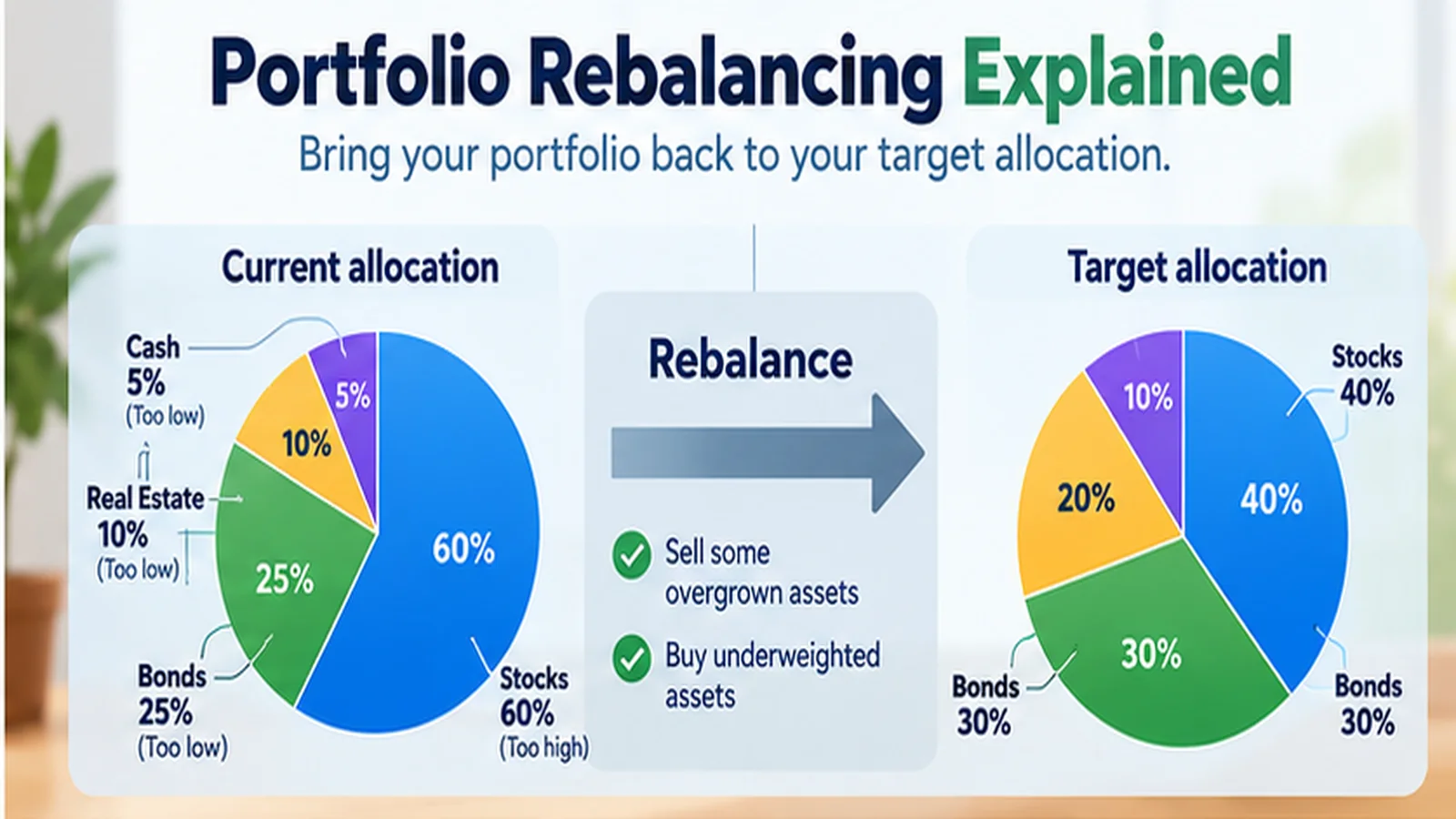
Portfolio rebalancing is the process of bringing an investment portfolio back toward its intended asset allocation after market movements change the weights. It is a risk-management process, not a method for predicting the next market winner.
Why portfolios drift
If different assets earn different returns, their weights change. A portfolio that began at 60% shares and 40% bonds might later become 70% shares and 30% bonds after a strong equity market. That means the investor is now taking a different mix of risk from the one originally chosen.
What rebalancing does
Investor.gov defines rebalancing as bringing a portfolio back to its original asset allocation mix. FINRA similarly describes it as making adjustments so the portfolio continues to reflect its target allocation.
Rebalancing does not guarantee higher returns. Its main purpose is to manage drift and keep the portfolio aligned with a chosen risk profile.
Three common ways to rebalance
1. Sell overweight assets and buy underweight assets
An investor can reduce positions that have grown above target and use the proceeds to add to positions below target.
2. Direct new money to underweight assets
Instead of selling, new contributions can be allocated more heavily to the parts of the portfolio that are below target.
3. Use withdrawals strategically
For investors taking money out, withdrawals can sometimes be taken from overweight positions, although tax and cash-flow consequences need consideration.
Calendar rebalancing
A calendar approach reviews the portfolio at set intervals, such as every six or twelve months. Investor.gov notes that some financial experts use these kinds of regular intervals.
The benefit is simplicity. The drawback is that a portfolio may drift significantly before the review date or may require little action when the date arrives.
Threshold rebalancing
A threshold approach rebalances when an asset class moves beyond a predefined tolerance band. For example, an investor might review a 60% target when it moves several percentage points away from the intended allocation.
The advantage is that the portfolio itself triggers the review. The disadvantage is that frequent monitoring and trading can increase complexity, costs or taxes.
Example
Imagine a £100,000 portfolio with a target of 60% shares and 40% bonds. After market movements it becomes £72,000 in shares and £38,000 in bonds, for a total of £110,000.
The target at £110,000 would be £66,000 in shares and £44,000 in bonds. Rebalancing would therefore involve moving about £6,000 of exposure from shares toward bonds, or directing future contributions and withdrawals in a way that gradually closes the gap.
Why rebalancing can feel uncomfortable
Rebalancing may require trimming assets that recently performed well and adding to assets that lagged. That can feel counterintuitive because recent winners often attract the most attention.
The purpose is not to claim that the weaker asset is about to outperform. It is to restore the portfolio's intended risk mix.
Costs and taxes matter
Investor.gov cautions that rebalancing methods can trigger transaction costs or tax consequences. This is one reason contribution-based rebalancing can be attractive in some situations.
The relevant tax treatment depends on jurisdiction, account type and personal circumstances.
When not to rebalance automatically
A change in allocation should not be treated as a purely mechanical decision if the investor's circumstances have changed. Time horizon, financial goals, need for liquidity and tolerance for losses may all justify a deliberate review of the target itself.
That is different from changing the target simply because one market has recently performed well.
Common rebalancing mistakes
- rebalancing too frequently and creating unnecessary costs;
- changing the target to chase recent performance;
- ignoring taxes in taxable accounts;
- focusing on tiny deviations that do not meaningfully change risk;
- rebalancing individual holdings while ignoring the overall portfolio;
- assuming rebalancing prevents losses.
A practical review process
- Write down the target allocation.
- Calculate current weights.
- Measure the gap between current and target weights.
- Check whether the gap is large enough to justify action under the chosen policy.
- Consider new contributions, withdrawals, taxes and transaction costs.
- Document the decision so future reviews use the same framework.
Key takeaway
Rebalancing is best understood as portfolio maintenance. It helps keep risk exposure aligned with an investment plan as markets move, but it does not predict returns or eliminate investment risk.
Sources
- Investor.gov — Beginner's Guide to Asset Allocation, Diversification and Rebalancing
- Investor.gov — Asset Allocation and Diversification
- FINRA — Asset Allocation and Diversification
Educational notice: Rebalancing can involve taxes, transaction costs and investment losses. This article is general education and not personalised financial, tax or legal advice.