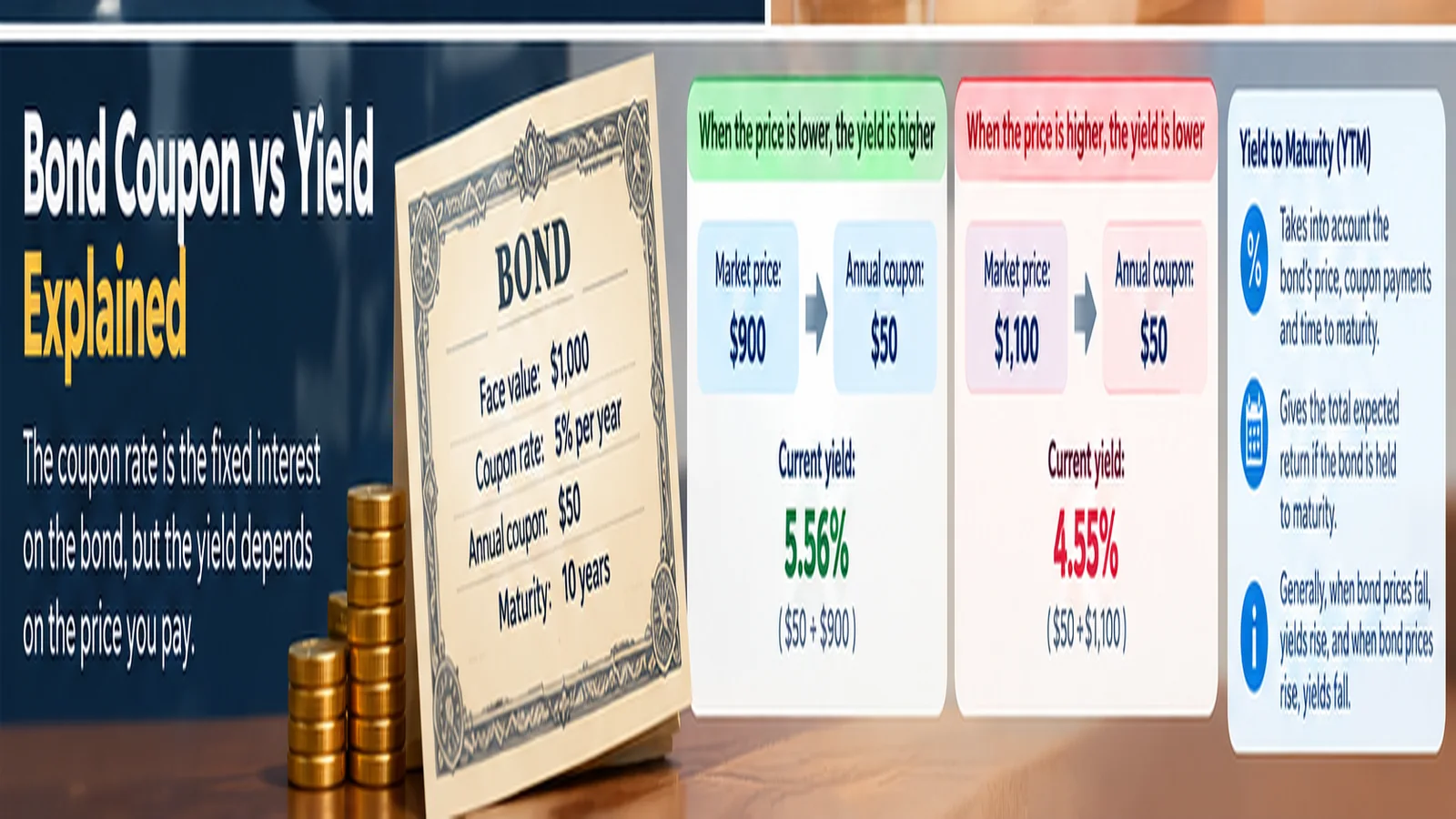
A bond's coupon rate and its yield are not the same thing. The coupon is tied to the bond's face value and is normally set when the bond is issued. Yield depends on the price an investor pays and on which yield measure is being used.
What is a bond coupon?
A bond coupon is the interest payment promised by the issuer. FINRA explains that the coupon rate is established at issuance and is tied to the bond's par or face value.
For example, a £1,000 bond with a 5% annual coupon pays £50 of interest each year, assuming the issuer makes the scheduled payments.
What is current yield?
Current yield compares the annual coupon payment with the bond's current market price:
Current yield = annual coupon payment ÷ market price
If the £1,000 bond paying £50 a year falls in price to £900, its current yield becomes about 5.56% (£50 ÷ £900). If the price rises to £1,100, the current yield falls to about 4.55%.
Why bond prices and yields move in opposite directions
When market interest rates rise, newly issued bonds may offer higher coupons. Older bonds with lower coupons become less attractive unless their prices fall. When market rates fall, an older bond with a relatively high coupon can become more valuable, so its market price may rise.
This inverse relationship is one of the most important principles in bond investing.
Coupon rate is not total return
The coupon tells you the contractual interest rate on face value. It does not capture the gain or loss caused by buying a bond above or below par and later receiving par at maturity.
That is why investors often look at yield to maturity rather than coupon rate alone.
What is yield to maturity?
FINRA describes yield to maturity, or YTM, as the overall annualised return implied by the bond's market price if the bond is held to maturity and the promised payments are made. The calculation incorporates the bond's price, coupon payments, time to maturity and repayment of principal.
YTM is useful for comparing bonds, but it relies on assumptions and does not automatically account for taxes, fees, default risk or the difficulty of reinvesting coupons at the same rate.
Other yield measures
Yield to call
Some bonds can be redeemed by the issuer before maturity. Yield to call estimates the return if the bond is called on an eligible call date.
Yield to worst
For callable bonds, yield to worst compares possible yield outcomes and focuses on the lowest of the relevant calculated yields under the stated assumptions.
Premium and discount bonds
A bond trading above face value is at a premium. A bond trading below face value is at a discount.
If an investor buys a bond at a premium and holds it to maturity, the investor receives only the face value at maturity, so part of the purchase premium is effectively lost. If the bond is bought at a discount and repaid at par, the investor receives a capital uplift in addition to coupon payments, assuming the issuer does not default.
Why yield is not a guarantee
Quoted yield does not remove credit risk, liquidity risk, call risk, inflation risk or interest-rate risk. A company or government issuer may fail to make payments, and an investor who sells before maturity may receive more or less than expected.
Common mistakes
- assuming a higher coupon always means a better bond;
- comparing coupon rates without considering purchase price;
- ignoring call provisions;
- treating yield to maturity as guaranteed;
- forgetting taxes, fees and inflation;
- assuming a bond fund behaves exactly like an individual bond held to maturity.
Key takeaway
The coupon tells you what interest the bond promises on its face value. Yield tells you what return that payment stream represents relative to the price and assumptions used. Understanding both is essential before comparing bonds.
Sources
Educational notice: Bonds involve credit, interest-rate, liquidity and other risks. Yields are not guaranteed returns. This article is general education and not personalised financial, tax or legal advice.