Imagine putting £1,000 aside and leaving it untouched for many years.
When you return, the account may still show:
£1,000
Nothing appears to have disappeared.
But there is another question that matters:
What can that £1,000 actually buy now?
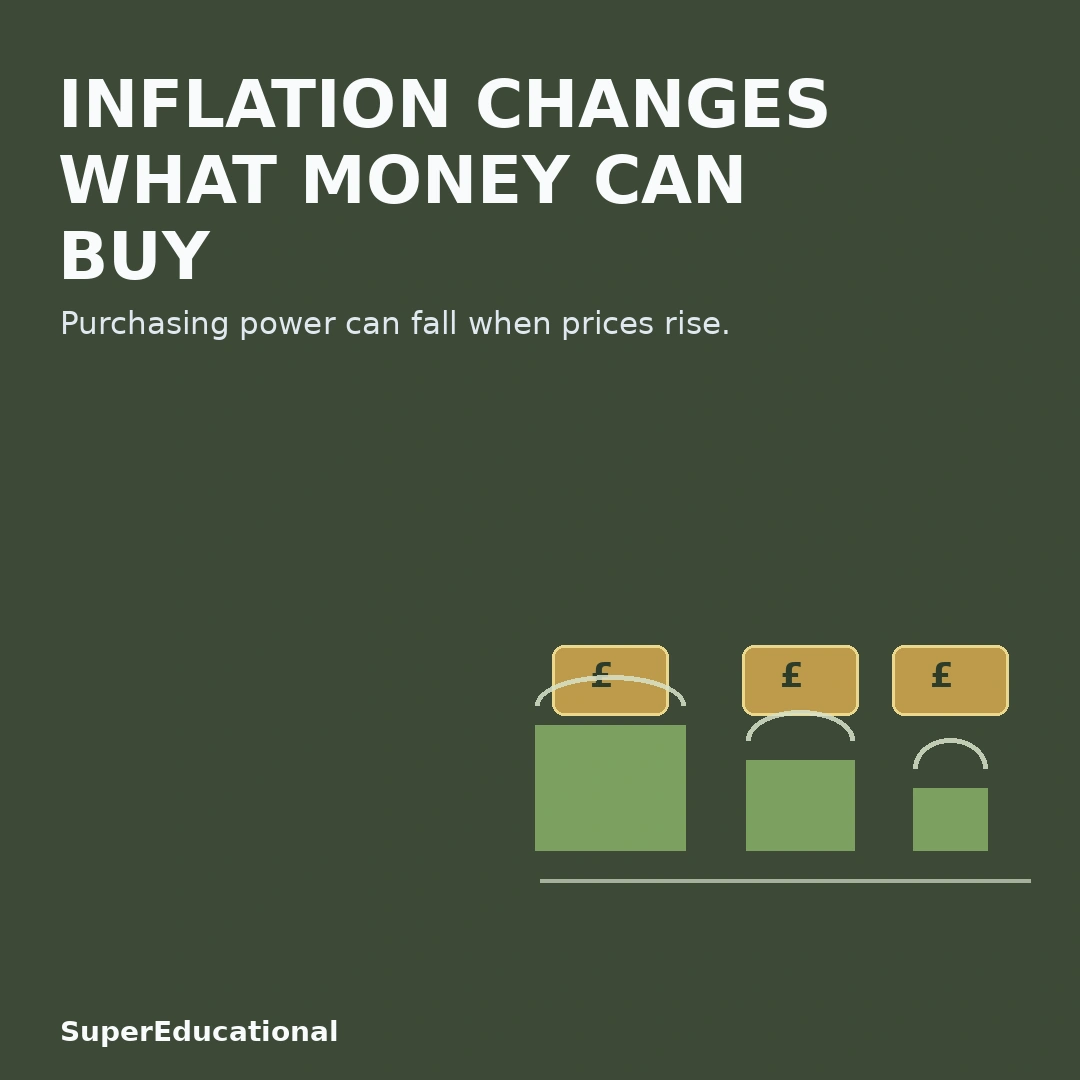
If the prices of food, transport, housing, clothing and other goods and services have risen substantially during that period, the number of pounds has remained the same while the purchasing power of those pounds has fallen.
This is one of the most important distinctions in economics:
The amount of money you have and the amount that money can buy are not the same thing.
What Is Purchasing Power?
Purchasing power describes how much in goods and services a unit or amount of money can buy.
Investor.gov defines purchasing power as the amount of goods and services that can be purchased by a given unit of currency while taking the effect of inflation into account.
That makes purchasing power useful when comparing money across different periods.
Suppose £5 once bought a particular combination of groceries.
Years later, the same groceries cost £8.
Your £5 note did not physically shrink.
But its ability to purchase those goods did.
That is a decline in purchasing power.
What Is Inflation?
Inflation refers broadly to an increase in the general level of prices over time.
It does not mean that every product becomes more expensive at exactly the same rate.
Some prices may rise quickly.
Others may barely change.
Some may even fall.
Statistical agencies therefore monitor large groups of goods and services to estimate how consumer prices are changing across the economy.
In the UK, for example, the Office for National Statistics uses large representative “baskets” of goods and services when calculating consumer price inflation.
The basket is weighted because households spend more on some things than others.
A sharp rise in something households spend heavily on can therefore matter more to measured inflation than an identical percentage increase in a relatively minor purchase.
Inflation Does Not Mean Your Money Disappears
This is where the distinction between nominal value and real value becomes useful.
Nominal value
Nominal value is the amount expressed in currency.
If your account contains £1,000, its nominal balance is:
£1,000
Real value
Real value considers what that amount can actually purchase after changes in prices are taken into account.
So your account might still display £1,000 while the real economic value of that money has declined.
The pounds are still there.
Their buying capacity has changed.
A Simple Example
Suppose a basket of everyday goods costs £100 today.
Now imagine that, after a period of inflation, exactly the same basket costs £110.
Someone whose available money increased from £100 to £110 could still purchase roughly the same basket.
But someone whose money remained at £100 could no longer buy everything in it.
Their nominal amount did not change.
Their purchasing power did.
This is why looking only at the number printed on money can give an incomplete picture of economic value.
Inflation Compounds Over Time
One year of moderate inflation may not appear dramatic.
But repeated price increases accumulate.
Suppose, purely as an illustration, prices rose by 5% each year.
A product costing £100 would become £105 after one year.
The next year's 5% increase would not be calculated from the original £100.
It would apply to £105.
That is why cumulative inflation over several years can be considerably larger than simply looking at one year's inflation rate.
This is also why small differences in inflation become important over long periods such as:
- retirement planning;
- university savings;
- long-term household budgets;
- pensions;
- salaries;
- insurance benefits; and
- long-term contracts.
£1,000 Today Is Not Automatically Equivalent to £1,000 in the Future
Consider two people.
One receives £1,000 today.
Another receives £1,000 ten years from now.
The numbers are identical.
Economically, however, they are not necessarily equivalent.
If prices rise significantly during those ten years, the future £1,000 may purchase fewer goods and services than £1,000 purchases today.
This is why economists and financial analysts frequently distinguish between values expressed in current money and values adjusted for inflation.
Without that adjustment, comparisons across long periods can be misleading.
Inflation Also Changes How We Should Think About Income
Purchasing power applies to wages as well as savings.
Suppose someone's annual salary increases from £30,000 to £31,200.
That is a 4% nominal increase.
At first glance, the worker appears financially better off.
But suppose the overall prices relevant to that worker have risen by around 6% during the same period.
Their salary increased in pounds, but their income may still buy less than before.
This introduces another important economic concept:
Nominal wage
The amount of money someone is paid.
Real wage
The purchasing power of that income after taking inflation into account.
A pay rise therefore does not automatically mean an equivalent improvement in living standards.
The key question is:
Did income rise faster or slower than the relevant increase in prices?
The Same Principle Applies to Savings
Suppose you keep £10,000 available in cash or a deposit account.
One year later, the account still contains £10,000.
If prices have increased during that year, the money may purchase less than it could previously.
If the account earns interest, the comparison becomes:
How much did the balance grow relative to how much prices increased?
For example, an account balance might rise in nominal terms while still losing purchasing power if its growth is substantially below the relevant inflation rate.
This does not mean saving cash is pointless.
It means the number in the account is only one part of the picture.
Why Cash Is Still Useful
Discussions about inflation sometimes lead to the oversimplified statement:
“Cash is bad because inflation destroys it.”
That is not a useful conclusion.
Cash and highly liquid savings can serve important purposes.
They may provide:
- emergency funds;
- money for upcoming bills;
- short-term financial stability;
- predictable nominal value;
- immediate access to funds;
- protection from having to sell other assets at an inconvenient time.
The correct lesson is therefore not:
“Never hold cash.”
It is:
Understand that cash has a nominal value and a purchasing power, and those two measures can behave differently.
Different financial goals require different balances between liquidity, stability, risk, return and protection against inflation.
Inflation Matters to Pensions Too
Imagine a pension that pays exactly £20,000 every year for decades without increasing.
The nominal income remains unchanged.
But if the cost of everyday living rises over that period, £20,000 may gradually support a lower level of consumption.
That is why inflation assumptions matter when people, governments and organisations think about long-term retirement income.
A pension's future number is important.
So is what that number is expected to buy.
Inflation Can Affect Borrowers Differently
Inflation also helps explain something that initially seems surprising.
A fixed debt is stated in nominal terms.
Suppose someone owes £100,000 at a fixed interest rate.
If incomes and prices rise substantially over many years while the nominal debt remains fixed, that £100,000 obligation may become smaller relative to future income.
Economists sometimes describe this as a reduction in the real burden of fixed nominal debt.
However, this does not mean inflation is automatically beneficial to borrowers.
Interest rates may rise, income may fail to keep pace with inflation, household expenses may increase sharply, and many loans have variable rather than fixed rates.
The broader lesson is that inflation affects different financial positions in different ways.
Your Personal Inflation Rate May Feel Different From the Headline Number
Suppose official consumer inflation is reported at 3%.
That does not necessarily mean every household's expenses increased by exactly 3%.
Two families can experience price changes differently because they buy different things.
One household may spend heavily on:
- rent;
- childcare;
- public transport; and
- electricity.
Another may spend more on:
- mortgage payments;
- fuel;
- food;
- healthcare; and
- travel.
If prices rise faster in the categories that dominate your own budget, your experience may feel more severe than the headline inflation rate.
The Office for National Statistics similarly notes that the effect of headline inflation on individual households depends partly on what those households actually buy.
So inflation statistics describe broad price movements.
They do not mean every person's cost of living changes identically.
Inflation Is About Price Levels, Not Just One Expensive Product
Another common misunderstanding is:
“Petrol became more expensive, so inflation is high.”
One price increase can contribute to inflation, particularly if the item carries significant weight in household spending.
But economy-wide inflation is broader than one product.
Economists are interested in changes across a wide range of goods and services.
Similarly, if the price of one popular product doubles while most other prices remain stable, that does not mean the general price level doubled.
Understanding this distinction helps prevent individual price movements from being mistaken for the entire inflation picture.
Falling Inflation Does Not Usually Mean Falling Prices
This is another important distinction.
Suppose inflation falls from 8% to 3%.
It is tempting to think:
“Prices are going back down.”
Not necessarily.
A lower positive inflation rate generally means prices are still rising, but more slowly than before.
Imagine something costs £100.
After a 10% increase, it costs £110.
If inflation then slows substantially, the price does not automatically return to £100.
It may instead continue rising from the new £110 level, just at a slower pace.
A reduction in the inflation rate is therefore different from a broad decline in the overall price level.
A sustained general decline in prices is known as deflation.
Why Central Banks Care About Inflation
Money serves several important economic functions.
One is acting as a store of value.
For money to perform that role effectively, people need reasonable confidence in what it will be able to purchase.
Persistently high or unpredictable inflation makes future purchasing power more uncertain.
That is one reason central banks pay close attention to price stability.
The Bank of England, for example, explains that high inflation erodes the real value of money and that relatively stable prices help money function reliably as a store of value.
Price stability does not necessarily mean prices never change.
Rather, the objective is generally to avoid large and unpredictable changes that make economic decisions more difficult.
How to Compare Money Across Time More Intelligently
Whenever you compare an amount of money from two different periods, ask:
1. What is the nominal amount?
How many pounds, dollars, naira, euros or other currency units are involved?
2. How much have prices changed?
What happened to the general cost of relevant goods and services?
3. What is the real purchasing power?
What can the money actually buy in each period?
This matters when comparing:
- historical salaries;
- house prices;
- pensions;
- company revenues;
- government spending;
- savings;
- inheritances;
- old product prices; and
- long-term financial targets.
A salary of £10,000 several decades ago cannot be meaningfully compared with £10,000 today simply by looking at the two numbers.
The economic environment around those amounts was different.
A Useful Formula for Thinking About Money
You do not need advanced economics to understand the principle.
Think of it this way:
Money's usefulness depends partly on what it can exchange for.
If you have £100 and the things you normally buy cost more, the economic capacity of that £100 has fallen.
If your income or savings grow faster than relevant prices, your purchasing power may rise.
That is why financial progress is sometimes better understood in real terms rather than nominal terms alone.
Five Questions to Ask When Inflation Changes
When prices are rising, consider:
1. Is my income changing too? Compare wage growth with changes in living costs.
2. Which expenses are increasing fastest for me? Your household budget may differ considerably from the average basket.
3. How much readily available cash do I need? Liquidity remains valuable even when inflation exists.
4. Are my long-term targets stated only in today's money? A target that seems adequate today may need adjustment if the expense is years away.
5. Am I comparing nominal numbers when I should be comparing real value? This matters especially for long historical comparisons.
The Bigger Lesson
Inflation is sometimes described simply as:
“Everything gets more expensive.”
But the deeper economic lesson is about the relationship between money and what money can command.
£1,000 is always £1,000 in nominal terms unless money is added or removed.
But £1,000 does not guarantee the same standard of consumption forever.
Its purchasing power depends partly on the prices of the goods and services available at that time.
That distinction helps explain why inflation matters to:
- wages;
- household budgets;
- savings;
- pensions;
- business planning;
- borrowing;
- government policy; and
- long-term financial decisions.
Key Takeaway
Do not look only at the number printed on money or displayed in an account.
Ask what that number can actually buy.
Nominal value tells you how much money you have.
Real purchasing power tells you what that money is economically capable of buying.
Inflation is one of the forces that can create a growing difference between the two.