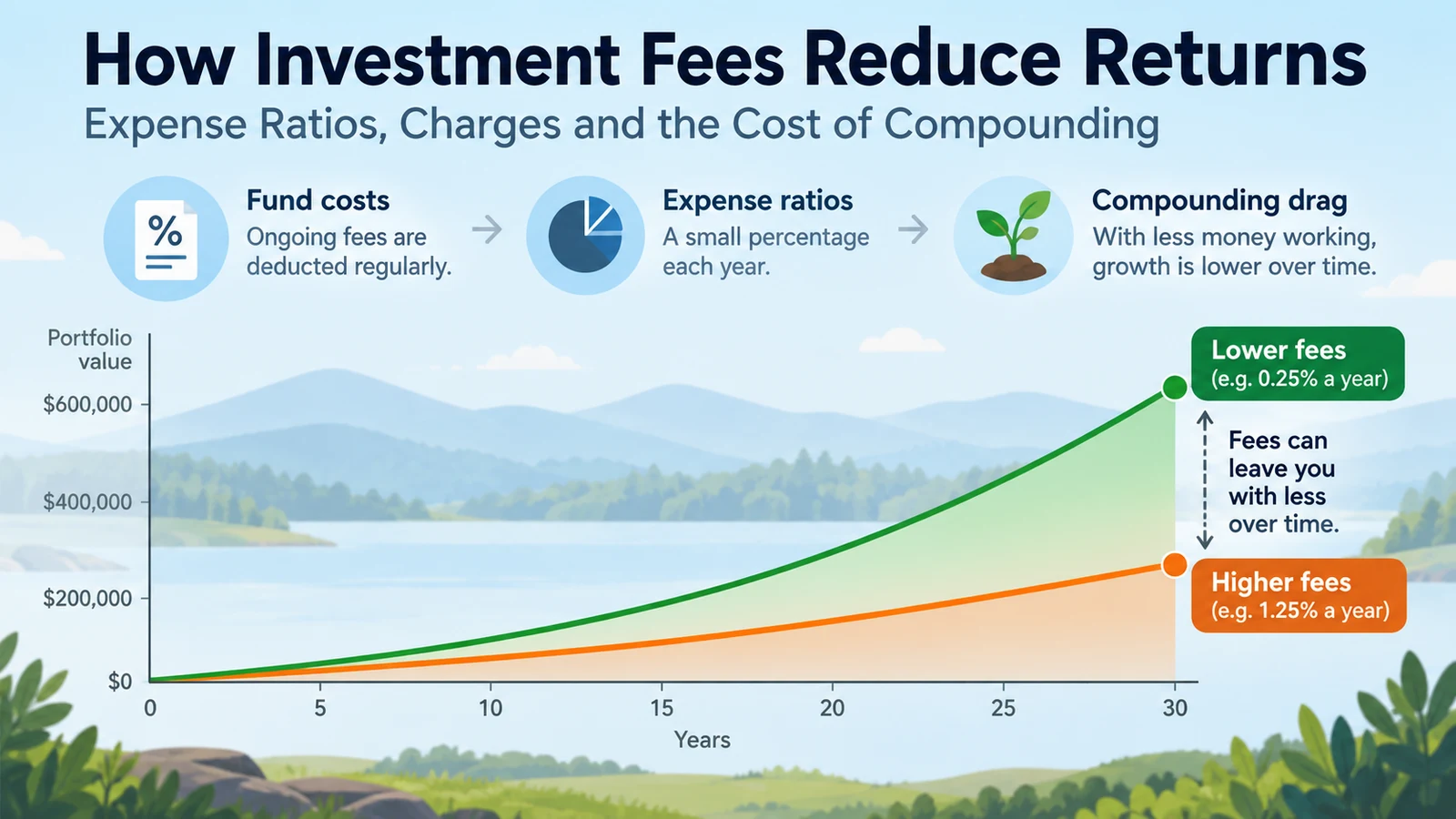
Investment fees can look small on a factsheet, but their effect compounds over time. A recurring charge does not only reduce your portfolio by the fee you pay this year. It also reduces the amount of money left invested to earn future returns. Over long periods, that difference can become substantial.
This guide explains what expense ratios and other investment charges are, how they affect returns, how to compare them, and why cost is important without being the only factor that matters. The examples are illustrative, not forecasts or personalised financial advice. Investments can rise or fall in value, and tax rules, product structures and disclosure requirements vary by jurisdiction.
What are investment fees?
Investment fees are costs charged for investment products, services, transactions or administration. Some are paid directly by the investor. Others are deducted from a fund or portfolio before the investor sees the net return.
Common examples include:
- Ongoing fund charges or expense ratios: recurring costs of operating and managing a fund.
- Management or advisory fees: charges for portfolio management or investment advice.
- Transaction costs: costs associated with buying and selling investments, which may include commissions or dealing costs.
- Entry or exit charges: one-off costs applied when entering or leaving certain products.
- Performance fees: charges linked to specified performance conditions in some products.
- Platform, custody or administration fees: charges for holding, administering or servicing investments.
The precise labels and disclosure rules differ across markets. For example, the UK Financial Conduct Authority distinguishes one-off entry and exit costs, ongoing costs, transaction costs, performance fees and carried interests in its consumer investment disclosure framework. US fund prospectuses also provide standardised fee and expense information.
What is an expense ratio?
An expense ratio is an annual operating cost expressed as a percentage of a fund's assets. It helps investors compare the recurring cost burden of funds, although the exact terminology and what is included can differ by jurisdiction and product.
If a fund has an expense ratio of 0.50%, that does not normally mean you receive a bill for 0.50% once a year. The cost is generally reflected in the fund's assets and therefore reduces the return investors ultimately receive.
For an illustrative £10,000 holding, a 0.50% annual charge corresponds to roughly £50 in the first year if the fee were applied to a constant £10,000 balance. In reality, the amount can change as the portfolio value changes and as charges are accrued under the product's actual methodology.
Why small fees matter over long periods
The main reason is compounding. Compounding means returns can be earned on earlier returns. The same mechanism also makes recurring costs more important over time: money removed as fees is no longer available to participate in future growth.
Consider a simplified example with these assumptions:
- Starting investment: £10,000
- Hypothetical gross return before fees: 6% a year
- Time period: 30 years
- No additional contributions or withdrawals
- No taxes
- Two illustrative annual fee levels: 0.25% and 1.25%
For teaching purposes, assume the annual fee is subtracted from the 6% gross return. The simplified calculation is:
Future value = starting amount × (1 + gross return − annual fee)years
With a 0.25% annual fee:
£10,000 × (1 + 0.06 − 0.0025)30 ≈ £53,507
With a 1.25% annual fee:
£10,000 × (1 + 0.06 − 0.0125)30 ≈ £40,237
The difference is about £13,271 after 30 years under these assumptions.
This does not mean either outcome will occur. Real markets are volatile, returns are not fixed, fees may be calculated differently, taxes may apply, and some higher-cost products may provide services or exposures that a lower-cost product does not. The example simply shows the mathematical effect of recurring cost differences when everything else is held constant.
Fees reduce the amount that remains invested
The US Securities and Exchange Commission's investor education materials emphasise that fees and expenses reduce investment returns because they reduce the amount of money left in the portfolio to earn future returns. The SEC also illustrates how different annual fee levels can create materially different ending portfolio values over long periods.
This is why comparing only headline performance can be misleading. When assessing an investment, it is important to understand whether quoted performance is gross or net of costs and which charges are included.
Not all investment costs appear in the same place
A useful comparison starts by identifying the complete cost structure rather than focusing on one percentage.
1. Product-level costs
Funds may deduct management and operating expenses from fund assets. Mutual funds and exchange-traded funds can have different expense levels, and each product's prospectus or official disclosure document should explain them.
2. Service-level costs
A broker, adviser, platform or pension provider may charge separately for account administration, custody, advice or portfolio management.
3. Trading costs
Buying and selling can generate commissions, spreads and other transaction costs. For exchange-traded products, the bid-ask spread can matter, particularly for investors who trade frequently.
4. One-off charges
Some products impose entry, exit, surrender or switching charges. A low annual expense ratio does not automatically make a product cheap if other charges are high.
5. Performance-linked charges
Some investment products charge a fee when performance meets defined conditions. Investors should understand the benchmark, calculation period, high-water mark or other rules that determine when the fee applies.
Expense ratio versus total cost of investing
An expense ratio is useful, but it is not always the same as the total cost of investing. The total cost may include product charges plus advice, platform fees, transaction costs, taxes and other expenses.
That distinction matters when comparing products. Two funds with similar expense ratios may still produce different investor outcomes because of transaction costs, tracking quality, taxes, trading spreads, portfolio turnover or service fees.
Does lower cost always mean better?
No. Cost is an important input, not a complete investment decision.
A sensible comparison asks whether two products provide broadly similar exposure, risk, liquidity, diversification, tax treatment and service. If they do, a persistent cost difference deserves attention because the higher-cost option must overcome that difference to deliver the same net result.
But products may differ materially. A higher fee might accompany specialised research, active management, advice, risk controls, a less liquid asset class or a service package. Those features do not guarantee better performance, but they mean that cost should be considered alongside what the investor is actually receiving.
FINRA similarly advises investors to examine fund fees and notes that higher-cost funds must perform better than lower-cost funds to generate the same net return, all else equal.
Active and passive funds: where fees fit in
Active funds generally involve managers selecting securities in an attempt to meet a stated objective or outperform a benchmark. Passive funds generally seek to track an index or rules-based benchmark. Cost levels vary within both groups.
ESMA's research on EU retail investment products has repeatedly found that costs are an important determinant of investor outcomes and has reported cost differences between active and passive products. Its 2025 market report, published in 2026, found that costs had continued to decline overall but that progress was uneven across products.
This does not mean every passive fund is automatically appropriate or every active fund is automatically poor value. Investors still need to examine the strategy, risks, benchmark, diversification, liquidity, tracking quality and total charges.
Common misconceptions about investment fees
“One per cent is too small to matter.”
A one-percentage-point annual difference can become meaningful when repeated across decades because the difference affects both current capital and future compounding.
“The fee only matters in years when the fund makes money.”
Many recurring charges continue to apply even when investment performance is weak or negative. The exact mechanics depend on the product.
“A no-commission investment has no costs.”
Zero commission does not necessarily mean zero cost. There may still be spreads, fund expenses, platform charges, foreign-exchange costs or other fees.
“The cheapest fund must be the best fund.”
Price alone cannot establish suitability or quality. Risk, diversification, investment objective, tracking, liquidity, tax treatment and operational quality also matter.
“Past high returns prove a higher fee is worth paying.”
Historical performance does not guarantee future results. A fair comparison should consider costs and risk as well as performance, and should avoid assuming that past outperformance will persist.
A practical framework for comparing investment costs
- Identify the investment objective. Compare products that are genuinely intended to do similar jobs.
- Read the official cost disclosure. Use the prospectus, key information document, product summary or equivalent official document.
- Separate recurring and one-off costs. List annual fund charges, advice/platform fees, transaction costs and entry/exit charges.
- Check whether performance figures are net or gross of fees. Do not compare unlike figures.
- Estimate the long-term effect. Model several fee levels over your expected holding period using cautious assumptions.
- Consider trading frequency. Frequent buying and selling can make spreads and transaction charges more important.
- Review risk and diversification. A low fee does not compensate for an unsuitable or poorly diversified exposure.
- Check jurisdiction-specific tax and regulatory rules. Taxes and product availability can materially change outcomes.
- Revisit the comparison periodically. Fees, products and personal objectives can change.
Key takeaways
- Investment fees reduce the amount of money that remains invested and can therefore reduce future compounded growth.
- An expense ratio is an annual operating-cost percentage, but it may not capture every cost an investor pays.
- Recurring fee differences that appear small can produce large differences over long periods when all other assumptions are held constant.
- Lower cost is not automatically better; compare like with like and consider risk, diversification, service, liquidity and investment objective.
- Past performance does not guarantee future returns, and investments can lose value.
- Use official product documents and regulator guidance when comparing costs.
Frequently asked questions
What is a good expense ratio?
There is no universal percentage that is “good” for every investment. Appropriate comparisons depend on the asset class, strategy, market, product structure and services provided. Compare similar products and focus on total cost as well as what you receive for that cost.
Are ETF expense ratios charged separately from my account?
Typically, a fund's operating expenses are reflected in the fund's assets rather than billed as a separate annual invoice to each investor. However, investors may also face brokerage, spread, platform or other costs. Check the fund's official documents and your provider's fee schedule.
Can fees make an investment lose money?
Fees reduce net returns. If investment performance is weak, recurring costs can deepen the loss or reduce any gain. Market risk remains separate: even a low-cost investment can lose value.
Should I choose the cheapest index fund?
Cost is important, but also compare the index tracked, diversification, tracking difference, liquidity, fund structure, tax treatment, securities-lending policy where relevant, and provider quality.
Do fees matter more for long-term investors?
Long holding periods give recurring fee differences more time to compound. That makes cost discipline particularly relevant to long-term investing, although other factors such as risk and asset allocation remain essential.
Authoritative references
- Investor.gov — How Fees and Expenses Affect Your Investment Portfolio
- Investor.gov — Mutual Fund and ETF Fees and Expenses
- FINRA — Mutual Funds and Fund Fees
- ESMA — Market Report on Costs and Performance of EU Retail Investment Products 2025
- Financial Conduct Authority — DISC 6 Costs and Charges Information
Educational notice: This article provides general investment education only. It is not personalised financial, tax or legal advice. Investment values can fall as well as rise, and you may receive back less than you invest. Fees, taxes, product availability and regulatory protections vary by country.