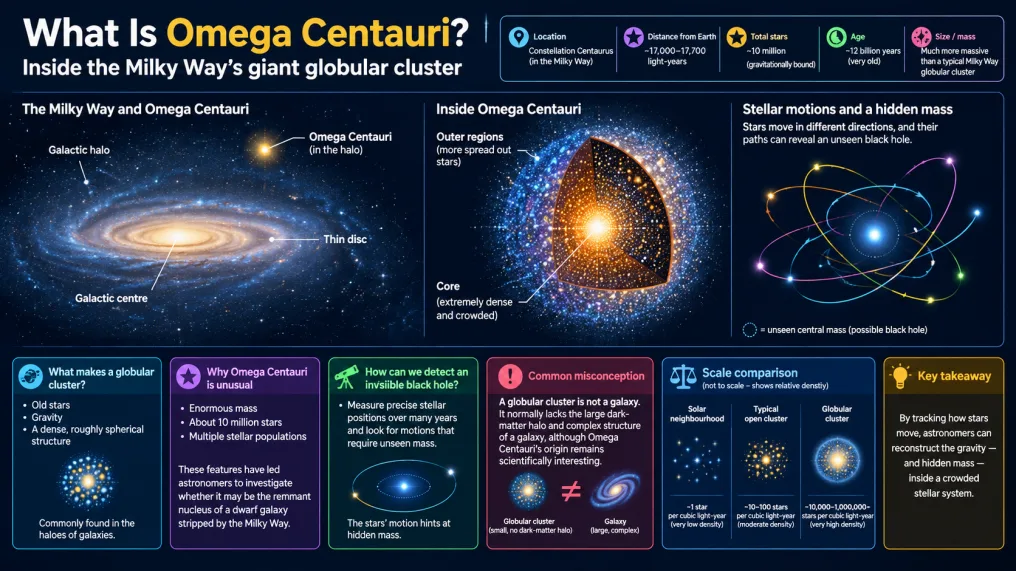
Omega Centauri is one of the most remarkable star clusters in the Milky Way. Also catalogued as NGC 5139, it is a vast, roughly spherical swarm containing about 10 million gravitationally bound stars. From Earth it appears as a bright fuzzy object in the constellation Centaurus, but telescopes resolve that glow into an extraordinarily crowded stellar system.
Its size, mass, complex stellar populations and unusual internal motions make Omega Centauri especially useful for learning how astronomers reconstruct the history and gravity of distant systems.
What is a globular cluster?
A globular cluster is a dense, approximately spherical collection of stars held together by their mutual gravity. The Milky Way contains many such clusters, most of them orbiting in the Galaxy's extended halo rather than within the thin disc where the Sun resides.
Globular clusters are generally ancient. Their stars formed early in the history of the Milky Way, so astronomers use them as laboratories for studying stellar evolution, gravitational dynamics and the assembly of galaxies.
Where is Omega Centauri?
Omega Centauri lies roughly 17,000–17,700 light-years from Earth in the direction of Centaurus. It orbits the Milky Way and is much more massive than a typical Galactic globular cluster.
Despite the name “Centauri”, it is not a single star. Early observers without modern telescopes could not resolve its millions of individual stars, which helps explain why it acquired a star-like designation.
How many stars does it contain?
Estimates place the population at roughly 10 million stars. The stars are not distributed evenly. They become much more densely packed towards the cluster's centre, where gravitational interactions are correspondingly important.
This density is difficult to imagine from our relatively sparse Solar neighbourhood. Nearby stars around the Sun are separated by light-years, whereas a globular cluster can contain enormous numbers of stars inside a comparatively compact volume.
Why is Omega Centauri unusual?
Many globular clusters can be approximated as populations whose stars formed over a relatively limited period from chemically similar material. Omega Centauri is more complicated. Astronomers have identified multiple stellar populations with different chemical compositions and ages.
Its unusual mass and chemical complexity have led researchers to investigate an intriguing possibility: Omega Centauri may be the surviving nuclear region of a dwarf galaxy whose outer stars and material were stripped away through interactions with the Milky Way.
That origin is an active scientific question rather than something that can be inferred simply from its appearance.
Is Omega Centauri a galaxy?
No. It is classified as a globular cluster. A galaxy is generally a much larger and more complex gravitational system containing stars, gas and other components, commonly embedded in a substantial dark-matter halo.
The suggestion that Omega Centauri could be a former dwarf-galaxy nucleus concerns its origin. It does not mean that today's object should simply be treated as an ordinary galaxy.
How can astronomers detect something they cannot see?
Gravity provides one of astronomy's most powerful clues. An invisible object can still influence the motions of visible stars around it. By measuring stellar positions repeatedly over many years, astronomers can calculate how quickly stars move and how their trajectories change.
If stars near the centre of a cluster move in ways that cannot be explained by the visible stars alone, researchers can test whether additional unseen mass — potentially a black hole — provides a better explanation.
What has Hubble found in Omega Centauri?
Astronomers have used more than two decades of Hubble Space Telescope observations to measure the motions of stars in Omega Centauri with exceptional precision. One study identified seven fast-moving stars in the central region whose velocities provide strong evidence for an intermediate-mass black-hole candidate.
An intermediate-mass black hole would occupy the broad mass range between stellar-mass black holes produced by individual stars and the supermassive black holes found in the centres of large galaxies. Establishing such objects securely is important because astronomers are still investigating how black holes grow across these very different mass scales.
What are Hubble and Webb adding?
Combining precise observations from instruments such as Hubble and the James Webb Space Telescope allows astronomers to extend measurements of stellar motion and examine crowded regions in complementary ways. Recent work has also identified a candidate stellar-mass black-hole binary in Omega Centauri.
The important scientific lesson is broader than any one candidate: motion maps gravity. Researchers can infer otherwise invisible mass by tracking how visible objects respond to it.
Open clusters, globular clusters and galaxies
An open cluster usually contains far fewer stars and has a looser structure. Many open clusters occur in the Galactic disc and can eventually disperse as stars escape.
A globular cluster is generally older, more massive, more densely packed and roughly spherical. A galaxy operates on a much larger scale and can contain many different stellar populations, gas, dust, star clusters and substantial dark matter.
Omega Centauri is especially interesting because some of its properties are more complicated than the simple textbook picture of a globular cluster.
Why do multiple stellar populations matter?
Stars preserve information about the material from which they formed. Astronomers analyse stellar spectra to determine the abundances of chemical elements. If groups of stars have systematically different compositions, those differences can reveal multiple episodes of star formation or chemical enrichment.
That makes Omega Centauri a kind of archaeological site: its stars retain clues about events that happened billions of years ago.
A practical astronomy lesson: position is only the beginning
A photograph shows where stars appear at one moment. Repeated measurements turn that picture into a dynamical experiment. Astronomers compare positions across years, calculate proper motions, combine them with other measurements and build gravitational models.
This technique demonstrates an important principle of science: we do not always need to see an object directly to test whether it exists. We can measure its effects.
Common misconception: every dense star system is a galaxy
It is not. Classification depends on physical properties and history, not simply on how crowded or bright an object appears. Globular clusters and galaxies differ in scale, structure, stellar populations and typical dark-matter content.
Key takeaways
- Omega Centauri, or NGC 5139, is an enormous globular cluster roughly 17,000–17,700 light-years away.
- It contains approximately 10 million gravitationally bound stars.
- Its multiple stellar populations make it more complex than many typical globular clusters.
- Researchers have investigated whether it is the surviving nucleus of a dwarf galaxy disrupted by the Milky Way.
- Precise measurements of stellar motion allow astronomers to infer hidden mass and search for black holes.
- Omega Centauri demonstrates how stellar dynamics and chemistry can reveal the history of an ancient system.
Frequently asked questions
Can you see Omega Centauri without a telescope?
Under sufficiently dark southern skies, Omega Centauri can be visible to the unaided eye as a fuzzy point or patch, although a telescope reveals far more of its stellar structure.
How old is Omega Centauri?
Its stellar populations are ancient, with major populations around 12 billion years old. Its multiple populations mean its history is more complicated than assigning every star exactly the same age.
Does Omega Centauri definitely contain an intermediate-mass black hole?
Observations provide strong evidence for a candidate central intermediate-mass black hole, but researchers continue to test the interpretation with increasingly precise measurements and dynamical models.
Why is the centre so crowded?
Gravity binds the cluster, and its stellar density rises strongly towards the core. Over billions of years, gravitational interactions also redistribute energy and alter stellar orbits.
Why do astronomers care about globular clusters?
They provide laboratories for studying old stars, stellar evolution, gravitational dynamics, black holes and the early assembly history of galaxies.
Authoritative references
- NASA Astronomy Picture of the Day, Omega Centauri, 25 September 2026.
- NASA/Hubble research on fast-moving stars and an intermediate-mass black-hole candidate in Omega Centauri.
- European Southern Observatory resources describing Omega Centauri and its stellar populations.