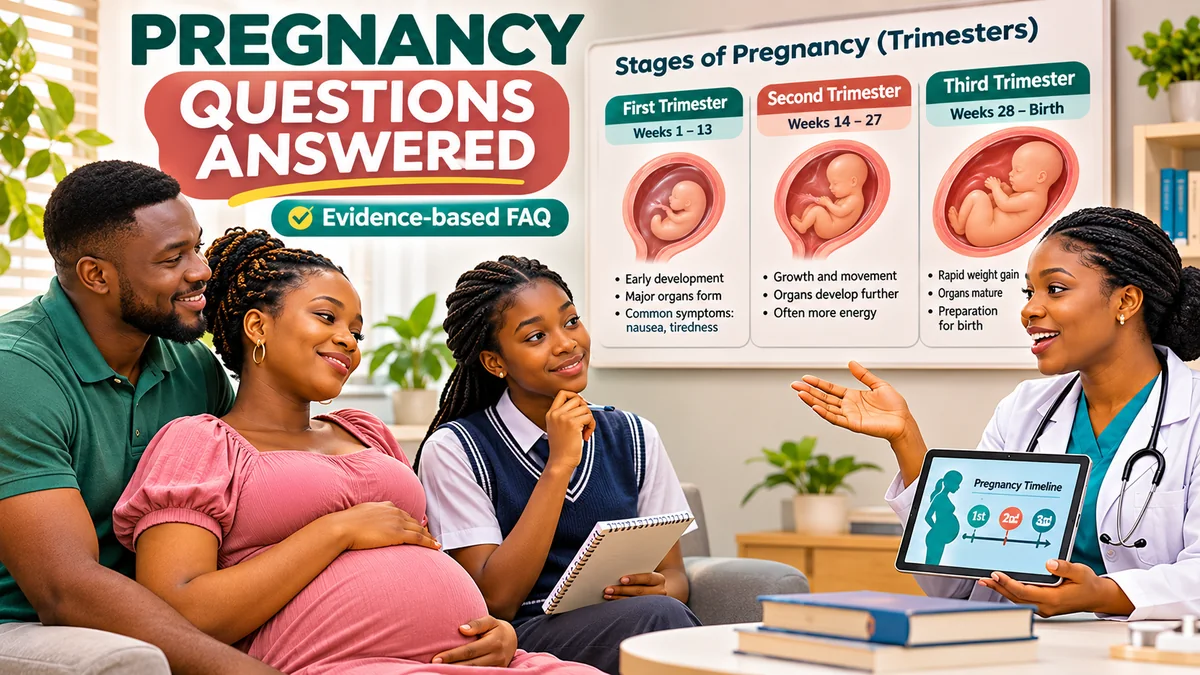
Stages of Pregnancy: Evidence-Based FAQ for Students and Families
What happens during each stage of pregnancy, how are the weeks counted, and which changes call for medical advice? These questions matter to students studying human development and to families planning antenatal care. Pregnancy is a continuous process, usually organised into three trimesters: weeks 1–13, weeks 14–27, and week 28 until birth. These ranges follow the American College of Obstetricians and Gynecologists (ACOG) convention; some educational sources use slightly different boundaries.
This evidence-based FAQ gives direct answers, explains what is known and what varies between individuals, and distinguishes ordinary pregnancy changes from warning signs. For a broader chronological overview, see SuperEducational's companion article Stages of Pregnancy: Evidence-Based Explanations and Essential Facts (scheduled for publication). This guide is educational, not personalised medical advice.
Quick-reference pregnancy stages table
| Trimester | Gestational age | Key focus |
|---|---|---|
| First | Weeks 1–13 | Early organ formation and initial antenatal care |
| Second | Weeks 14–27 | Fetal growth, movement, anatomy assessment |
| Third | Week 28 to birth | Organ maturation, ongoing monitoring, birth planning |
Pregnancy basics: dates, stages and terminology
1. What are the three stages of pregnancy?
Pregnancy is commonly divided into the first trimester (1 week to 13 weeks and 6 days), second trimester (14 weeks to 27 weeks and 6 days) and third trimester (28 weeks until birth). In the first, foundational body structures form; in the second, growth and movement become more apparent; and in the third, organs continue maturing and the fetus gains weight. These are teaching and care-planning divisions, not rigid biological switches. Development continues across every boundary.
2. Why is a pregnancy said to last 40 weeks when conception happens later?
Clinicians usually measure gestational age from the first day of the last menstrual period. Fertilisation often occurs approximately two weeks afterwards in a typical cycle, so the first two gestational weeks precede conception. This method offers a common reference point when the precise day of fertilisation is unknown. An estimated due date is 40 gestational weeks from that reference, but it is only an estimate. Cycle variation and ultrasound measurements can change the most reliable dating assessment.
3. What is the difference between an embryo and a fetus?
An embryo is the early developing organism, especially during the weeks when major body plans and organ foundations form. The term fetus is generally used after eight completed weeks following fertilisation, equivalent to about ten gestational weeks under standard menstrual dating. The two clocks are a common source of confusion in textbooks. The change in terminology does not mean that organs stop developing; growth and functional maturation continue throughout pregnancy.
4. Does every pregnant person have the same symptoms or trimester dates?
No. Some individuals experience nausea, fatigue and breast tenderness; others have few early symptoms. The timing and intensity of physical changes differ. Trimester boundaries can also vary slightly by educational source. For examinations and medical conversations, use the gestational week and state which convention you are following. Symptoms alone cannot reliably establish fetal health or gestational age. Any concern should be discussed with a qualified maternity professional rather than judged against a fixed symptom checklist.
5. Can a pregnancy test identify the week of pregnancy?
A home urine test primarily detects human chorionic gonadotropin (hCG), a hormone produced after implantation. It can indicate pregnancy but ordinarily cannot precisely date gestation. A clinician estimates dates using menstrual history and, where appropriate, ultrasound. hCG levels vary, so interpreting a single result as an exact number of weeks is unreliable. A negative test very early after conception may need repeating according to the test instructions or a healthcare professional's advice.
Questions about the first trimester
6. What happens in the earliest weeks after fertilisation?
Following fertilisation, dividing cells travel towards the uterus, and the blastocyst implants into the uterine lining. The placenta and supporting tissues begin developing. Soon afterwards the neural tube, early circulatory structures and limb buds form. Because critical structures begin developing before some people realise they are pregnant, preconception healthcare and early antenatal contact matter. Developmental illustrations depict averages: actual appearances and sizes vary from week to week and are not a substitute for ultrasound or clinical assessment.
7. Why are nausea and tiredness common in early pregnancy?
Hormonal and physiological changes contribute to nausea, sensitivity to smells, tiredness and breast changes. Nausea is not confined to mornings; it can occur at any time. Some people experience little nausea, whereas others have vomiting serious enough to cause dehydration. Seek clinical help if fluids cannot be kept down, urine output decreases, dizziness develops or weight loss is concerning. Neither the presence nor absence of morning sickness, on its own, confirms that a pregnancy is developing normally.
8. Why is folic acid important before and during early pregnancy?
Folic acid supports normal neural-tube development. The US CDC recommends 400 micrograms daily for people who could become pregnant, particularly before and during early pregnancy, to help prevent neural tube defects. People with certain medical histories or medicines may need different prescribed amounts. Supplements cannot prevent every birth defect, and a healthcare professional should advise on an appropriate prenatal plan. Do not assume that all multivitamins contain the correct ingredients or dose.
9. Is light bleeding during the first trimester always harmless?
No. Spotting can have several explanations, but bleeding may also indicate pregnancy loss or ectopic pregnancy and requires professional assessment, especially when accompanied by one-sided or severe abdominal pain, shoulder-tip pain, dizziness or fainting. Heavy bleeding or collapse requires emergency care. A family member should not reassure someone that bleeding is simply implantation without evaluation. The appropriate response depends on symptoms, examination and sometimes ultrasound and laboratory testing.
10. Which checks might be offered at the first antenatal appointment?
Early care commonly includes a medical and pregnancy history, blood-pressure check, review of medication and supplements, blood and urine tests and discussion of ultrasound. Screening for anaemia, blood group and certain infections may be included according to local guidelines. The healthcare team can discuss genetic screening, vaccination, nutrition, safeguarding and mental wellbeing. These checks serve different purposes; a screening result is not the same as a diagnosis. Patients may ask what each test looks for and whether informed consent is required.
Questions about the second trimester
11. When can someone first feel fetal movement?
Many pregnant people begin to notice movement between 16 and 24 weeks, sometimes later in a first pregnancy. Initially it may resemble fluttering, bubbling or gentle tapping. An anterior placenta can make some movement harder to perceive. If no movement has been felt by 24 weeks, contact a midwife or maternity service for advice. Once a usual pattern becomes established, a reduction or marked change calls for immediate assessment rather than waiting for the next appointment. See the NHS movement guidance .
12. What is the purpose of the mid-pregnancy anatomy scan?
An anatomy or anomaly ultrasound, often offered at roughly 18–22 weeks depending on the healthcare system, examines aspects of fetal structure and growth and may assess the placenta. Some conditions may be visible, while others cannot be reliably identified on a scan. If something needs a closer look, further imaging, specialist review or diagnostic testing may be offered. A normal scan is reassuring but does not guarantee that every genetic, developmental or medical condition has been excluded.
13. Can ultrasound show the baby's biological sex?
Ultrasound may sometimes reveal the appearance of external genitalia during the second trimester, depending on fetal position, image quality and local policy. This is not the primary purpose of a structural examination, and an image-based estimate can be wrong. Biological sex characteristics and gender identity are not identical concepts. Parents should not treat the ultrasound appearance as certainty or interpret it as evidence about the child's future gender identity.
14. Why do back pain, heartburn and skin changes develop?
As pregnancy advances, an enlarging uterus shifts posture and can increase mechanical strain. Hormonal effects may contribute to reflux, changes in connective tissue and pigmentation. Constipation and nasal congestion can also occur. Mild discomfort may respond to clinician-approved adjustments in activity, posture and diet. However, severe pain, persistent vomiting, bleeding or symptoms accompanied by headache and visual changes should not be written off as ordinary pregnancy. Ask a healthcare professional about safe remedies rather than self-medicating.
15. What is gestational diabetes screening and when is it offered?
Gestational diabetes is high blood glucose first recognised during pregnancy. Many care systems routinely offer testing around 24–28 weeks, although earlier testing may be appropriate when risk factors or symptoms are present. Procedures and diagnostic thresholds vary by country. Screening matters because untreated high glucose can affect pregnancy outcomes; when identified, healthcare teams can advise on monitoring, nutrition, activity and medication if needed. It is not possible to diagnose gestational diabetes from thirst or fatigue alone.
16. Does a calmer second trimester guarantee that complications are unlikely?
No. Some people find that nausea improves and energy returns, but others continue to have symptoms. Disorders such as high blood pressure, anaemia and infections can occur even when someone feels reasonably well. Regular antenatal checks matter precisely because some problems do not cause obvious early symptoms. Sudden or severe headache, visual disturbances, upper abdominal pain and marked swelling merit urgent assessment, especially after 20 weeks, because they may signal pre-eclampsia or another serious condition.
Questions about the third trimester and labour
17. What changes most during the third trimester?
From about 28 weeks, the fetus continues gaining weight as the brain, lungs and other organs mature. The pregnant person may experience greater pelvic pressure, heartburn, sleep disruption and more frequent urination. Some fetuses settle into a head-down position before labour, while others remain breech or in another position. Clinicians assess growth, presentation, symptoms and relevant medical risks. Developmental milestones are averages; one ultrasound measurement does not by itself determine whether the pregnancy is healthy.
18. Is it normal for fetal movement to slow near the due date?
No. The Royal College of Obstetricians and Gynaecologists explains that the type of movement can feel different, but a baby's usual activity pattern should remain apparent up to birth. A reduction, cessation or significant change in movement requires immediate contact with maternity services, including at night. Do not rely on home Doppler devices, sugary drinks or waiting until morning to decide whether the baby is well.
19. What is the difference between Braxton Hicks contractions and labour?
Braxton Hicks contractions are episodes of uterine tightening that are often irregular and do not progressively lead to cervical change. Labour contractions tend to become more regular, stronger and closer together, although individual experiences vary. Ruptured membranes, vaginal bleeding or severe constant pain should prompt a call to the maternity team regardless of whether contractions have begun. Anyone who thinks labour may be starting before 37 weeks should seek urgent advice because preterm labour requires assessment.
20. Is 37 weeks the same as full term?
Not under the widely used ACOG definitions. Early term means 37 weeks 0 days through 38 weeks 6 days; full term means 39 weeks 0 days through 40 weeks 6 days. Later terms include late term and post-term. These labels help clinicians communicate changing risks and benefits, but they do not predict one person's exact delivery date. When a medical complication is present, delivery before 39 weeks can be safer than continuing the pregnancy.
21. What should families prepare before delivery?
Useful preparation includes identifying a suitable maternity facility, arranging transport and emergency contacts, understanding how to contact the maternity team, collecting relevant clinical records and discussing pain relief and birth preferences. Families can also learn about newborn feeding, safe sleep, postnatal warning signs and practical support after birth. A birth plan should allow flexibility because medical circumstances may change. The pregnant person's informed choices and privacy should remain central to decisions made by family members or partners.
Care, safety, myths and learning
22. How many antenatal appointments are recommended?
The World Health Organization recommends at least eight antenatal contacts as a model of pregnancy care, but local systems may organise visits differently. The number and timing required depend on clinical needs: a high-risk pregnancy may require more frequent assessment. Antenatal care is not just a count of visits; it should include respectful communication, appropriate testing, preventive care and a plan for managing complications. Starting care early is more useful than waiting until the pregnancy becomes visibly advanced.
23. Are prenatal screening and diagnostic tests the same?
No. A screening test estimates the likelihood of a condition; it does not normally establish a definite diagnosis. A diagnostic test seeks a more definitive answer for specific conditions, but it has its own limits and sometimes procedural risks. ACOG recommends discussing available genetic screening and diagnostic options with pregnant patients. People should receive understandable information about accuracy, possible results and what follow-up may be needed, and they may accept or decline testing after informed counselling.
24. Can diet, activity or supplements guarantee a healthy baby?
No. Balanced nutrition, appropriate physical activity, recommended supplements, routine care and avoiding harmful exposures can reduce some risks, but cannot guarantee a particular outcome. Existing health conditions, genetics, placental factors and events outside anyone's control also matter. Alcohol and tobacco avoidance is advised; all prescribed and over-the-counter medicines should be discussed with a clinician rather than stopped or started casually. Families should offer practical support without blaming a pregnant person if a complication develops.
25. Which pregnancy symptoms are medical emergencies?
Heavy bleeding, fainting, severe abdominal pain, seizures, chest pain, serious breathing difficulty, a persistent severe headache, visual changes, fluid leakage and reduced fetal movement can require immediate assessment. Fever, severe vomiting with dehydration and thoughts of self-harm also merit urgent attention. The CDC's urgent maternal warning-sign guidance applies during pregnancy and the postnatal period. Call emergency services for life-threatening symptoms, and contact maternity services promptly for other concerning changes.
26. What is a common misconception about pregnancy months?
Calling pregnancy “nine months” is a useful shorthand, but calendar months vary in length. Gestational weeks provide a clearer medical timeline. For instance, 28 weeks is generally classified as the start of the third trimester in the ACOG system, even when a family describes the pregnancy using a different month count. Students should avoid converting weeks into months by simply dividing by four, since most calendar months contain more than 28 days.
27. How can students revise pregnancy biology accurately?
Use three questions for each trimester: What structures are developing? What changes might the pregnant person notice? What monitoring or care is relevant? Distinguish gestational from fertilisation age, and learn the difference between embryo and fetus, placenta and umbilical cord, and screening and diagnosis. Draw a simple timeline with week numbers. For a deeper reading passage, consult the companion pregnancy stages explainer . Keep medical red flags separate from ordinary symptoms in your notes.
28. How can families support someone through each trimester?
Ask which kind of help is welcome rather than assuming what the pregnant person needs. Support may include transport to appointments, shared household work, nutritious meals, childcare arrangements and help accessing reliable information. Listen seriously to new symptoms or changes in fetal movement, and support urgent assessment when indicated. Respect confidentiality and decisions about screening, birth and feeding. Practical, consistent support matters more than dramatic advice or unverified claims found on social media.
Key takeaways
- Pregnancy weeks are counted from the last menstrual period, not usually from fertilisation.
- Trimesters are useful learning categories; real development is continuous and individual variation is normal.
- Screening gives probabilities; diagnosis and clinical decisions require professional assessment.
- Seek immediate advice for reduced fetal movement or serious maternal warning signs.
Conclusion
Studying the stages of pregnancy becomes easier when the timeline is connected to specific questions rather than memorised as three isolated lists. Families benefit from knowing what is expected, what may vary and when professional assessment is essential. Use trusted sources and keep antenatal care central to decisions. For individual symptoms or treatment choices, consult an appropriately qualified healthcare professional.