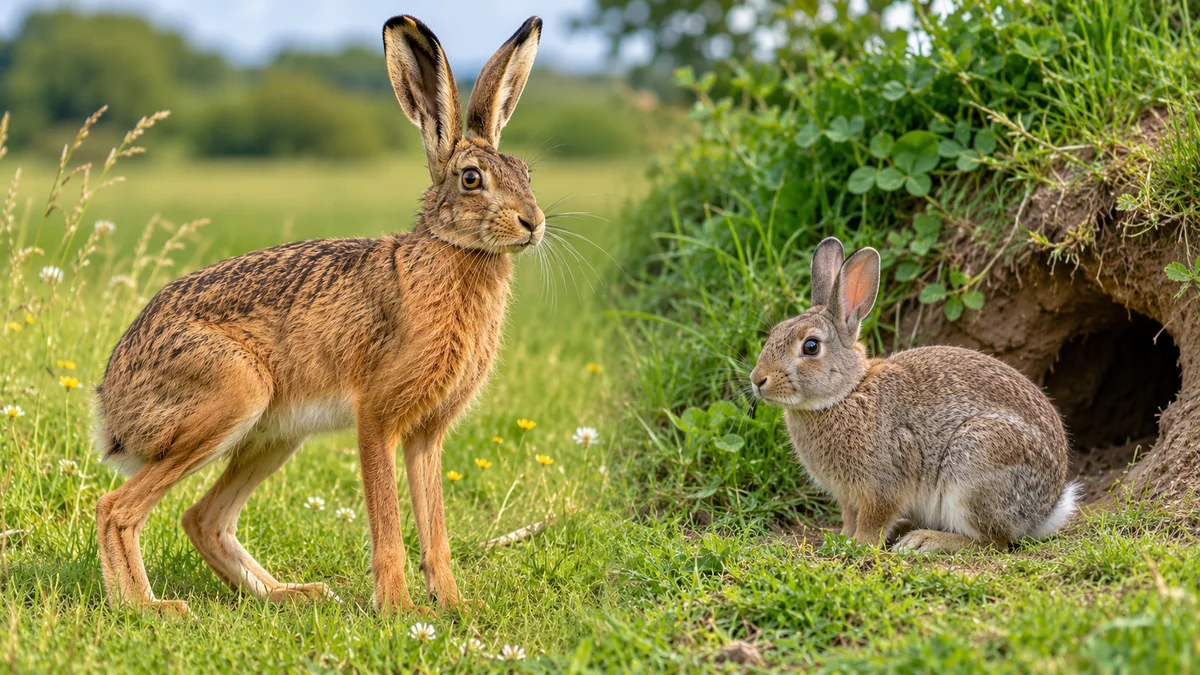
What is the difference between a rabbit and a hare? Rabbits and hares are close relatives, but they are not the same animal. Hares are usually longer-legged, larger and better adapted to rapid running, while many rabbits are smaller and depend more on hiding places or burrows. The clearest distinction appears at birth: baby hares, called leverets, are generally born with fur and open eyes; baby rabbits, called kits or kittens, are usually born hairless, with closed eyes, and need a protected nest.
Those differences are useful, but nature has exceptions. Not every rabbit digs a warren, not every hare lives in open fields, and some giant domestic rabbits outweigh some wild hares. This comparison focuses on the familiar European rabbit (Oryctolagus cuniculus) and European brown hare (Lepus europaeus) when discussing typical appearance, while explaining how other species differ. It answers the practical question—rabbit vs hare: how can you tell which one you are looking at?—without reducing animal biology to misleading rules.
Rabbit vs hare: key differences at a glance
| Feature | Rabbit | Hare |
|---|---|---|
| Classification | Several genera of rabbit within family Leporidae; European rabbit is Oryctolagus cuniculus | True hares and jackrabbits belong to genus Lepus |
| Typical build | Often more compact, shorter-legged and relatively round-bodied | Often taller, longer-limbed and more athletic in outline |
| Ears | Generally shorter relative to the body in many familiar species | Often longer; brown hares have conspicuous black ear tips |
| Habitat | Many prefer dense cover, scrub, field margins or burrow access | Many inhabit open fields, grasslands and scrub; some are forest or tundra specialists |
| Resting and nesting | European rabbits form warrens; many other rabbits use surface nests rather than permanent burrows | Brown hares rest above ground in shallow hollows called forms |
| Newborns | Kits: typically blind, largely hairless and dependent | Leverets: typically furred, eyes open and able to move soon after birth |
| Predator response | Often escape into nearby cover or burrow | Often rely on camouflage, speed and changes of direction |
| Social behaviour | European rabbits often live in groups | Brown hares are usually more solitary; exceptions occur |
These are typical patterns, not an identification test that works everywhere. According to the University of Michigan's Animal Diversity Web , the hare-and-rabbit family contains varied body forms, habitats, nesting strategies and social systems.
Are rabbits and hares the same species or family?
Both belong to the mammalian order Lagomorpha and the family Leporidae. Pikas are also lagomorphs, but belong to a different family. Rabbits and hares are therefore related, yet a brown hare is not simply an adult version of a young rabbit. They are separate evolutionary lineages with distinct species and reproductive biology.
Hares: The group commonly called true hares comprises the genus Lepus. This includes European brown hares, Arctic hares, snowshoe hares and the animals known as jackrabbits.
Rabbits: The common name covers multiple other genera, including Oryctolagus (European rabbit), Sylvilagus (cottontails) and Brachylagus (pygmy rabbit). Domestic rabbits descend from the European rabbit, not from hares.
Neither group belongs to the rodent order, despite having prominent front teeth. Lagomorphs have a distinctive second pair of small upper incisors behind the main pair. For a wider explanation of mammals and biological groups, read SuperEducational's animal classification guide .
Size and appearance: how to identify a rabbit versus a hare
Body size and proportion
When you compare a European brown hare with a wild European rabbit, the hare normally looks much taller and more stretched out. Its long hind legs sit beneath a lean body, while the rabbit has a comparatively compact outline. The Mammal Society's brown-hare profile gives a head-and-body length of about 55 cm, with adult weights around 3.3 kg for males and 3.7 kg for females. Its separate European rabbit profile is useful for identifying the smaller, shorter-legged comparison species.
Do not use size alone. Young hares can be smaller than adult rabbits, and large domestic rabbit breeds can exceed some hare species in mass. Distance, perspective and a crouching posture may also make the same animal appear much shorter.
Ears and eyes
Brown hares often have particularly long ears with dark or black tips and conspicuous amber-coloured eyes. Wild European rabbits usually have shorter ears without those distinctive black tips and often show darker brown eyes. These are useful field marks in Europe, not universal labels for every species worldwide. A snowshoe hare, for example, looks and behaves differently from a brown hare.
Legs, feet and running style
Hares tend to have longer, more powerful hind limbs for fast movement across ground where shelter may be distant. Rabbits can also run quickly, but species that rely on burrows or nearby thickets may take short, rapid routes into cover. The Utah Division of Wildlife Resources describes the longer ears and larger feet of local jackrabbits compared with cottontails. Avoid using a single advertised top speed as a biological rule: it will vary by species, condition and terrain.
Colour and tails
Colour is only a secondary clue. European brown hares often have warm reddish-brown fur, whereas many European rabbits appear greyer. Some northern hares, such as the snowshoe hare, turn largely white during winter; brown hares do not make that same winter colour change. Rabbits and hares both show substantial natural colour variation, so a brown animal is not necessarily a hare.
Habitat: do rabbits live underground while hares live above ground?
This is one of the best-known differences, but it needs a species-specific explanation.
European rabbits: social burrows and warrens
The wild European rabbit often lives in a network of connected underground burrows called a warren. Entrances lead to sheltered spaces where rabbits escape predators and where females can raise young in protected nests. Nearby grassland, scrub and field edges supply food and concealment. Their social lives can involve stable groups, scent marking and dominance relationships.
However, it would be wrong to say that all rabbits live underground. North American cottontails commonly use vegetation and shallow, lined surface nests rather than excavating elaborate warrens. Animal Diversity Web specifically documents a minority of rabbit species that dig their own burrows.
Brown hares: forms in open country
A brown hare usually rests in a shallow, above-ground depression called a form. It may be hidden among grass, stubble, shrubs or rocks. Remaining still lets the animal's coat blend into its surroundings, often until an approaching predator gets close. Then it may sprint away rather than seek a nearby warren. Agriculture Victoria's European hare account describes this form-resting and escape strategy.
Exceptions: forests, deserts and snow
Some hares inhabit forested areas: snowshoe hares thrive in northern woodland with dense cover. Arctic hares survive in cold tundra landscapes, while jackrabbits are found in several open or semi-arid habitats. A few hare species dig temporary shelters, particularly in extreme heat or cold. The more reliable generalisation is that many hares are adapted to above-ground living and extended flight, while certain rabbits depend more heavily on safe, sheltered retreat.
Young: leverets vs rabbit kits—the most important difference
The distinction between the young of hares and rabbits is often more decisive than adult size or ear length. Biologists describe it with two terms: precocial and altricial.
Baby hares: precocial leverets
A baby hare is a leveret. Leverets are generally born with fur, their eyes open and the ability to move soon after birth. A brown hare's young are born above ground, often in a form among grass or other cover. This advanced development makes sense for a species whose newborns do not benefit from an extensive underground nursery.
Being mobile does not mean a newborn leveret can survive without its mother. The mother returns to nurse, typically for brief visits while the young remain spread out and hidden. The Mammal Society describes brown-hare leverets gathering around sunset to feed during the first weeks of life.
Baby rabbits: altricial kits or kittens
A baby rabbit is called a kit or kitten. European rabbit kits are typically born largely hairless, with their eyes closed. They remain in a nest lined with grass and the mother's fur while they develop. In the European rabbit, the nest is generally underground; cottontails often build it at the surface under vegetation.
Rabbit mothers also tend to visit and nurse their offspring briefly rather than sitting beside the nest continually. This can surprise people who assume an unattended nest must have been abandoned. RSPCA wildlife guidance describes the differences between young rabbits and hares and explains why apparently solitary young animals often do not need rescue.
What do precocial and altricial mean?
Precocial young are relatively mature at birth, with functional senses and the ability to move. Altricial young begin life in a less developed state and depend heavily on protected nesting and parental care. These terms help explain why hares usually conceal individual leverets above ground, while many rabbits invest in more sheltered nests.
| At birth | Rabbit kit | Hare leveret |
|---|---|---|
| Eyes | Closed | Open |
| Fur | Little or no fur | Furred |
| Movement | Relatively helpless | Can move soon after birth |
| Typical nest | Fur-lined sheltered nest; often underground in European rabbits | Above-ground depression or concealed vegetation |
| Maternal nursing | Brief visits | Brief visits |
Why these differences matter: two survival strategies
Imagine a predator moving across a field. A brown hare may freeze in its form and rely on camouflage. If discovered, its long legs allow a fast run and abrupt changes of direction. A European rabbit near a warren may dash towards a familiar entrance and disappear underground. Neither strategy is automatically better; each reflects the animal's habitat, body form and evolutionary history.
The same contrast helps explain newborn development. A leveret born on the surface benefits from being furred, alert and mobile, but depends on concealment and periodic nursing. A rabbit kit in a protected nest can spend its first days developing more slowly. The Animal Diversity Web's account of Leporidae places these differences within broader patterns of predator avoidance and reproduction.
Diet, digestion and daily behaviour: how alike are they?
Rabbits and hares share more than their appearance. Both are mainly plant-eaters, consuming grasses, leaves, shoots and other vegetation, with seasonal variation. Both are hindgut fermenters: microbes in the caecum process fibrous plant material, and the animals re-ingest special soft droppings known as caecotrophs to recover nutrients.
Many species are especially active around dawn and dusk, though local conditions, predators and human disturbance affect daily movement. Both rely on sharp hearing and wide fields of vision. A hind-foot thump can be an alarm signal among several rabbit species; our future guide, “Why Do Rabbits Thump? A Guide to Rabbit Communication,” explores that topic separately rather than repeating it here.
Social structure differs noticeably in familiar European species: European rabbits may live in organised groups, while brown hares are more often solitary outside breeding periods. Yet Arctic hares can sometimes form groups, and not every rabbit species shares the European rabbit's warren-based social system. Behaviour is a clue, not a universal rule.
How to tell a rabbit from a hare in the wild: a five-step field guide
- Identify the region and species likely to occur there. An animal in Britain may be a brown hare or European rabbit; in western North America it could be a cottontail, snowshoe hare or jackrabbit. Place is essential context.
- Observe body proportions from a safe distance. Look for a long-legged, upright hare silhouette versus a more compact rabbit profile. Do not rely on apparent size alone.
- Study the ears and face. Black-tipped, exceptionally long ears point towards a brown hare in suitable European habitat, but other species require other field marks.
- Notice shelter and escape behaviour. Does the animal race into a burrow system, or remain concealed in a shallow surface form before running across open ground?
- Combine multiple clues, never disturb the animal. Location, coat, size, ears and movement together produce a better identification than one feature or photograph.
For a broader foundation in identifying mammals, explore the existing SuperEducational animal classification chart . Do not handle wildlife or approach nests merely to check whether a youngster has its eyes open.
Common misconceptions about rabbits and hares
“A hare is just a large rabbit”
False. Hares and rabbits are distinct groups within Leporidae. Body size overlaps across species and domestic breeds; reproductive development and evolutionary relationships are much more meaningful.
“All rabbits dig burrows; no hare ever does”
False. European rabbits are famous for warrens, but many cottontails use surface nests. Some hares dig temporary shelters in harsh climates. Ask which species is being described.
“All hares turn white in winter”
False. Some northern hares, including snowshoe hares, undergo conspicuous seasonal coat changes. The European brown hare generally remains brown throughout the year.
“Jackrabbits must be rabbits”
False. Despite the name, jackrabbits are hares in the genus Lepus. The Canadian Wildlife Federation highlights this common naming trap.
“A leveret alone in the grass has been abandoned”
Usually false. Hare mothers often leave young concealed for long stretches and return briefly to feed. Moving or feeding an apparently healthy leveret can cause harm.
What should you do if you find a baby rabbit or hare?
First, keep your distance and move pets away. A fully furred, open-eyed leveret sitting alone may be behaving normally. Rabbit kits are usually in a nest and may not have an adult present during the day. Do not remove them simply because their mother is out of sight.
Seek advice from a wildlife rehabilitator or veterinarian if an animal is clearly injured, has been caught by a cat or dog, is exposed to immediate danger or shows other signs of distress. Do not attempt to provide food, water or medication without specialist instruction. The RSPCA's rabbit-and-hare rescue guidance offers practical advice about when intervention is justified.
Frequently asked questions
Is a hare faster than a rabbit?
Hares such as the European brown hare are generally better adapted for long, rapid runs across exposed ground. Rabbits also run fast, but many species rely more on a short dash to cover. Exact speeds differ by species and conditions.
Can hares and rabbits breed together?
Ordinary domestic rabbits and true hares are distinct animals and do not interbreed to produce rabbit–hare hybrids. Similar appearance and membership of the same family do not make them reproductively interchangeable.
What is the difference between a baby rabbit and baby hare?
A baby rabbit, or kit, is typically born with its eyes shut and very little fur. A baby hare, or leveret, is generally born furred and open-eyed, capable of movement soon after birth.
Why does a hare have longer ears than a rabbit?
Long ears aid vigilance and hearing; ear shape can also affect heat exchange. The extent of each adaptation differs by species and environment, so a very long-eared individual is not automatically a hare.
Are wild rabbits and pet rabbits the same thing?
Pet rabbits descend from the European rabbit through domestication. Hares have not undergone the same process and should not be treated as pet rabbits. Care needs and legal restrictions differ for wild animals.
Which is more social, rabbits or hares?
European rabbits commonly live in groups with complex social interactions. Brown hares tend to be more solitary, although they interact during breeding and feeding. Other rabbit and hare species vary.
Conclusion: look beyond the ears
The simplest rabbit vs hare distinction is that hares are often long-legged, open-country runners with precocial leverets, while many rabbits are more compact animals whose dependent kits develop in protected nests. A brown hare's shallow form and a European rabbit's warren illustrate two different responses to predators. The most reliable comparison combines body proportions, local habitat, nesting behaviour and the dramatic contrast between newborns.
Remember the exceptions: cottontails do not behave exactly like European rabbits, snowshoe hares live in forests and some hares seek shelter below the surface. Understanding those details makes wildlife identification more accurate—and helps people avoid disturbing the animals they want to understand.