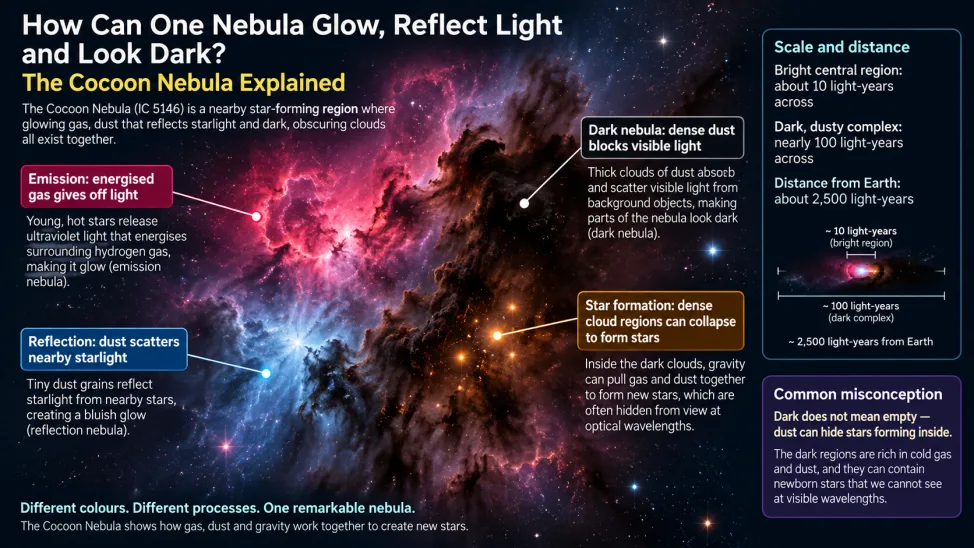
The Cocoon Nebula, catalogued as IC 5146, is a useful natural classroom because several processes that make nebulae visible—or apparently invisible—occur in the same star-forming complex. Some gas glows, some dust scatters nearby starlight, and denser dust blocks visible light from objects behind it.
What is the Cocoon Nebula?
IC 5146 lies in the constellation Cygnus and contains young stars, gas and interstellar dust. NASA's 21 September 2026 Astronomy Picture of the Day describes a bright central region about 10 light-years across alongside a dark dusty complex extending nearly 100 light-years. The wider structure is a star-forming environment rather than a single uniform cloud.
Why does part of the nebula glow?
An emission nebula shines because energetic radiation from hot young stars excites or ionises surrounding gas. In hydrogen-rich regions, electrons can later recombine with hydrogen ions and produce characteristic emission. This is why many stellar nurseries show strong reddish hydrogen emission in visible-light images.
How can dust reflect starlight?
A reflection nebula does not need to generate most of the light we see from it. Fine dust grains scatter light from nearby stars. Shorter visible wavelengths are often scattered efficiently, which can give reflection nebulosity a bluish appearance. A simple analogy is a beam of light becoming visible when it passes through mist: particles redirect some of the light towards the observer.
Why does some of the Cocoon look dark?
Dark regions are not necessarily empty. A dark or absorption nebula contains enough dust to absorb and scatter visible light from stars and bright material behind it. NASA observations of the Cocoon region show that the apparent darkness can conceal stars and star formation. Infrared observations are especially useful because longer wavelengths can reveal structures and young objects that visible light does not show clearly.
How can all three effects exist together?
The labels emission, reflection and dark nebula describe how material interacts with light; they do not require three completely separate objects. Conditions vary across a large molecular cloud. Close to energetic young stars, gas may glow. In another location, dust may scatter stellar light. Along a dense line of sight, dust may instead obscure background light. The Cocoon Nebula therefore demonstrates how geometry, density, temperature, radiation and wavelength influence what astronomers observe.
How do stars form inside dark clouds?
Cold molecular clouds contain gas and dust. Where parts of a cloud become sufficiently dense, gravity can pull material together. The contracting region can develop into a protostar and, eventually, a star if conditions permit. New stars then alter their surroundings through radiation and outflows, so a stellar nursery changes as successive generations of stars develop.
What do astronomers learn by changing wavelength?
Visible-light images show glowing gas, scattered starlight and silhouettes produced by dust. Infrared observations can penetrate or trace dusty regions differently and can reveal embedded young stars. Comparing observations at several wavelengths therefore helps astronomers separate what is truly absent from what is merely hidden.
A common misconception: dark means empty
A black patch in an astronomical image is not automatically empty space. It may be a foreground cloud blocking light from a rich background star field. The Cocoon's obscuring material is an example: dust that makes a region look dark in visible light can be associated with active star formation.
Practical way to read a nebula image
When looking at an astronomical image, ask four questions: What wavelength was used? Is the material producing light or scattering another source's light? Could foreground dust be blocking the background? Do observations at other wavelengths reveal hidden structures? These questions prevent colour alone from being treated as a complete physical explanation.
Key takeaways
- Emission nebulae shine because energised gas emits light.
- Reflection nebulae are visible because dust scatters nearby starlight.
- Dark nebulae can be dense dusty clouds that obscure background visible light.
- One star-forming complex can show all of these effects in different regions.
- Dense dusty regions can hide young stars, so infrared observations add important information.
Frequently asked questions
Is the Cocoon Nebula one type of nebula?
It is better understood as a star-forming complex displaying multiple observational behaviours, including emission, reflection and obscuration by dust.
Why are emission nebulae often red?
Hydrogen emission can be strong at visible red wavelengths when hydrogen gas is excited or ionised by energetic young stars.
Why are reflection nebulae often blue?
Small interstellar dust grains can scatter shorter visible wavelengths efficiently, often producing a blue appearance.
Can stars really form inside regions that look black?
Yes. Dense molecular material can obscure visible light while gravitational collapse and star formation occur within it. Infrared observations can help reveal embedded objects.
Does an astronomical image show what the nebula would look like to the human eye?
Not necessarily. Exposure time, filters, wavelength coverage and image processing all affect the final image. Scientific interpretation depends on the underlying measurements, not colour alone.