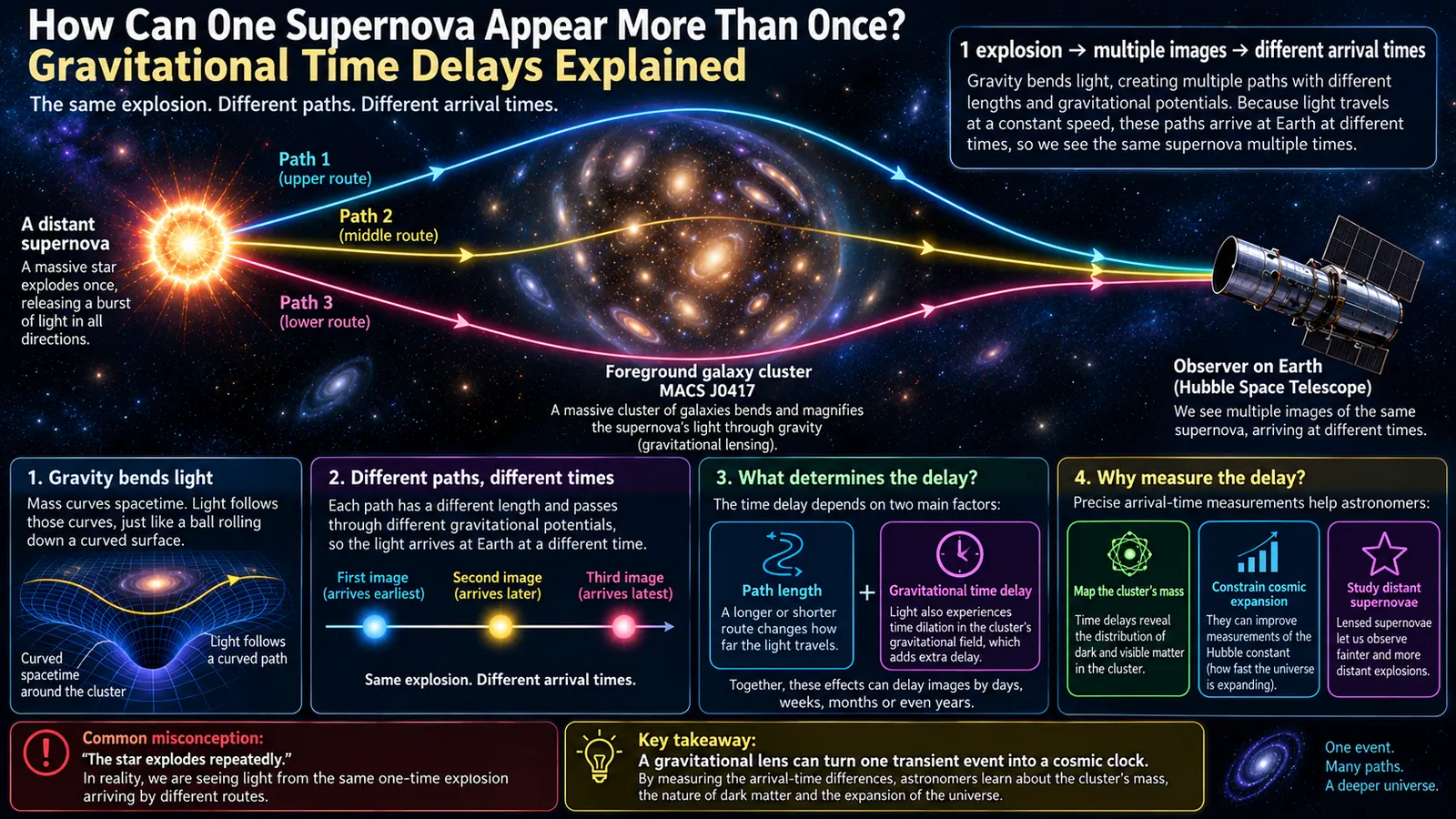
A supernova happens once. Yet under the right cosmic conditions, astronomers can see the same stellar explosion more than once — sometimes separated by months or years.
The reason is gravitational lensing. A massive foreground object, such as a galaxy cluster, curves spacetime and bends light from a much more distant object behind it. If the geometry is favourable, light from one supernova can reach Earth along several different routes. Because those routes are not equivalent, the images do not have to arrive at the same time.
NASA is currently using the Hubble Space Telescope to monitor galaxy cluster MACS J0417 for the predicted reappearance of a supernova nicknamed Athena, discovered by the James Webb Space Telescope in 2025. NASA says another appearance is expected between now and early March 2027.
How can one explosion make several images?
Imagine a distant supernova behind a massive galaxy cluster. The cluster contains galaxies, gas and large amounts of dark matter. Together, that mass warps the surrounding spacetime.
Light normally travels along the straightest possible paths through spacetime, called geodesics. Around a massive lens, those paths are curved. Different bundles of light from the same source can therefore travel around different sides of the cluster and still reach the observer.
The result can be multiple apparent images of the same background source. For a steady galaxy, those images can be visible at the same time. For a transient event such as a supernova, however, the different routes create a particularly useful effect: time delays.
Why do the images arrive at different times?
There are two main reasons.
First, the routes have different geometric lengths. One light path may take a longer journey around the lens than another.
Second, gravity itself affects travel time. Light passing through different gravitational potentials experiences what is often described as a gravitational, or Shapiro, delay. In gravitational-lensing theory, the total delay is described by differences in the lensing system’s Fermat potential, which combines the geometric and gravitational contributions.
The speed of light in vacuum remains the same locally. What differs is the total spacetime route taken by each bundle of light. That is why the same one-time explosion can be observed at different dates.
What is special about supernova Athena?
Athena lies behind the massive cluster MACS J0417, which acts as a natural gravitational lens. Webb discovered the supernova in 2025. Hubble is now repeatedly returning to the same field to look for a predicted later image.
NASA reports that Athena is expected to reappear between the present observing campaign and early March 2027. The exact arrival time matters scientifically because it can be compared with predictions from models of the cluster’s mass distribution.
How can a time delay map invisible mass?
The paths followed by lensed light depend on how mass is distributed in the foreground cluster. That includes both visible matter, such as galaxies and hot gas, and invisible dark matter.
If a model predicts that a delayed image should appear on one date but the actual image arrives noticeably earlier or later, astronomers can adjust the mass model. In this way, measured time delays become an additional constraint on where the cluster’s mass is located and how strongly it bends spacetime.
This is one reason gravitational lenses are sometimes called natural telescopes: they magnify distant objects, but their distortions also encode information about the lens itself.
How can supernova time delays tell us about cosmic expansion?
The measured delay depends not only on the local lens geometry but also on cosmological distances between the observer, lens and source. Those distances depend on how the universe has expanded.
With a sufficiently accurate lens model and well-measured time delays, astronomers can therefore constrain the Hubble constant — the present-day expansion rate of the universe. This method is known as time-delay cosmography.
A single lensed supernova does not determine the expansion rate by itself. Researchers must account for the mass distribution in the main lens, material along the line of sight, the source and lens redshifts, and measurement uncertainties. Combining multiple well-characterised systems improves the method.
Has this happened before?
Yes. A famous example is Supernova Refsdal. Hubble saw multiple images of the same supernova created by a foreground galaxy and galaxy cluster. Lens models predicted that another image should appear later, and Hubble subsequently detected that reappearance.
Refsdal demonstrated that astronomers can use a gravitational lens not just to magnify a supernova but also to predict when another image of that same explosion should become visible.
A simple analogy
Imagine several trains leaving the same station at the same moment and travelling at the same speed to the same destination, but taking different routes through a complicated rail network. The train on the shortest route arrives first; another may take a longer route and arrive later.
Gravitational lensing is more subtle because spacetime itself is curved and the gravitational potential contributes to the delay, but the analogy captures the central idea: one departure, several routes, different arrival times.
Common misconception
Misconception: the supernova is exploding repeatedly.
Reality: the star explodes once. We see different packets of light from that same explosion after they travel along different gravitationally lensed paths.
Why Hubble and Webb are useful together
Webb’s infrared sensitivity helps it find extremely distant and highly redshifted objects, while Hubble can repeatedly monitor the same field in visible and near-infrared wavelengths. Together, observatories with different capabilities can discover lensed transients, monitor their evolution and test predictions about future appearances.
Practical scientific value
Precisely timed lensed supernovae can help astronomers:
- map the distribution of visible and dark matter in galaxy clusters;
- test gravitational-lensing models;
- study a distant supernova at different apparent stages;
- probe otherwise very faint, distant galaxies; and
- constrain cosmological distances and the universe’s expansion rate.
Key takeaways
- A gravitational lens can create multiple images of a single background supernova.
- The images arrive at different times because the light follows different spacetime paths.
- Both geometric path differences and gravitational time delay contribute.
- NASA expects another lensed appearance of supernova Athena between now and early March 2027.
- Measuring the delay can refine the mass map of MACS J0417 and help constrain cosmic expansion.
FAQs
Does gravitational lensing change the speed of light?
No. Light still travels locally at the speed of light in vacuum. The observed delay comes from differences in the curved spacetime paths and gravitational potential encountered along those paths.
Can every supernova appear multiple times?
No. Multiple images require a favourable alignment between the distant supernova, a sufficiently massive foreground lens and the observer.
Why are galaxy clusters such powerful lenses?
Galaxy clusters contain enormous amounts of mass, including dark matter, spread across large regions. Their gravity can strongly bend and magnify light from background objects.
What happens if Athena does not appear when predicted?
That would still be scientifically useful. A mismatch between prediction and observation could indicate that the lens model, mass distribution or other assumptions need refinement.