Artificial intelligence can help researchers and health professionals analyse complex data, identify patterns and support decisions. But a technically impressive model can still cause harm if the surrounding system has weak governance.
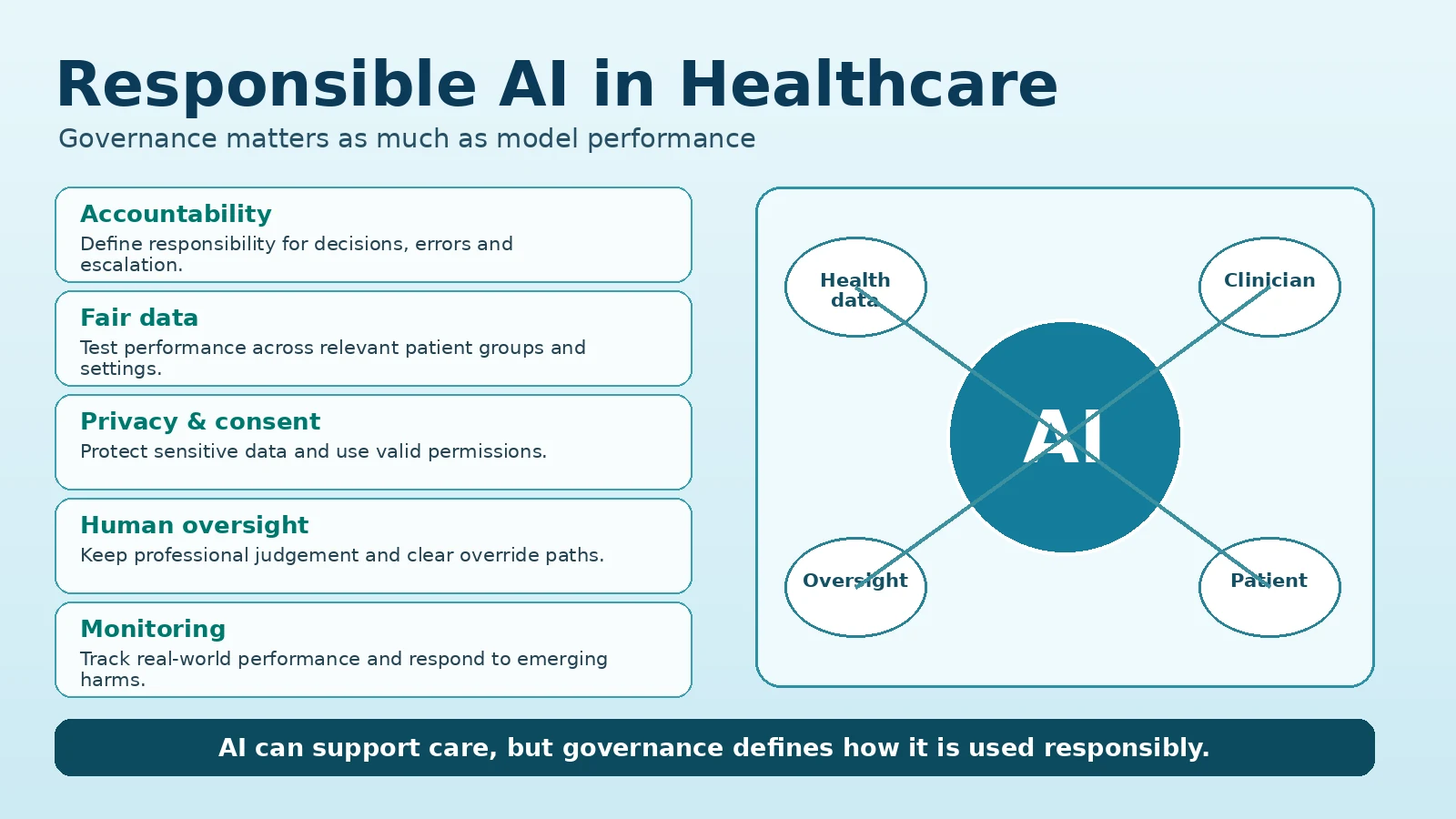
Recent World Health Organization work highlights a central lesson: responsible AI in health requires ethical oversight, clear accountability, appropriate data governance, transparency, human expertise and attention to inequity—not just better algorithms.
What does governance mean in healthcare AI?
Governance is the set of rules, responsibilities and oversight processes that determine how an AI system is developed, tested, introduced, monitored and, when necessary, withdrawn. It asks questions such as: Who is accountable? What evidence is required? Who can access the data? How are patients informed? What happens when the system performs poorly?
Why accuracy is not enough
An average accuracy score can hide important differences between patient groups. A model trained on fragmented or unrepresentative data may work less reliably for populations that were poorly represented. Even a high-performing model can be unsafe if users misunderstand its limits or if no one is clearly responsible for acting on errors.
Data, privacy and consent
Health data are particularly sensitive. Responsible systems need lawful and ethical data access, appropriate consent or other valid governance mechanisms, security controls and clear limits on secondary use. Researchers also need to consider whether benefits and burdens are distributed fairly.
Human oversight and accountability
AI outputs should be interpreted within the clinical or research context. Governance should define when human review is required, who can override an automated recommendation, how incidents are reported and how performance is monitored after deployment.
Why low-resource settings need special attention
WHO highlights risks including power imbalances, limited oversight capacity, inequitable benefit sharing and the possibility that systems developed elsewhere may be deployed without adequate local validation. Responsible adoption therefore requires local participation and capacity building, not simply importing a model.
AI literacy matters
Clinicians, researchers, managers and patients need enough understanding to ask sensible questions about evidence, limitations, privacy and accountability. AI literacy does not mean everyone must become a machine-learning engineer; it means people should understand what a system can and cannot establish.
Common misconception
Misconception: removing a human from the decision makes healthcare AI more objective. Reality: AI systems reflect choices about data, objectives, thresholds and deployment, so responsible human governance remains essential.
Key takeaways
- Model performance is only one part of responsible healthcare AI.
- Governance should establish accountability, oversight, transparency and monitoring.
- Biased or fragmented datasets can create unequal performance.
- Patients and clinicians should be involved in the design and deployment of systems that affect them.
FAQs
Does responsible AI mean avoiding AI in healthcare?
No. It means matching use to evidence, safeguards and context while monitoring benefits and harms.
Can governance eliminate every AI risk?
No. Governance cannot remove all uncertainty, but it can make risks visible, assign responsibility and create processes for prevention, monitoring and correction.