Most complex cells do not cope well with extreme heat. Proteins can lose their shape, membranes can become unstable, and genetic material can suffer damage. Yet a newly described amoeba from the geothermal waters of California’s Lassen Volcanic National Park has pushed the known heat limit for eukaryotic life higher than scientists had previously confirmed.
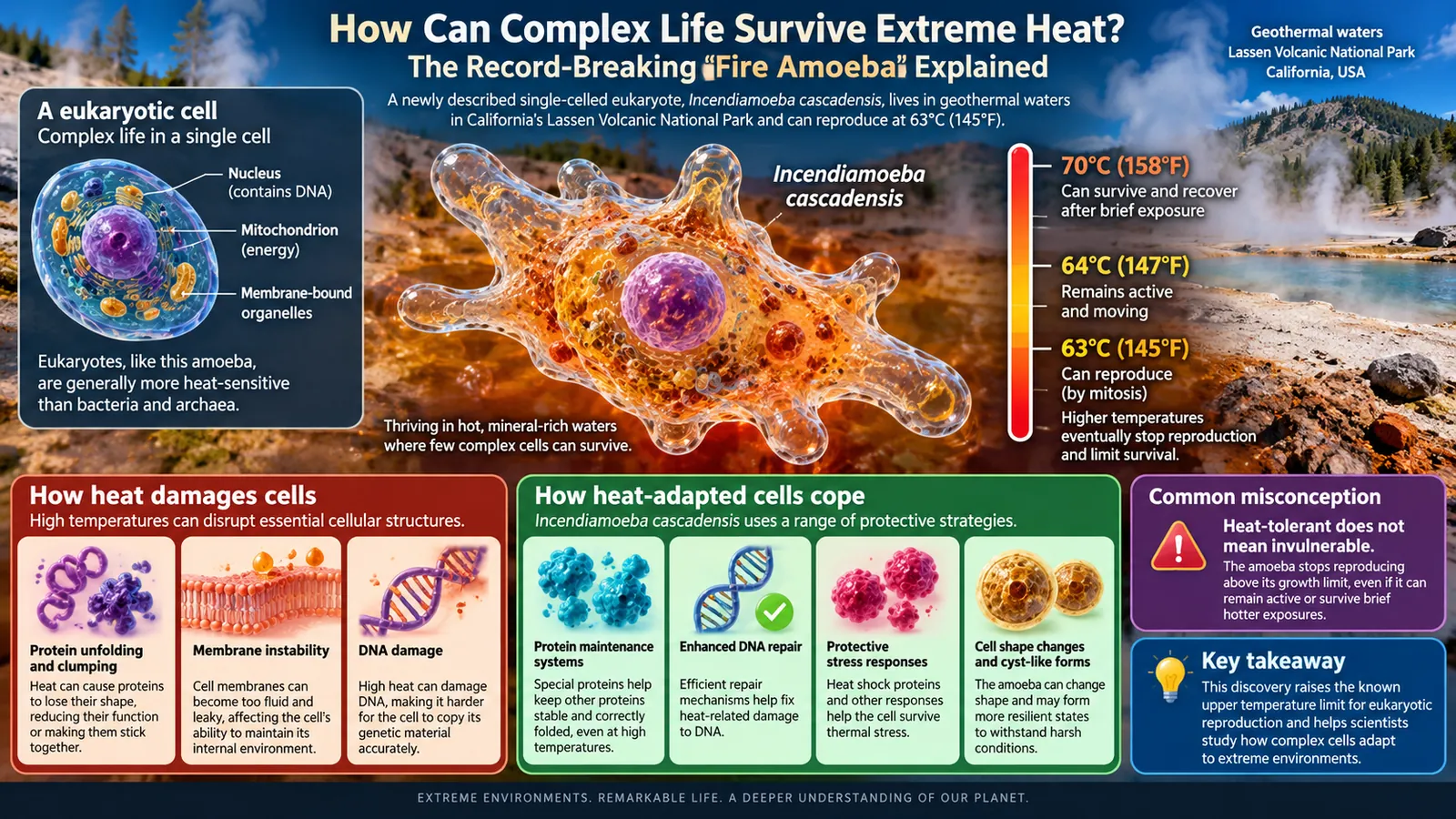
The organism is Incendiamoeba cascadensis, nicknamed the “fire amoeba”. NASA-supported research reports that it can reproduce by cell division at 63°C (145°F), remains active and moving at still higher temperatures, and can recover after a brief exposure to 70°C (158°F).
Why is this discovery unusual?
I. cascadensis is a eukaryote. Eukaryotic cells contain a nucleus that encloses their DNA and membrane-bound structures such as mitochondria and the endoplasmic reticulum. Animals, plants, fungi, algae and many single-celled organisms are eukaryotes.
That internal complexity gives eukaryotic cells many capabilities, but it also creates more structures that high temperatures can damage. Before this study, the experimentally demonstrated upper limit for eukaryotic reproduction was about 60°C in a few fungi and red algae. The fire amoeba raises that confirmed reproductive limit to 63°C.
What exactly can the fire amoeba tolerate?
The temperature figures describe different biological outcomes, so they should not be treated as interchangeable.
- 63°C: the amoeba can reproduce by mitosis.
- 64°C: reproduction stops, but cells can still move and search for food.
- About 66°C: NASA reports that cells can remain partially active when pushed further in laboratory tests.
- 70°C: cells can recover after a five-minute exposure when returned to more favourable conditions.
- 80°C: the cells did not recover in the reported experiments.
This distinction matters. Surviving a short exposure is not the same as growing normally, and remaining active is not the same as reproducing.
How does heat damage cells?
Proteins can unfold
Proteins depend on precise three-dimensional shapes. Heat increases molecular motion and can disrupt the weak chemical interactions that help proteins keep those shapes. A protein that unfolds may stop working or stick to other damaged proteins.
Membranes can become unstable
Cell membranes are built largely from lipids and proteins. Heat can make them too fluid and leaky, making it harder for cells and organelles to control what moves in and out.
DNA and other molecules can be damaged
High temperatures can increase chemical damage to DNA and interfere with replication, repair and gene regulation. Eukaryotic cells must protect both their nuclear DNA and the machinery used to copy and express it.
How does Incendiamoeba cascadensis cope?
The researchers sequenced the amoeba’s genome and examined gene activity at different temperatures. NASA reports several strategies that may contribute to its heat tolerance.
DNA protection and repair
The amoeba has genes involved in stabilising DNA and protecting it from breakdown. Reliable repair systems become especially important when heat increases molecular damage.
Protein-folding maintenance
At high temperatures, expression increases for genes involved in maintaining correct protein folding. Cells use specialised proteins, including molecular chaperones, to help other proteins fold correctly or recover from stress.
Heat-stable proteins
Some proteins in the amoeba have unusually high positive surface charge. The researchers suggest that this may help them remain stable at high temperature. Similar features occur in heat-adapted bacteria and archaea.
Changes in cell state
Independent reporting on the study describes the amoeba changing shape and forming protective states when conditions become too hot for normal growth. Such changes can reduce activity while helping a cell endure a short period of severe stress.
Does this mean eukaryotes can live anywhere hot?
No. Temperature is only one part of habitability. A cell also needs suitable water availability, acidity, oxygen conditions, pressure, nutrients and ecological partners.
NASA notes that I. cascadensis depends on other organisms in its environment for food. Its heat tolerance therefore does not mean it could survive alone in every hot environment on Earth—or on another world.
Why did this challenge a proposed membrane limit?
Scientists had suggested that eukaryotic organelle membranes might become too unstable above roughly 62°C. The amoeba’s ability to divide at 63°C demonstrates that this proposed limit was not universal.
That does not make membranes immune to heat. Instead, it shows that evolution can produce combinations of membrane composition, protein stability, repair systems and stress responses that keep a complex cell functioning under conditions once thought too hot.
What does this teach us about evolution?
Extremophiles show how natural selection can reshape cellular systems around severe environmental pressures. If survival depends on functioning at high temperature, variants that stabilise proteins, preserve membranes or repair DNA more effectively can provide a strong advantage.
The researchers also found related DNA sequences in geothermal datasets from places including Yellowstone National Park and New Zealand. That suggests relatives of the fire amoeba may exist in other hot environments and that the upper temperature limit of eukaryotic life may still not be fully known.
Why is NASA interested?
Astrobiology studies the limits of life on Earth partly to guide the search for life elsewhere. If scientists underestimate what terrestrial organisms can tolerate, they may also underestimate the range of extraterrestrial environments worth investigating.
The fire amoeba does not prove that complex life exists beyond Earth. It expands the experimentally demonstrated range of conditions in which complex cells can function and helps researchers refine ideas about habitability.
Could heat-adapted biology have practical uses?
Potentially. Heat-stable proteins and enzymes can be useful in biotechnology because industrial processes often operate under conditions ordinary biological molecules cannot tolerate. Research on thermophiles has previously supplied valuable enzymes for laboratory and industrial use.
Possible applications from I. cascadensis are still a research question. Its immediate significance is scientific: it gives researchers a new system for studying how eukaryotic cells maintain complex machinery at extreme temperatures.
Common misconception
Misconception: because the fire amoeba can recover after 70°C exposure, it grows normally at 70°C.
Reality: its demonstrated reproductive limit is 63°C. Above that temperature, reproduction stops. The amoeba can remain active somewhat higher and recover from a short 70°C exposure, but those are different levels of heat tolerance.
Key takeaways
- Incendiamoeba cascadensis is a newly described heat-loving eukaryotic amoeba from Lassen Volcanic National Park.
- It can reproduce at 63°C, raising the confirmed upper temperature limit for eukaryotic reproduction.
- It remains active above its reproductive limit and can recover after a five-minute exposure to 70°C.
- Genome evidence points to DNA protection, protein-folding maintenance and heat-stable proteins as important adaptations.
- The discovery helps scientists study the biochemical limits of complex cells and refine ideas about habitability on Earth and beyond.
FAQs
What is a eukaryote?
A eukaryote is an organism whose cells contain a nucleus and membrane-bound organelles. Animals, plants, fungi and many single-celled organisms are eukaryotes.
Is the fire amoeba multicellular?
No. It is a single-celled organism. “Complex life” here refers to eukaryotic cellular organisation, not necessarily to having many cells.
What is a thermophile?
A thermophile is an organism adapted to live and reproduce at high temperatures. NASA describes organisms that replicate, move, eat and survive above 45°C as true heat-loving thermophiles.
Can the amoeba survive boiling water?
No evidence shows that. In the reported experiments it could recover from five minutes at 70°C, but 80°C was too hot for recovery. Boiling water at standard atmospheric pressure is 100°C.