
Earth has a centre of shape, but it also has a centre of mass: the balance point of all the mass in the planet and its fluid envelopes. Geodesists call this point the geocentre.
The geocentre does not stay perfectly fixed relative to Earth's geometric centre. Water, ice and air move around the planet through the seasons, shifting the balance point by several millimetres.
Centre of shape versus centre of mass
The geometric centre depends on Earth's shape. The centre of mass depends on where the planet's mass is distributed.
If mass moves from one region to another, the balance point changes slightly even though the planet itself has not moved kilometres through space.
A simple balance analogy
Imagine a ball balanced on a point. If its material is distributed evenly, the balance point lies near the centre. Add extra mass to one side and the balance point shifts slightly toward that side.
Earth behaves in a more complicated three-dimensional way, but the principle is similar.
What moves mass around Earth?
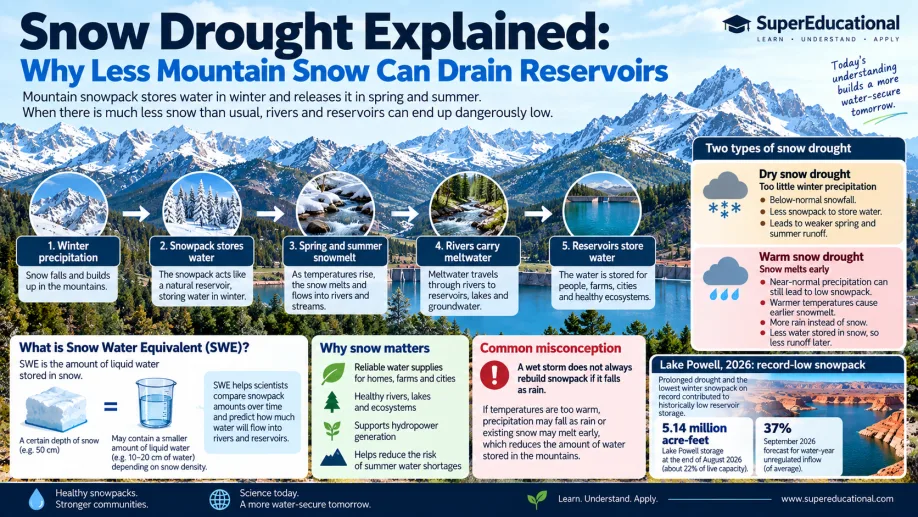
- Snow and ice: seasonal accumulation stores water on land, then melting returns it to rivers and oceans.
- Continental water: rivers, lakes, groundwater and soil moisture move large amounts of water.
- Oceans: currents and sea-level changes redistribute mass.
- Atmosphere: moving air masses change where atmospheric mass is concentrated.
Why are the shifts seasonal?
Winter snow accumulation in one hemisphere stores more water on land. Spring melt transfers some of that mass into rivers and oceans. Weather patterns continuously move atmospheric mass, while ocean circulation redistributes seawater.
These changes repeat in seasonal patterns, though weather, climate and long-term trends also affect them.
Why do satellites care?
Satellite orbits and ground measurements need a stable reference frame. The geocentre is a fundamental origin for precise Earth-coordinate systems.
If scientists want to measure land elevation, sea level or satellite position to millimetre-level accuracy, they must know where Earth's centre of mass is.
How is the geocentre measured?
Space-geodetic techniques such as satellite laser ranging, GNSS, very long baseline interferometry and other global observing systems contribute to terrestrial reference frames.
Different methods have different strengths. Combining them helps scientists estimate Earth's shape, rotation and centre of mass more accurately.
Does this mean Earth is wobbling off-centre?
No. The shift discussed here is tiny—only millimetres. Illustrations usually exaggerate the distance so the concept can be seen.
Why millimetres matter
A few millimetres may sound insignificant, but modern geodesy measures changes at that scale. Errors in the reference origin can propagate into measurements of sea-level change, ice-sheet height and crustal motion.
Key takeaways
- The geocentre is Earth's centre of mass.
- It differs conceptually from the geometric centre.
- Moving water, ice and air can shift the geocentre by millimetres.
- Precise satellite navigation and Earth measurements depend on an accurate geocentre.
Frequently asked questions
Can people feel the geocentre shift?
No. The movement is far too small to be felt.
Does the geocentre shift change Earth's orbit around the Sun?
The seasonal internal redistribution described here is tiny compared with Earth's planetary motion and does not mean Earth suddenly leaves its orbit.
Why not just use Earth's geometric centre?
Satellite dynamics are governed by gravity, which is tied to mass distribution, so the centre of mass is the physically relevant reference point.
Authoritative references
- NASA — Earth geodesy and geocentre research.
- International Earth Rotation and Reference Systems Service — terrestrial reference frames.