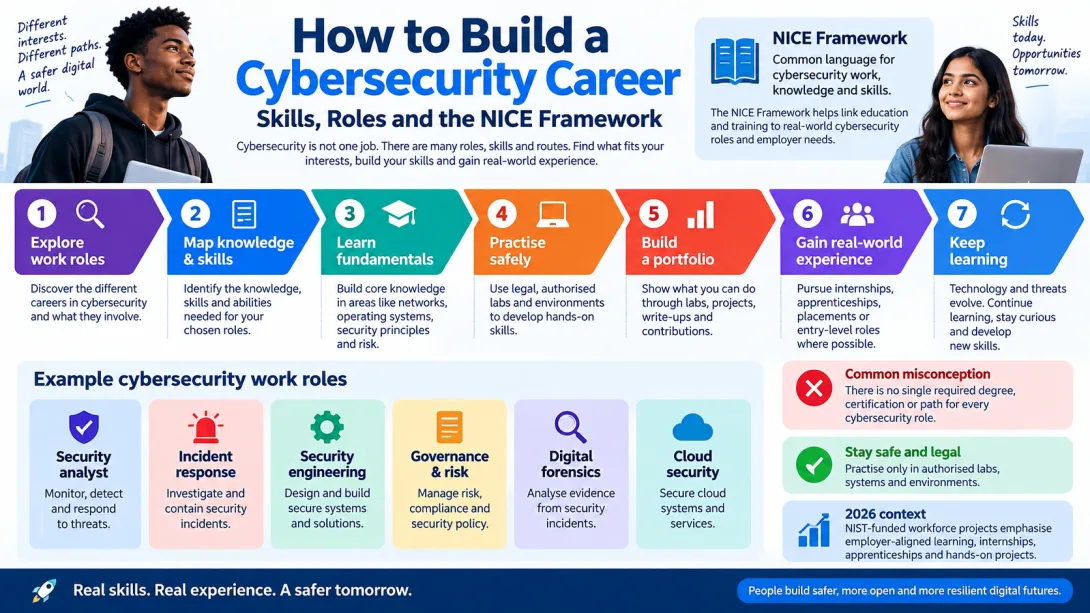
“Cybersecurity” describes a wide range of jobs rather than one career. Security analysts, incident responders, engineers, risk specialists, cloud-security professionals and digital-forensics practitioners solve different problems and need different combinations of knowledge and skills.
A useful way to plan a cybersecurity career is to start with the work you want to do, then map the knowledge and skills needed for that work.
What is the NICE Framework?
The NICE Workforce Framework for Cybersecurity, maintained by NIST, provides a common language for describing cybersecurity work and the knowledge and skills associated with it.
It helps employers, educators and learners talk about cybersecurity roles more consistently.
Step 1: Explore work roles
Before choosing a certification or course, explore different kinds of cybersecurity work.
- Security analysis: monitoring and investigating threats.
- Incident response: containing and recovering from security incidents.
- Security engineering: designing and building secure systems.
- Governance and risk: managing policy, compliance and organisational risk.
- Digital forensics: analysing evidence after incidents.
- Cloud security: protecting cloud platforms and services.
Step 2: Map the knowledge and skills
Once a role interests you, identify the technical and non-technical abilities that role requires. The NICE Framework can help structure this research.
Common foundations include networking, operating systems, identity and access, basic scripting, security principles and risk awareness.
Step 3: Learn the fundamentals
A strong foundation makes advanced tools easier to understand. Learn how computers communicate, how operating systems manage users and processes, and how common security controls reduce risk.
Step 4: Practise safely and legally
Hands-on experience is valuable, but it must be authorised. Use training labs, capture-the-flag environments, intentionally vulnerable practice systems and machines you own or have explicit permission to test.
Never test systems without authorisation.
Step 5: Build evidence of competence
A portfolio can show what you can do. Useful evidence may include documented labs, scripts, defensive projects, write-ups, diagrams, threat-analysis exercises or contributions to legitimate open-source projects.
Step 6: Gain real-world experience
Internships, apprenticeships, placements, entry-level IT roles and supervised projects can provide context that isolated study cannot.
NIST's 2026 workforce projects emphasise employer-aligned learning and practical pathways including internships, apprenticeships and hands-on projects.
Step 7: Keep learning
Threats, platforms and defensive methods change. Cybersecurity careers require continuing learning rather than a one-time qualification.
Do you need a degree?
There is no single universal requirement for every role. Some employers prefer or require a degree for certain positions; others place more weight on experience, certifications, portfolios or apprenticeships.
Choose education and credentials based on the requirements of the roles and employers you are targeting.
Common misconception
“There is one correct cybersecurity path.” No. Different roles value different skills, and people enter the field through university, vocational study, IT experience, certifications, apprenticeships, self-study or combinations of these.
Key takeaways
- Cybersecurity is a collection of work roles, not one job.
- The NICE Framework helps describe cybersecurity work and required skills.
- Learn fundamentals before specialising.
- Practise only in authorised environments.
- Build evidence through projects and labs.
- Internships and apprenticeships can provide valuable real-world experience.
Frequently asked questions
Which cybersecurity job is best for beginners?
There is no universal answer. Start by comparing roles with your interests and current skills.
Do I need to know programming?
It depends on the role. Basic scripting is useful in many areas, while some engineering roles require deeper programming skills.
Are certifications required?
Some employers value or require particular certifications, but there is no certification required for every cybersecurity job.
Authoritative references
- NIST — NICE Workforce Framework for Cybersecurity.
- NIST — Cybersecurity Workforce Development, September 2026.