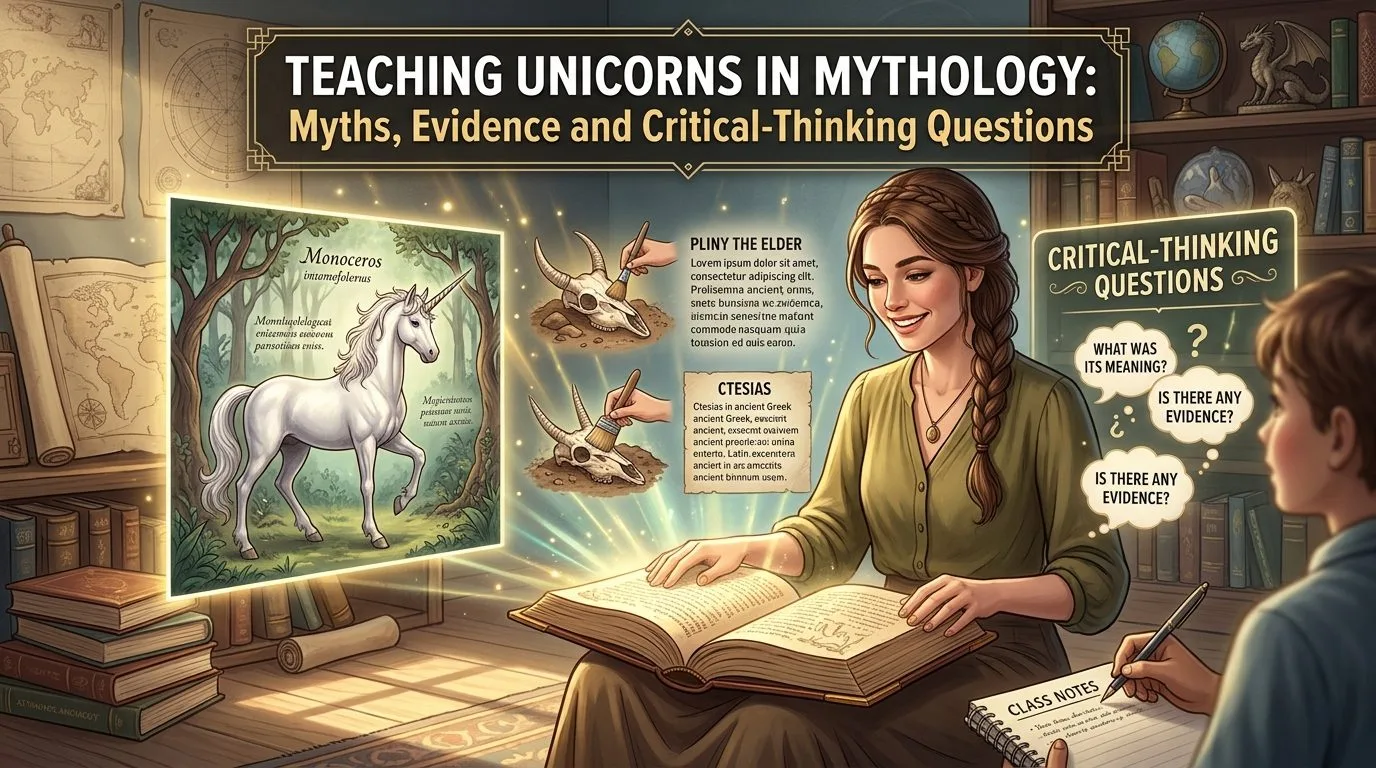
How can teachers use unicorns in mythology to teach critical thinking? Start with a question that has more than one meaning: What counts as evidence that a unicorn existed? An ancient carving proves that people represented a one-horned animal. A medieval manuscript shows what some writers believed or wanted to teach. A real narwhal tusk explains why later audiences accepted supposed “unicorn horns”. None of those sources, by itself, demonstrates that a magical horse-like species once lived. Asking students to explain that distinction turns an engaging legend into a lesson in history, science, evidence and interpretation.
This teaching unicorns in mythology guide offers a classroom-ready inquiry for teachers, parents and informal educators. Learners compare five evidence sets, practise sourcing and corroboration, evaluate confident-sounding claims and write a reasoned conclusion. The approach is adaptable for upper-primary, secondary and general-interest groups; a suggested two-lesson structure uses two 40–45-minute sessions or one longer workshop. It builds on the Digital Inquiry Group's historical inquiry methods and the US National Archives' document-analysis worksheets .
What students should learn: lesson objectives and key vocabulary
By the end of the lesson, learners should be able to:
- Identify a source's creator, date, place and purpose before using it as evidence.
- Distinguish evidence that a belief or image existed from evidence that an actual animal existed.
- Compare representations from different cultures without assuming they describe the same creature.
- Explain the difference between a surviving original object, a later report of an earlier text and a modern scholarly interpretation.
- Make a carefully qualified claim using at least two named sources, including limits or uncertainties.
| Term | Classroom-friendly meaning |
|---|---|
| Myth | A culturally meaningful narrative; it should not automatically be equated with a simple lie |
| Legend | A story passed down or retold, often connected with places, people or extraordinary events |
| Primary source | Material produced within the period or context being studied, such as a seal or tapestry |
| Secondary source | A later study, catalogue or explanation interpreting historical evidence |
| Claim | An assertion that someone asks us to accept |
| Evidence | Information or material relevant to evaluating a specific claim |
| Corroboration | Comparing independent sources to check how well a claim is supported |
| Contextualisation | Understanding a source in relation to its time, place and intended audience |
| Inference | A conclusion drawn from evidence, with its uncertainty acknowledged |
Explain that a source may be excellent evidence for one question and poor evidence for another. An illuminated image can reliably show a particular artistic convention, but it is not automatically a reliable description of an animal's anatomy.
Before teaching: five evidence sets to prepare
Select five source stations with a short caption, an accessible image or excerpt where available, and a clearly identified institution. Teachers should use the linked museum pages directly or follow the museums' reuse terms when printing images. Do not present an AI-generated unicorn picture as a newly discovered ancient artefact. The purpose is to compare real records and their interpretations.
| Station | Evidence and source | Question it helps answer |
|---|---|---|
| A. Ancient image | Metropolitan Museum of Art: Indus “unicorn” seal , c. 2600–1900 BCE | Did ancient people depict a one-horned animal? |
| B. Ancient written report | Scholarly assessment of Ctesias' On India , reporting a fourth-century BCE account | What kind of animal did a Greek writer describe, and how did he know? |
| C. Medieval allegory | Getty Museum: unicorn from the Ashmole Bestiary , c. 1210–1220 | How could an animal image communicate religious meaning? |
| D. Medieval artwork | The Met: The Unicorn Rests in a Garden , c. 1495–1505 | What can a tapestry reveal about elite tastes and symbolism? |
| E. Real animal specimen | Walters Art Museum: narwhal tusk , a modern museum specimen | What natural object could be mistaken for a mythical horn? |
Important dating distinction: Station E's museum specimen is a real narwhal tusk, not a documented medieval purchase. It can show what such a tusk physically is; separate historical records are needed to discuss medieval trade. The Met's explanation of narwhal tusks and unicorn legend supplies that historical context.
Station A: the Indus Valley unicorn seal
The Metropolitan Museum of Art catalogues a stamp seal and modern impression depicting an animal described as a “unicorn”, along with another feature cautiously labelled an incense burner with a question mark. The seal is dated to the Mature Harappan period, approximately 2600–1900 BCE. Its animal has one visible forward-projecting horn in profile.
Start with observation: What lines and shapes are visible? How many horns can students actually see? Are they certain a second horn could not be hidden by the perspective? What else appears beside the animal? Then inspect the museum catalogue, which notes that the Indus script remains undeciphered. The image's precise meaning is not settled. A profile drawing is evidence of an ancient motif; it does not prove that the animal was a living horse-like unicorn.
Critical-thinking question: If the seal was made long before European bestiaries, does that prove medieval European artists copied it? No. A similar image is not enough to establish a chain of communication across cultures and millennia. To argue for direct transmission, historians would need additional connected evidence.
Station B: Ctesias and the one-horned Indian wild ass
The Greek physician and writer Ctesias described an extraordinary animal from India in the fourth century BCE. Surviving accounts associated with his lost Indica describe a wild ass with a single horn and the belief that vessels made from the horn could protect against poisoning. Ctesias did not leave a modern field record supported by a verified specimen, and the work survives through later transmission.
Students should not treat a modern scholarly summary as Ctesias' original manuscript. The Bryn Mawr Classical Review notes that Ctesias transmitted much of what he heard and did not himself travel to India. More recent work in The Classical Quarterly examines the changing tradition around the one-horned ass and its reputed powers.
Ask: Who wrote the story? What was the author's access to the animal? What was reported by others? What additional evidence would change our confidence? One plausible hypothesis is that reports of real rhinoceroses or other unfamiliar animals contributed to the narrative. But competing hypotheses must be labelled as interpretations, not settled identification.
Station C: the medieval bestiary and its symbolic purposes
Medieval European bestiaries mixed descriptions of animals with moral and religious teaching. The Getty Museum displays a unicorn illustration from the Ashmole Bestiary, an English manuscript dated to about 1210–1220. Medieval versions often tell of an elusive unicorn captured through its encounter with a maiden.
The Getty explains that the unicorn could represent Christ, the maiden the Virgin Mary, and the animal's death elements of Christian theology. This interpretation is a cultural and religious explanation, not a claim that every medieval reader understood the story in exactly the same way.
Let students compare the illustration with the Greek animal report. The texts differ in audience, purpose and depiction. A work intended to teach an allegory is not trying to solve the same problem as a modern zoological classification guide. One of the best questions here is: What could this document teach us even if the creature is fictional? It could reveal how imagery helped communicate values within a particular community.
Use the Getty's introduction to bestiaries for the historical background. Educators should invite respectful discussion of religious symbolism without demanding that students adopt or reject a belief.
Station D: interpreting the Unicorn Tapestries
The Unicorn Tapestries at The Met Cloisters, generally dated to 1495–1505, are surviving works of richly detailed late-medieval art. One scene, The Unicorn Rests in a Garden, shows the unicorn enclosed in a flowery setting. Other hangings portray a hunt. The Met notes the possibility of both religious and secular meanings and cautions that the series' original intended significance is not fully known.
Give students two plausible interpretations: the animal as a religious symbol, or the animal as part of courtly romance and elite visual culture. Then ask them to support each interpretation with specific visual details and catalogue evidence rather than intuition alone. It is acceptable for the best conclusion to be: “Both readings are possible, but the available evidence does not establish one exclusive meaning.”
Compare the richly decorated tapestry with the small Indus seal. They are both primary artefacts for their own times, but they come from different societies, materials and contexts. Similar unicorn labels in modern museum descriptions do not make their creators' intentions identical. Read the Met's exhibition background alongside the catalogue.
Station E: narwhal tusks and the difference between legend and specimen
A narwhal is a real Arctic whale. Its long, spiralled “horn” is actually a specialised tooth. Narwhal tusks entered European collections and trade, where some were presented as supposed unicorn horns. This historical association is documented by the Natural History Museum and The Met .
Show the museum specimen and ask: Is the object itself real? Yes. Does the label “unicorn horn” establish that it came from a horse-like creature? No. What other evidence determines biological identity? Comparative anatomy, zoological observations and evidence linking tusks to narwhals.
This source is especially useful for separating misidentification from deliberate fabrication. An object can be authentic while a story about its origin is mistaken. Students can also discuss how access to geographical information, trading networks and scientific knowledge may influence what people believe.
A two-lesson plan: research, compare and justify
The following timetable is a suggested teaching plan, not a tested universal lesson duration. Use two sessions of approximately 40–45 minutes. Provide source captions and shorter extracts for younger learners; older students can inspect the complete catalogues or scholarly discussions.
| Time | Teaching step | Student product |
|---|---|---|
| Lesson 1, 0–5 min | Display a modern unicorn illustration beside the Indus seal; ask what each can prove | One initial claim and one question |
| 5–12 min | Teach primary versus secondary source, sourcing and historical context | Vocabulary annotations |
| 12–37 min | Five stations, about five minutes each; small-group rotation | Completed evidence log |
| 37–45 min | Students select the strongest source for a specific question | Short evidence-based justification |
| Lesson 2, 0–10 min | Review source findings; compare discrepancies | Revised evidence rankings |
| 10–25 min | Group discussion or structured debate of claims | Claim-evidence-reasoning response |
| 25–38 min | Individual paragraph, poster or audio explanation | Assessable final product |
| 38–45 min | Exit questions, feedback and reflection | Brief assessment |
The routines reflect the Digital Inquiry Group's sourcing, contextualisation, close-reading and corroboration approach . The Library of Congress also recommends observing, reflecting and questioning sources before drawing conclusions.
Printable source-analysis worksheet
Students can copy this table into notebooks or a shared document. A source may support more than one kind of claim, but the explanation must be specific.
| Prompt | My notes |
|---|---|
| Source title / museum | ________________________ |
| Who made it, or who is reporting it? | ________________________ |
| Approximate date and place | ________________________ |
| What do I directly observe or read? | ________________________ |
| What does the source claim? | ________________________ |
| What could it reliably prove? | ________________________ |
| What cannot it prove? | ________________________ |
| What other independent source would help? | ________________________ |
| My confidence: high / moderate / low, and why | ________________________ |
Before students work alone, model one completed row. For example: “The Met's Indus seal is strong evidence that an ancient community made a one-horned animal image. It is not direct evidence that a horse with a magical horn existed.” This is not a statement that the artefact is unimportant: it is a precise statement about what question the artefact answers.
Eight critical-thinking questions for discussion
- What does “real unicorn” mean? Does it mean a real work of art, a historical belief, a real single-horned animal, or a supernatural horse? Why must we define the claim first?
- Which evidence is earliest? Does the oldest surviving image necessarily reveal the first person to imagine a creature?
- Who had firsthand knowledge? How does a report repeated from a traveller differ from a documented animal specimen?
- Could two similar traditions be independent? What is needed before claiming a direct link between Indus, classical and medieval imagery?
- What is a museum label? Is the museum's modern description itself an ancient primary source, or is it interpretation of a historical object?
- Does repetition make a story true? If three authors copy the same earlier writer, have they independently corroborated the story?
- Can a mistaken explanation involve a genuine object? How does a narwhal tusk demonstrate the difference?
- What would change your mind? What kind of animal remains, consistent anatomical evidence or reproducible observations would be needed to support a proposed new species?
Rather than rewarding the quickest answer, invite students to say “the source shows…”, “this suggests…”, “this does not establish…”. These phrases build habits of proportional reasoning.
Classroom exercise: match each claim to the right evidence
Present these claims, then ask students which source could reasonably support them:
| Claim | Reasonable evaluation |
|---|---|
| “People in the Indus civilisation represented a one-horned animal.” | Supported: the dated seal records the motif |
| “The Indus seal proves the medieval European unicorn came from India.” | Not established: evidence of a continuous connection is missing |
| “Some medieval European texts gave unicorns religious meaning.” | Supported: bestiary imagery and texts document that interpretation |
| “Every medieval person believed unicorns were living animals.” | Overgeneralised: belief differed among audiences and contexts |
| “Some supposed unicorn horns were narwhal tusks.” | Supported: museum collection and trade history provide examples |
| “Narwhal tusks prove the legendary unicorn existed.” | Unsupported: they are whale teeth |
| “A tapestry can show medieval beliefs even if the animal is imaginary.” | Supported: the artefact documents choices by patrons and makers |
Have students separate the labels supported, contradicted, unproven and too broad. An unsupported statement is not always shown to be false; sometimes the present evidence simply does not answer it. That nuance is central to responsible historical reasoning.
Answer guidance: sample claim-evidence-reasoning paragraph
Claim: Historical unicorn imagery is well documented, but there is no confirmed zoological evidence for the magical horse-like animal of modern legend.
Evidence: The Met holds an Indus seal dated around 2600–1900 BCE showing a one-horned animal motif, and medieval museums preserve bestiary illustrations and unicorn tapestries. Separately, narwhal tusks can be identified as teeth from a known whale species even though some were historically sold as unicorn horns.
Reasoning: The ancient and medieval objects show that people made, shared and interpreted unicorn images. The tusks show how genuine natural specimens could support a mistaken explanation. None of these records directly identifies a living species matching the legendary creature. This conclusion can change if sufficiently strong new zoological evidence emerges, but it is the position supported by the evidence currently described.
Encourage learners to improve this paragraph by adding exact dates, a creator or institution for each item, a meaningful counterargument and one limitation. Avoid presenting the sample as the only acceptable wording.
Suggested rubric: assess reasoning, not memorisation
| Criterion | Points | What earns full credit? |
|---|---|---|
| Source identification | 0–2 | Correctly names at least two source creators or holding institutions and dates/context |
| Evidence accuracy | 0–2 | Uses details that the chosen sources actually support |
| Interpretation and limits | 0–2 | Clearly distinguishes a belief, depiction or report from biological proof |
| Corroboration | 0–2 | Compares sources rather than counting dependent retellings as independent evidence |
| Clarity and respectful discussion | 0–2 | Makes a coherent argument and discusses different cultural traditions fairly |
Total: 10 points. Allow oral presentations or accessible formats to demonstrate the same reasoning. Grade the evidence and argument, not whether a learner likes fantasy stories.
Adapt the lesson for different learners
Younger students or beginners
Use three stations instead of five: the seal, the tapestry and the narwhal tusk. Provide short captions, large images and sentence starters such as “I can see…” and “This source cannot tell me…”. Replace longer scholarly text with a teacher-written, clearly attributed summary and ask for one supported claim.
Older students
Add the source-transmission problem around Ctesias: the original Indica is lost, and later writers preserve descriptions attributed to it. Ask whether two later accounts drawing on the same source are independent. Advanced groups may compare different scholarly interpretations of the tapestries and explain why ambiguity persists.
Inclusive discussion
Invite students to share other cultural stories of one-horned or composite creatures when they have trustworthy sources, but do not collapse the Chinese qilin, Indus animal and European unicorn into a single undifferentiated myth. If a learner belongs to a tradition under discussion, do not make them a spokesperson for it. Focus the assessment on sources and reasoning.
Limited internet or classroom equipment
Display museum pages on one device, prepare accessible short text descriptions or use legally reusable images according to the holding institution's rights statement. Students can analyse source descriptions if images are unavailable. A paper evidence log works as well as a digital one.
How to teach the difference between history and science
Historians and scientists both value evidence, but they may ask different questions. The historical question “Did people imagine and represent unicorns?” can be answered with dated artefacts and texts. The zoological question “Did a horse-like species with a supernatural horn exist?” requires evidence such as identifiable specimens, anatomical remains or credible repeated observations. An ancient author making a claim is part of the first investigation; it is not automatically a successful answer to the second.
Real animals with one prominent horn or tusk exist or have existed, including rhinoceroses and narwhals. Their presence makes certain sources understandable without proving every detail of the legend. For additional biological context, SuperEducational's animal classification guide explains how modern zoology groups real animals using observable characteristics.
The strongest educational message is neither “old people believed anything” nor “all myths are secretly factual”. It is that historical images, symbolic narratives, trade objects and zoological evidence each have different evidential strengths.
A useful extension: test an AI-generated “unicorn discovery” claim
Show learners a clearly labelled fictional social-media example: “Scientists have found proof of unicorns; see this amazing picture!” Make the visual obviously illustrative, not a fabricated museum finding. Ask students to identify the missing evidence: a named institution, a published scientific report, a specimen with provenance and independent verification.
Have them search for an original source instead of trusting a screenshot, a sensational headline or a realistic-looking generated picture. The Digital Inquiry Group's digital-literacy history lessons and the National Archives' teaching-with-documents resources support this broader evidence-evaluation habit.
Students should label illustration, reenactment, museum object, photograph and AI-generated scene accurately. The ability to separate a persuasive image from its evidential basis applies well beyond mythology.
Frequently asked questions about teaching unicorn mythology
What age group is this lesson for?
It is adaptable for upper-primary and secondary students or an adult general-interest group. Younger learners can work with three visual sources; older learners can examine written transmission, contested interpretation and source independence.
Can a unicorn myth be a valid topic for science class?
Yes, if the learning aim is explicit: evaluating biological claims, identifying natural specimens and distinguishing evidence from speculation. The cultural interpretation itself also belongs in history, literature and art education.
Does an ancient unicorn image prove unicorns existed?
It proves an ancient image or motif existed. It cannot alone demonstrate that an animal matching the legendary description lived in nature.
What is the best source to begin with?
The Met's dated Indus seal is an effective opening because students can observe an actual historical artefact and immediately ask what a depiction proves. The narwhal tusk is useful for a later comparison between an authentic object and a mistaken identity.
Should students be asked whether religious unicorn symbolism is true?
The history lesson should ask what the source meant to its makers and audiences, supported by documentary evidence. A classroom need not require learners to accept or reject a religious belief to analyse medieval Christian imagery respectfully.
How can I assess critical thinking fairly?
Look for properly identified sources, specific observations, plausible reasoning and acknowledgement of limitations. A well-supported cautious conclusion should score better than an unsupported confident assertion.
Conclusion: make the unicorn a lesson in evidence
Teaching unicorns in mythology works particularly well when students move beyond the question “Were unicorns real?” to ask “Real in what sense, and what evidence answers that question?” The Indus seal, Ctesias' later-transmitted report, medieval bestiaries, the Unicorn Tapestries and narwhal tusks offer a rich comparison between cultural representation, textual tradition, symbolism and natural specimens.
With careful sourcing, contextualisation and corroboration, students can enjoy mythology while making rigorous claims about the past. The most valuable result is a transferable habit: inspect the source, define the claim, distinguish observation from inference and explain what remains unknown.
Sources and teaching resources
- The Metropolitan Museum of Art — Indus “unicorn and incense burner (?)” seal .
- Bryn Mawr Classical Review — Ctesias, On India, scholarly book review .
- The Classical Quarterly — An Ass's Horn for Alexander the Great .
- J. Paul Getty Museum — Book of Beasts: The Bestiary in the Medieval World .
- J. Paul Getty Museum — An Introduction to the Bestiary .
- The Metropolitan Museum of Art — The Unicorn Rests in a Garden .
- The Metropolitan Museum of Art — Search for the Unicorn .
- Walters Art Museum — Narwhal Tusk/Unicorn Horn .
- The Metropolitan Museum of Art — Meet the Narwhal .
- Natural History Museum — Narwhals: Mysterious Unicorns of the Sea .
- Digital Inquiry Group — Reading Like a Historian .
- US National Archives — Document Analysis Worksheets .
- Library of Congress — Teacher's Guides and Primary Source Analysis Tools .