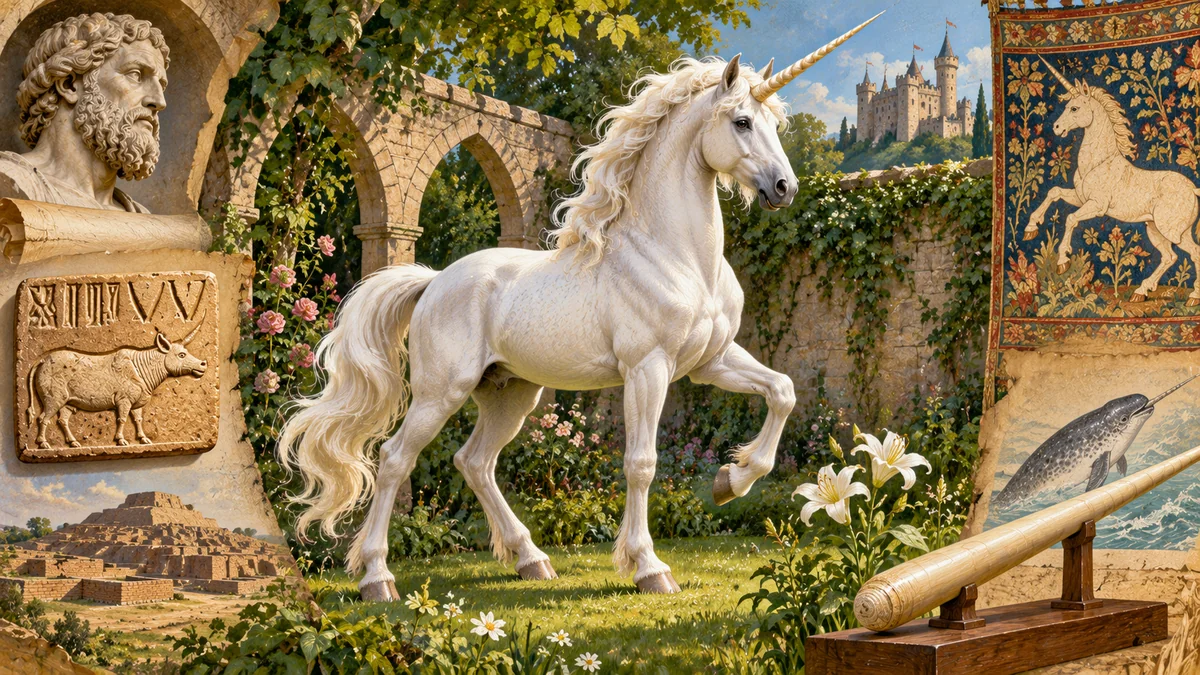
Where did unicorns in mythology come from? The familiar unicorn—a horse-like creature with a single horn—is the result of several traditions developed across centuries. Ancient writers reported extraordinary one-horned animals; medieval European storytellers gave the creature religious and moral meanings; artists represented it in manuscripts and tapestries; and traders sold real narwhal tusks as supposed unicorn horns. There is extensive historical evidence for these beliefs, images and objects, but no scientifically verified evidence that the legendary horse-like unicorn was a real species.
Even the question of a single “origin” has complications. An animal with one visible horn appears on Indus Valley seals dating to approximately 2600–1900 BCE, while one of the earliest influential written reports in Greek literature came from Ctesias in the fourth century BCE. Their meanings and possible connections are not established. A Chinese qilin, meanwhile, is sometimes translated as a “unicorn” but belongs to a distinct cultural tradition. Treating them all as the same creature would flatten important historical differences.
This guide examines the evidence in chronological and cultural context, using museum catalogues, surviving texts and zoological research. It explains what historians can establish—and where fascinating theories remain unproven.
Unicorn history at a glance: evidence versus interpretation
| Period or context | What survives | What it does—and does not—establish |
|---|---|---|
| Indus Valley, c. 2600–1900 BCE | Carved seals showing a so-called “unicorn” animal in profile | Confirms an ancient motif; does not establish a living one-horned horse or its precise meaning |
| Fourth century BCE Greek literature | Accounts attributed to Ctesias of an extraordinary Indian wild ass | Confirms a circulating report, not an independently verified animal |
| Roman natural history | Descriptions of a one-horned monoceros | Shows how extraordinary zoological accounts spread and changed |
| Early Christian and medieval Europe | Bestiaries, illuminated manuscripts and religious interpretations | Documents symbolic meaning, including a maiden who tames a unicorn |
| Late medieval Europe, c. 1495–1505 | The Met Cloisters' Unicorn Tapestries | Physical evidence of costly art and layered beliefs, not zoological proof |
| Medieval and early modern trade | Narwhal tusks sold or displayed as “unicorn horns” | Explains real specimens behind some horn claims; narwhals are whales |
| Scottish heraldry | Royal emblems and architectural unicorns | Demonstrates the creature's political and cultural importance |
| Modern palaeontology | Fossils of the extinct rhinoceros Elasmotherium | Confirms a real prehistoric mammal, not the medieval horse-like unicorn |
1. Did unicorns first appear in the Indus Valley?
One of the oldest surviving visual traditions associated with “unicorns” appears in the Indus civilisation of what is now Pakistan and north-western India. Some small carved stamp seals show a bovine-like animal in profile with one apparent forward-projecting horn, often facing a separate object described cautiously as an incense burner or ritual device.
The Metropolitan Museum of Art dates a representative “unicorn and incense burner (?)” stamp seal to approximately 2600–1900 BCE. Its catalogue explains that Indus seals served functions such as identifying ownership and status, and that their script remains undeciphered.
Historians cannot read the image as though it were a modern field guide. The single apparent horn might represent an imaginary composite creature, a convention of profile drawing or a symbolic animal. Its precise interpretation is debated. Crucially, there is no established continuous historical chain linking this Indus motif directly to the medieval European unicorn. The seal is strong evidence for an ancient image, not a fossil or sighting of a species.
2. Ctesias and the Greek account of a one-horned Indian animal
The Greek physician Ctesias of Cnidus, who served at the Persian court, wrote an account of India known as Indica during the fourth century BCE. The original work is lost, but descriptions survive through later writers and summaries. In one well-known passage, Ctesias describes a large, swift, horse-sized Indian wild ass with a horn and extraordinary colouring. He also records the belief that drinking vessels made from the horn protected against poison or illness.
Ancient authors did not necessarily present these reports as modern readers present supernatural fairy tales. They could appear in writings that claimed to describe distant geography, rare animals and natural marvels. Yet Ctesias was not documenting a specimen with the methods of modern zoology. The Bryn Mawr Classical Review's assessment of a scholarly edition of On India notes how difficult it is to separate reports from exaggeration and later transmission.
The historian's caution is straightforward: we have evidence that Ctesias transmitted a story; we do not have proof that his described creature existed exactly as reported. Proposals involving rhinoceroses, antelopes or other real animals are possibilities rather than settled identifications.
3. Aristotle, Pliny and the evolution of the classical unicorn
The ancient Greek philosopher Aristotle mentions a one-horned “Indian ass” alongside other unusual animals. Later, Pliny the Elder described a fierce creature called the monoceros, combining features associated with a horse, stag, elephant and boar, together with a single horn.
These descriptions are not identical to today's gentle white horse with a spiralling horn. Their changing anatomy shows how literary accounts were copied, retold and reinterpreted across time. A 2025 article in The Classical Quarterly discusses Ctesias and later versions of the horned Indian animal, including the tradition that a horn could protect against poisoning. See “An Ass's Horn for Alexander the Great” .
It is tempting to declare that one particular species—perhaps the Indian rhinoceros—“was the unicorn”. Such a conclusion goes beyond the evidence. An unfamiliar real animal may have contributed to some descriptions, while travellers' stories, artistic conventions and symbolic embellishments changed the result. More than one animal could have influenced the tradition.
4. From distant animal reports to medieval Christian allegory
In medieval European culture, unicorns acquired meanings that went well beyond their supposed zoology. Bestiaries—illustrated books about animals, combining observation, inherited lore and moral interpretation—often depicted the unicorn as a fierce beast that could be approached or captured only when it rested beside a maiden.
This narrative drew on traditions associated with the ancient Physiologus and later bestiary literature. The J. Paul Getty Museum's introduction to medieval bestiaries describes the familiar story: the unicorn approaches the maiden, lays its head in her lap and becomes vulnerable to hunters.
Within Christian symbolic interpretation, the unicorn could represent Christ, while its encounter with the maiden evoked the Incarnation and the Virgin Mary. The beast's capture or death could take on further religious meanings. The same motif could also suggest courtly love, fidelity or desire, depending on the artwork and audience. See the Getty's “Book of Beasts” exhibition .
Importantly, medieval viewers did not always draw a sharp boundary between natural history and symbolism in the way scientists do today. A symbolic account was not necessarily intended as a controlled zoological observation. Reading it within its own intellectual and religious setting reveals more than calling it merely a mistaken biology textbook.
5. What the Unicorn Tapestries tell us about medieval belief
The magnificent Unicorn Tapestries at The Met Cloisters in New York show a complicated hunt across seven surviving hangings. The Met dates them to around 1495–1505; they were designed and woven in a European courtly-art context involving wealthy patrons and skilled textile workshops.
The sequence includes hunters entering a forest, searching for and confronting a unicorn, and scenes that connect the animal with a maiden and an enclosed garden. The textiles contain elaborate plants, animals and costumes, carefully woven from luxurious materials. The Met's catalogue for The Hunters Enter the Woods and its exhibition overview provide historical context.
What the exact sequence means is still debated. Religious interpretations, secular romance, marriage symbolism and aristocratic identity may overlap. The Met explicitly cautions that a lack of original documentation makes some intended meanings uncertain. This is a reminder that even when an artwork survives intact, historians should distinguish what can be observed from what is inferred.
The tapestries prove that unicorn imagery mattered to people who invested great resources in its creation. They do not prove that the creature was observed alive in fifteenth-century Europe.
6. Why was the unicorn linked to purity, healing and magical water?
The medieval unicorn often symbolised purity and a force that could not easily be captured. Legends also credited its horn with removing poison, curing illness or purifying contaminated water. These meanings helped make the creature attractive in religious storytelling, medicine-related folklore and decorative art.
Stories about miraculous horns were not clinical evidence. People historically used and traded substances that they believed could heal, but claims of protection from poisoning must be evaluated separately from the fact of those beliefs. The Met's The Unicorn Purifies Water is useful evidence for how the theme was represented in visual culture.
The association with a maiden also needs sensitive interpretation. Medieval allegorical ideas about chastity and virginity reflect specific religious and social settings; they should not be treated as universal beliefs shared by every culture, past or present.
7. The narwhal: real “unicorn horns” from the Arctic
One of the strongest material links between unicorn legends and real nature comes from the narwhal, a toothed whale living in Arctic waters. The familiar long, twisted “horn” is actually an elongated tooth, commonly the upper left canine of a male. It can extend several metres beyond the animal's head.
For centuries, narwhal tusks entered European trade networks and collections, where some were described or sold as unicorn horns. These objects offered something apparently tangible to people who had never seen the living whale. The Natural History Museum's narwhal collection guide explains the tusks' anatomy and their role in the historical trade.
This evidence supports an important but limited conclusion: narwhal tusks reinforced and altered European unicorn beliefs, particularly the image of a long spiralling horn. It cannot explain all stories about one-horned animals, because several textual and visual traditions are much older than this trade. Nor does the existence of a tusk establish a horse-like animal with magical healing powers.
Scientists can identify a narwhal tusk by anatomy and zoological comparison. The historic label “unicorn horn” tells us about a seller's or buyer's understanding, not necessarily the object's biological origin.
8. Are unicorns and China's qilin the same creature?
The Chinese qilin is sometimes described in English as a “Chinese unicorn”, but this translation can be misleading. Traditional depictions and descriptions vary: the qilin may combine features of deer, horses, dragons or other animals, and it may have one horn or more complex horn-like forms. It is often connected with auspicious events, wise rule and moral significance.
These traditions developed in a cultural setting different from European Christian unicorn allegory. Similarities in horn imagery do not prove direct descent from the same myth. The Smithsonian's account of giraffes in fifteenth-century China describes how a giraffe presented to the Ming court was associated with the qilin, while also stressing that the interpretation was embedded in political and cultural ideas.
For meaningful comparison, ask what a creature does in a tradition, what qualities people associate with it and how it is represented in original sources. Simply matching the English word “unicorn” can conceal more history than it reveals.
9. Why is the unicorn the national animal of Scotland?
The unicorn became an important emblem in Scottish royal heraldry, where it appears on seals, arms, carved monuments and later decorative objects. In modern usage, it is widely recognised as Scotland's national animal. Its symbolic associations with strength, independence and purity made it a memorable heraldic creature.
The Historic Environment Scotland guide highlights unicorns on surviving Scottish buildings and monuments. The Royal Family's explanation of coats of arms identifies the Scottish unicorn as one supporter of the United Kingdom's royal arms, opposite the English lion in the standard version.
A heraldic unicorn often wears a chain. Different writers have offered symbolic readings of that detail, but it would be unwise to insist on one universal meaning for every carved or painted example. The unambiguous historical fact is the creature's prominent role in royal and national imagery—not its biological existence.
10. What about the “Siberian unicorn” fossil?
Real fossils provide an entirely different kind of evidence. Elasmotherium sibiricum, popularly nicknamed the “Siberian unicorn”, was a large extinct relative of modern rhinoceroses. It was not a white horse with a single spiralling forehead horn. Reconstructions of its appearance reflect fossil anatomy and scientific inference, not a preserved medieval unicorn.
A study published in Nature Ecology & Evolution used dating and DNA-related evidence to investigate the animal's evolutionary relationships and extinction. The Natural History Museum's explanation reports that the species survived until roughly 39,000 years ago, far later than some earlier estimates.
Could memories of an unusual rhinoceros have contributed to horned-animal folklore? It is an interesting hypothesis, but there is no demonstrated transmission of a specific Elasmotherium story into medieval European unicorn art. A sensational nickname and an extinct mammal cannot by themselves establish an origin for the myth.
11. What counts as historical evidence for a unicorn?
A useful way to evaluate the legend is to separate categories of evidence. They answer different questions, and none should be made to answer a question it cannot.
| Evidence type | What it can show | What it cannot establish on its own |
|---|---|---|
| Ancient seals or carvings | A culture represented a one-horned figure | That the figure depicts a literal living species |
| Literary accounts | Writers transmitted beliefs, observations or second-hand reports | That every physical description was accurate |
| Bestiaries and tapestries | Religious, courtly and artistic meanings | The existence of an animal with supernatural traits |
| Horns in collections | Historical collecting, trade and identification practices | That a narwhal tooth came from a horse-like unicorn |
| Identified fossils | Real extinct animals and their anatomy | A continuous link to a particular mythical tradition |
| Modern zoological evidence | Animal species supported by specimens, anatomy, genetics and observations | Evidence for an undocumented legendary animal without supporting data |
Biologists classify real animals using observable and testable evidence. For an introduction to those methods, SuperEducational's animal classification guide explains how zoological groups differ—a useful contrast with a legendary creature that can change its anatomy from one story to another.
The conclusion is not that ancient people were simply foolish. Their sources, purposes and available knowledge differed from ours. The historical task is to explain why a story made sense in its context, while the scientific task is to establish which animals have empirical support.
12. How unicorns changed in modern storytelling
The modern image of a friendly white horse with a shimmering spiral horn owes much to centuries of European art, literature and later children's fantasy. It brings together features that were not always present in early texts: delicate horse-like anatomy, purity, gentle behaviour and magical healing.
Today unicorns may symbolise imagination, rarity, innocence, beauty or individuality. Their appearance in books, games, toys and digital imagery is evidence of cultural adaptation, not biological discovery. The stories also continue to be reinterpreted, sometimes challenging older ideas about the maiden, the hunt or who is allowed to approach the creature.
Scholars and teachers can use these transformations to explore how myths travel: a reported animal becomes a religious symbol, an expensive object becomes a “horn”, and a heraldic emblem becomes a familiar fantasy character. The history is more interesting because the meanings changed.
Frequently asked questions
Are unicorns part of Greek mythology?
Unicorn-like animals appear in ancient Greek natural-history and geographic writing, notably in material attributed to Ctesias. That is not the same as saying the familiar unicorn played a major role in the classical Greek pantheon or heroic myths.
What is the oldest unicorn picture?
Indus Valley seals dated around 2600–1900 BCE contain figures scholars often call “unicorns”. Because the Indus script is undeciphered and the image's precise meaning is debated, it is more accurate to call these among the earliest one-horned animal motifs than proof of the exact later European creature.
Did medieval people really believe unicorns existed?
Some did, but beliefs varied across places, periods and individuals. Bestiaries could combine apparent natural history with religious allegory, and genuine narwhal tusks could reinforce claims that unicorn horns were real objects.
Is a narwhal's tusk a unicorn horn?
No. It is a specialised elongated tooth of a real Arctic whale. Historically, however, such tusks were sometimes marketed or displayed as unicorn horns.
Did unicorns have magical healing powers?
Healing and anti-poison properties belong to folklore and historical medical beliefs. There is no clinical evidence that a legendary unicorn horn possessed supernatural powers.
Did the Siberian unicorn really exist?
Elasmotherium was a real prehistoric rhinoceros relative, known from fossils. The nickname “Siberian unicorn” should not be confused with evidence for the horse-like animal of medieval legend.
Why is a unicorn on the royal coat of arms?
The unicorn is a long-standing Scottish heraldic emblem. Its place alongside the lion in the United Kingdom's royal arms expresses historic royal symbolism rather than a belief about living wildlife.
Conclusion: the real history behind the mythical unicorn
Unicorns in mythology are best understood as a family of evolving stories and images, not a single creature with a traceable zoological biography. Indus seals preserve ancient one-horned imagery; Greek and Roman writers recorded reports of extraordinary animals; medieval bestiaries transformed the unicorn into religious and courtly allegory; narwhal tusks supplied real objects that fuelled belief; and Scottish heraldry gave it lasting political visibility.
We can verify the manuscripts, tapestries, seals, tusks and fossils. We cannot verify the legendary horse-like unicorn as a real species. Recognising the difference between **evidence for belief** and **evidence for biological existence** makes the unicorn's history both more accurate and more compelling.
References and further reading
- The Metropolitan Museum of Art — Indus Valley stamp seal and modern impression: unicorn and incense burner (?) .
- Bryn Mawr Classical Review — Ctesias, On India, scholarly edition review .
- The Classical Quarterly (2025) — An Ass's Horn for Alexander the Great .
- J. Paul Getty Museum — An Introduction to the Bestiary .
- J. Paul Getty Museum — Book of Beasts: The Bestiary in the Medieval World .
- The Metropolitan Museum of Art — Search for the Unicorn .
- The Metropolitan Museum of Art — The Unicorn Purifies Water .
- Natural History Museum — Narwhals: Mysterious Unicorns of the Sea .
- Smithsonian Magazine — The Peculiar Story of Giraffes in 1400s China .
- Historic Environment Scotland — On the Trail of the Unicorn .
- The Royal Family — Coats of Arms .
- Nature Ecology & Evolution — Evolution and Extinction of Elasmotherium sibiricum .