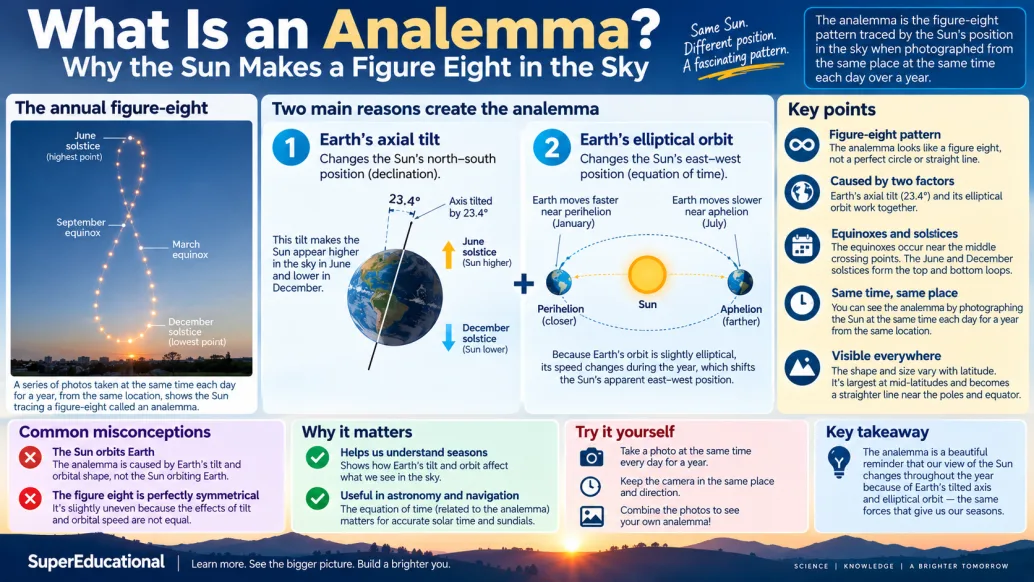
An analemma is the figure-eight pattern you get when you record the Sun’s position from the same place at the same clock time repeatedly throughout a year. The Sun appears to move north and south with the seasons, while also drifting slightly east and west relative to an average clock. Combine those two motions and the result is the familiar, slightly uneven figure eight.
NASA’s Astronomy Picture of the Day for 20 September 2026 highlighted an analemma photographed near the Callanish Stones in Scotland. NASA explains that the two fundamental causes are Earth’s axial tilt and the ellipticity of Earth’s orbit. The timing is especially useful for learning because the September 2026 equinox occurs on 23 September at 00:05 UTC, when the centre of the Sun crosses Earth’s equatorial plane.
What exactly is an analemma?
Imagine fixing a camera in one location and photographing the Sun at exactly the same clock time every few days for an entire year. If you combine those photographs without moving the camera, the Sun will not appear in a single spot. Instead, its positions will trace a curve shaped roughly like the number eight.
That curve is the analemma.
The idea can also be represented mathematically by plotting two quantities that change through the year: the Sun’s declination, which describes its apparent north–south position in the sky, and the equation of time, which describes the difference between apparent solar time and a uniform clock.
The analemma therefore contains information about both the changing seasons and the uneven relationship between the real Sun and our average 24-hour timekeeping system.
Why doesn’t the Sun return to exactly the same place every day?
There are two main reasons.
1. Earth’s axis is tilted
Earth’s rotational axis is tilted by about 23.4 degrees relative to the plane of its orbit around the Sun. As Earth travels around the Sun, that tilt changes the Sun’s apparent north–south position in our sky.
Astronomers describe this north–south position using declination. Around the June solstice, the Sun reaches its northernmost declination. Around the December solstice, it reaches its southernmost declination. Near the March and September equinoxes, the Sun crosses the celestial equator.
This seasonal north–south motion creates the vertical component of the analemma.
2. Earth’s orbit is slightly elliptical
Earth does not move around the Sun in a perfect circle. Its orbit is slightly elliptical, and its orbital speed changes during the year: Earth moves somewhat faster when it is closer to the Sun and slower when it is farther away.
That changing speed means the apparent Sun does not keep perfectly uniform time relative to an imaginary “mean Sun” used for civil timekeeping. The difference contributes to what astronomers call the equation of time.
This timing difference creates much of the east–west component of the analemma.
Neither effect alone produces Earth’s familiar analemma. The figure eight emerges from their combination.
What is the equation of time?
A clock assumes a mean solar day of 24 hours. But the real Sun does not cross the local meridian at exactly 12:00 clock time every day.
The difference between apparent solar time — the time indicated by the real Sun — and mean solar time — the averaged time used by clocks — is called the equation of time.
Two physical effects contribute strongly to it:
- Earth’s orbital speed changes because its orbit is elliptical;
- Earth’s tilted equator is projected onto the plane of its orbit, which also changes how solar motion translates into clock time.
A sundial therefore does not remain perfectly synchronised with a modern clock throughout the year without a correction.
Where are the solstices on an analemma?
The solstices occur near the upper and lower extremes of an analemma because those are the times when the Sun reaches its greatest northern or southern declination.
For an observer in the Northern Hemisphere, the June solstice corresponds to the Sun’s most northerly seasonal position and the December solstice to its most southerly position.
Exactly which part appears visually “top” or “bottom” in a photograph depends on the observer’s location, camera orientation and time of day, but the solstices mark the two declination extremes.
Where are the equinoxes?
A common misconception is that the two equinoxes must occur at the central crossing point of the figure eight.
NASA specifically notes that this is not generally correct. The equinoxes correspond to middle portions of the analemma, but not necessarily to its geometric intersection.
This happens because the crossing point depends on both declination and the equation of time. At an equinox the Sun’s declination is approximately zero because it is crossing the celestial equator, but the equation-of-time component does not simultaneously have to be zero.
For 2026, NASA gives the September equinox as 23 September at 00:05 UTC. The astronomical event is one instant worldwide, although local clocks may place it on a different date depending on time zone.
Why is one loop larger than the other?
Earth’s analemma is not a perfectly symmetrical figure eight. One loop is larger than the other.
That asymmetry comes from the way Earth’s axial tilt and orbital eccentricity interact. The two effects do not reach their maximum values at the same times of year and do not contribute equally to the Sun’s apparent motion.
If Earth’s orbit were perfectly circular but the planet remained tilted, the analemma would have a different and more symmetrical form. If Earth had no axial tilt but retained an elliptical orbit, the pattern would also be very different.
The familiar figure eight is therefore a visual signature of Earth’s particular combination of tilt and orbital shape.
Do other planets have analemmas?
Yes. Any world with an observer able to track the Sun from a fixed location can, in principle, have an analemma-like pattern.
Its shape depends largely on the planet’s axial tilt and orbital eccentricity. NASA has illustrated this by comparing Earth’s analemma with Mars’s. Mars has an axial tilt similar to Earth’s, but its orbit is substantially more eccentric, so its solar analemma has a noticeably different shape.
This is a useful reminder that the analemma is not simply a photographic curiosity. Its geometry encodes information about how a planet rotates and orbits its star.
Is the Sun really moving in a figure eight around Earth?
No. The analemma shows the Sun’s apparent position in Earth’s sky when sampled at the same clock time throughout the year.
Earth is rotating on its axis while simultaneously orbiting the Sun. The changing viewing geometry makes the Sun appear at different positions against our local sky.
The figure eight is therefore an observational pattern produced by Earth’s motions, not evidence that the Sun physically travels around Earth in that shape.
Why does “same clock time” matter?
If you photographed the Sun at random times of day, its ordinary daily east-to-west motion would dominate the result.
Keeping the clock time fixed removes most of that daily motion from the comparison. What remains is the slower annual change caused by Earth’s tilt and orbital motion.
You also need to photograph from the same location and with the camera pointed in the same direction. Otherwise, changes in framing would hide the geometry you are trying to measure.
Can you photograph an analemma yourself?
In principle, yes, but it requires patience and careful solar safety.
A typical project involves taking an image from the same fixed position at the same clock time every several days for about a year, then aligning and combining the photographs.
Never look directly at the Sun through a camera viewfinder, telescope, binoculars or optical instrument without an appropriate certified solar filter. Concentrated sunlight can permanently damage eyes and equipment. Photographers should follow established solar-imaging safety guidance and use equipment designed for the task.
Clouds will inevitably interfere on some dates, which is why published analemmas are often composites of observations made every few days rather than literally every day.
What does location change?
The underlying astronomical causes are the same everywhere on Earth, but the way the analemma appears against a local horizon depends on latitude, the chosen clock time, camera orientation and season.
A noon analemma may stand relatively upright in one location, while an early-morning or late-afternoon analemma can appear tilted. Some portions of the curve may also be difficult or impossible to photograph if the Sun is below the horizon, hidden by terrain or blocked by seasonal weather.
This is why two photographers can record recognisably related but visually different analemmas.
What does an analemma teach us about seasons?
The vertical part of the analemma is a compact record of the Sun’s changing declination, which is directly connected to Earth’s seasons.
Earth’s axial tilt changes both the angle at which sunlight strikes each hemisphere and the length of daylight through the year. Around the June solstice, the Northern Hemisphere is tilted more towards the Sun. Around the December solstice, it is tilted more away. The equinoxes occur between these extremes when the centre of the Sun crosses Earth’s equatorial plane.
The analemma therefore connects several ideas that are often taught separately: axial tilt, declination, solstices, equinoxes, orbital motion and solar time.
Common misconceptions
- “The figure eight is the path the Sun physically follows around Earth.” No. It records the Sun’s apparent position at one chosen clock time through the year.
- “Earth’s seasons happen because we are much closer to the Sun in summer.” The primary cause of the seasons is Earth’s axial tilt.
- “The equinoxes are exactly at the analemma’s crossing point.” NASA notes that equinoxes correspond to middle portions of the curve, not necessarily its intersection.
- “The Sun is late or early because our clocks are inaccurate.” The changing difference between apparent solar time and mean clock time is a predictable consequence of Earth’s orbit and tilt.
- “Every analemma photograph should look identical.” The appearance depends on observing location, clock time, orientation and how the images are projected.
Key takeaways
- An analemma is the figure-eight pattern traced by the Sun’s apparent position when observed from the same place at the same clock time over a year.
- Earth’s axial tilt produces the main north–south seasonal movement.
- Earth’s slightly elliptical orbit and changing orbital speed contribute to the east–west timing shift represented by the equation of time.
- Solstices mark the Sun’s northern and southern declination extremes on the curve.
- Equinoxes occur along middle portions of the analemma but are not necessarily at the crossing point.
- The September 2026 equinox occurs at 00:05 UTC on 23 September, according to NASA.
Frequently asked questions
What does the word analemma mean in astronomy?
It refers to the curve representing the Sun’s apparent position at a fixed mean solar time throughout the year. For Earth, that curve is normally shaped like a slightly uneven figure eight.
Why is the analemma a figure eight instead of a straight line?
Because two annual motions are combined: the north–south change caused by Earth’s axial tilt and the east–west timing change produced by Earth’s orbital geometry and varying orbital speed.
Does the analemma show the seasons?
It reflects the seasonal change in solar declination, so the solstices and equinoxes occupy identifiable parts of the curve.
Is an analemma the same everywhere on Earth?
The underlying declination and equation-of-time cycle is global, but the curve’s appearance in a local sky depends on the observer’s latitude, chosen time and viewing orientation.
Can Mars have an analemma?
Yes. NASA has shown that Mars produces a different-shaped analemma because its axial tilt and orbital eccentricity differ from Earth’s.
Authoritative references
- NASA Science — APOD: Analemma over the Callanish Stones, 20 September 2026
- NASA Science — Embracing the Equinox
- NASA Science — Two Worlds, Two Analemmas
- NASA Goddard — Analemma and the Equation of Time
Suggested next learning step: explore the equation of time in more detail and compare apparent solar noon with clock noon at different times of the year.