The Moon may look timeless, but its surface is still changing. Small asteroids and comets continue to hit it, creating fresh impact craters that spacecraft can detect.
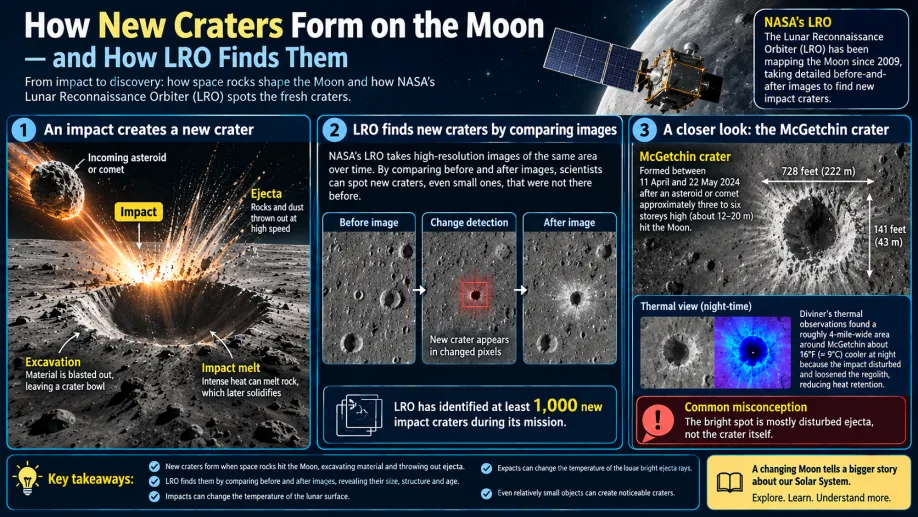
NASA’s Lunar Reconnaissance Orbiter recently provided a striking example with McGetchin crater, a fresh crater formed between 11 April and 22 May 2024 and reported in September 2026.
Why impacts reach the lunar surface
Earth's atmosphere burns up or strongly slows many small incoming objects. The Moon has no substantial atmosphere, so incoming rocks can reach the surface at very high speeds.
What happens during an impact?
At impact, enormous kinetic energy is released in a tiny fraction of a second. Surface material is compressed, heated and accelerated outward.
The impact excavates a bowl-shaped cavity. Rock and dust thrown outward are called ejecta. Some material can melt under the intense heat and later solidify as impact melt.
How secondary craters form
Large pieces of ejecta can travel away from the main crater and strike the surface again. These later impacts produce smaller secondary craters.
Why fresh craters can look bright
Fresh impacts expose and redistribute material that has not yet been darkened by long-term space weathering. This can produce bright ejecta patterns around a crater.
The bright feature may cover an area much larger than the crater itself.
How LRO finds new craters
LRO repeatedly photographs the lunar surface. Scientists can compare images of the same place taken at different times and search for changes that were absent before.
A change-detection process can reveal a new bright patch or crater. Follow-up images from LRO's Narrow-Angle Camera then provide higher-resolution views.
The McGetchin crater case study
McGetchin crater is about 222 metres wide and 43 metres deep. NASA estimates that the impacting object was roughly the size of a three- to six-storey building.
The crater formed sometime between 11 April and 22 May 2024. NASA estimates an impact of this magnitude occurs about once a century or less frequently.
During its mission, LRO has identified at least 1,000 new impact craters and many more related surface changes.
What thermal measurements reveal
LRO's Diviner instrument measures thermal radiation from the lunar surface. Around McGetchin, scientists found a roughly four-mile-wide region that was about 16°F (9°C) cooler at night than surrounding terrain.
The explanation is not that the impact created permanently cold rock. The impact disturbed and loosened the regolith, changing how effectively the surface stores and releases heat.
Common misconception
“The bright spot seen in orbital images is the crater itself.” Usually much of the visible bright feature is ejecta spread around the crater.
Key takeaways
- The Moon continues to receive new impacts.
- High-speed impacts excavate craters and throw out ejecta.
- Ejecta can create secondary craters and bright rays.
- LRO finds new impacts by comparing repeated images of the same surface.
- Thermal observations can reveal how impacts change the physical structure of lunar soil.
Frequently asked questions
Why doesn't the Moon's atmosphere stop incoming rocks?
Because the Moon has only an extremely tenuous exosphere, not a substantial atmosphere like Earth's.
Do all impacts make circular craters?
Many high-speed impacts produce approximately circular craters because the energy release spreads outward rapidly, though impact angle and terrain can affect the final shape.
Why do fresh ejecta rays fade?
Over time, micrometeorite impacts and radiation alter exposed material in a process known as space weathering.
Authoritative references
- NASA — Lunar Reconnaissance Orbiter report on McGetchin crater, September 2026.
- NASA Moon resources — lunar impact craters and ejecta.