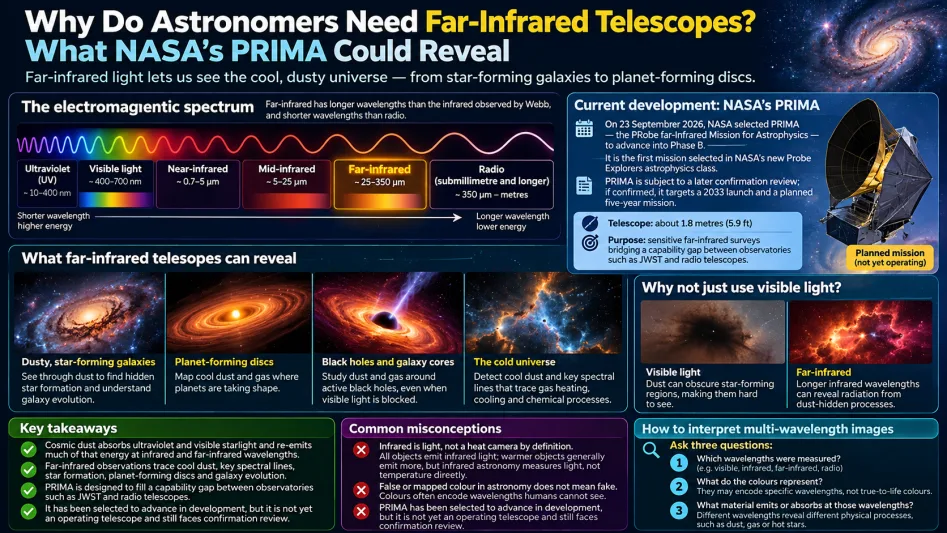
Much of the Universe cannot be understood from visible light alone. Dust can absorb ultraviolet and visible radiation, while cool material emits strongly at longer wavelengths. That makes the far-infrared a powerful window on star formation, planet-forming discs and galaxy evolution.
NASA’s PRobe far-Infrared Mission for Astrophysics (PRIMA) provides a timely example. NASA selected PRIMA in September 2026 to advance into Phase B of development. It is not yet an operating telescope and remains subject to a later confirmation review.
Where is far-infrared light?
The electromagnetic spectrum runs from high-energy gamma rays through X-rays, ultraviolet, visible light and infrared to microwave and radio wavelengths. Far-infrared light has longer wavelengths than the infrared bands commonly associated with observatories such as Webb and shorter wavelengths than much radio emission.
Why dust changes the view
Interstellar dust absorbs some ultraviolet and visible starlight. The grains warm and reradiate energy at infrared wavelengths. A region that appears dark or obscured in visible light can therefore be bright and scientifically rich in the infrared.
What can far-infrared telescopes study?
Star formation: young stars can remain embedded in dusty clouds. Far-infrared measurements help trace the energy emerging from these hidden regions.
Planet-forming discs: cool dust and gas around young stars contain clues about the environments in which planets form.
Galaxy evolution: dust-hidden star formation can account for an important part of a galaxy’s energy output.
Spectral lines: specific atoms, ions and molecules emit or absorb at characteristic wavelengths, helping researchers infer physical conditions such as gas temperature, density and radiation environment.
What is PRIMA?
PRIMA is planned as a sensitive far-infrared survey observatory with a telescope roughly 1.8 metres across. NASA selected it to advance in development as the first mission in the agency’s Probe Explorers astrophysics class. If it passes later confirmation, the current plan targets launch in the 2030s.
Why not just use visible light?
Different wavelengths answer different questions. Visible light is excellent for many stars and galaxies, but dust can obscure active regions. Far-infrared observations measure radiation associated with cooler material and dust-hidden processes. Radio, X-ray and other observatories add still more information.
How astronomers use mapped colour
Human eyes cannot see far-infrared light. Astronomers therefore map measured wavelengths to visible colours for display. That does not make the data fake: the colours encode measurements outside human vision. Captions should explain what each colour represents.
Common misconceptions
“Infrared means a heat camera.” Infrared is electromagnetic radiation. Thermal cameras are one application, but infrared astronomy measures light from many physical processes.
“PRIMA is already observing.” No. It has advanced in development but still faces confirmation before becoming an operational mission.
“False colour means fake.” No. Mapped colour can communicate real measurements, provided the mapping is documented.
Practical reading tip
When viewing a multi-wavelength astronomy image, ask three questions: which wavelengths were measured, what do the displayed colours encode, and what physical material or process emits or absorbs at those wavelengths?
Key takeaways
- Far-infrared astronomy reveals cool dust and obscured regions.
- Dust absorbs shorter-wavelength light and reradiates energy in the infrared.
- Different wavelength bands provide complementary physical information.
- PRIMA has advanced in development but is not yet an operating observatory.