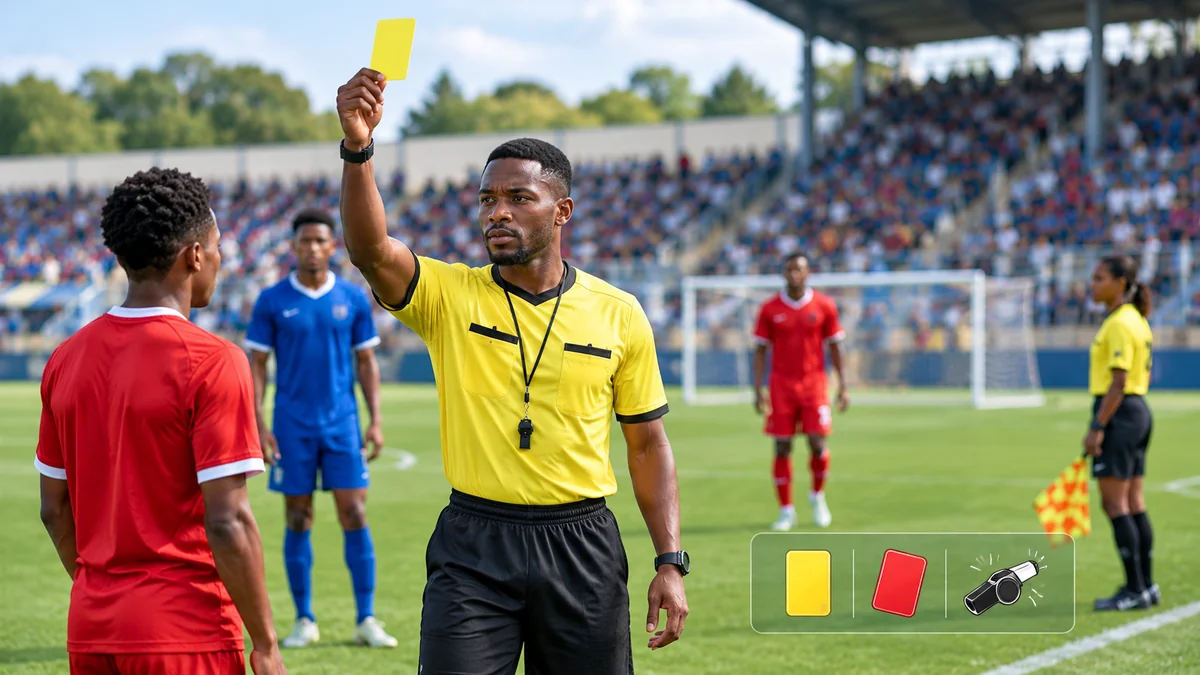
Football referees apply the Laws of the Game to decide when play continues, when it stops, which team receives the restart, and whether misconduct deserves a warning, yellow card or red card. The whistle and hand signals may look simple, but a good decision can depend on the exact location of an offence, whether the ball was in play and whether an advantage develops.
This educational guide to football referee rules explained is based primarily on the International Football Association Board (IFAB) 2026/27 Law 5 , Law 12 , and supporting official Laws. It covers common signals, free kicks, penalties, offside, goalkeeper time limits, 2026/27 changes and the limits of VAR. A 15-question practice quiz with explained answers lets learners test what they understand.
The full IFAB Laws apply to standard association football. Youth, grassroots and some other formats may use approved modifications and competition-specific rules. They should not be confused with futsal or other football codes, which have separate rulebooks.
What does the referee actually decide?
The main referee has authority to enforce the Laws of the Game. Referees assess physical challenges, control the match, decide whether a ball has entered or left play, approve restarts, manage time and take disciplinary action. They work with assistant referees, a fourth official and, where authorised, video match officials.
The referee uses the Laws, what the officials observe, and the spirit of the game. A decision does not automatically change because players protest or a television replay looks different. IFAB Law 5 also restricts when a decision can be altered after play restarts.
For a beginner, three separate questions help decode most decisions: (1) What happened? (2) How does play restart? (3) Is a disciplinary sanction needed? A careless foul, for example, can mean a free kick without a card; a reckless challenge can mean the same restart plus a yellow card.
Referee signals: what the gestures mean
| Signal or action | What spectators should understand |
|---|---|
| One arm raised above the head | An indirect free kick; the arm generally stays raised until the ball touches another player, goes out of play or a direct goal is no longer possible |
| Arm extended towards one end | A direct free kick for the team attacking in that direction |
| One or both arms extended forward | Advantage: the referee allows play to continue despite an offence |
| Arm pointing at the penalty mark | A penalty kick has been awarded |
| Arm pointing towards the corner area | A corner kick is awarded |
| Arm pointing towards the goal area | A goal kick is awarded |
| Yellow card held aloft | A caution; two cautions in the same match result in a sending-off |
| Red card held aloft | A player or team official is sent off |
| Rectangle shape formed by hands | The referee is signalling an on-field video review in a VAR match |
| Raised hand counting down | Can indicate the final five seconds of a goalkeeper's eight-second controlled-ball limit or an applicable restart countdown |
The IFAB referee guidance contains the approved graphic signals. The meaning of a gesture must be read in context: a raised arm during an indirect free kick is not the same as a raised hand counting down seconds. The whistle is a communication tool, not the entire legal basis for a decision.
What do assistant referee flags mean?
An assistant referee can signal the ball going over a touchline, a throw-in, a corner or goal kick, possible offside, and other matters within their duties. For offside, the assistant typically raises the flag first; after the referee stops play, the flag can indicate the near, middle or far side of the field. The referee makes the final decision after considering the assistant's information.
Fouls, contact and the difference between no card, yellow and red
Football is a contact sport, and not every collision or tackle is a foul. Under IFAB Law 12, challenges such as kicking, tripping, pushing and charging are judged according to whether they are careless, reckless or use excessive force. Conduct such as holding an opponent and certain handball offences can also result in direct free kicks.
- Careless: A player lacks sufficient attention or precaution. The referee awards the appropriate restart; a card is not required solely because the challenge is careless.
- Reckless: A player disregards the danger to, or consequences for, an opponent. The referee generally cautions the player with a yellow card.
- Excessive force: A challenge endangers an opponent's safety or uses force beyond what is necessary. The referee sends off the offender with a red card for serious foul play where applicable.
A player can also be cautioned for dissent, persistent offences or other unsporting behaviour, and sent off for violent conduct or serious misconduct. A second yellow card in one match is followed by a red card. This distinction matters in the 2026/27 VAR rules, which allow review of a clearly incorrect second caution resulting in a sending-off; that does not mean VAR watches for every missed yellow card.
Is every touch of a hand or arm a handball?
No. IFAB states that not every hand/arm contact with the ball is an offence. Deliberately handling the ball or making the body unnaturally bigger with an unjustifiable arm position can be punishable. The precise context matters, and there are additional rules for certain attacking handball situations. Do not assume that a ball merely brushing a naturally positioned arm automatically means a penalty.
Direct free kick, indirect free kick or penalty?
A direct free kick allows a goal to be scored directly against the opponents. It is used for offences including certain careless, reckless or excessive-force contact fouls, holding and punishable handball.
An indirect free kick requires the ball to touch another player before a goal can count. IFAB Law 13 requires the referee to signal an indirect free kick by raising an arm above the head. Indirect-kick offences include dangerous play without contact, obstruction without contact and certain goalkeeper or procedural offences.
If an indirect free kick is struck straight into the opponents' goal without another touch, the restart is a goal kick, not a goal. If the referee failed to give the required indirect signal and the kick entered directly, the kick must be retaken under IFAB guidance.
A penalty kick is normally awarded when a player commits a direct-free-kick offence inside their own penalty area while the ball is in play, subject to the detailed provisions of Law 12. The referee points to the penalty mark. A foul just outside the area is not a penalty because the attacker fell inside after contact; the location of the offence matters.
Penalty kicks have their own procedure under IFAB Law 14 , including positioning of the goalkeeper and other players, the kicker's required forward kick and rules about a second touch. A 2025 clarification carried into the latest Laws distinguishes accidental double touches when a penalty is scored (retake) from an accidental double touch when it is missed (normally an indirect free kick in ordinary play).
Offside: a position is not automatically an offence
Offside is one of the most misunderstood decisions. In broad terms, an attacker is in an offside position when a playable part of their body is in the opponents' half and closer to the opponents' goal line than both the ball and the second-last opponent. Arms and hands do not count for determining that position, and being level with the second-last opponent is onside.
But standing in an offside position is not itself an offence. Under IFAB Law 11 , the player must become involved in active play after a team-mate plays or touches the ball—such as by playing it, challenging an opponent or otherwise interfering in the ways specified by the Law.
There is no offside offence when a player receives the ball directly from a goal kick, throw-in or corner kick. Once another player touches or plays the ball, ordinary offside considerations may apply again. When an offside offence occurs, the restart is an indirect free kick.
Advantage: why referees sometimes let a foul go
A referee may signal advantage when stopping immediately for an offence would unfairly interrupt a more promising situation for the non-offending team. For example, an attacker is carelessly tripped but manages to pass to a team-mate who is running towards goal. Allowing that attack to continue may be more valuable than awarding a free kick.
However, advantage is not unlimited. The referee considers the severity of the offence, the opportunity to attack and other circumstances. An offence warranting a sending-off generally requires play to stop unless there is a clear opportunity to score a goal. Referees can return to the original foul when the expected advantage fails to develop within the short period allowed under Law 5 and its guidance.
The advantage signal does not mean the original foul was “legal”. Depending on the offence and how play develops, disciplinary action may still be considered when play next stops, subject to the applicable provisions of the Laws.
The 2026/27 rules every learner should know
The 2026/27 IFAB law changes added new procedures to reduce time-wasting and broaden certain VAR reviews. These changes are important because some older online referee quizzes use out-of-date answers.
1. Goalkeeper with the ball for more than eight seconds: corner kick
When a goalkeeper controls the ball with their hands or arms inside the penalty area for more than eight seconds before releasing it, the referee awards a corner kick to the opposition on the side nearest to the goalkeeper's position. The referee decides when control starts and visually counts down the final five seconds. Bouncing the ball does not reset the count. This rule was introduced in 2025/26 and remains in force in 2026/27. Do not use older guidance saying the ordinary sanction is an indirect free kick.
2. Deliberately delayed throw-ins and goal kicks
Under the 2026/27 five-second protocol , the referee can whistle and visibly count down five seconds when a team is deliberately delaying a throw-in or goal kick. If it is not taken in time, a delayed throw-in goes to the opponents, while a delayed goal kick becomes a corner kick for the opponents. The countdown is used for deliberate delay, not for every routine restart.
3. Substitutions and injury assessment have tighter time procedures
The latest Law 3 generally expects a player being substituted to leave within ten seconds after the substitution signal, subject to exceptions. If not, the match restarts and the replacement normally must wait until the first stoppage after a minute has elapsed. Injury-assessment guidance also provides a general one-minute period off the field after the restart for certain injured outfield players, with important exceptions for serious injuries, goalkeepers and other protected situations. Competition implementation and authorised modifications should be checked.
4. VAR can review certain second-yellow and optional corner decisions
Under the 2026/27 VAR protocol , the usual match-changing categories include goal/no goal, penalty/no penalty, red card and mistaken identity. A clearly incorrect second yellow card that results in a red card may be reviewed. VAR may also help correct a clearly wrongly awarded corner kick only where the competition has adopted the option and it can be corrected immediately without delaying the restart. These are specific exceptions; not every throw-in, foul, first yellow card or disputed tackle becomes reviewable.
The referee remains responsible for the final decision, and the use of VAR requires authorised competition arrangements. Most school and community matches will not have VAR available.
Match restarts that are easy to confuse
| Situation | Typical restart |
|---|---|
| Ball completely crosses touchline | Throw-in for opponents of the last player to touch it |
| Ball crosses goal line outside the goal, last touched by attacker | Goal kick |
| Ball crosses goal line outside the goal, last touched by defender | Corner kick |
| Careless trip by defender outside own penalty area while ball in play | Direct free kick |
| Same punishable trip inside defender's own penalty area | Penalty kick |
| Offside offence | Indirect free kick |
| Goalkeeper holds the ball with the hands beyond eight seconds | Corner kick to opponents |
| Deliberately delayed goal kick after referee's applicable five-second countdown | Corner kick to opponents |
The referee also decides when the ball is in or out of play: generally, the whole ball must cross the whole touchline or goal line to be out. A ball touching a line has not necessarily crossed it completely.
What is added time, and who decides it?
A normal adult match has two halves of 45 minutes, subject to agreed modifications and competition rules. Under IFAB Law 7 , referees add an allowance for time lost to substitutions, injuries, time-wasting, disciplinary action, VAR delays, goal celebrations and other significant interruptions.
The fourth official's board shows the minimum additional time decided by the referee. The referee may increase it for further delays but does not reduce it simply because the announced number has elapsed. For learners, “five added minutes” should be understood as at least five minutes, not a promise that the match will end at an exact second.
Practice quiz: 15 football referee decisions
Instructions: Answer each question before checking the solutions. Choose the best answer under the standard 2026/27 IFAB Laws. All examples assume the ball is in play where relevant and no other offence changes the decision. Award yourself one point for each correct answer.
- A referee raises one arm straight above the head at a free kick. What does it mean?
(A) Penalty kick (B) Indirect free kick (C) Throw-in - An attacker stands in an offside position but does not interfere with play or any opponent. Is that alone an offence?
(A) Yes (B) No (C) Only in the penalty area - A defender carelessly trips an opponent outside the defender's penalty area. No other offence is involved. What is normally awarded?
(A) Direct free kick, no automatic card (B) Red card always (C) Corner kick - The same careless trip occurs inside the defender's own penalty area while the ball is in play. What is awarded?
(A) Goal kick (B) Penalty kick (C) Indirect free kick - A player makes a reckless challenge. What is the usual disciplinary action?
(A) No sanction ever (B) Yellow card (C) Red card always - A player uses excessive force in a tackle endangering the opponent. What is the sanction?
(A) Red card (B) Verbal warning only (C) Throw-in - A player receives the ball directly from a team-mate's throw-in while positioned beyond the second-last defender. Is that direct reception an offside offence?
(A) Yes (B) No (C) Only if the throw is long - A goalkeeper controls the ball with their hands inside their penalty area for longer than eight seconds. What is the 2026/27 restart?
(A) Corner kick to the opponents (B) Indirect free kick to the opponents (C) Dropped ball - An indirect free kick enters the opponents' goal without touching anyone else, and the referee signalled correctly. What follows?
(A) Goal awarded (B) Goal kick (C) Penalty kick - What does the referee's advantage signal generally mean?
(A) No offence happened (B) Play continues because it benefits the non-offending team (C) The game is over - After a deliberate delay at a throw-in, the referee starts the official five-second countdown. The throw-in is still not taken in time. What happens?
(A) Throw-in to opposing team (B) Automatic red card (C) Penalty kick - A team deliberately delays a goal kick beyond the referee's applicable five-second countdown. What is awarded?
(A) Retake goal kick (B) Corner kick to opponents (C) Indirect free kick - In 2026/27, can an authorised VAR review a clearly incorrect second yellow card that directly results in a sending-off?
(A) Never (B) Yes, under the specific protocol (C) Every yellow card can always be reviewed - When a player is substituted, how quickly do the 2026/27 Laws generally require them to leave after the signal, subject to exceptions?
(A) Ten seconds (B) One minute (C) No limit of any kind - The fourth official displays five minutes of added time. Is that necessarily the exact amount to be played?
(A) Yes, never more (B) No, it is a minimum and can be increased (C) It applies only to substitutions
Practice quiz answers and explanations
- B — Indirect free kick. The referee holds an arm up to indicate that a goal cannot be scored directly without another player touching the ball. Source: Law 13.
- B — No. Offside position by itself is not an offence; involvement in active play is required. Source: Law 11.
- A — Direct free kick, without an automatic card. A careless trip is a direct-free-kick foul, but carelessness alone does not require a caution. Source: Law 12.
- B — Penalty kick. A direct-free-kick offence by the defender inside their own penalty area normally leads to a penalty while the ball is in play. Source: Laws 12 and 14.
- B — Yellow card. Reckless challenges are cautionable. Source: Law 12.
- A — Red card. A tackle using excessive force and endangering safety is a sending-off offence. Source: Law 12.
- B — No. There is no offside offence from receiving the ball directly from a throw-in, goal kick or corner. Source: Law 11.
- A — Corner kick. The old indirect-free-kick answer is out of date; the eight-second goalkeeper rule awards a corner. Source: Law 12.
- B — Goal kick. An indirect kick cannot produce a direct goal against the opposition without a further touch. Source: Law 13.
- B — Play continues for an advantage. An offence may still have happened; the referee has judged it better not to stop immediately. Source: Law 5.
- A — Throw-in to the opposing team. The 2026/27 delayed-restart procedure reverses the award after the countdown expires. Source: Law 15.
- B — Corner kick to opponents. Deliberately delaying a goal kick beyond the applicable countdown produces a corner. Source: Law 16.
- B — Yes, in the specified circumstances. A clearly incorrect second caution leading to a red card is reviewable under the expanded 2026/27 VAR protocol. Ordinary first yellows are not generally reviewable. Source: VAR protocol.
- A — Ten seconds. The substitution procedure has a general ten-second departure requirement with specific exceptions and consequences. Source: Law 3.
- B — It is the minimum. Referees can add more time for subsequent delays; the board is not an exact final whistle timer. Source: Law 7.
Score guide: 13–15 correct: excellent foundation; 10–12: good progress; 7–9: revisit the restart and signal sections; 0–6: work through the table and quiz again. These bands are teaching suggestions, not official referee qualification standards.
Use the quiz as a classroom or team exercise
Teachers can split learners into groups of three: one student acts as referee, one reads a scenario and one explains the correct restart. After revealing an answer, the group should identify the relevant Law number, the correct signal and whether any card is needed.
For practical learning, avoid running uncontrolled physical tackle simulations. Use diagrams, walking-speed role-play and paper cards instead. When practising the official advantage or free-kick gestures, ensure students do not mistake a signal for permission to engage in unsafe contact.
Frequently asked questions
Who writes the football referee rules?
The International Football Association Board (IFAB) maintains the Laws of the Game for association football. Competitions implement those Laws with any permitted variations and authorised protocols.
Does every foul deserve a yellow card?
No. A careless foul may require only a free kick. Reckless challenges are generally cautioned, while excessive force or serious foul play can require a red card.
Can a player be offside from a throw-in?
No offence occurs when the player receives the ball directly from the throw-in. A later pass or touch by a team-mate can create an ordinary offside situation.
Is a goalkeeper allowed to hold the ball for six seconds?
The old six-second rule was replaced by an eight-second limit. In 2026/27, holding it longer than eight seconds with the hands or arms inside the penalty area leads to a corner kick for the opposition.
Can VAR change a yellow card?
Not every one. The 2026/27 VAR protocol permits review of a clearly incorrect second caution that leads to a sending-off, and mistaken-identity cases; unrelated first-yellow decisions do not become freely reviewable.
Why does a referee sometimes allow play after a foul?
They may apply advantage if the non-offending team benefits from the continuation. The original offence still matters, and disciplinary consequences depend on the situation.
Are these laws the same in a school football game?
The core principles are similar, but authorised youth or grassroots modifications and competition rules can affect some procedures. Check the applicable local rules, especially for substitutions, match duration and VAR availability.
Conclusion: decisions become clearer when you separate offence, restart and signal
Understanding referee decisions is less about memorising isolated gestures and more about recognising a sequence: identify the offence, select the correct restart, decide any disciplinary sanction and communicate it clearly. The 2026/27 Laws make that especially important because newer time-management rules and VAR categories may differ from older guides.
Use the referee signals table during matches, revisit the official IFAB links when a decision seems confusing and repeat the quiz until you can explain not only what a referee gives, but why.
Editorial review: 16 November 2026. This guide is based on IFAB Laws of the Game 2026/27 and does not replace accredited referee training or competition-specific instructions. Illustrative scenarios assume standard association football unless noted.