How do dogs learn? They learn when experiences change what they expect and what they do next. A puppy may associate the sound of a food bowl with dinner, discover that sitting calmly earns attention, or recognise that a familiar hand signal predicts an enjoyable walk. These abilities involve association, reinforcement, memory, observation and emotion—not an instinctive understanding of every human word.
Understanding how dogs learn makes training clearer and more humane. Classical conditioning helps explain how a dog learns that one event predicts another. Operant conditioning explains how consequences influence whether a behaviour occurs again. Social learning describes ways dogs can gain information from other animals and people. Throughout all three, a dog's body language can help tell you whether the learning environment is comfortable, confusing or frightening.
For most everyday training, the practical starting point is reward-based teaching: make the desired behaviour easy to perform, mark it clearly, deliver something the dog values and gradually practise under more challenging conditions. The American Veterinary Society of Animal Behavior (AVSAB) , Merck Veterinary Manual and RSPCA training guidance provide the scientific and welfare foundation for this guide.
The three main ways dogs learn: an easy comparison
| Learning process | What changes? | Dog training example | Common confusion |
|---|---|---|---|
| Classical (Pavlovian) conditioning | A stimulus predicts another event; emotional or automatic responses can change. | The click of a treat pouch predicts a snack; a gently introduced harness predicts a pleasant walk. | The dog need not choose a voluntary action for an association to form. |
| Operant conditioning | The consequences of an action influence the likelihood of doing it again. | Four paws on the floor are followed by attention; the dog greets more calmly. | “Reinforcement” means a behaviour increases—not simply that food was offered. |
| Social learning and cue-reading | The dog obtains information by watching people or other animals and interpreting their signals. | A puppy follows a person's pointing gesture toward a hidden treat. | Watching is not proof that dogs understand human language or intentions exactly as people do. |
Real interactions involve multiple processes together. During recall training, the dog's name may become associated with attention, returning is reinforced by a reward, and the dog notices the person's posture and gestures. A peer-reviewed review of working-dog training describes these overlapping learning mechanisms.
1. Classical conditioning: learning what predicts what
Classical conditioning is often introduced through Ivan Pavlov's experiments, in which a neutral signal repeatedly paired with food came to elicit a food-related response. For dogs today, the same general mechanism helps explain why a sound, location or person can become associated with anticipation, excitement or fear.
Suppose your dog hears a gentle jingle just before you bring out a favourite toy. After repeated pairings, the jingle itself may create anticipation. The dog is not necessarily deciding to feel excited; the predictive meaning of the sound has changed. That is different from rewarding a deliberate sit.
Unfortunately, unpleasant experiences are also learned. If a dog repeatedly feels frightened at a veterinary clinic, the building, smell or waiting room can become associated with distress. Humane handling and carefully planned counterconditioning can help change emotional associations, but severe fear often requires professional guidance.
The Merck Veterinary Manual's discussion of behaviour treatment explains how learned associations and emotional responses influence behaviour. An important lesson is that training changes feelings as well as actions.
2. Operant conditioning: why consequences matter
Operant conditioning describes how the results of a behaviour affect whether it happens again. If a dog sits and immediately receives a treat it likes, sitting in that situation may become more likely. If jumping no longer results in the usual attention, jumping may decrease, although removing an expected outcome can sometimes temporarily increase frustration or persistence.
Four terms appear in learning science. Positive means something is added; negative means something is removed. Reinforcement increases a behaviour; punishment decreases it. These are technical descriptions, not moral judgements or recommendations.
| Term | Definition | Illustrative example |
|---|---|---|
| Positive reinforcement | Add a valued consequence, making the behaviour more likely. | Give a small treat immediately after the dog sits. |
| Negative reinforcement | Remove something unpleasant, making the behaviour more likely. | A dog moves to avoid pressure, which then stops. This is not the preferred humane teaching method. |
| Positive punishment | Add an unpleasant consequence to reduce a behaviour. | An aversive correction follows barking; welfare risks make this an unsuitable routine approach. |
| Negative punishment | Remove access to something desirable to reduce a behaviour. | A calm person briefly pauses play when the dog becomes too rough, then resumes when safe. This must not create fear or deprivation. |
The key distinction is that positive reinforcement is a learning principle, not simply handing out treats at random. The reward must follow the relevant behaviour closely and actually make that behaviour more likely. If a dog is too worried to eat or would rather sniff than take a toy, the intended reward may not function as reinforcement at that moment. AVSAB's explanation of reward-based methods addresses these subtleties.
3. Why is reward-based dog training recommended?
Veterinary behaviour organisations recommend reward-based training because it teaches useful behaviours without deliberately relying on fear or pain. Reward-based methods include food, play, social contact and access to desired activities, alongside environmental management that prevents rehearsing unsafe behaviours. In its current humane-training position, the AVSAB continues to endorse its 2021 evidence-based statement and recommends reward-based methods for everyday training and behavioural problems.
Evidence about welfare is relevant. In a 2020 PLOS ONE study , dogs trained in schools using more aversive techniques showed more stress-related behaviour during training and higher post-training cortisol changes than dogs in reward-based schools. Study designs, contexts and methods differ, so this finding should not be exaggerated into a universal prediction for every individual dog or training task. It does, however, support concerns about unnecessary aversives.
Researchers continue to debate the effectiveness of particular techniques for specific high-stakes tasks. One 2024 chasing-behaviour experiment , for instance, tested differing protocols in a narrowly defined setting. Its findings should not be used to claim that punishment is generally required, that the reward protocols represented every possible humane recall method, or that welfare outcomes are irrelevant. For general pet training, humane reinforcement and safety management remain the responsible default.
4. Rewards are more than food: finding what motivates your dog
Rewards only work well when the individual dog values them. For one dog, a tiny piece of approved food may be highly motivating; for another, a favourite toy, a chance to sniff a safe patch of grass or permission to greet a familiar person may matter more. The value can change with location, fatigue, hunger and anxiety.
- Food rewards: easy to deliver quickly and useful for most short training exercises; use dog-safe, appropriately sized portions and consider the daily diet.
- Play rewards: short retrieves or tug games may motivate a toy-oriented dog if the play remains controlled and enjoyable.
- Life rewards: opening the door, continuing a walk or allowing a sniff can reinforce behaviour when offered at the right moment.
- Social rewards: calm praise or gentle contact may matter to some dogs, but many do not find touch rewarding in every situation.
Too many treats can contribute excess calories. Food used for learning can be counted as part of the day's intake, and health conditions may require advice from a veterinarian. Likewise, insisting on food when a dog is too stressed to eat is not a good training plan. The RSPCA's practical training guide emphasises choosing rewards that the dog enjoys.
5. Timing and markers: why the moment matters
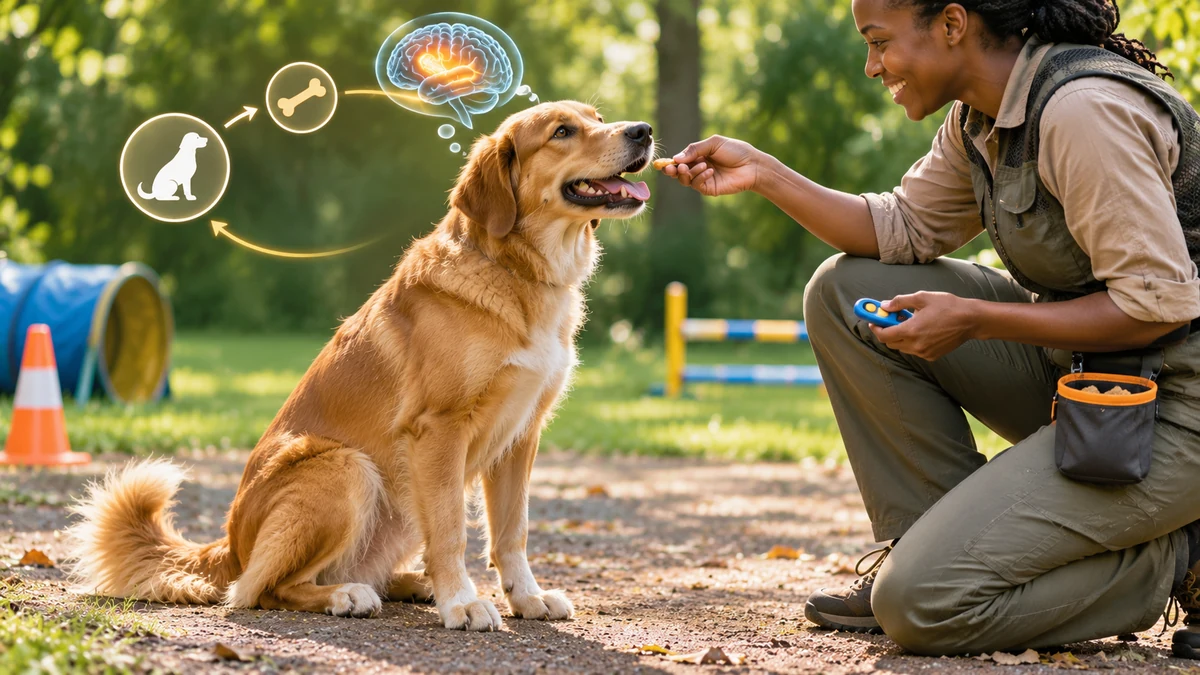
Imagine your dog sits, stands up and then receives a treat. Which behaviour did you reward? Dogs learn more clearly when the consequence is closely connected in time to the action you want. A marker signal, such as a clicker or a consistent word like “yes”, can identify the precise moment of success before you reach for the reward.
To introduce a marker, first present the sound briefly and follow it with a reward several times. The signal can then become a reliable predictor of good things. During training, mark the chosen behaviour and follow with the promised reward. A clicker is not a remote-control device; it is a learned signal whose value comes from consistent pairing.
A 2025 study of detection dogs found that a marker group completed a particular scent-alert training stage in fewer trials and performed more accurately on some tests than a reward-only group. Those are task-specific results, not proof that every household dog must use a clicker. A consistent verbal marker can also work when the timing and reward association are clear.
6. Cues, luring, capturing and shaping: four practical training tools
A cue is a signal that tells a dog when a known action is likely to pay off. It could be a short word, a hand gesture or another consistent signal. Dogs do not automatically know what “sit”, “stay” or “come” means in English; they learn which responses follow those particular sounds and movements.
Luring uses the movement of a reward to guide an action. Capturing rewards a desirable action that the dog offers spontaneously. Shaping reinforces small steps toward a more complex behaviour. A marker helps communicate which step worked.
For example, you could capture a spontaneous moment of lying on a mat, then reinforce increasingly relaxed behaviour there. Once the dog readily offers the action, add a short verbal cue. Phase out the visible food lure so the dog responds to the cue rather than needing to see a treat in your fingers. This progression is described in the Merck Veterinary Manual's guidance on behaviour modification .
7. Step-by-step: teach a dog to sit with rewards
This beginner exercise is appropriate when the dog is healthy, relaxed and physically comfortable with sitting. Never press down on a dog's hips or force a posture, especially if the animal has joint pain or mobility limitations.
- Choose a quiet setting. Reduce distractions and have a few small, appropriate rewards ready.
- Wait for or gently encourage a sit. You can capture an offered sit or move a treat slowly in a way that makes sitting easy without pushing the dog.
- Mark the moment. When the dog's bottom reaches the ground, say “yes” or click once.
- Deliver the reward. Give the promised treat promptly while the dog is still in a comfortable position.
- Repeat a few times. Stop before the dog becomes bored or stressed; brief, successful sessions are preferable to prolonged drilling.
- Add a cue. Once the sit is predictable, say “sit” shortly before the dog performs it, then mark and reward.
- Practise in more places. Begin in a familiar room, then try another quiet area before introducing bigger distractions.
If a dog refuses to sit repeatedly, consider whether the surface is slippery, the reward is uninteresting or the movement is uncomfortable. Persistent difficulty or signs of pain warrant veterinary assessment rather than stronger physical pressure. Do not use a sit cue to force a frightened dog to remain near something it wants to escape.
8. Step-by-step: teach a reliable recall
Recall means returning to the handler when called. It is an important safety skill, but no animal should be assumed perfectly reliable around traffic, wildlife or highly exciting distractions. Start where success is easy and use a secure fenced area or appropriate long line as training advances.
- Stand a short distance from your dog in a quiet, safe room.
- Use one cheerful recall cue, such as “come”, without repeating it continuously.
- When the dog moves toward you, warmly encourage its approach; mark and reward arrival generously.
- Let the dog go back to a pleasant activity sometimes, so returning does not always mean the fun ends.
- Increase distance and distractions gradually, one difficulty at a time.
- If recall breaks down, return to an easier setting rather than scolding the dog for arriving late.
The RSPCA's recall guide recommends building the skill in low-distraction settings and maintaining reward value. Use secure leads, fences and supervision for real-world safety even while recall is improving.
9. Training calm greetings, loose-leash walking and settling
Many everyday frustrations are opportunities to teach a replacement behaviour rather than waiting for an unwanted action and reacting harshly.
Jumping to greet: arrange enough distance or a barrier for the dog to stay composed. Reward four paws on the floor and ask visitors to participate calmly. Do not make greetings exciting and then punish the dog for responding to that excitement.
Leash pulling: begin in a quiet area, reward moments when the leash is slack and the dog returns toward you, and gradually practise around distractions. Appropriate equipment can help with management, but painful leash jerks do not teach a dog what loose-leash walking looks like.
Settling on a mat: reward the dog for approaching the mat, then for standing or lying calmly on it. Build duration in small increments and give the dog an opportunity to rest voluntarily. A mat should become a predictable, positive place—not an enforced isolation area.
These exercises use environmental management, clear criteria and reinforcement. Training should work with the animal's physical and emotional capacities, not against them. Merck's social-behaviour chapter discusses constructive play and training activities.
10. Reading dog body language while training
Dogs communicate through their entire bodies: posture, facial muscles, eyes, ears, tails, vocalisations and movement. A wagging tail does not automatically mean a dog is comfortable. Tail height, speed, stiffness and the rest of the body help provide context. Researchers have documented that different tail movements may relate to different emotional situations, but these associations are not a simple word-for-word translation of canine feelings. A peer-reviewed review of dog communication explains these signals.
| Observation | Possible interpretation | Training response |
|---|---|---|
| Loose muscles, normal breathing, relaxed movement, willingly approaching | The dog may be comfortable and receptive. | Continue at an achievable difficulty, watching for change. |
| Looking away repeatedly, slowing down, sniffing unusually, lip licking outside eating | Could indicate uncertainty, conflict, displacement or context-specific behaviour. | Pause, assess the whole situation and simplify the task. |
| Freezing, stiffening, hard stare, tense mouth, weight shifted away | Possible discomfort or escalating tension. | Increase distance and remove pressure; prioritise safety. |
| Cowering, repeated attempts to flee, trembling, tucked posture | Possible fear or severe distress. | Stop the exercise; provide a safe exit and consider professional guidance. |
| Growling or showing teeth | Warning or distress in a particular context. | Do not punish the warning; give space and evaluate the trigger. |
One signal cannot diagnose an emotion. Panting may reflect heat or activity; lip licking may occur around food; tail carriage differs by anatomy. Look for clusters of signs, the setting and change from the dog's usual behaviour. The RSPCA's illustrated body-language guide and RSPCA Australia guide provide accessible examples.
11. Why dogs stop listening: distractions, fear and generalisation
A dog that sits reliably in the kitchen may not sit in a park full of unfamiliar smells, people or squirrels. This is a normal part of generalisation: a response learned in one context may not transfer automatically to every other place. Training across several comfortable environments helps dogs discover that the cue predicts the same behaviour in different situations.
Change one difficulty at a time. Increase duration while staying in a quiet room, then practise a shorter duration in a new location. Raise distraction levels only when the dog can succeed. If the dog is barking, lunging or refusing food because it is frightened, the immediate priority is space, safety and emotional regulation, not obedience to a louder command.
Pain, illness, fatigue, insufficient rest and unsuitable training expectations can also interfere with learning. A sudden behaviour change or persistent difficulty deserves appropriate veterinary assessment. Merck's behaviour-problems guidance stresses medical evaluation, safety management and individually tailored behaviour plans.
12. How much practice is enough? Building a humane routine
Short, successful sessions are usually more productive than a single lengthy session that ends in frustration. As an illustrative starting point, many healthy pet dogs can practise for two to five minutes at a time, with breaks and adjustments based on the individual. That is a practical suggestion, not a scientifically fixed limit or a demand that every puppy and adult follow one schedule.
| Stage | Training focus | What success looks like |
|---|---|---|
| Start | Quiet environment, one easy action, immediate reward | Dog willingly offers the behaviour several times |
| Add a cue | One consistent word or hand signal | Dog responds without needing a visible lure |
| Change one element | New room, slightly longer duration or modest distance | Behaviour remains relaxed and repeatable |
| Generalise | Different safe locations and ordinary distractions | Dog can respond in varied contexts |
| Maintain | Occasional meaningful rewards and continued practice | Skill stays useful without constant visible food prompts |
When a skill is new, reward it consistently. As it becomes reliable, it can be maintained through a suitable mixture of rewards and everyday opportunities, but do not abruptly stop rewarding a behaviour that is still fragile. For difficult situations, increase reward value or reduce task difficulty rather than treating mistakes as deliberate disobedience.
13. Puppies, socialisation and older dogs: is learning age-dependent?
Puppies learn early, including through interactions with littermates, people and the environment. The AVSAB identifies the first three months of life as a particularly important socialisation period. Good socialisation is not forcing a puppy to meet everything: it means safe, positive, manageable experiences with different people, surfaces, sounds, sights and appropriate animals. Consult a veterinarian about vaccination, local infection risks and safe opportunities for exposure. Read the AVSAB socialisation guidance .
Adult and older dogs can also learn new behaviours. Age, sensory changes, pain and previous experiences may affect the pace or kind of training that works best, but learning does not suddenly end after puppyhood. Older dogs may benefit from comfortable surfaces, shorter sessions and modified cues if hearing or vision has changed.
Research on dog cognition offers further context. A 2021 comparison of dog and wolf puppies found that dog puppies often responded more readily to certain human communicative gestures. A separate study of eight-week-old dog puppies found early-emerging responsiveness to human signals. Those findings do not mean training is automatic or that all dogs understand every human intention; individual experience and learning still matter.
14. When is training alone not enough?
Basic reward-based training is not a substitute for professional help when a dog shows repeated biting, serious resource guarding, panic when left alone, severe reactivity, sudden aggression or persistent fear. These problems can involve medical issues, emotional distress and safety risks. The response should involve reducing triggers, protecting people and animals, obtaining veterinary assessment and working with a qualified professional who uses humane, evidence-based methods.
Desensitisation and counterconditioning may help change difficult emotional responses when carried out carefully at manageable intensity, but deliberately exposing a frightened dog to overwhelming stimuli can make problems worse. Do not try to “flood” a dog with its fear or suppress growling through threats. The ASPCA's training-method statement recommends qualified professionals for severe distress or risk of injury.
If a bite or scratch has already occurred, attend to human safety and seek appropriate healthcare advice rather than relying on training alone. SuperEducational's published guide to what to do after an animal bite or scratch explains the urgency of exposure assessment and professional care. Training guidance and medical treatment are separate responsibilities.
Common dog-training myths and what the evidence supports
| Myth | Evidence-based correction |
|---|---|
| “Dogs naturally understand words like sit and stay.” | They learn consistent cues through experience and context. |
| “A treat is a bribe, so rewards undermine training.” | Well-timed reinforcement teaches behaviour; gradually reducing visible lures is different from removing all meaningful reinforcement. |
| “Clickers magically improve every dog's learning.” | Markers can clarify feedback; effects depend on task, timing and the dog's learned association. |
| “Dominating a dog is the foundation of obedience.” | A universal alpha hierarchy is not a reliable explanation of everyday training problems. |
| “A wagging tail always means the dog is happy.” | Tail movement must be read with posture, facial expression and context. |
| “A dog that disobeys is being spiteful.” | Distraction, incomplete learning, stress, pain or mismatched rewards may explain the response. |
| “Puppies must be forced to greet many strangers.” | Positive, voluntary socialisation is safer than overwhelming exposure. |
| “Old dogs cannot learn new skills.” | Dogs can learn throughout life, with training adapted to health and sensory abilities. |
Frequently asked questions about how dogs learn
What is the best way to train a dog?
Begin with humane, reward-based teaching: make the desired behaviour easy, mark it clearly, reward promptly and practise gradually in different settings. If a dog is distressed or behaviour poses a safety risk, seek qualified professional support.
How do dogs learn words and commands?
They learn to associate particular sounds or gestures with situations and consequences. Clear, consistent cues work better than repeatedly changing a word or assuming the dog understands it automatically.
What is positive reinforcement for dogs?
It means adding something the dog values after a behaviour so that the behaviour becomes more likely. Food, play, praise and access to enjoyable activities can function as reinforcers when the dog actually values them.
Is clicker training better than treats alone?
A clicker is a marker, not a substitute for the reward it predicts. Some studies find benefits in particular tasks, but a reliable verbal marker or well-timed direct reward can also be useful.
Why does my dog listen at home but not outside?
Dogs do not automatically generalise a cue between settings. Outdoor environments contain more distractions, novel smells and competing motivations. Return to easier practice and increase difficulty gradually.
Does a wagging tail mean a dog wants attention?
Not necessarily. A wag can accompany several kinds of emotional arousal. Look at the whole body, the situation and whether the dog voluntarily approaches or withdraws.
Should you punish a dog for growling?
No. Growling may warn of fear or discomfort. Give space, manage the situation safely and address the underlying problem. Suppressing warnings without changing the cause can increase risk.
How long should a dog training session last?
There is no single prescribed duration for every dog. Several brief sessions of a few minutes may work well for beginners, provided the dog remains relaxed and interested.
Can older dogs learn new things?
Yes. Adult and senior dogs can learn, although pain, sensory changes, fatigue and previous experiences may call for different training methods and pacing.
What if reward-based training does not solve aggression?
First prioritise safety and veterinary assessment. A qualified veterinary behaviourist or appropriately credentialled humane behaviour professional can design a plan that addresses emotion, health, management and learning rather than relying on punishment.
Conclusion: understanding learning makes training more effective
How dogs learn becomes easier to understand when we separate association, consequences and social information. Classical conditioning helps dogs predict events and develop emotional associations. Operant conditioning explains how well-timed consequences can strengthen useful behaviour. Social learning and attention to human cues enrich their understanding of the world.
Good training then brings those principles together through clear signals, meaningful rewards, gradual practice and careful observation of body language. A relaxed dog that can succeed is more likely to learn than one overwhelmed by pain or fear. By treating training as a partnership shaped by science, experience and welfare, people can build reliable skills while respecting dogs as individual animals.
References and further reading
- American Veterinary Society of Animal Behavior — Humane Dog Training Position Statement (2021, current AVSAB guidance) .
- AVSAB — What Are Reward-Based Training Methods for Dogs and Cats? .
- Merck Veterinary Manual — Behavior Modification in Dogs .
- Merck Veterinary Manual — Treatment of Behavior Problems in Animals .
- Merck Veterinary Manual — Social Behavior of Dogs .
- Merck Veterinary Manual — Behavior Problems of Dogs .
- Frontiers in Veterinary Science (2021) — Working Dog Training for the Twenty-First Century .
- PLOS ONE (2020) — Does Training Method Matter? Effects of Aversive-Based Training on Companion Dog Welfare .
- Animals (2024) — Comparison of Training Methods for Interrupting Chasing Behaviour .
- Frontiers in Veterinary Science (2025) — Effectiveness of Marker Training for Detection Dogs .
- RSPCA — How to Train Your Dog .
- RSPCA Australia — Teaching Recall .
- RSPCA — Understanding Your Dog's Body Language .
- Animals (2018) — Communication in Dogs .
- AVSAB — Puppy Socialization Position Statement .
- Current Biology (2021) — Cooperative Communication with Humans Emerges Early in Dogs .
- Current Biology (2021) — Early-Emerging and Highly Heritable Sensitivity to Human Communication in Dogs .
- ASPCA — Position Statement on Training Aids and Methods .