Dog biology explores how domestic dogs are built, how they sense their surroundings, why they behave as they do and how they evolved through a long partnership with humans. A dog is a mammal in the family Canidae, commonly classified as Canis lupus familiaris or Canis familiaris. Dogs share ancestry with ancient grey-wolf populations, but the ancestor of today's dogs was not simply a modern wolf turned into a pet.
A dog's skeleton supports running and jumping; its teeth and digestive system reflect a carnivorous ancestry and adaptation to varied food; and its nose, ears and eyes gather information that people experience very differently. Dogs also communicate through posture, facial movement, vocalisations and scent. Their behaviour emerges from a mixture of genetics, learning, development and circumstances, not from breed labels alone.
There is an important new discovery in the history of domestication: two Nature studies published on 25 March 2026 reported ancient canine genetic evidence including a dog from Pınarbaşı, Türkiye, about 15,800 years ago, and a dog from Gough's Cave, Britain, about 14,300 years ago. The precise origin and geographical location of dog domestication remain uncertain. Those findings make it especially important not to repeat a misleading claim that every dog was domesticated at one known place or on one exact date. See the ancient-DNA study and companion genomic analysis .
Dog biology at a glance
| Feature | Biological explanation |
|---|---|
| Scientific classification | Mammal; order Carnivora; family Canidae; domestic dog, usually Canis lupus familiaris or Canis familiaris |
| Body covering | Hair or fur over skin, with substantial variation across breeds and individuals |
| Skeleton and movement | Vertebral column, four limbs, flexible joints and digitigrade stance on the toes |
| Teeth | Usually 28 temporary puppy teeth and 42 permanent adult teeth |
| Senses | Highly developed smell; sensitive hearing; dichromatic colour vision; tactile and body-position systems |
| Diet | Nutritionally adaptable omnivore with carnivorous ancestry; needs a complete, balanced diet |
| Communication | Posture, tail and ear position, facial expressions, vocalisations, scent and context |
| Reproduction | Placental mammal; typically around 63 days' gestation when timed from ovulation |
| Domestication | Derived from ancient wolf ancestry; unequivocal genetic evidence by about 15,800 years ago |
These are species-level patterns. Dogs range from tiny companion animals to large working dogs; no single breed represents the anatomy, behaviour or health of every dog. For more on how mammals fit within the animal kingdom, see SuperEducational's published guide to animal classification .
1. Dog anatomy: bones, joints and muscles
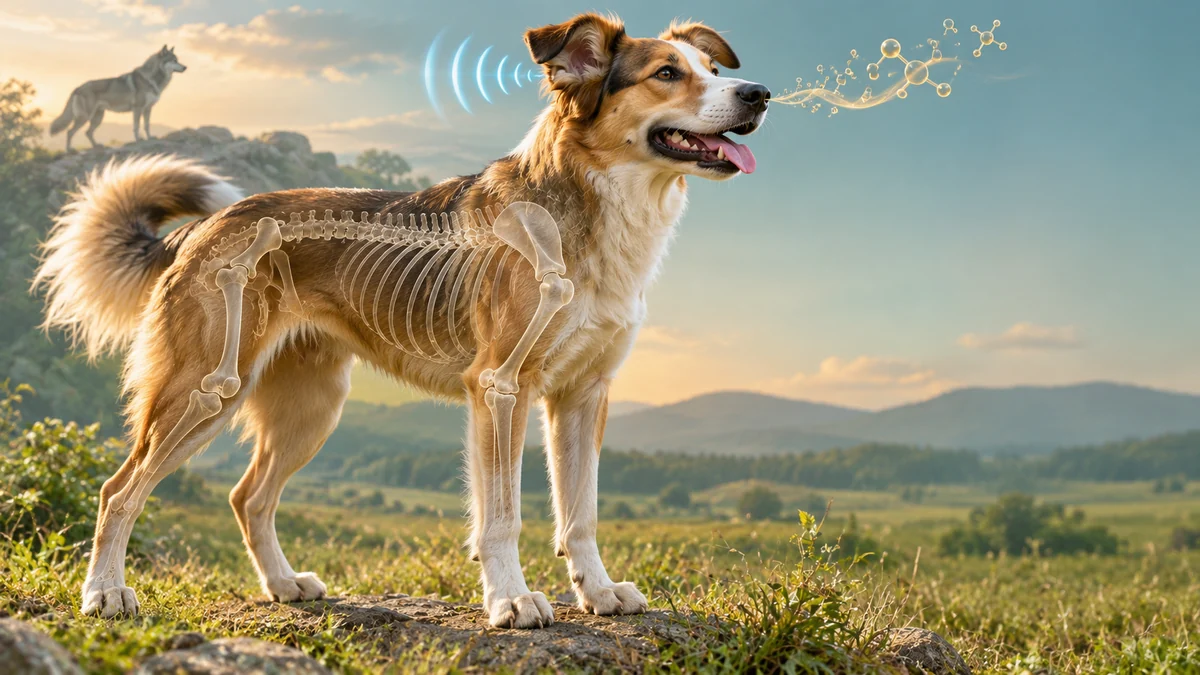
The dog has an internal vertebrate skeleton, consisting of a skull, vertebral column, rib cage and limb bones. Its skull protects the brain and supports the jaws, while its backbone supports posture and protects the spinal cord. The shoulder blade, upper arm, forearm, pelvis, thigh and lower-leg bones connect through joints that permit walking, running, climbing, digging and jumping.
Dogs generally walk in a digitigrade posture: their weight is supported principally by their toes rather than by laying the whole sole on the ground as humans do. Their paw pads provide grip and cushioning. Most front paws have four main weight-bearing toes plus a dewclaw, although anatomy varies, and extra digits may occur. Strong tendons, muscles and ligaments help stabilise the joints and transfer force during movement.
Breed-associated shapes can change how these structures are loaded. A long-backed dog, a short-faced dog and a tall, deep-chested dog share the same basic mammalian architecture but may have different physical capabilities and inherited health vulnerabilities. The Merck Veterinary Manual's introduction to dogs describes their main structural features and variations.
How does a dog run?
Running requires coordinated extension and flexion of the forelimbs and hindlimbs, stabilisation of the spine and accurate sensory feedback about foot placement. Different gaits—walk, trot, canter and gallop—change which feet contact the ground and how force is distributed. The nervous system, muscles, tendons and body-position sensors work together; no single “running muscle” controls the whole action.
2. Dog teeth and the digestive system
Most puppies develop 28 temporary teeth, which are replaced by 42 permanent teeth in a normal adult mouth. Permanent dentition usually includes 12 incisors, four canine teeth, 16 premolars and ten molars. The long canines grip, while premolars and molars help cut or crush food. Specialised carnassial teeth are part of the carnivore evolutionary heritage and are especially suited to shearing. The Merck Veterinary Manual dental guide provides the counts.
Food passes through the mouth, oesophagus, stomach, small intestine and large intestine. The stomach begins chemical digestion, while enzymes and secretions from the pancreas and liver-associated system support digestion and nutrient absorption farther along. The large intestine absorbs water and processes remaining material. Dogs need protein, fats, vitamins, minerals, water and appropriate energy intake for their age and activity.
Are dogs carnivores or omnivores?
Dogs belong to the mammalian order Carnivora, but taxonomic classification is not the same thing as a strict dietary rule. Their ancestors ate substantial animal-derived food, yet domestic dogs have adaptations that allow them to use a range of foods, including starches. Veterinary nutrition references generally describe dogs as nutritional omnivores, in contrast to obligate carnivores such as cats. Their diet must nevertheless be formulated to meet canine nutritional requirements. Merck's small-animal nutrition overview explains this distinction.
In practical terms, a diet that sounds “natural” is not necessarily complete or safe. Puppies, adults, pregnant dogs and animals with medical conditions may need different nutritional approaches. A qualified veterinarian can assess individual needs without treating dog biology as a reason to feed one fashionable diet to every animal.
3. How do dogs smell so well?
Smell is a dominant sensory channel for dogs. Airborne chemicals reach the olfactory region of the nose, where receptor neurons respond to molecular features. Sniffing changes airflow and helps sample odours, while the olfactory bulb and other brain networks interpret patterns of receptor activation. Dogs can follow scent trails, investigate the environment and obtain social information through smell.
The popular claim that every dog has exactly “300 million smell receptors” is too rigid. Olfactory anatomy, receptor genes, receptor expression and performance vary across individuals and lineages; scent detection also depends on training, environment, airflow and the chemical being detected. A 2025 genetic and anatomical study compared 56 domestic dog breeds with wolves and coyotes and found meaningful variation rather than one fixed olfactory system. A review of canine olfaction explains sniffing and odour recognition.
Dogs use scent for exploration, recognition and communication, and carefully trained dogs can help find missing people or detect particular materials under controlled conditions. A dog's interest in one smell does not prove it has diagnosed a disease or identified a substance with certainty. In scientific work, performance is checked through appropriate controls and error rates.
4. Dog hearing: sensitive ears and sound processing
Sound waves travel through the ear canal, vibrate the eardrum and pass through the middle-ear bones to the inner ear. In the cochlea, tiny hair cells convert mechanical movement into signals sent along the auditory nerve. The brain processes the patterns to identify direction, timing and meaning.
Dogs can detect many higher-frequency sounds than adult humans, although hearing sensitivity varies with age, ear health, genetics and the particular frequency. Moving external ears may help some dogs collect or orient toward sounds. This helps explain why a dog may respond to a whistle or distant noise that its human companion barely notices. The peer-reviewed review of canine olfaction, vision and hearing explains these specialised systems.
High-frequency sensitivity is not an invitation to use painful or extremely loud training sounds. Animals can be frightened by fireworks, thunder or household noise. Hearing-related discomfort, new sound sensitivity or apparent hearing loss should be assessed with veterinary advice rather than assuming a dog is being disobedient.
5. Dog vision: can dogs see colour?
Dogs are not limited to black-and-white vision. They have a dichromatic colour-vision system, commonly described as distinguishing blues and yellows better than red–green differences. Humans with typical trichromatic vision have three main cone classes; dogs generally have two. Consequently, a red object against green grass may be less visually distinct to a dog than a blue or yellow object.
Dogs also have retinal adaptations that help in lower light, including a high contribution from rod cells and, in many dogs, a reflective layer called the tapetum lucidum. However, their visual acuity and colour discrimination are not identical to a person's. Breed, skull shape, eye position, light level and health all affect performance. See the American Kennel Club's colour-vision overview and the veterinary sensory review .
Dogs often combine vision with scent and hearing. A dog searching for a toy may use movement and contrast to find it, then confirm its identity through smell. Evaluating a dog's world through one human-like visual standard misses this multisensory processing.
6. Touch, whiskers and body-position senses
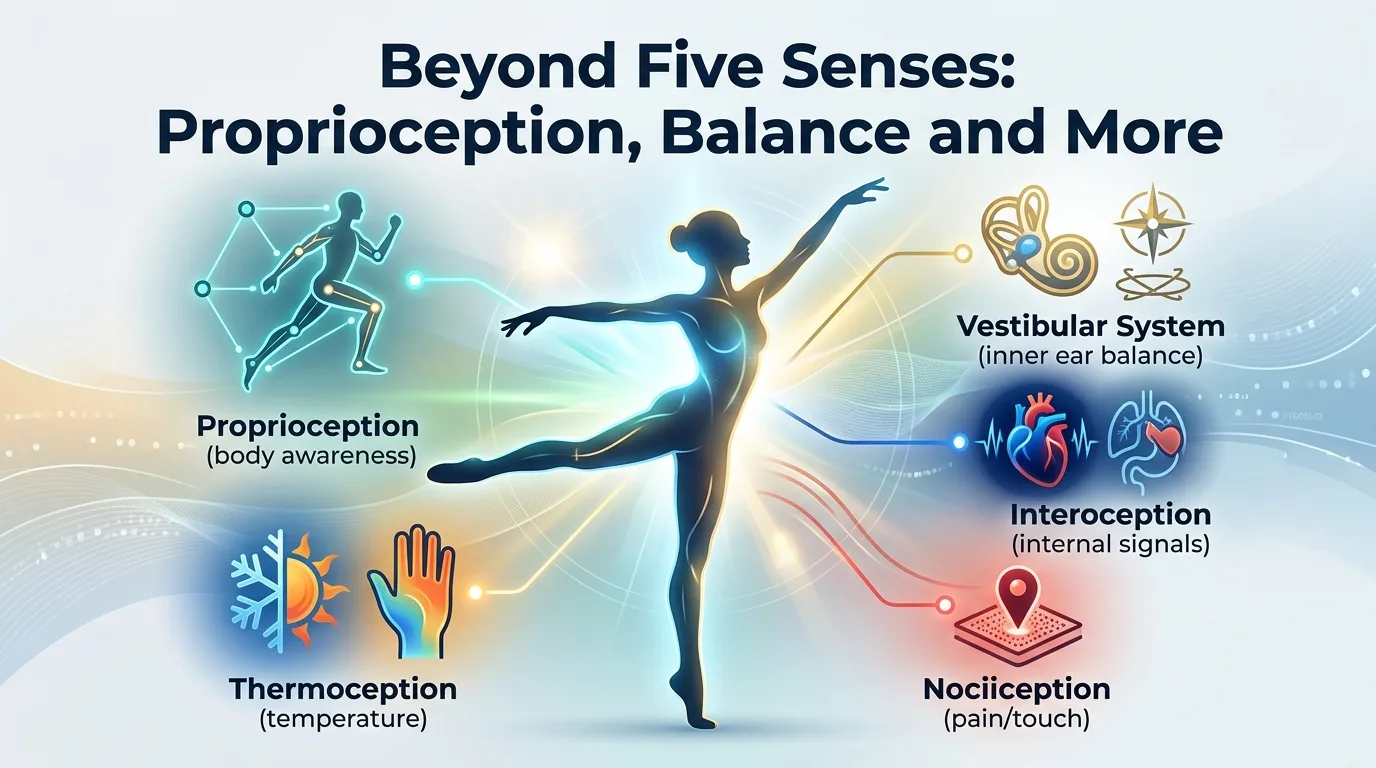
Dogs feel contact, temperature and potentially harmful stimuli through sensory nerves in the skin and deeper tissues. Their whiskers, or vibrissae, are specialised tactile hairs associated with sensory nerve endings. They provide information when objects or air movements contact the whiskers and should not be regarded as merely decorative fur.
Dogs also depend on proprioception, which supplies information about the position and movement of muscles and joints, and on the vestibular system in the inner ear, which helps detect head motion and orientation. These systems work together with the eyes to support balance and coordinated locomotion.
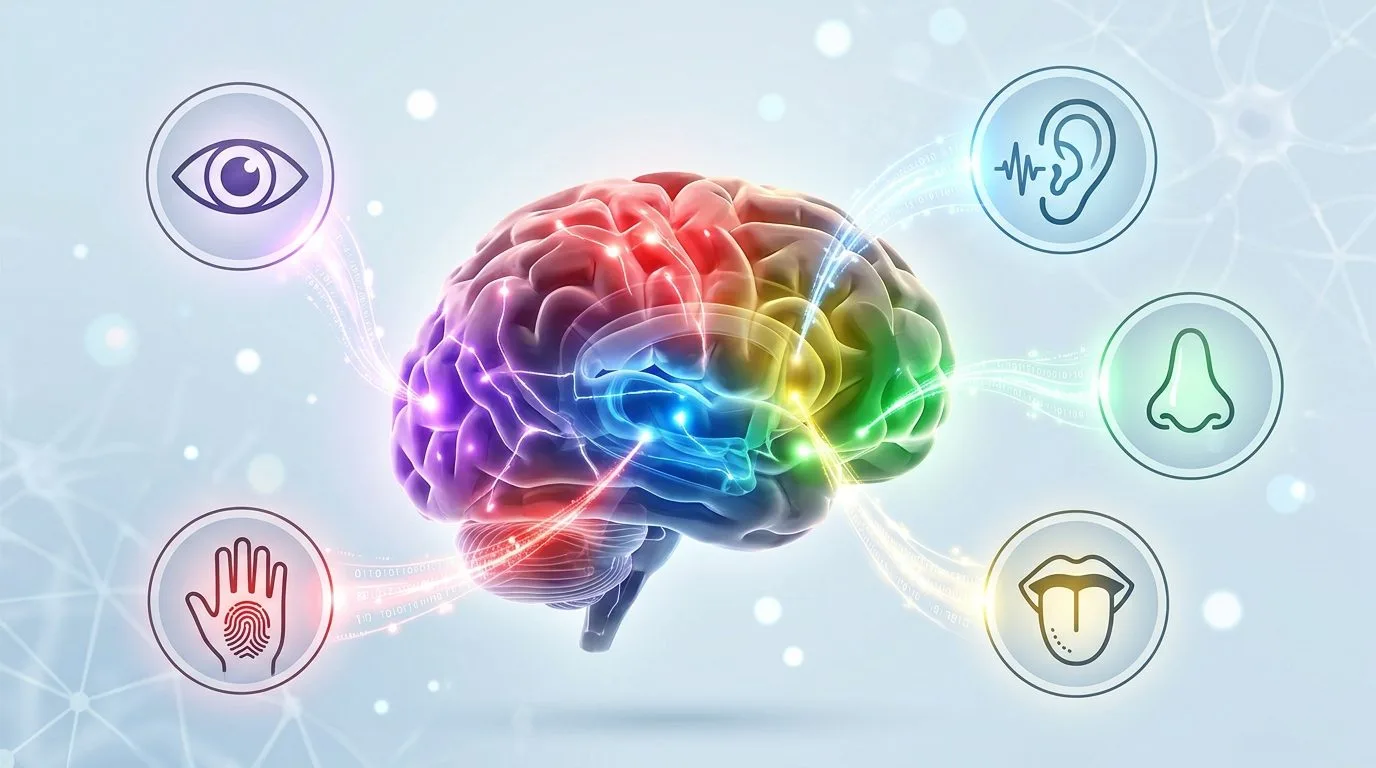
This is a reminder that the standard list of five senses is an introductory framework rather than a complete inventory of mammalian sensory abilities. SuperEducational's later lessons on the human senses explore the same general biological principles, but a dog's receptor distribution and sensory performance need not match those of a human.
7. How dogs stay cool: panting and thermoregulation
Dogs are endothermic mammals: they regulate body temperature through metabolism, circulation and physiological responses. Unlike humans, they do not cool themselves mainly by sweating across large areas of skin. They rely heavily on panting, which promotes evaporation from moist respiratory surfaces. Dogs also have sweat glands in parts of their paws, but that contribution is limited compared with full-body human sweating.
Hot weather, humidity, activity, age, health and physical conformation all affect the ability to shed heat. Thick coats and shortened muzzles can create different challenges for some dogs, although risk cannot be determined by a breed label alone. Water, shade and avoiding excessive exertion in heat matter; a parked vehicle can become dangerously hot very quickly. The Merck Veterinary Manual discusses panting and heat risks.
8. Dog behaviour: communication through the whole body
Dog behaviour is shaped by motivation, sensory information, development, past experiences, health and social context. Dogs communicate with people and other dogs through posture, ears, tails, gaze, vocalisations and scent. No single sign translates directly into a fixed human sentence.
A wagging tail does not always mean a dog is friendly. Tail movement can accompany arousal, uncertainty or tension as well as relaxed social interest. A loose body, soft facial muscles, natural ear position and voluntary approach together suggest a different situation from a stiff body, hard stare, frozen posture or attempts to withdraw. Context matters: the same tail position may have a different meaning in a curled-tail breed and a naturally low-tailed one.
Barking, growling, whining and howling are forms of communication but also depend on circumstances. Growling can be a valuable warning that an animal needs space; punishing a warning without addressing its cause may increase risk. The Merck Veterinary Manual's canine social-behaviour chapter provides a veterinary account of communication and social relationships.
Are dogs trying to dominate their families?
The simplistic idea that every unwanted behaviour reflects a dog striving to become a household “alpha” is not a sound general explanation. Dogs can compete over resources or learn habits through consequences, but their relationships with humans are not accurately described as a single dominance contest. Humane teaching focuses on creating predictable environments, reinforcing desired behaviours and understanding fear, frustration or unmet needs. The American Veterinary Society of Animal Behavior publishes guidance on humane training.
9. Social learning, play and canine intelligence
Dogs can learn through repeated experiences, rewards, observation, social interactions and problem solving. Many are especially sensitive to familiar human routines and gestures. In experiments, dog puppies have shown greater attraction to human social cues and stronger responses to pointing than intensively human-reared wolf puppies under some controlled conditions. A 2021 comparative study found differences in human-directed social skills early in development.
These findings do not mean wolves lack intelligence or every dog understands a person's intention. Dogs and wolves may excel at different tasks, and performance changes with learning and context. Being good at interpreting a pointing finger is a specific ability, not a universal measure of intelligence. Researchers continue to investigate how domestication and experience have affected social cognition.
Play serves multiple functions: practising movement, exploring objects, interacting with others and learning behavioural boundaries. Healthy social learning should not require forced contact with unfamiliar dogs. Young animals benefit from carefully managed, positive exposure, adequate rest and opportunities to withdraw from overwhelming situations.
10. Do dog breeds determine behaviour?
Selective breeding has produced astonishing variation in size, fur, skull shape and some working abilities. Certain populations have inherited tendencies shaped by human selection for herding, retrieving, tracking or companionship. Yet breed is a poor predictor of the personality of an individual dog. A large genomic and owner-survey study published in Science in 2022 found that behavioural traits have genetic components but generally do not separate neatly into breed categories. Read the study .
Follow-up research on canine genomes also shows that genes linked to behaviour are complex and can overlap with variants associated with appearance or lineage. A 2025 analysis of genetic prediction cautioned against assuming current DNA tests can accurately forecast a single dog's behaviour. Learning, individual history, health and environment remain essential.
Therefore, statements such as “all members of this breed are aggressive” or “this breed is automatically safe with children” are poor substitutes for observing an individual animal and managing interactions responsibly.
11. Where did domestic dogs come from?
Dogs evolved from an ancient wolf lineage through a long process of association with humans. That association preceded agriculture and may have involved multiple stages: wolves living near human communities, differences in tolerance or behaviour, mutual advantages and later deliberate selection. The exact pathway remains debated. It is inaccurate to suggest that a single person tamed one wolf and thereby created every modern dog.
Genetic studies show that living dogs are related to grey wolves but do not simply descend from one living wolf population. An earlier study of 27 ancient dog genomes found shared dog ancestry distinct from present-day wolves. Some ancient wolf populations may have contributed different ancestry through a complicated history of divergence and gene flow.
What changed in the 2026 ancient-DNA research?
On 25 March 2026, two major papers in Nature strengthened the historical record. One identified dog ancestry in a specimen from Pınarbaşı, Türkiye, around 15,800 years ago, and in another from Gough's Cave in Britain, around 14,300 years ago. The other analysed early European dog genomes, including a 14,200-year-old dog from Kesslerloch, Switzerland, and demonstrated connections with the ancestry of later dogs. These studies indicate that domestic dogs were already distributed in more than one part of western Eurasia during the Palaeolithic. Read the first paper and the companion study .
Importantly, the oldest securely identified dog specimen is not automatically the date domestication began. Archaeology only preserves a fraction of past animals, while a genetic split between ancestral populations may have occurred before a recognisable domestication relationship developed. The research does not establish one undisputed “first dog village”.
12. How did domestication change dogs?
Over generations, human association and selection helped shape dogs' social tolerance, communication, feeding adaptations and diversity of body forms. Early populations were not equivalent to modern standardised breeds. Many familiar breeds reflect much later, often recent, selection by humans for appearance or specific tasks.
Some traits may have been favoured because they helped dogs coexist with people, while others arose through selection for herding, guarding, transport or companionship. The relationship was not always equally beneficial to dogs: human management also affected disease exposure, freedom of movement and reproduction. Domestication is a population-level evolutionary history rather than the training of an individual animal.
The review of canine genomic history explains the demographic changes and genetic bottlenecks associated with domestication and later breed formation. Breeding for exaggerated physical traits can create welfare problems, which is why health and function are important considerations alongside appearance.
13. Reproduction, development and lifespan
Dogs are placental mammals that give birth to live puppies and nourish them with milk. Pregnancy is often summarised as about 63 days from ovulation, although a measured interval from mating can vary considerably because mating date and fertilisation date are not identical. Merck's reproductive reference gives the timing distinctions.
Puppies begin life highly dependent on the mother and caregivers. Their sensory systems, movement and responses develop rapidly over their early weeks and months. Appropriate veterinary care, nutrition and calm, well-managed exposure to normal environments support development.
Dogs' lifespans vary with genetics, size, medical history, living conditions and access to healthcare. Small dogs often live longer than very large dogs on average, but there are many exceptions, so a single promised lifespan for all breeds would be inaccurate. For a broader discussion of animal lifespan differences, see SuperEducational's published biology of animal longevity .
14. What does responsible dog care have to do with biology?
Biological understanding helps make everyday care more appropriate. Exercise and enrichment should match the animal's age, health and capabilities; sniffing and exploration are meaningful activities, not simply distractions from walking. Complete, balanced nutrition must match life stage. Veterinary assessment helps detect problems involving teeth, ears, joints, breathing or other systems before they become severe.
People should learn to recognise when dogs are uncomfortable rather than expecting all animals to tolerate touch, handling or crowded social settings. A dog that freezes, moves away, growls or shows unusual changes in behaviour may need space or medical evaluation. Humane, reward-based training can teach desired behaviour without relying on intimidation or a simplistic alpha theory.
Dog biology also reminds us to avoid anthropomorphism: dogs can form strong social relationships and respond to human signals, but it is not scientifically justified to assume every human emotion or motive maps perfectly onto canine behaviour.
Dog biology: safe educational activities
| Activity | Method | Lesson |
|---|---|---|
| Skeleton diagram | Label skull, vertebrae, ribs, forelimb and hindlimb on a printed anatomical drawing. | Vertebrate body plan and digitigrade movement |
| Teeth comparison | Compare veterinary diagrams of a puppy mouth and adult dog teeth; never pry open an unfamiliar dog's mouth. | Temporary versus permanent dentition |
| Sensory comparison | Describe hypothetical scent and sound tasks using reliable sources; do not expose dogs to strong scents or loud noises. | Smell and hearing specialisations |
| Body-language study | Discuss photos of relaxed, uncertain and defensive dogs, noting posture and context. | Whole-body communication rather than single signs |
| Domestication timeline | Plot 15,800, 14,300 and 14,200 years ago using the 2026 studies. | What genetic evidence establishes—and what remains uncertain |
Always obtain consent from an animal's caregiver if a living dog is involved, use positive and voluntary interactions, and offer a way for the animal to move away. These are classroom observations, not veterinary diagnoses or behavioural tests.
Common myths about dogs and their biology
| Myth | Evidence-based explanation |
|---|---|
| “Dogs see only black and white.” | Dogs have colour vision, especially in the blue-yellow range. |
| “Every dog has the same number of smell receptors.” | Olfactory anatomy and genetic variation differ among individuals and lineages. |
| “A wagging tail always means happiness.” | Tail movement must be interpreted with posture and context. |
| “All dogs are obligate carnivores like cats.” | Dogs have carnivorous ancestry but are nutritionally adaptable omnivores. |
| “Breed perfectly predicts a dog's personality.” | Breed is a poor predictor of individual behavioural traits. |
| “Every behaviour problem is an alpha contest.” | Learning, fear, motivation and environment offer more useful explanations. |
| “Dogs were domesticated exactly 10,000 years ago in one known place.” | Ancient DNA verifies dogs at least 15,800 years ago; exact origins remain unresolved. |
| “Dogs cool down by sweating just like humans.” | They rely mainly on panting, with limited paw-pad sweating. |
Frequently asked questions about dog biology
What is the scientific name of a dog?
Domestic dogs are often classified as Canis lupus familiaris, treating them as a subspecies of the grey wolf, or as Canis familiaris in species-level treatments. Both reflect their very close evolutionary relationship with wolves.
How many bones does a dog have?
The number varies with individual anatomy, particularly the number of tail vertebrae and certain extra digits or small bones. For this reason, one fixed skeleton count is less useful than learning the skull, spine, ribs and limb systems.
How many teeth does an adult dog have?
Most normal adult dogs have 42 permanent teeth, compared with 28 temporary teeth in puppies.
What is a dog's strongest sense?
Smell is especially important and sophisticated in dogs, although hearing, vision and touch also support their daily activities. Sensory performance varies by individual, task and environment.
Can dogs see red and green like humans?
No. Their dichromatic colour system distinguishes blue and yellow ranges better than many red–green contrasts. That does not mean they see in black and white.
Are dogs wolves?
Dogs and grey wolves are extremely closely related, and dogs derive from ancient wolf ancestry. However, modern dogs are not simply tame modern wolves; their populations have undergone a distinctive domestication history.
When were dogs first domesticated?
Genetic findings published in March 2026 verify domestic dog ancestry in a roughly 15,800-year-old specimen. Domestication itself probably began earlier, but its exact timing and location remain uncertain.
Do dogs understand human pointing?
Many dogs can use pointing and other human gestures to locate targets, sometimes early in development. Performance varies, and it is not proof that dogs understand every human intention.
Why do dogs pant?
Panting helps release heat through evaporation from moist respiratory surfaces. Dogs rely less on skin sweating than humans do, which contributes to their vulnerability in hot weather.
Conclusion: dogs are shaped by evolution and experience
Understanding dog biology connects anatomy, senses, behaviour and domestication into one story. Their skeletons and muscles support agile movement; teeth and digestion reflect carnivore ancestry with dietary flexibility; and smell, hearing, vision and body-position senses help them navigate a complex world. Their social behaviour emerges from communication, learning, individual experience and genetics.
Ancient DNA places recognisable domestic dogs in human-associated environments at least 15,800 years ago, but the first stages of domestication remain an active research question. Today's dogs are diverse descendants of that long evolutionary partnership—not a collection of perfectly predictable breed stereotypes. A scientifically grounded view of dogs improves education, supports responsible care and deepens respect for the animals themselves.
References and further reading
- Nature (2026) — Dogs Were Widely Distributed Across Western Eurasia During the Palaeolithic .
- Nature (2026) — Genomic History of Early Dogs in Europe .
- Natural History Museum (2026) — Oldest Genetic Evidence of Domestic Dogs .
- Science (2020) — Origins and Genetic Legacy of Prehistoric Dogs .
- Nature Reviews Genetics — Demographic History, Selection and Functional Diversity of the Canine Genome .
- Merck Veterinary Manual — Description of Dogs .
- Merck Veterinary Manual — Dentition and Dental Nomenclature .
- Merck Veterinary Manual — Overview of Nutrition: Small Animals .
- Molecular Biology and Evolution (2025) — Genetic and Anatomical Determinants of Olfaction in Dogs and Wild Canids .
- Animals (2021) — Canine Olfaction: Physiology, Behavior and Practical Applications .
- Veterinary Review — Canine Special Senses: Olfaction, Vision and Audition .
- American Kennel Club — Can Dogs See Color? .
- Merck Veterinary Manual — Social Behavior of Dogs .
- American Veterinary Society of Animal Behavior — Position Statements .
- Current Biology (2021) — Cooperative Communication with Humans Emerges Early in Dogs .
- Science (2022) — Ancestry-Inclusive Dog Genomics Challenges Breed Stereotypes .
- PNAS (2025) — Genetic Testing Predicts Appearance but Not Behaviour in Dogs .
- Merck Veterinary Manual — The Reproductive System in Animals .