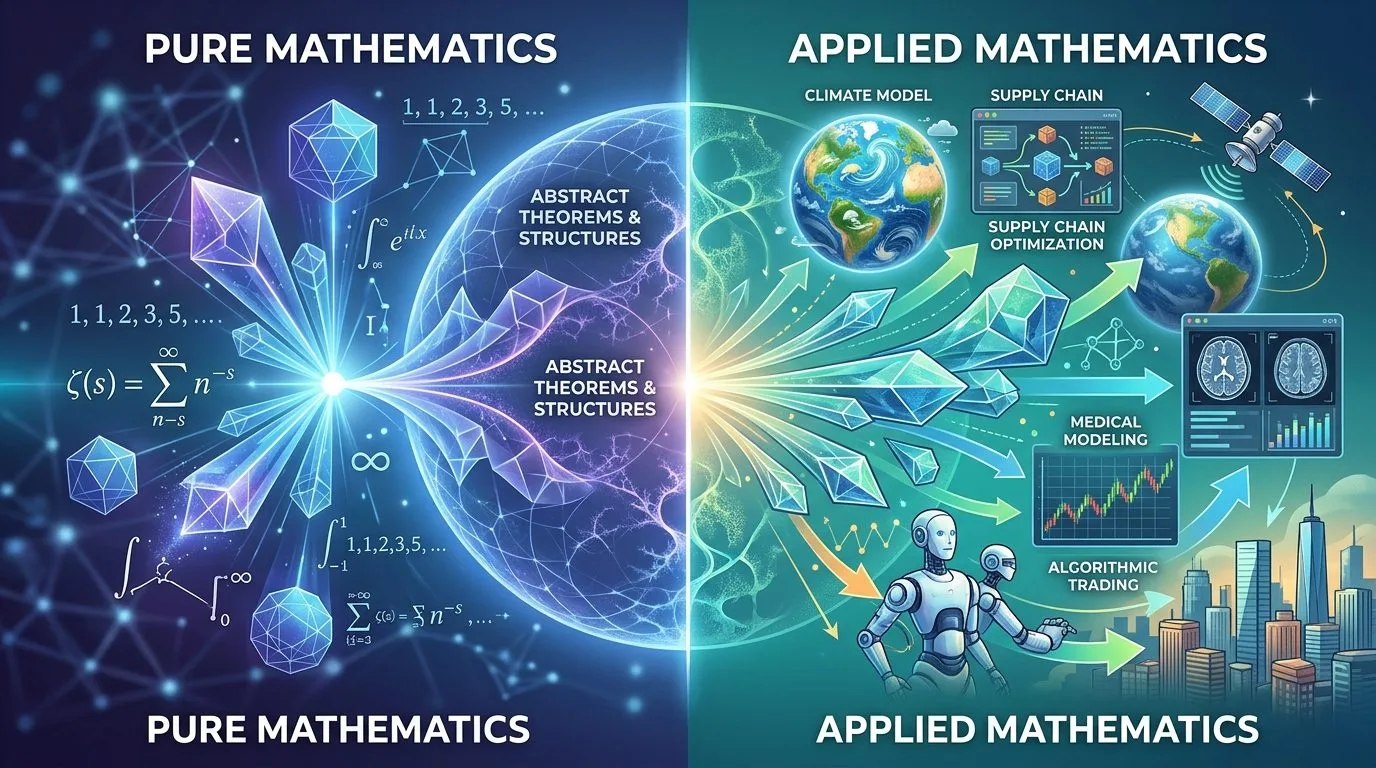
Pure mathematics investigates mathematical ideas, structures and relationships for their own sake, using definitions, logical reasoning and proof. Applied mathematics develops and uses mathematical methods to understand or solve problems in science, technology, business and society. The difference is mainly one of emphasis, not a permanent boundary: pure mathematicians can work on practical questions, and applied mathematicians frequently prove theorems.
If you are choosing a degree, planning a career or wondering why universities teach different forms of maths, this guide to pure vs applied mathematics compares what students learn, what daily work involves, which careers may follow and how to choose a direction. It includes a worked proof, a practical mathematical model, a career comparison chart and a student decision checklist.
The University of Waterloo describes pure maths as placing greater emphasis on rigorous justifications and abstract structures, while applied maths emphasises mathematical tools for real-world problems. Waterloo explicitly notes that applications appear in pure-maths courses and proofs also appear in applied-maths courses. The Society for Industrial and Applied Mathematics (SIAM) likewise defines applied maths through developing and applying mathematical tools across multiple disciplines.
Pure vs applied mathematics: differences at a glance
| Question | Pure mathematics | Applied mathematics |
|---|---|---|
| Primary emphasis | Understand and prove general mathematical truths | Use and develop mathematics to address a defined problem |
| Typical starting question | “Is this statement always true, and why?” | “How can we model, measure or improve this system?” |
| Common methods | Definitions, abstraction, logical arguments and proof | Modelling, analysis, approximation, optimisation and computation |
| Example topics | Number theory, abstract algebra, real analysis, topology, logic | Differential equations, numerical methods, optimisation, mathematical modelling, applied probability |
| Typical output | A theorem, proof, definition or new mathematical structure | A model, prediction, simulation, algorithm or improved decision rule |
| Role of computers | Useful for exploration, computation and some formal proofs | Often central to simulation, data analysis and numerical experiments |
| Career direction | Research, education, cryptography, algorithms and many other transferable paths | Data science, operations research, engineering modelling, finance, risk and research |
| Overlap | Can lead to applications and industry work | Requires theoretical insight and may involve rigorous proofs |
Neither subject is inherently more difficult, intelligent or employable. Individual courses, skills, projects and employers matter more than the label alone. A student studying applied mathematics may take very abstract modules; a pure mathematics student may become a software developer or quantitative analyst after building relevant additional skills.
What is pure mathematics?
Pure mathematics seeks to understand mathematical structures and discover relationships that can be established by proof. The questions may arise from curiosity rather than a customer's immediate problem. Instead of only calculating an answer for several examples, a mathematician might investigate whether a claim holds for every object satisfying stated assumptions.
Common subjects include number theory (properties of integers and primes), abstract algebra (groups, rings and fields), real and complex analysis (limits, continuity and functions), geometry and topology (spaces and their properties), and logic (the foundations of mathematical reasoning). These are overlapping research areas, not an exhaustive list. The Mathematics Subject Classification 2020 , maintained by Mathematical Reviews and zbMATH, demonstrates the range of modern mathematical research.
A proof is more than checking that something worked in five examples. It must explain why a conclusion follows for every case covered by the theorem. Advanced topics such as real analysis and abstract algebra therefore require practice in writing definitions and logically complete arguments. For an example of the university approach, see MIT OpenCourseWare's real analysis course .
A simple pure-maths example: why do odd numbers form perfect squares?
Notice a pattern:
1 = 1²
1 + 3 = 4 = 2²
1 + 3 + 5 = 9 = 3²
1 + 3 + 5 + 7 = 16 = 4²
The general claim is that the sum of the first n positive odd numbers equals n². A mathematical argument can prove it for every positive integer. Start with 1 = 1². If the first n odd numbers sum to n², the next odd number is 2n + 1. Adding it gives n² + 2n + 1 = (n + 1)². Therefore, the pattern continues from each positive integer to the next. This is an example of mathematical induction: establishing a base case and a rule that carries the claim forward.
This type of proof illustrates the pure-maths objective: a general explanation, not simply a list of correct calculations. It is also useful in computer science and algorithms, showing how theoretical and practical interests overlap.
What is applied mathematics?
Applied mathematics connects mathematical reasoning with a question outside—or motivated by—mathematics itself. A researcher might model how traffic moves, design a more efficient supply chain, investigate disease spread under defined assumptions or estimate how a bridge responds to loads.
SIAM identifies differential equations, linear algebra, numerical analysis, operations research, discrete maths, optimisation, control and probability as important applied-maths areas. SIAM's overview also explains the connection to computational science, where mathematical methods and software are combined to investigate complex systems.
Applied mathematical work often follows a cycle: define the problem → choose assumptions → build a model → analyse or compute → compare with evidence → improve the model. A mathematically correct result can still be unsuitable if its real-world assumptions are wrong. A prediction is therefore tested against data where possible, and uncertainty must be communicated honestly.
A simple applied-maths example: comparing two service prices
Imagine two fictional mobile data plans. Plan A charges a fixed ₦2,000 plus ₦100 per GB used, while Plan B charges a fixed ₦3,500 plus ₦50 per GB. Let g be the number of gigabytes purchased or used under this simplified pricing model.
Cost of A: A(g) = 2,000 + 100g. Cost of B: B(g) = 3,500 + 50g.
To find the break-even usage, set A(g) = B(g): 2,000 + 100g = 3,500 + 50g. Subtract 50g and 2,000 to get 50g = 1,500, so g = 30 GB. At that level both plans cost ₦5,000. Under these invented assumptions, A is cheaper below 30 GB and B is cheaper above it.
This is mathematical modelling because it translates a practical decision into equations. Real plan comparisons could also involve speed, coverage, data caps, expiry dates, taxes and other charges. The conclusion is valid only for the simplified terms stated here; these are illustrative prices, not actual offers.
Where do pure and applied mathematics overlap?
The relationship is two-way. Number theory, often studied through abstract questions about primes and divisibility, supplies concepts used in some cryptographic systems. Linear algebra develops rich theoretical results about vector spaces while also underpinning computer graphics, scientific computing and parts of machine learning. Graph theory explores abstract networks, but the same structures can describe road routes, communications and supply chains.
Applied research can also generate new pure-maths questions. A physical or economic model may require a theorem about when a solution exists, whether it is unique or how an approximation behaves. That theorem can become a subject of pure research beyond its original application. The SIAM explanation explicitly notes that applications may lead to new mathematical models and theories.
One clear university example is that Cambridge's undergraduate mathematics programme offers a broad foundation before students choose more specialised courses. Exact degree titles and the timing of specialisation vary across universities. The choice between pure and applied need not close every other door.
Pure mathematics careers: what can you do with the degree?
A pure-maths education builds the ability to work with precise definitions, develop logical arguments, recognise patterns and solve unfamiliar abstract problems. These skills may transfer into roles outside pure mathematical research, especially when combined with coding, statistics, communication or domain knowledge.
| Possible direction | How pure mathematics helps | Additional preparation commonly useful |
|---|---|---|
| University researcher or lecturer | Proof, abstract theory, original mathematical investigation | Often a PhD, publications, teaching and research experience |
| Cryptography or security research | Number theory, algebra, discrete structures | Computer science, modern cryptographic protocols, security engineering |
| Algorithms or theoretical computer science | Logic, combinatorics, graph theory, proofs | Programming, algorithms, complexity theory and software projects |
| Quantitative research | Rigorous reasoning, analysis, probability | Statistics, finance, coding, research projects and domain expertise |
| Teaching and mathematics education | Deep subject understanding and mathematical explanations | Relevant teaching qualifications and local registration where required |
| Software or data roles | Structured thinking and abstract problem-solving | Programming, data engineering, statistics and professional portfolios |
There is no rule that only pure-maths graduates can work in cryptography or that pure-maths study alone qualifies someone to deploy secure systems. Similarly, research positions typically require advanced training and are competitive. Cambridge's undergraduate careers information identifies research, data science, finance, teaching, cryptography, computing and other pathways, illustrating the breadth rather than guaranteeing placement.
Applied mathematics careers: where the methods are used
Applied mathematics can prepare students for fields where models, computation, statistical reasoning and decisions under constraints are central. It also provides routes into research and teaching; the word “applied” does not mean the work must be done outside a university.
| Career or field | Mathematics often used | Practical skills to add |
|---|---|---|
| Data scientist or analyst | Probability, statistics, linear algebra, optimisation | Python or R, SQL, data cleaning, communication and model evaluation |
| Operations research analyst | Optimisation, graphs, probability, simulation | Programming, spreadsheet modelling and operational knowledge |
| Actuary or risk specialist | Probability, statistics, financial mathematics | Professional actuarial exams, insurance or pension expertise |
| Computational scientist | Numerical analysis, differential equations, linear algebra | Scientific programming, simulation, domain science |
| Quantitative finance professional | Stochastic modelling, statistics, optimisation | Finance, coding, market knowledge and risk management |
| Engineering or climate modelling researcher | Differential equations, numerical methods, optimisation | Physics or engineering, specialist modelling tools and validation |
| AI or machine-learning specialist | Linear algebra, calculus, probability and optimisation | Programming, data infrastructure, responsible model testing |
| Applied mathematics researcher or lecturer | Mathematical modelling, proof and computational methods | Often postgraduate research and teaching experience |
SIAM's careers brochure makes a crucial observation: many jobs using substantial mathematics are not advertised with “mathematician” as the job title. Students should therefore research positions such as operations researcher, quantitative analyst, data scientist and computational engineer instead of searching only for pure or applied mathematician vacancies.
Careers and salaries: what recent US labour data actually says
For a concrete, carefully dated example, the US Bureau of Labor Statistics (BLS), updated August 2026 , reports the following 2025 US median annual wages and typical entry-level education requirements:
| US occupation | 2025 median annual pay | Typical entry-level education in the US |
|---|---|---|
| Actuary | US$130,000 | Bachelor's degree; professional examinations often required |
| Data scientist | US$120,230 | Bachelor's degree |
| Mathematicians and statisticians (combined listing) | US$105,720 | Master's degree |
| Operations research analyst | US$88,940 | Bachelor's degree |
These are US occupational medians—not salaries in Nigeria, not entry-level offers, and not guaranteed earnings for someone with either maths major. Jobs may require exams, specialised technical skills or postgraduate study. Employment demand and pay vary widely by country and employer. Because some high-paying occupations admit graduates from several disciplines, it would be misleading to interpret these figures as a direct pure-versus-applied salary comparison.
Another BLS field-of-degree analysis using 2024 US data shows mathematics-degree holders working across computer and mathematical occupations, education, management, business and finance. It reinforces that the degree is a foundation for multiple career directions rather than a single job description.
What subjects do pure and applied mathematics students study?
Both routes normally require a strong foundation in calculus, algebra, linear algebra, mathematical reasoning and problem-solving. The exact core and electives depend on the institution and academic level. Waterloo notes that its mathematics students take common first-year courses including algebra, calculus and computer science, with physics of particular interest for applied students.
| Study stage | Pure-maths emphasis | Applied-maths emphasis |
|---|---|---|
| Early university | Calculus, linear algebra, discrete maths, introductory proof | Calculus, linear algebra, programming, introductory modelling |
| Intermediate | Real analysis, abstract algebra, number theory, geometry | Differential equations, probability, statistics, numerical analysis |
| Advanced electives | Topology, functional analysis, advanced algebra, logic | Optimisation, operations research, simulations, mathematical biology |
| Capstone or research | Formal proof, theorem exploration or theoretical research | Model design, computational experiments, evaluation against evidence |
This is an illustrative map, not a curriculum for every university. For examples of advanced content, MIT's real analysis materials emphasise precise theory, while its numerical analysis syllabus demonstrates computer-based approximations. The two areas still share mathematical foundations.
Which should you study: pure or applied mathematics?
Start with the questions that genuinely interest you, then check actual course content. Degree labels can hide major differences between universities. “Applied mathematics” at one institution may emphasise mechanics and differential equations, while another offers more statistics, programming or industrial modelling. A general mathematics degree may allow you to sample both before specialising.
| If you especially enjoy... | Consider exploring... | But keep in mind... |
|---|---|---|
| Proving why mathematical rules must be true | Pure mathematics, analysis, algebra or logic | These skills can later be used in algorithms and applied research |
| Building simulations or predicting physical systems | Applied mathematics and computational science | Rigorous mathematical theory is still essential |
| Programming and abstract structures | Discrete mathematics, algebra, theoretical computing | Both pure and applied degrees can support this route |
| Working with data and uncertainty | Statistics, probability and applied maths | Pure probability theory also involves deep abstraction |
| Finance, economics and business decisions | Optimisation, statistics, financial mathematics | Career-specific training may be needed |
| Multiple interests and no fixed career yet | A flexible mathematics degree with varied electives | Check whether changing tracks is permitted |
A useful practical test is to try one proof-based task and one modelling task. For the first, prove the odd-number identity from earlier in this article. For the second, model how two fictional service prices change with usage. Ask yourself which questions you would happily spend longer investigating. That preference is informative, not a permanent personality diagnosis.
A career-building roadmap for mathematics students
- Strengthen your foundations. Build reliable algebra, functions, geometry, calculus and mathematical reasoning before chasing specialised topics.
- Explore both styles. Take a proof-oriented course and a modelling or statistics course if your programme permits it.
- Learn at least one computational tool. Python is widely useful; R, MATLAB, Julia, SQL or a computer algebra system may suit particular specialisations.
- Build evidence of your skills. A pure-maths portfolio could include well-written proofs, expository notes or computational explorations. An applied portfolio might include a documented simulation, cleaned dataset, optimisation model or reproducible analysis.
- Learn to communicate assumptions. Explain both what you proved and what your model cannot establish. Show code, results, limitations and meaningful checks.
- Seek relevant experience. Pursue supervised research, internships, teaching, industry projects or open academic seminars where available.
- Review qualification requirements. Research-focused university careers often require postgraduate degrees; actuarial or teaching careers may require local professional credentials.
If your current maths foundations need work, SuperEducational's published guide to personalised exam revision plans can help structure regular study. For responsible use of digital tools and tutors, see its beginner's guide to AI tools for studying . These are learning supports, not substitutes for course-specific advice from universities or employers.
Students in Nigeria and elsewhere should verify current university course requirements, accreditation, available specialisations and local professional rules directly with the relevant institution. The overseas degree and pay examples in this article show possible pathways, not promises that a specific qualification will be treated identically everywhere.
Five common misconceptions about pure and applied maths
| Claim | More accurate view |
|---|---|
| Pure mathematics has no practical use | Abstract work can later support technology and science; immediate usefulness is not its only purpose |
| Applied mathematics requires no proofs | Proofs are essential for understanding when models and methods work |
| Only applied graduates can work in data science | Employers value demonstrated coding, statistics and domain skills across degree backgrounds |
| Pure maths students can only become teachers | They may pursue research, technology, finance, algorithms, security and many other paths |
| Applied maths is simply using a calculator | It includes mathematical modelling, developing methods, theoretical analysis and testing assumptions |
The real question is not which label sounds more prestigious, but what methods and abilities your programme helps you develop. SIAM's 2024 industry careers discussion illustrates the many different ways advanced mathematics is used in companies and laboratories.
Frequently asked questions
What is the main difference between pure and applied mathematics?
Pure maths emphasises the internal structure of mathematical ideas and proof. Applied maths emphasises mathematical methods for practical or externally motivated questions. Both can involve advanced theory and computation.
Is pure mathematics harder than applied mathematics?
Neither is inherently harder. Proof-heavy courses may challenge students who prefer concrete examples; modelling and numerical courses can demand difficult abstraction, coding and interpretation. Difficulty depends on the topics, teaching and your preparation.
Which has better career prospects?
Both can lead to varied careers. Applied maths has direct connections to data science, modelling and operations research; pure maths can also lead to computing, security, finance and research when paired with relevant skills. Job prospects vary by market, qualifications and experience.
Can a pure mathematics graduate become a data scientist?
Yes, provided they develop strong statistics, programming, data handling and project skills. The degree title alone does not prove practical readiness.
Can applied mathematics graduates become researchers?
Yes. Applied mathematicians work in university research, public laboratories and industry. Many research positions require postgraduate study and expertise in a particular field.
Is statistics pure or applied mathematics?
Statistics is a distinct mathematical and scientific discipline with both theoretical and applied work. A mathematical statistician may prove properties of estimators, while an applied statistician may analyse real data. The distinction is not rigid.
Do I need coding for applied mathematics?
Not every exercise requires code, but programming is highly valuable in modern modelling, simulation and data-oriented work. Pure mathematicians also benefit from coding in some areas.
Is a PhD necessary for a career in mathematics?
Not for every career. Many data science, operations research and software roles have bachelor's-level entry pathways, though competitive roles may need further training. Independent research and university academic positions commonly require a PhD. Check the job and country-specific qualifications.
Can I move from pure to applied mathematics?
Yes. The shared foundations can make a transition possible, particularly if you add differential equations, statistics, programming, modelling or subject-specific knowledge. Institutional course rules and advanced prerequisites may affect the move.
Conclusion: choose a direction, not a permanent boundary
The comparison of pure vs applied mathematics is most useful when it helps you understand the questions you want to solve. Pure mathematics develops general insights through structure and proof; applied mathematics builds mathematical descriptions, methods and solutions for problems beyond mathematics. Their strongest work often depends on one another.
For students, the next step is practical: compare degree modules, try proof-based and modelling-based problems, build programming and communication skills where useful, and investigate real job requirements. You do not have to abandon theoretical thinking to work in industry—or abandon applications to pursue pure mathematical research.
Editorial note: Sources and occupational figures checked on 17 November 2026. US wage and degree data are labelled by geography and year. Career examples are illustrative, and no degree guarantees employment or a particular salary.