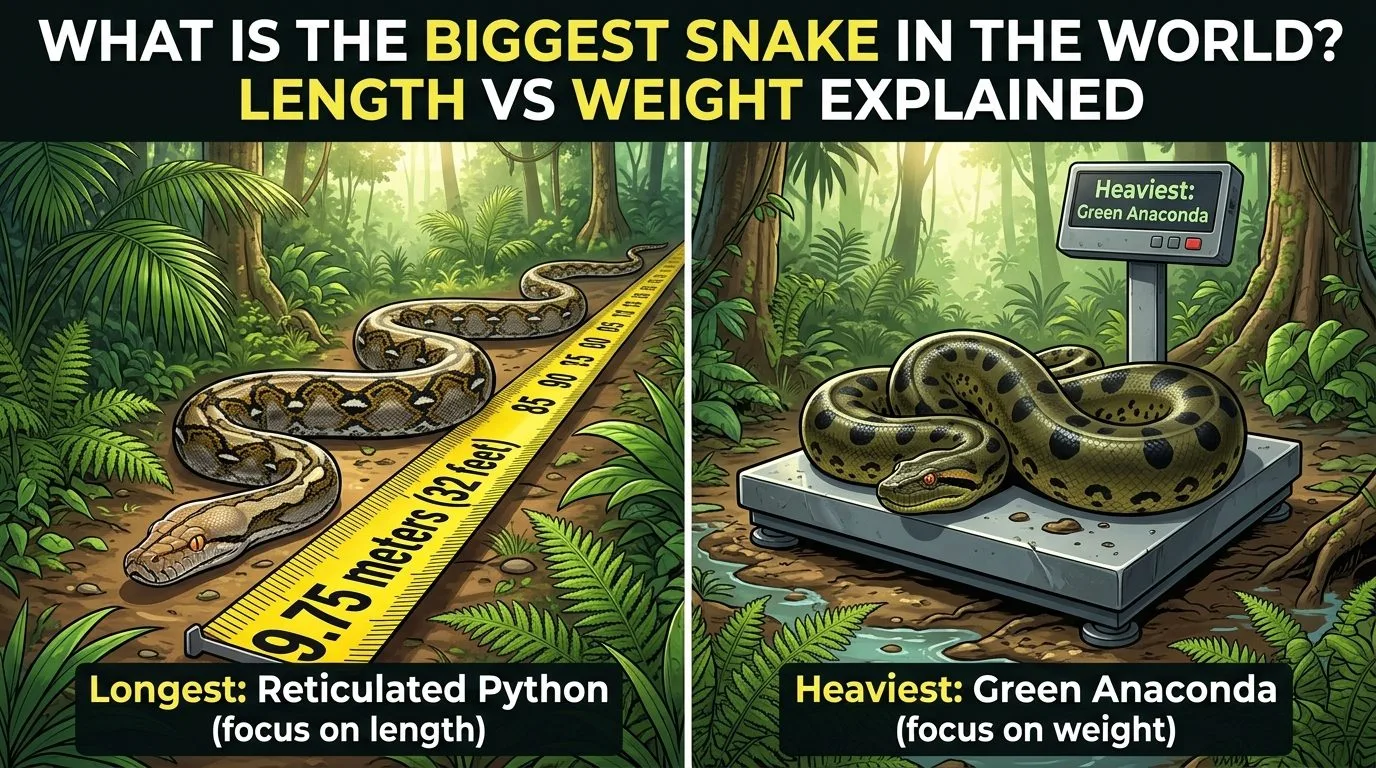
What is the biggest snake in the world? The answer depends on how you define biggest. By length, the longest living snake species is the reticulated python (Malayopython reticulatus) of South and Southeast Asia. By weight and body bulk, the title belongs to the green anaconda (Eunectes murinus in the traditional classification) of tropical South America. Both are exceptionally large, nonvenomous constrictors, but they achieve their size in different ways.
There is also a record-breaking update that older articles often miss. In January 2026, Guinness World Records verified a wild female reticulated python from Indonesia called Ibu Baron (“The Baroness”) at 7.22 metres (23 ft 8 in) long and 96.5 kilograms (213 lb). The longest documented snake in captivity remains another reticulated python, Medusa, measured at 7.67 metres (25 ft 2 in) in 2011. Meanwhile, the UK's Natural History Museum identifies the green anaconda as the heavyweight champion, citing a maximum recorded mass of about 227 kilograms (500 lb)—a figure that must not be confused with a typical adult's weight. See the 2026 Guinness wild-snake record and the Natural History Museum comparison .
What about giant prehistoric snakes such as Titanoboa and Vasuki indicus? Fossil studies suggest they may have been much longer and heavier than any living species, but their dimensions are scientific estimates from incomplete skeletons, not direct measurements of whole animals. This guide compares records, habitats, anatomy, how researchers measure snakes, and why sensational “30-foot anaconda” stories need careful scrutiny.
Quick answer: longest versus heaviest snake
| Question | Answer | Evidence and important qualification |
|---|---|---|
| Longest living snake species? | Reticulated python (Malayopython reticulatus) | Longest species overall; individual snakes vary greatly. |
| Longest verified wild individual? | Ibu Baron, reticulated python | 7.22 m, 96.5 kg; officially measured in Indonesia on 18 January 2026. |
| Longest recorded captive individual? | Medusa, reticulated python | 7.67 m, 158.8 kg; Guinness measurement on 12 October 2011. |
| Heaviest living snake species? | Green anaconda | More robust body and greater maximum mass; 227 kg is an exceptional published record figure, not a normal weight. |
| One of the largest extinct snakes? | Titanoboa cerrejonensis | Original fossil study estimated approximately 13 m and 1,135 kg, with uncertainty. |
| Could another extinct snake have been longer? | Vasuki indicus | 2024 study estimated 10.9–15.2 m using alternative methods; not proven longer than Titanoboa. |
Keep the categories separate: a species-level description, a verified individual animal, an unusually large reported specimen and a prehistoric estimate are not interchangeable forms of evidence. Guinness's longest-species entry and heaviest-species entry use these distinctions.
1. The reticulated python: the longest living snake
The reticulated python gets its common name from its striking network-like pattern of dark and light scales. It is native to parts of South and Southeast Asia, including Indonesia, Malaysia and the Philippines. The species occupies a variety of warm habitats and can swim, climb and move through vegetation and sometimes human-modified areas. It belongs to the family Pythonidae.
Many adults are far shorter than the extraordinary record holders. Guinness describes typical lengths of around 3–6 metres for the species, although some individuals exceed six metres and exceptional females can grow larger. That distinction matters: describing every reticulated python as an eight-metre giant would be misleading. In many large snakes, females grow substantially bigger than males, an example of sexual size dimorphism.
Reticulated pythons use muscular constriction to subdue prey, including birds and mammals. They are nonvenomous and do not rely on injected venom to kill prey. Like other pythons, they reproduce by laying eggs. The San Diego Zoo's python guide explains general python biology, while Guinness gives a closer look at the reticulated python's length records.
The reticulated python is often called the world's largest snake in everyday conversation, but it is more exact to say longest living snake species. Its body can be extremely long without being as heavy or thick-bodied as a comparably large female green anaconda.
2. The 2026 record: Ibu Baron, a 7.22-metre wild python
The most important recent update occurred in South Sulawesi, Indonesia. A female reticulated python discovered near the Maros region in late 2025 was examined by wildlife rescuer and licensed snake handler Diaz Nugraha and natural-history photographer Radu Frentiu. On 18 January 2026, they documented a 7.22-metre total length from the snake's head to the tip of its tail. Its recorded mass was 96.5 kilograms.
Called Ibu Baron, or “The Baroness,” the snake was recognised by Guinness World Records as the longest verifiably measured wild snake specimen . Photographs and video accompanied the assessment, helping distinguish it from unsupported anecdotes. The February 2026 National Geographic report also describes the measurement.
Why is that significant? Wild snakes are difficult to find, safely examine and measure accurately. They may be partly hidden, moving, coiled or in water. A snake that is estimated visually at “eight metres” cannot automatically replace a documented measurement. The new recognition refers to the best-verified wild individual within that record category, not a claim that no longer snake could exist unnoticed.
Guinness also notes that the animal came into the care of a local conservationist for protection. This is an important reminder that celebrating a giant snake should not encourage people to chase, restrain or harm wild animals in search of personal records.
3. Medusa: the 7.67-metre captive reticulated python
Another famous reticulated python, Medusa, was measured in Kansas City, Missouri, United States, on 12 October 2011. Guinness recorded her length as 7.67 metres (25 ft 2 in) and mass as 158.8 kilograms (350 lb). She holds the Guinness record for longest snake in captivity ever as reported in its record documentation.
Medusa was longer than the wild specimen Ibu Baron by 0.45 metres, but the two belong to different record categories and were measured years apart. Her greater mass does not change the species-level conclusion that green anacondas are generally bulkier and attain the greatest recorded masses among living snakes. Read the original Guinness coverage of Medusa .
Animals under human care may have reliable access to food, shelter and veterinary attention and may face fewer natural hazards. Those factors can affect lifespan and growth, but they do not make a captive record biologically unimportant. They simply explain why wild and captive comparisons must remain labelled. Statements that Medusa was the “longest snake ever known” should also distinguish modern record verification from older, less reliably documented historical claims.
4. The green anaconda: the heaviest snake in the world
For weight, the winner changes. The green anaconda is a massive boa from South American tropical wetlands, slow-moving rivers and seasonally flooded habitats. Its olive-green body with large dark spots is usually broader and heavier for its length than that of a reticulated python. The San Diego Zoo calls it the world's heaviest snake, and the Natural History Museum makes the same distinction between length and mass.
Here is an essential qualification: a 227-kilogram (500-pound) maximum is widely cited by museum and zoo sources, but this is an extreme recorded figure, not the size of most anacondas. Guinness describes fully grown female green anacondas as commonly measuring approximately 3–5 metres and weighing roughly 30–70 kilograms; exceptionally large animals can far exceed those ranges. Exact giant-specimen records are harder to verify than an ordinary animal's weight in a controlled setting, so unusually high claims should be attributed to their source.
Green anacondas are particularly adapted to water. Their powerful bodies can move efficiently through rivers and swamps, and they feed on available aquatic and terrestrial animals, including fish, birds, turtles, capybaras and other mammals. Like other boas, they give birth to live young rather than laying the external clutches typical of pythons. Females can be significantly larger than males. The Smithsonian National Zoo's green-anaconda profile offers further ecological context.
Are northern and southern green anacondas separate species?
The taxonomy requires care. A 2024 proposal described a “northern green anaconda,” Eunectes akayima, as distinct from the historically recognised Eunectes murinus. However, later specialists challenged the genetic interpretation and the naming process, and the status of the proposed split remains disputed. A detailed peer-reviewed reassessment, How not to describe a species: lessons from a tangle of anacondas , explains the problem.
Because taxonomic opinions differ, this article uses green anaconda for the familiar heavyweight group and Eunectes murinus for the traditional species concept, while noting the debated classification. It would be inaccurate to present the proposed northern species as unanimously accepted or to imply that its discovery suddenly created a snake larger than every previously known anaconda.
5. Reticulated python vs green anaconda: side-by-side comparison
| Feature | Reticulated python | Green anaconda |
|---|---|---|
| Biggest-snake title | Longest living species | Heaviest living species |
| Scientific name | Malayopython reticulatus | Traditionally Eunectes murinus; proposed species split disputed |
| Native region | South and Southeast Asia | Tropical South America and nearby regions |
| Typical adult body form | Long and comparatively slender | Heavy-bodied and thick, especially large females |
| Habitat | Forests, waterways and other warm habitats | Rivers, swamps and flooded wetlands |
| How it hunts | Ambush and muscular constriction | Ambush and muscular constriction, often around water |
| Venom | Nonvenomous | Nonvenomous |
| Reproduction | Lays eggs | Gives birth to live young |
| Notable measurement | Verified wild 7.22 m in 2026; captive 7.67 m in 2011 | Exceptional 227 kg cited by major museums; verification of giant claims varies |
The comparison illustrates why asking “anaconda or python—which is bigger?” is incomplete until you specify the measurement. A 7-metre python may be longer than a 5-metre anaconda yet weigh less, because length and thickness do not increase in identical ways. The two snakes also belong to different evolutionary branches of large constrictors, with differing reproductive strategies.
6. Why doesn't the longest snake always weigh the most?
Length measures the distance from head to tail; mass measures how much material the animal contains. A long, relatively narrow body can weigh less than a shorter, much thicker body. If two imaginary snakes had similarly shaped bodies and equal average density, their volumes—and therefore masses—would depend on both cross-sectional area and length. A thicker cross-section can make a very large difference.
Snake bodies are more complicated than perfect cylinders. Their girth varies from neck to midsection to tail, and mass can change with recent meals, hydration, reproductive condition and health. In fact, some truly massive specimens may be heavy after swallowing prey, while a snake measured before eating could weigh considerably less. Researchers should record this context where possible.
Length also has different conventions. Total length runs from the tip of the snout to the tail tip; snout–vent length ends at the cloaca, excluding the tail. A published figure using one method cannot be directly compared with a number measured by the other. Similarly, a curled snake's apparent straight-line width in a photograph tells us little about its entire length.
Example: Ibu Baron was documented at 7.22 m and 96.5 kg. Medusa was documented at 7.67 m and 158.8 kg. These are real observations of different individuals, not evidence that all snakes of a particular length have a predictable fixed weight. They also do not challenge the conclusion that the heavier-bodied green anaconda is the living species most associated with extreme mass.
7. How do scientists measure exceptionally large snakes?
Record claims are only as strong as their methods. Biologists and qualified handlers must consider animal welfare and personal safety before attempting to measure a large constrictor. In field research, scientists may record identifying features, location, date, sex, measurement technique and photographs or video of the procedure.
Length may be assessed using a flexible measuring tape following a snake's body curves, with consistent reference points from snout to tail tip. A relaxed or moving snake can be difficult to measure precisely, and forcefully stretching it can be unsafe and produce incomparable values. An image of a snake beside a person cannot substitute for a calibrated measurement because camera perspective distorts size.
Mass requires a suitable scale, often with the snake safely contained by professional handlers. The tare weight of the container must be subtracted. When possible, researchers note whether the animal has recently fed and report uncertainty. For record recognition, independent witnesses and transparent documentation can make the difference between a credible figure and a repeated anecdote.
The Guinness account of Ibu Baron is a valuable case study: her measurements were documented by experienced people and independently examined, unlike some past claims based only on photographs, second-hand reports or stretched skins. Do not attempt to catch or restrain a large wild snake to set a record.
8. Are 30-foot snakes real—or are the stories exaggerated?
There are historical reports of pythons and anacondas exceeding nine or even ten metres, but a very large claim is not automatically a verified measurement. Some involve deceased animals measured under unclear conditions; others involve stretched skins, uncertain identification or estimates made from photographs. In 2016, for example, a giant reticulated python reported from Malaysia was estimated at roughly 7.5–7.9 m, yet Guinness notes that its length was not documented by a comparable formal measurement, and the snake died soon afterward.
Guinness also records historical stories of exceptionally long snakes, including a reported 10-metre reticulated python from Sulawesi in 1912. Such accounts are important parts of the history of snake records, but they should not be confused with the more stringent modern documentation behind the 7.22-metre wild specimen and 7.67-metre captive record. “Longest ever reported” and “longest verifiably measured under a particular record category” are different statements.
Claims that a living anaconda is as long as a bus or weighs half a tonne require especially careful scrutiny. The Natural History Museum notes that green anacondas seldom reach the extreme lengths attributed to them in folklore. The strongest answer is not that every such observation is necessarily fraudulent, but that unverified claims cannot displace better-documented records.
9. What was the biggest snake that ever lived? Titanoboa
Living giants do not appear to match the most extraordinary fossil snakes. The extinct Titanoboa cerrejonensis lived approximately 58–60 million years ago, in tropical environments of what is now Colombia, after the non-avian dinosaurs had disappeared. Its fossil vertebrae were discovered in the Cerrejón coal-mine region.
In a landmark 2009 paper in Nature , researchers estimated a length of approximately 13 metres (about 43 feet) and a mass of roughly 1,135 kilograms—more than a metric tonne. Those figures are model-based estimates inferred from fossils, not actual lengths or weights of a complete preserved snake. A range of plausible body sizes remains possible.
The Smithsonian Institution's original announcement connects the fossil findings to ancient tropical ecosystems. Scientists have also used giant fossil snakes to explore past climate conditions, but climate reconstructions depend on multiple lines of evidence, not simply the assumption that a large snake proves a precise air temperature.
Titanoboa was likely a powerful constrictor in a river-rich tropical landscape. Still, descriptions of its exact appearance, preferred prey or hunting behaviour are partly reconstructions. Fossil discoveries tell us much about anatomy and evolution but do not provide eyewitness footage of an extinct animal.
10. Could Vasuki indicus have been even longer?
A fossil discovery announced in 2024 brought another contender into the debate. Scientists described Vasuki indicus from large vertebrae found in Gujarat, India. The species belonged to an extinct group called Madtsoiidae and lived during the Eocene, millions of years after Titanoboa.
The researchers used the dimensions of fossil vertebrae and comparison with other snakes to estimate body length. Depending on the mathematical method, their estimates spanned about 10.9–15.2 metres (36–50 feet). The 2024 Scientific Reports study explains that the two estimation methods produced different length ranges; Nature's research news places the finding in context.
The upper end could make Vasuki longer than the original central estimate for Titanoboa. But that is a possibility, not a confirmed new length record. Neither animal's entire body was preserved, and statistical extrapolation from vertebrae can be uncertain. At present, it is more scientifically responsible to describe them as among the largest snakes known from the fossil record than to assert an unquestionable winner.
They also lived tens of millions of years apart. Comparing them illustrates how different ecological conditions and evolutionary lineages produced giant snakes at different times.
11. Are the world's largest snakes dangerous to humans?
Both green anacondas and reticulated pythons are large, strong constrictors and should be treated with caution. They have teeth for gripping prey and can inflict serious injuries when mishandled. Neither is venomous. Research on boa constrictors has shown that constriction can impair blood circulation and cause rapid cardiovascular collapse in prey; it is oversimplified to say that giant constrictors always kill solely by “crushing bones” or slow suffocation. See the Smithsonian National Zoo explanation .
Nevertheless, films have exaggerated the image of anacondas as animals that routinely hunt people. The Smithsonian's green-anaconda profile notes that attacks on humans are rare. Rare does not mean impossible, and reticulated pythons have been involved in serious human incidents in parts of their range. The sensible response is to keep a safe distance, avoid approaching or provoking wild snakes, and contact trained wildlife authorities when a large snake enters a populated area.
Snakes are valuable predators that influence food webs, including by consuming rodents and other animals. Fear-driven killing and habitat pressures can be harmful to wildlife. A conservation-minded view does not romanticise giant constrictors or encourage risky close contact: it respects their role in ecosystems and the need for professional handling.
12. Biggest snake records: what should students learn about evidence?
The biggest-snake question provides an excellent example of how science uses measurement and uncertainty. Four statements sound similar but describe different evidence:
- Species comparison: Reticulated pythons are the longest living species, while green anacondas are the heaviest.
- Verified individual: Ibu Baron was documented at 7.22 m in January 2026; Medusa was measured at 7.67 m in captivity in 2011.
- Reported extreme: A historical 10-metre snake or 300-kilogram anaconda may appear in accounts without the same level of verification.
- Fossil estimate: Titanoboa and Vasuki dimensions are calculated from incomplete skeletal material and have uncertainty ranges.
When reading a headline, students should ask: What exactly was measured? Who recorded it? When? Was the animal alive or extinct? Was the length measured or inferred? Does “biggest” refer to length, weight, girth or a species average? These questions also apply to record-breaking trees, dinosaurs, whales and buildings.
Classroom activity: compare length, mass and evidence quality
Objective: Use record data to make accurate biological comparisons without handling live snakes.
| Record or estimate | Length | Mass | Type of evidence |
|---|---|---|---|
| Ibu Baron (2026) | 7.22 m | 96.5 kg | Documented living wild individual |
| Medusa (2011) | 7.67 m | 158.8 kg | Documented captive individual |
| Large green anaconda | Not one single standard length | Up to 227 kg cited by museum sources | Exceptional reported maximum; verify context |
| Titanoboa | About 13 m | About 1,135 kg | Fossil-based estimate, with uncertainty |
| Vasuki indicus | Approximately 10.9–15.2 m | Not reliably known from a direct weighing | Fossil-based length estimates using alternative models |
Activity instructions: Draw a horizontal bar chart of the lengths that are comparable, label each bar as “measured” or “estimated,” and keep extinct species separate from living specimens. Next, make a short table of the masses, clearly marking the anaconda extreme and the Titanoboa estimate. Do not connect every length to every weight as if the values belonged to the same snake. For more help classifying reptiles among vertebrates, see SuperEducational's guide to animal classification .
Questions: (1) Which documented living individual in the table was longer? Medusa. (2) Which species is regarded as the living heavyweight champion? Green anaconda. (3) Why is Vasuki's length given as a range? Scientists used different mathematical relationships to infer it from fossils. (4) Why can't we simply call a 10-metre snake report the official record? Its measurement evidence may be insufficient or non-comparable.
Common myths about giant snakes
| Myth | More accurate explanation |
|---|---|
| “Anacondas are the longest snakes.” | Reticulated pythons hold the length title; green anacondas hold the weight title. |
| “All giant pythons grow beyond seven metres.” | Such animals are exceptional, not representative of every adult. |
| “The largest snake in captivity must be the largest wild snake.” | Wild and captive records use different categories and have different documentation. |
| “A 227-kg anaconda is an ordinary adult.” | That is an exceptional reported figure, far above typical adult weights. |
| “Photographs can precisely prove a snake's length.” | Camera angle, coiling and perspective can distort estimates. |
| “The northern green anaconda is an undisputed new species.” | The proposed split and associated naming have been challenged by specialists. |
| “Titanoboa's size was measured directly.” | Length and mass were estimated from fossils using models. |
| “Giant constrictors routinely hunt people.” | Human attacks are uncommon; sensible distance and caution remain necessary. |
Frequently asked questions
What is the biggest snake in the world right now?
For length, the reticulated python is the longest living species. For weight, the green anaconda is the heaviest living species.
What is the longest wild snake ever officially measured?
Guinness World Records identifies Ibu Baron, a wild reticulated python in Indonesia measured at 7.22 metres on 18 January 2026, as the longest verifiably measured wild snake in its record category.
How long was Medusa the python?
Medusa was measured at 7.67 metres (25 ft 2 in) in Kansas City on 12 October 2011, with a recorded mass of 158.8 kilograms.
How much does the biggest anaconda weigh?
The Natural History Museum and zoo sources cite an exceptional figure of about 227 kilograms (500 pounds). However, green anacondas vary widely, and most adult females weigh substantially less. Not all extreme reported individuals have equally complete measurement records.
Can an anaconda grow longer than a reticulated python?
An individual anaconda may be longer than an individual small python, but the reticulated python is the longest species overall according to established wildlife and record sources. Stories of extraordinarily long anacondas require independent measurement evidence.
Do anacondas and pythons have venom?
No. These large snakes are nonvenomous constrictors. They use powerful muscular coils to subdue prey rather than injecting venom.
Which was larger, Titanoboa or Vasuki?
Both are among the largest known fossil snakes. The original Titanoboa study estimated roughly 13 metres and 1,135 kilograms. A 2024 analysis estimated 10.9–15.2 metres for Vasuki, depending on the method. The ranges overlap, so a certain winner by length is not established.
Was Titanoboa alive when dinosaurs existed?
No. Titanoboa lived around 58–60 million years ago, well after the end-Cretaceous extinction event that eliminated non-avian dinosaurs about 66 million years ago.
Why are female snakes often larger?
In some species, including the reticulated python and green anaconda, females can grow much larger than males. This sexual size difference relates to species-specific evolutionary and reproductive pressures, although body size also depends on age, food and environment.
Are gigantic snake videos online always real?
No. A video can document an encounter, but it may lack a calibrated scale, and images can be distorted or edited. Check for identifiable sources, dates, independent measurements and evidence of how the recorded length or mass was obtained.
Conclusion: the winner depends on how you measure “biggest”
The most accurate answer to what is the biggest snake in the world is a comparison, not a single name. The reticulated python is the longest living snake species; the green anaconda is the heaviest. In modern verified records, Ibu Baron measured 7.22 metres in the wild in January 2026, and Medusa reached 7.67 metres in captivity in 2011.
Ancient snakes such as Titanoboa and Vasuki may have been much larger, but their measurements are estimates derived from fossils. And reports of colossal modern snakes should be judged by how carefully they were measured. Once we distinguish length, mass, record categories and scientific uncertainty, the question becomes more than a competition: it becomes a lesson in how biologists describe remarkable animals using evidence.
References and further reading
- Guinness World Records — Longest Wild Snake Specimen (Ibu Baron, 2026) .
- Guinness World Records — Longest Species of Snake .
- Guinness World Records — Heaviest Species of Snake .
- Guinness World Records — Medusa, the Longest Snake in Captivity .
- Natural History Museum (London) — What Is the Biggest Snake in the World? .
- National Geographic (2026) — The Baroness, the World's Longest Wild Snake .
- San Diego Zoo Wildlife Alliance — Python .
- San Diego Zoo Wildlife Alliance — Anaconda .
- Smithsonian National Zoo — Green Anaconda .
- Zoological Journal of the Linnean Society — How Not to Describe a Species: Lessons from a Tangle of Anacondas .
- Nature (2009) — Giant Boid Snake from the Palaeocene Neotropics .
- Smithsonian Institution — World's Largest Snake Discovered in Fossilised Rainforest .
- Scientific Reports (2024) — Largest Known Madtsoiid Snake, Vasuki indicus .
- Nature (2024) — Meet Vasuki indicus, Among the Longest Snakes That Ever Lived .
- Smithsonian National Zoo — Boa Constrictor and Circulatory Effects of Constriction .