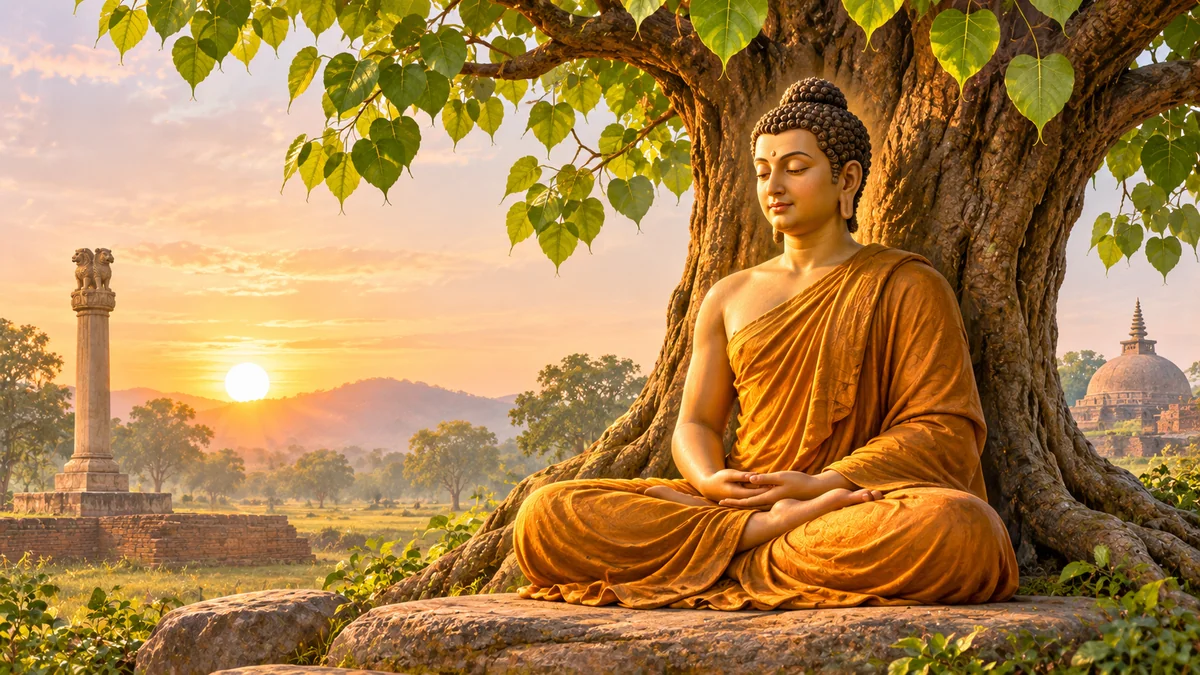
Siddhartha Gautama, widely known as the Buddha, was the ancient teacher whose teachings gave rise to Buddhism. He lived in the northern Indian subcontinent, probably around the fifth century BCE, and is traditionally associated with four major locations: his birthplace at Lumbini in present-day Nepal, his awakening at Bodh Gaya, his first teaching at Sarnath, and his final passing at Kushinagar, all three latter sites in present-day India.
His story is often told as the journey of a sheltered young man who encountered sickness, old age and death, left home, searched for an end to suffering and eventually taught a “Middle Way”. Yet historians cannot verify every episode or agree on exact birth and death years. A useful biography therefore separates what Buddhist traditions recount from what inscriptions, archaeology and historical scholarship can support.
This guide explains the Buddha's origins, offers a responsible timeline, introduces his central teachings and follows his long-lasting influence on religious communities, art and ethical thought.
Who was Siddhartha Gautama?
“Buddha” means “awakened one”. It is a title rather than a family surname. Siddhartha (Pali: Siddhattha) Gautama (Pali: Gotama) is traditionally identified as a member of the Shakya (Sakya) community in the Himalayan foothills. He is therefore also called Shakyamuni, the “sage of the Shakyas”. He was not a god in the ordinary creator-deity sense: the early Buddhist sources portray him as a human who attained awakening and taught a path that others could follow.
His life unfolded in a region of changing settlements, kingdoms, republic-like communities and competing religious and philosophical movements. Teachers debated ritual, rebirth, karma, asceticism and liberation. This setting matters because Gautama's message was part of a wider ancient South Asian conversation, even as it developed distinctive explanations of suffering, impermanence and release. The Stanford Encyclopedia of Philosophy's study of the Buddha provides a scholarly introduction to these intellectual questions.
When did the Buddha live? Why historians disagree about the dates
Dates such as 563–483 BCE or 623–543 BCE appear in traditional or popular timelines, but they should not be presented as universally agreed historical facts. Buddhist traditions preserve different chronological systems, and early texts were transmitted orally before being compiled and written down in surviving forms. Independent contemporary documentation of the Buddha's birth or death is scarce.
Many historians place the Buddha broadly in the fifth century BCE, although proposals vary. The Stanford Encyclopedia of Philosophy notes that some contemporary scholarship places his death around 405 BCE rather than the older estimate around 480 BCE. An Oxford scholarly overview of Buddhism's early history likewise cautions that reliable evidence for exact dates is limited.
For students, the safest wording is: “Siddhartha Gautama probably lived during the fifth century BCE, but precise dates remain debated.” Traditional ages and sequences below are presented as part of the Buddhist life story rather than as independently established biographical timestamps.
Origins and early life: Lumbini, Kapilavastu and the Shakya community
Birth and family traditions
Buddhist traditions place his birth at Lumbini, now in southern Nepal near the Indian border. His mother is named Maya (Mayadevi), and his father Suddhodana, a leading member of the Shakya community. Later retellings frequently describe Siddhartha as a prince raised in luxury, but “prince” can obscure the complexity of Shakya political organisation and should not be assumed to mean a monarch's son in a modern royal court. The traditional narratives name Yashodhara as his wife and Rahula as his son; the precise historical details are harder to verify.
Lumbini's importance is supported by material evidence. The UNESCO World Heritage listing for Lumbini documents a pillar erected by the Mauryan emperor Ashoka in the third century BCE recording the site's connection with the Buddha's birth. This is strong evidence of the place's early sacred significance, but it does not independently prove an exact birth year or every scene in later biographies. UNESCO's account of early Lumbini shrines also discusses archaeological findings and the history of worship at the site.
The traditional “four sights”
One familiar story says the sheltered young Siddhartha ventured beyond his comfortable surroundings and encountered an elderly person, a sick person, a dead person and a wandering renunciant. The four sights made him reflect on ageing, illness, mortality and the possibility of a spiritual response. The story is a powerful illustration of Buddhist questions about suffering, but its exact details are part of an evolving religious biography rather than independently witnessed events.
Why did Siddhartha leave home?
According to Buddhist tradition, Siddhartha became dissatisfied with a comfortable life that could not protect anyone from change, sickness or death. He left household life to seek a deeper answer to the human condition—an event commonly called the Great Renunciation. Traditional accounts sometimes place this departure around his late twenties, but an exact age cannot be established historically.
He studied with meditation teachers and practised severe ascetic disciplines, including extreme fasting. Over time, the Buddhist story portrays him rejecting both indulgence in pleasure and destructive self-denial. This shift is central to the Middle Way, a balanced path of ethical conduct, disciplined mental training and insight. The early discourse SN 56.11, often called the “Setting in Motion the Wheel of the Dhamma” , explicitly presents this teaching as avoiding two extremes.
Enlightenment at Bodh Gaya
Buddhist traditions place Siddhartha's awakening beneath a bodhi tree at Bodh Gaya in present-day Bihar, India. The narratives describe a decisive meditation in which he gained liberating insight into suffering and the causes that sustain it. Once awakened, he became known as the Buddha. Symbolic elements, including encounters with Mara (a figure associated with temptation and obstruction), communicate spiritual meaning; historians do not treat each dramatic detail as a separately verified event.
The UNESCO World Heritage Centre's Mahabodhi Temple Complex record identifies Bodh Gaya as the great site of the Buddha's awakening in Buddhist tradition and describes its historic temple, bodhi tree and sacred spaces. The present buildings and commemorative features have histories of construction, repair and revival: visiting them today should not be confused with seeing an unchanged fifth-century BCE setting.
In Buddhist thought, nirvana (Pali: nibbana) is liberation from the conditions sustaining suffering and the cycle of rebirth. It is not adequately described as simple happiness, falling asleep or the destruction of the physical world. Its interpretation is explored differently across Buddhist traditions, which is another reason to distinguish an introductory definition from the full philosophical debate.
The first sermon at Sarnath and the beginning of the Sangha
After his awakening, the Buddha is traditionally said to have travelled to Sarnath, near Varanasi, and taught five former companions in a deer park. This event is often described as the first turning of the wheel of Dharma, the beginning of his public teaching mission. The UNESCO record for the Ancient Buddhist Site of Sarnath identifies the site with the first sermon and earliest disciples.
The sermon narrative introduces the Four Noble Truths and the Noble Eightfold Path. The small group of students grew into the Sangha, the community of people devoted to practising and transmitting the teachings. Early Buddhist traditions also describe women seeking and entering the monastic community, including the story of Mahapajapati Gotami; scholars examine how such accounts were preserved and modified in different texts.
Siddhartha Gautama timeline: traditional events and historical evidence
| Stage | Place or period | What can responsibly be said |
|---|---|---|
| Birth and upbringing | Lumbini; Shakya region near present-day Nepal–India border | Birth at Lumbini is a longstanding sacred tradition supported by early pilgrimage evidence; the exact year is disputed |
| Encounter with suffering | Traditional youth narratives | The “four sights” are formative elements of Buddhist biography, not independently documented observations |
| Renunciation | Northern Indian subcontinent | Sources describe Gautama leaving household life in search of liberation; precise age uncertain |
| Meditation and ascetic practice | Before enlightenment | Traditional texts describe teachers, austerities and a turn towards the Middle Way |
| Awakening | Bodh Gaya, present-day India | Sacred tradition locates awakening under the bodhi tree; exact date cannot be proved |
| First public teaching | Sarnath, near Varanasi | Tradition places the first sermon and early Sangha here |
| Travelling and teaching | Ganges plain, northern India | Early Buddhist sources depict decades of teaching, debate and community formation |
| Final passing | Kushinagar (ancient Kusinara), present-day India | Traditional accounts describe his final passing or parinirvana, commonly at age 80; year disputed |
| Later royal patronage | Third century BCE | Ashoka's inscriptions and monuments provide firmer dated evidence of Buddhism's development after Gautama |
Why no precise BCE year for each event? Many popular timelines assign ages 29, 35 and 80 to renunciation, awakening and death. These belong to influential traditions; converting them into calendar years with false precision would hide the genuine scholarly uncertainty. See the Internet Encyclopedia of Philosophy's overview for the challenges historians face in reconstructing his life.
What did the Buddha teach? The Four Noble Truths
The Four Noble Truths summarise a practical diagnosis of the human condition and a path of transformation. The English word suffering only partly conveys dukkha, which also includes dissatisfaction, instability and the inability of changing things to provide permanent security.
- The truth of dukkha: ordinary conditioned experience is marked by vulnerability to change, loss and dissatisfaction, even when life includes joy.
- The origin of dukkha: craving, clinging and related patterns of ignorance sustain dissatisfaction.
- The cessation of dukkha: liberation is possible when the causes of suffering are brought to an end.
- The path leading to cessation: the Noble Eightfold Path offers practical training towards that liberation.
This is not the claim that every moment of existence is miserable, nor that all desire is morally wrong. Buddhist thinkers distinguish harmful craving from wholesome aspirations, and different schools debate important philosophical details. The earliest sermon tradition, preserved in the translated Saṃyutta Nikāya discourse SN 56.11 , gives a foundation for understanding the four truths in context.
The Noble Eightfold Path explained simply
The Eightfold Path is often grouped into three interrelated forms of training: wisdom, ethical conduct and mental cultivation. The steps are not necessarily a strict ladder completed once from one to eight; they support one another in practice.
| Path factor | Broad area | Student-friendly explanation |
|---|---|---|
| Right view | Wisdom | Understanding suffering, its causes and the consequences of actions |
| Right intention | Wisdom | Developing intentions free from ill will and harmful attachment |
| Right speech | Ethics | Speaking truthfully and avoiding harmful speech |
| Right action | Ethics | Acting without causing unnecessary harm |
| Right livelihood | Ethics | Earning a living in ways compatible with ethical principles |
| Right effort | Mental cultivation | Encouraging helpful mental states and reducing unhelpful ones |
| Right mindfulness | Mental cultivation | Developing attentive, clear awareness of experience |
| Right concentration | Mental cultivation | Training stable and focused attention through meditation |
The labels vary in translation—“right” can also be rendered “appropriate” or “complete” in different contexts. The Stanford Encyclopedia of Philosophy's discussion of Buddhist ethics places these practices within a wider moral tradition.
Other important ideas: impermanence, non-self, karma and compassion
Impermanence (anicca)
People, emotions, relationships and material things change. Recognising impermanence is not meant to deny their value, but to challenge the expectation that changing conditions can remain permanently fixed.
Non-self (anatta)
Early Buddhist teaching challenges the idea of an independent, unchanging essence behind personal experience. This is a subtle philosophical position, not a statement that people do not exist or lack moral significance. The scholarly Stanford Buddha entry explains why the interpretation has been debated across Buddhist schools.
Karma and ethical responsibility
In Buddhist traditions, karma centrally concerns intentional action and its consequences. It should not be reduced to the everyday slogan “what goes around comes around” or used to blame people for every illness or misfortune. Ethical responsibility instead invites examination of intentions and conduct.
Compassion and non-harming
Compassion (karuna), loving-kindness (metta) and non-harming are important Buddhist values. They can be explored respectfully in a classroom without treating the tradition as merely a set of generic motivational tips. Students studying ethical storytelling may also find SuperEducational's guide to teaching kindness through moral stories a useful, separate classroom resource.
How did Buddhism spread beyond the Buddha's lifetime?
After Gautama's death, Buddhist communities preserved teachings through recitation, debate, rules of monastic life and, later, written collections. The familiar Tripitaka/Tipitaka (“three baskets”) broadly refers to collections of discipline, discourses and analytical teachings, but the surviving canons differ among Buddhist traditions. It is inaccurate to claim that the Buddha personally wrote a single book containing all later Buddhist scriptures.
By the third century BCE, Emperor Ashoka of the Mauryan dynasty was a major patron of Buddhism. His inscriptions and monuments are especially valuable for historians because they can be dated much more securely than many stories about the Buddha's own lifetime. Ashoka's patronage helped support Buddhist institutions and the spread of Buddhist ideas; the movement's development nevertheless involved many communities over centuries.
Buddhism travelled across South and Southeast Asia, along Central Asian routes into China and Korea, and later to Japan, Tibet and Himalayan regions. Different schools developed distinct practices, texts and ideals. Theravada, Mahayana and Vajrayana are broad labels for living Buddhist traditions, not three organisations founded personally by the Buddha. Modern Buddhism also exists in communities worldwide.
What is the Buddha's legacy today?
The Buddha's legacy is visible in religion, philosophy, literature, visual art, architecture and meditation practices. Temples, monasteries, stupas, images and pilgrimage routes express Buddhist devotion and community identity. Places associated with his life remain important: Lumbini , Bodh Gaya and Sarnath have particularly strong heritage significance. Kushinagar is also traditionally connected to his final passing.
Beyond devotional settings, Buddhist approaches to attention, compassion and the examination of mental habits have influenced modern conversations about well-being and philosophy. It is important, however, not to confuse modern secular mindfulness programmes with all of Buddhism: the historical traditions also include ethics, community, ritual, rebirth and aims of liberation.
One major part of this legacy is the continuing practice of asking how a teaching was transmitted and what it meant in its original context. For an educational method of comparing claims and checking evidence, see SuperEducational's guide to verifying information online .
Historical evidence versus sacred tradition: how to read the story
A respectful historical study should not label every traditional episode either proven fact or meaningless fiction. Instead, it should ask what kind of source is being used and what that source can demonstrate:
- Archaeological sites: Lumbini's monuments and Ashokan pillar show early commemoration of the Buddha, but do not independently verify the four sights or a precise birth year.
- Early Buddhist texts: discourses preserve teachings and memories central to Buddhist communities, but their transmission and editing histories require scholarly care.
- Later biographies and art: richer stories, miracles and symbolic images communicate devotional meaning, even when historians cannot independently date the episodes.
- Modern scholarship: historians compare language, manuscripts, inscriptions and cultural context, sometimes reaching different conclusions.
In short, a student can recognise that Siddhartha Gautama is a historical figure of enormous importance while also recognising why no one can confidently provide a fully verified day-by-day biography from more than two millennia ago.
Frequently asked questions about Siddhartha Gautama
Where was Siddhartha Gautama born?
Buddhist tradition identifies Lumbini, in present-day Nepal, as his birthplace. The site has early monuments and an Ashokan inscription marking that association.
Was the Buddha born in India or Nepal?
His traditional birthplace, Lumbini, lies in modern Nepal. But modern national borders did not exist in the same way during his lifetime. His later teaching activity is strongly associated with places in what is now northern India.
What year was the Buddha born?
There is no universally established birth year. Traditional dates vary, while many modern scholars place his life broadly in the fifth century BCE.
What does Buddha mean?
It means “awakened one”. Siddhartha Gautama is known as the Buddha because Buddhist traditions regard him as having attained liberating awakening.
Where did the Buddha attain enlightenment?
According to Buddhist tradition, he attained enlightenment beneath a bodhi tree at Bodh Gaya, India, now home to the Mahabodhi Temple Complex.
Where did the Buddha give his first sermon?
Tradition places it at Sarnath near Varanasi, where he taught former companions about the Middle Way, Four Noble Truths and Eightfold Path.
Is the Buddha considered a god?
Early Buddhist presentations describe him as an awakened human teacher rather than a creator god. Buddhist traditions differ in devotional and philosophical understandings of Buddhas, so one simple definition does not cover every school.
How did Siddhartha Gautama die?
Traditional sources place his final passing—parinirvana—at Kushinagar and commonly say he was around 80 years old. Exact medical details and the historical year cannot be independently established with confidence.
Conclusion: a life whose influence outlasted its dates
Siddhartha Gautama (the Buddha) is remembered as a teacher who confronted fundamental questions about suffering, change and the possibility of liberation. His traditional journey runs from Lumbini and the Shakya community through renunciation and awakening at Bodh Gaya, public teaching at Sarnath and final passing at Kushinagar. The precise chronology remains debated, but the influence of the teachings is clear: Buddhist communities developed across Asia and, eventually, the world.
For students and general readers, the most important lesson is twofold: understand the Buddha's ideas and their historical setting, and treat traditional narratives, historical evidence and modern interpretation with the appropriate distinctions. That approach yields a more informative—and more respectful—account of his lasting legacy.