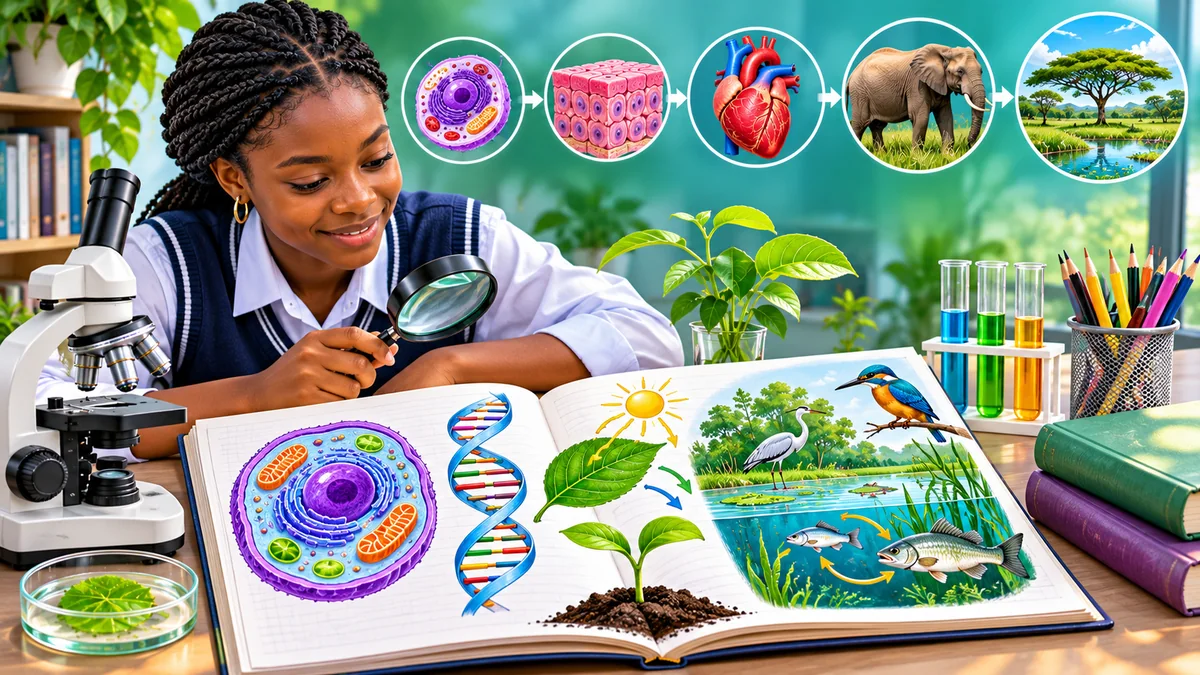
Biology for beginners becomes easier when you learn a few connected ideas before memorising long lists of definitions. A cell is the basic unit of cellular life. DNA stores genetic information. Organisms use energy and materials to grow and survive. Populations evolve across generations, and living things interact within ecosystems. Nearly every school biology topic builds on these foundations.
If words such as organelle, osmosis, allele and homeostasis feel unfamiliar, you do not need an advanced science background to begin. This guide explains essential biology vocabulary in plain English, gives a practical example for each group of terms, and helps you tell commonly confused ideas apart.
You will find a 48-term beginner biology glossary, cell comparison charts, a simple explanation of photosynthesis and respiration, a two-week learning schedule, a safe plant-observation activity, and a ten-question quiz with answers. The definitions draw primarily from OpenStax Biology 2e and the National Human Genome Research Institute's genetics glossary . For a broader introduction to what biologists study, see the distinct foundational article What Is Biology? Meaning, Major Branches and Real-Life Examples once it is published on SuperEducational; this lesson focuses instead on vocabulary and practice.
Six big ideas to understand before learning biology terms
- Living organisms consist of cells. Some, such as bacteria, have one cell; humans and trees have many.
- Cells exchange matter and energy. They use nutrients and chemical reactions to build, maintain and operate structures.
- Genetic information connects generations. DNA-based instructions influence inherited traits, but environment and multiple genes can also matter.
- Organisms regulate and respond. Maintaining useful internal conditions and responding to changing surroundings are fundamental biological processes.
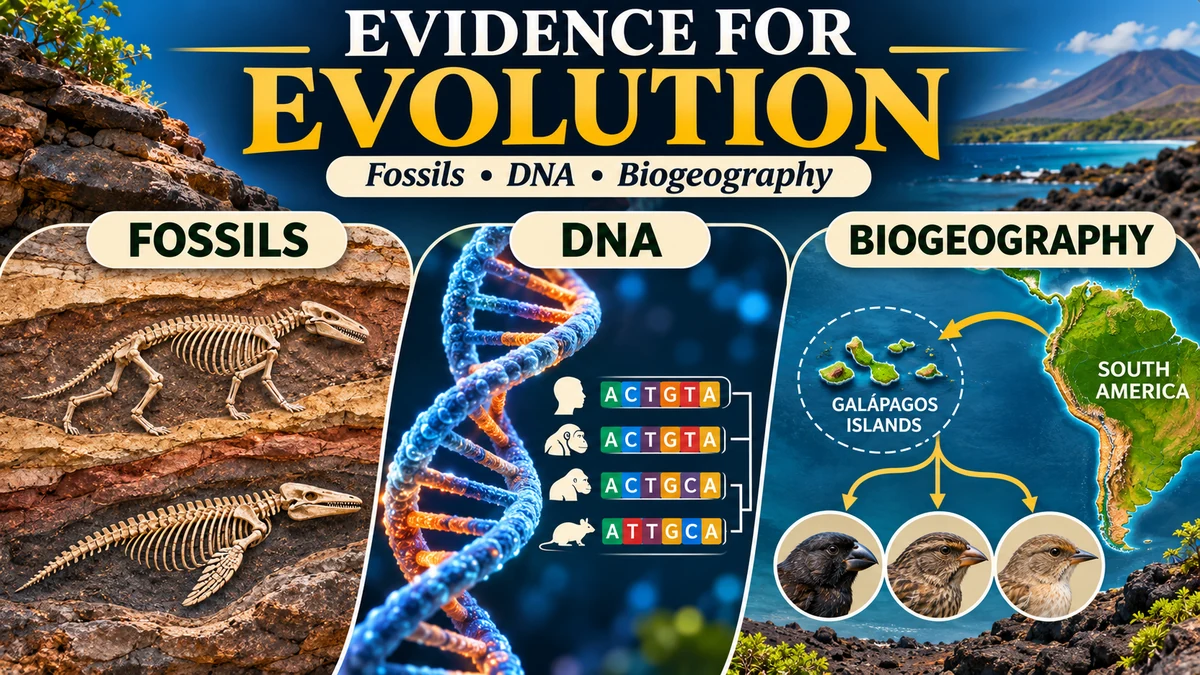
- Populations evolve. Inherited variation changes across generations through processes such as natural selection and genetic drift.
- Life is interconnected. Organisms interact with members of their own species, other species and the nonliving environment.
Keep these six ideas beside your notebook. When you meet a new term, ask which idea it helps explain. This method turns isolated definitions into a concept map rather than a collection of facts.
Biology key terms and definitions: cells and organisation
Cells are a sensible starting point because every recognised cellular organism has them. The OpenStax prokaryotic-cell chapter explains that cells share a plasma membrane, cytoplasm, genetic material and ribosomes, while more complex internal structures vary.
| Term | Simple definition | Beginner example |
|---|---|---|
| 1. Biology | The scientific study of life and living systems | Investigating how seeds germinate |
| 2. Organism | An individual living entity | A bacterium, frog or mango tree |
| 3. Cell | The basic structural and functional unit of cellular life | A leaf cell or human nerve cell |
| 4. Cell membrane | A selectively permeable boundary that controls interactions between cell and surroundings | Regulating what enters a cell |
| 5. Cytoplasm | Material within the cell membrane, including fluid and cellular components | The environment around cell structures |
| 6. Nucleus | Membrane-bound structure containing most DNA in typical eukaryotic cells | Nucleus in a human cheek cell |
| 7. Organelle | Specialised structure carrying out a cell function | Chloroplast or mitochondrion |
| 8. Mitochondrion | Organelle involved in energy transformation and ATP production in many eukaryotic cells | Present in typical muscle cells |
| 9. Chloroplast | Photosynthetic organelle in plants and algae | Chloroplasts in green leaf cells |
| 10. Ribosome | Cellular machinery that builds proteins | Making enzymes from amino acids |
| 11. Prokaryote | Cellular organism whose cells have no membrane-bound nucleus | Bacteria and archaea |
| 12. Eukaryote | Organism whose cells have nuclei and membrane-bound internal compartments | Animals, plants and fungi |
| 13. Tissue | Group of cells working together in a multicellular organism | Muscle tissue |
| 14. Organ | Structure made from tissues that carry out a function | Heart or plant leaf |
Cell theory is a related concept: organisms are made of one or more cells, the cell is the basic unit of life, and cells arise from pre-existing cells. Not every organism has tissues and organs; bacteria consist of single cells. OpenStax's cell-theory overview gives the historical evidence.
Plant cells, animal cells and bacterial cells: a starter comparison
| Feature | Typical plant cell | Typical animal cell | Typical bacterial cell |
|---|---|---|---|
| Membrane-bound nucleus | Yes | Yes | No |
| Cell membrane | Yes | Yes | Yes |
| Cell wall | Usually cellulose-rich | No | Usually present, commonly peptidoglycan-rich; exceptions exist |
| Mitochondria | Usually present | Usually present | No |
| Chloroplasts | In many photosynthetic cells, not every plant cell | No | No chloroplasts, though some bacteria photosynthesise |
| Ribosomes | Yes | Yes | Yes |
Remember that these are typical features, not universal rules for every specialised cell. A mature mammalian red blood cell, for example, lacks a nucleus, even though the organism is a eukaryote. Many plant root cells have no photosynthetic chloroplasts. Do not identify a cell solely from its shape in a textbook drawing.
Quick check: A bacterium lacks a nucleus but still has DNA and ribosomes. The presence of DNA is therefore not proof that a cell has a nucleus. A virus is also not simply a smaller bacterium: it is non-cellular and requires a host cell to reproduce. OpenStax's virus introduction explains the distinction.
Biology vocabulary: energy, food and regulation
All living cells require energy and materials. Metabolism is the combined set of chemical reactions of a living system; it includes reactions that break down substances and others that build them. The OpenStax metabolism chapter connects these reactions to enzymes and energy transfer.
| Term | Simple definition | Beginner example |
|---|---|---|
| 15. Metabolism | All chemical reactions involved in maintaining life | Using nutrients to build and maintain cells |
| 16. Enzyme | Biological catalyst that speeds up a reaction without being consumed | Digestive enzymes breaking down food |
| 17. Nutrient | Substance an organism uses for energy, growth or maintenance | Minerals absorbed by roots |
| 18. Photosynthesis | Process that captures light energy to build organic molecules from carbon dioxide | Green leaves producing sugars |
| 19. Cellular respiration | Metabolic pathways through which cells obtain usable energy from organic molecules | Cells generating ATP from food molecules |
| 20. ATP | Adenosine triphosphate, a molecule used to transfer usable energy in cells | ATP supporting muscle contraction |
| 21. Diffusion | Net movement of particles down a concentration gradient | Oxygen moving across a thin membrane |
| 22. Osmosis | Net water movement across a selectively permeable barrier due to differences in water potential | Water entering plant cells |
| 23. Homeostasis | Regulation of internal conditions within functional ranges | Body temperature regulation |
| 24. Producer | Organism that builds organic matter from inorganic sources, using light or chemical energy | Grass in a sunlit field |
| 25. Consumer | Organism that obtains energy and matter by consuming other organisms or organic material | Grasshopper feeding on leaves |
| 26. Decomposer | Organism that breaks down dead organic material and wastes | Many fungi and soil bacteria |
Photosynthesis vs cellular respiration
Photosynthesis and cellular respiration are different processes, not identical reactions running in reverse under every condition. In a simplified overview, oxygen-producing photosynthesis uses light energy, carbon dioxide and water to construct carbohydrates and release oxygen. Cellular respiration uses chemical pathways to transfer energy from organic molecules into ATP; aerobic respiration commonly uses oxygen and releases carbon dioxide and water.
| Question | Photosynthesis | Cellular respiration |
|---|---|---|
| Primary role | Stores captured light energy in organic molecules | Makes usable ATP available from chemical energy |
| Where it occurs | Photosynthetic organisms, including many plants, algae and cyanobacteria | Across organisms in different metabolic forms |
| Typical school example | Green leaf in sunlight | Root, leaf or animal cell using fuel |
| Common misconception | Plants only photosynthesise | Only animals respire |
Plants also perform cellular respiration. And “respiration” in cell biology is not the same as breathing: breathing moves air into and out of lungs, while cellular respiration refers to chemical energy transformations. Explore photosynthesis and energy in living systems for the full processes. SuperEducational's published article on measuring photosynthesis from space shows how this school concept becomes real environmental research.
Biology key terms: DNA, heredity and cell division
These terms describe biological information and what happens when organisms grow or reproduce. NHGRI's genetics glossary is an accessible reference, and OpenStax's introduction to heredity covers how genes and chromosomes are inherited.
| Term | Simple definition | Beginner example |
|---|---|---|
| 27. DNA | Molecule carrying hereditary genetic information in cellular organisms | DNA stored on chromosomes |
| 28. Gene | Functional region of DNA whose information helps make a product such as RNA or protein | A gene involved in haemoglobin production |
| 29. Chromosome | Organised DNA-containing structure carrying many genetic sequences | Human nuclear chromosomes |
| 30. Genome | An organism's complete set of genetic material | The human genome |
| 31. Heredity | Passing of genetic information from parents to offspring | An inherited blood-group trait |
| 32. Allele | One of multiple versions of a gene at a particular location | Different inherited versions of a gene |
| 33. Trait | Observable or measurable characteristic of an organism | Plant flower colour |
| 34. Mutation | Change in genetic sequence | A change that may or may not affect a protein |
| 35. Mitosis | Eukaryotic nuclear division, ordinarily yielding genetically similar nuclei | Part of growth and tissue repair |
| 36. Meiosis | Specialised eukaryotic division reducing chromosome sets in sexual life cycles | Production of gametes in animals |
DNA is not the same as a gene, and a gene is not the same as a chromosome. A gene is a functional stretch of genetic material; a chromosome is a larger organised DNA structure carrying many sequences. The genome includes the complete genetic material rather than just one gene.
Mutations are not always harmful. Their effects can be harmful, neutral or occasionally advantageous in a particular environment. Likewise, inheritance does not mean that all traits are controlled by a single gene; nutrition and other environmental conditions can influence how a trait develops. A medically relevant example of inherited variation appears in SuperEducational's published sickle cell disease genetics guide . That link is for deeper education, not for diagnosing an individual's genetic status.
In eukaryotes, mitosis divides the nucleus, while meiosis involves two divisions following one round of DNA replication and contributes to sexual reproduction. Bacteria do not divide by mitosis; most reproduce through binary fission. See the cell cycle and meiosis .
Biology key terms: evolution and ecology
Evolution and ecology connect the individual organism with much larger patterns. Evolution addresses inherited change across generations; ecology addresses interactions among organisms and their surroundings. OpenStax's evolution chapter explains natural selection, and its ecology chapter describes how ecological scales relate.
| Term | Simple definition | Beginner example |
|---|---|---|
| 37. Species | Basic classification unit; criteria for boundaries depend on organism and context | One identified species of frog |
| 38. Population | Members of the same species in a defined place | Frogs of one species in a pond |
| 39. Community | Populations of different species interacting in an area | Frogs, fish, insects and plants in a pond |
| 40. Ecosystem | A biological community interacting with its nonliving environment | A pond with its water, nutrients and organisms |
| 41. Habitat | Place or type of environment where an organism normally lives | Mangrove roots supporting juvenile fish |
| 42. Biodiversity | Variety of life across genes, species and ecosystems | Different species within a forest |
| 43. Evolution | Heritable change in populations across generations | Changing frequency of resistance-related variants |
| 44. Natural selection | Differences in survival or reproduction linked to heritable traits in an environment | Some inherited traits becoming more common over generations |
| 45. Adaptation | Inherited feature shaped by evolution that improves fitness in a particular context | Camouflage in some organisms |
| 46. Food chain | Simplified sequence of feeding relationships and energy transfer | Grass → grasshopper → frog |
| 47. Food web | Network of linked feeding relationships | Fish and birds feeding on different pond organisms |
| 48. Scientific hypothesis | Testable proposed explanation for an observation | “Seedlings with less water will show reduced growth” |
Do not confuse habitat (where something lives) with ecosystem (the interactions between a biological community and its environment). A food chain gives one teaching pathway through a food web; actual ecosystems contain many connected feeding routes. Energy flows through ecosystems and is dissipated, while chemical nutrients such as carbon and nitrogen are recycled through processes involving organisms and the environment. See OpenStax's ecosystem chapter .
If you are learning zoology, SuperEducational's published animal classification guide explains how groups are named by shared characteristics and evolutionary relationships. Classification and evolution support one another but answer different questions: one organises biodiversity; the other investigates its history and causes.
Frequently confused biology concepts: a revision chart
| Terms | Distinction to remember |
|---|---|
| Cell vs tissue | A cell is one basic living unit; a tissue is a cooperating group of cells |
| Prokaryote vs eukaryote | Prokaryotes lack membrane-bound nuclei; eukaryotes possess them |
| Osmosis vs diffusion | Osmosis concerns water across a selectively permeable barrier; diffusion is a broader particle movement process |
| Photosynthesis vs respiration | Photosynthesis stores captured energy in organic molecules; respiration makes ATP from chemical energy |
| DNA vs gene | DNA is genetic material; a gene is a functional region within it |
| Mitosis vs meiosis | Mitosis divides a eukaryotic nucleus; meiosis reduces chromosome sets in sexual life cycles |
| Adaptation vs individual response | Evolutionary adaptations arise across generations; an individual response can occur within a lifetime |
| Hypothesis vs theory | A hypothesis is a specific testable explanation; a scientific theory is a well-supported explanatory framework, not merely a guess |
Try covering the right-hand column and explaining each contrast in your own words. Understanding a distinction is more valuable than memorising two separate dictionary entries without knowing when to use them.
A two-week biology study plan for beginners
This 14-day roadmap is a flexible study suggestion, not a research-validated guarantee that you will master the subject in two weeks. Aim for manageable sessions with retrieval practice, diagrams and self-explanation. Adjust the time and topics to your age, available support and school syllabus.
| Days | Focus | Study task |
|---|---|---|
| 1–2 | What life is; cells and organisation | Define organism, cell, tissue and organ; draw and label a typical cell |
| 3–4 | Prokaryotic and eukaryotic cells | Compare plant, animal and bacterial cells without copying the table |
| 5–6 | Energy and transport | Explain photosynthesis, respiration, diffusion and osmosis using examples |
| 7 | Review | Quiz yourself on the first 26 words and correct misunderstood terms |
| 8–9 | DNA, inheritance and cell division | Build a DNA → gene → chromosome concept map and compare mitosis with meiosis |
| 10–11 | Evolution and biodiversity | Explain population, mutation, natural selection and adaptation in your own words |
| 12 | Ecology | Draw a local food chain and extend it into a small food web |
| 13 | Observation and evidence | Design a safe seedling observation with a clear question and recorded measurements |
| 14 | Self-test and next steps | Complete the quiz below without notes; revisit any missed concepts |
Effective studying requires more than highlighting vocabulary. Write a definition from memory, draw a diagram, answer a question that uses the term, then check your explanation against a trusted source. OpenStax's introductory chapter is useful for practising scientific questions and evidence-based explanation.
A safe beginner biology activity: observe plant growth
Question: How does a familiar seedling change over one week under normal household growing conditions?
Use a common non-toxic bean or maize seed, a clean container or pot with suitable growing material, clean water, a ruler and a notebook. Follow ordinary planting instructions and keep the growing area clean. Do not taste seeds or growing material. A teacher or adult can supervise younger learners.
- Record the planting date and describe the seed and growing conditions.
- Observe at the same time each day without digging up the plant unnecessarily.
- Record visible changes such as germination, stem height and emerging leaves.
- Measure in centimetres and write observations separately from guesses.
- Draw a simple labelled diagram at the beginning and end of the week.
- Explain which biological terms apply: growth, development, organism, cells, environment and, once green leaves develop, photosynthesis.
This is primarily an observation exercise, not proof of what caused a change. To investigate cause and effect, an appropriate controlled comparison would need carefully defined variables and multiple plants per group. Never culture unknown microbes or handle potentially infectious samples for an unsupervised beginner project.
How to remember biology vocabulary and use it correctly
A strong revision technique is to build a three-part biology card: term, your own short definition, and one new example. For instance, front: osmosis; back: “net movement of water across a selectively permeable barrier,” followed by an example involving plant cells.
Next, connect terms with arrows showing relationships: DNA → genes → RNA/proteins → cell functions → traits. This is a simplified teaching map, not a statement that every trait is caused by one gene or that every gene codes for a protein. Draw a second map for producers → consumers → decomposers, and remember that the full ecosystem includes multiple links and abiotic factors.
Ask yourself “why?” as often as “what?” If you can explain why plant root cells still need cellular respiration, why bacteria can contain DNA without a nucleus or why a change during one person's life is not automatically evolutionary change, you are applying biology rather than just recalling a word.
Biology for beginners quiz: 10 questions and answers
- What is the basic unit of cellular life? A. Ecosystem B. Cell C. Organ
- Which structure makes proteins? A. Ribosome B. Cell wall C. Chloroplast
- Which cells have a membrane-bound nucleus? A. Typical bacteria B. Eukaryotic cells C. All viruses
- Which process uses light energy to make organic molecules? A. Mitosis B. Photosynthesis C. Diffusion
- Do green plants carry out cellular respiration? A. Yes B. No C. Only at night
- Which term refers to a functional region of DNA? A. Gene B. Tissue C. Ecosystem
- Which type of cell division helps generate gametes in animals? A. Binary fission B. Meiosis C. Osmosis
- Which definition best describes natural selection? A. An organism decides to change its genes B. Heritable traits affect survival or reproduction in a given context C. Every mutation is helpful
- What is an ecosystem? A. One species only B. A food chain only C. A community interacting with its nonliving surroundings
- What does a scientific hypothesis need to be? A. Testable against evidence B. Popular C. Proven before investigation
Answers and explanations
- B — Cell. Cells form the basic units of cellular organisms.
- A — Ribosome. Ribosomes assemble proteins.
- B — Eukaryotic cells. Eukaryotes have membrane-bound nuclei; most bacteria and archaea do not.
- B — Photosynthesis. Photosynthetic organisms capture light energy to build organic molecules.
- A — Yes. Plants photosynthesise where appropriate and also use cellular respiration.
- A — Gene. A gene is a functional sequence of genetic material.
- B — Meiosis. Meiosis helps produce haploid gametes in animals and supports sexual life cycles in many eukaryotes.
- B — Differential survival or reproduction involving heritable traits. Natural selection changes populations over generations.
- C — A community plus nonliving surroundings. An ecosystem includes organisms, water, soil, light and other factors.
- A — Testable. A scientific hypothesis must be assessed using suitable observations or experiments.
If you missed a question, return to the relevant glossary section and try to make a new example. A correct answer that you can explain is a stronger indication of understanding than one selected by luck.
Frequently asked questions about learning biology
What should a biology beginner learn first?
Start with cells, the features of life, cellular organisation and how living systems use energy. Then study DNA and heredity, evolution, and ecological relationships. This sequence makes later topics easier to connect.
What are the most important biology terms?
Cell, organism, DNA, gene, nucleus, cell membrane, metabolism, photosynthesis, cellular respiration, homeostasis, evolution and ecosystem are useful foundations. The best vocabulary depends on the school topic and learning goal.
What is the difference between a cell and an organism?
A cell is a basic unit of life. Some organisms consist of just one cell, while multicellular organisms are made of many cooperating cells. Not every individual cell is a complete organism.
Are plants and animals the only living things?
No. Fungi, bacteria, archaea and many other eukaryotes are also cellular living organisms. Viruses require special consideration because they are non-cellular.
Is photosynthesis the same as cellular respiration?
No. Photosynthesis uses light energy to build organic molecules; cellular respiration makes usable energy available by breaking down organic compounds through metabolic pathways. Plants can carry out both.
Is every mutation a disease-causing change?
No. Some genetic changes are harmful, many have little detectable effect, and some may be beneficial in particular circumstances. Their consequences depend on context and biology.
Can I learn biology without a microscope?
Yes. Textbooks, diagrams, videos, plant observations and safe outdoor ecology activities can teach major concepts. Microscopes help with cellular observations but are not required to start learning.
How do I prepare for a biology test?
Study concepts in logical order, practise labelled diagrams, use short retrieval quizzes, compare similar terms and explain answers aloud. Align the material with the actual syllabus and ask a teacher about areas you repeatedly misunderstand.
Conclusion: build understanding one concept at a time
Biology for beginners does not have to start with hundreds of disconnected scientific words. Begin with cells, understand where biological energy comes from, connect genes with inherited variation, and learn why organisms evolve and interact. From there, the vocabulary becomes a set of tools for asking and answering questions about life.
Use the glossary as a reference, practise the distinctions, complete the safe observation activity and review your quiz answers. With these foundations, you will be better equipped to study anatomy, genetics, ecology, microbiology and more advanced biology.
Editorial note: Scientific and educational references checked 17 November 2026. Definitions are simplified for beginners and qualified where exceptions are important. Suggested study intervals are illustrative rather than guarantees of mastery.