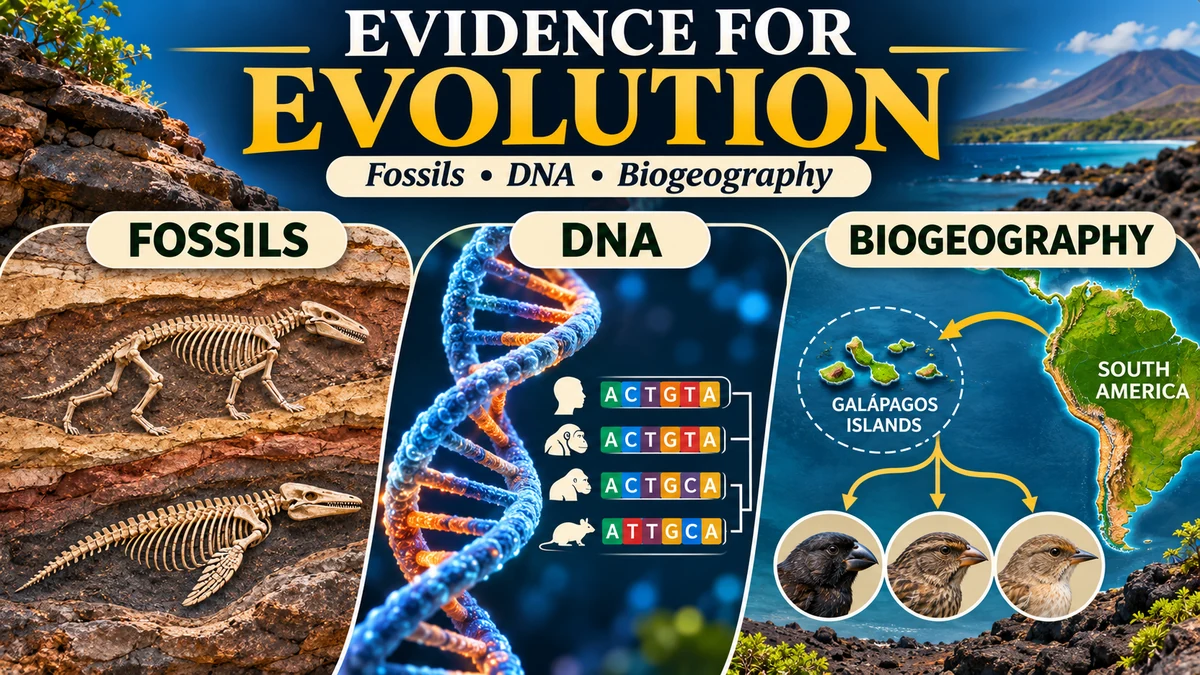
Evidence for evolution comes from many independent scientific fields—including fossils, DNA, comparative anatomy and biogeography. Fossils document organisms that lived in the past and show combinations of features found in different groups. DNA comparisons reveal inherited similarities and differences, while biogeography investigates why related species occur in particular places. Together, these findings help scientists reconstruct the branching history of life on Earth.
Consider three questions: Why do ancient whale fossils include legs and other land-mammal features? Why does human chromosome 2 contain evidence of a fusion involving chromosomes that remain separate in other great apes? And why do the Galápagos Islands host related finches with different beaks? Each question is approached through different evidence, yet all can be investigated using common ancestry and evolutionary change over time.
This guide explains evidence for evolution in accessible terms, examines real studies, distinguishes the mechanism of natural selection from evidence of common descent, and answers common questions about fossils, genetics and the distribution of life.
What counts as evidence for evolution?
In science, evidence consists of observations and measurements that can be tested against explanations and predictions. Evolution describes changes in heritable characteristics of populations across generations. Common descent proposes that species share ancestors, with branches separating and diversifying through time. The evidence supporting these ideas is not one fossil, one DNA percentage or one textbook diagram. It is the agreement among many lines of investigation.
| Evidence type | What scientists examine | What it can reveal |
|---|---|---|
| Fossils and rock layers | Preserved bones, shells, footprints and geological contexts | Ancient organisms, extinction, timing and transitions in anatomy |
| DNA and proteins | Shared genes, sequence differences, chromosome structure and molecular family trees | Genetic inheritance, relatedness and common ancestry |
| Biogeography | Where living and extinct species occur across continents and islands | Patterns of isolation, dispersal and diversification |
| Comparative anatomy | Corresponding skeletal and developmental structures | Features inherited and modified from shared ancestors |
| Direct observations | Changes in traits and genes in populations across generations | Evolutionary mechanisms operating within observable timescales |
The OpenStax Biology 2e chapter on evolution and the Khan Academy evidence overview explain how fossil, molecular and geographical observations can be evaluated together. For terminology such as mammals, vertebrates and invertebrates, see SuperEducational's guide to the major animal groups .
1. Fossil evidence: the history preserved in rocks
Fossils are preserved remains, impressions or traces of past life, such as bones, leaves, footprints or burrows. Fossils are found within geological contexts: the position of a rock layer, the surrounding sediments and its age provide crucial information. They reveal that many species once existed and later became extinct, and that life in different geological periods differed from life today.
Fossilisation is unusual. Soft bodies often decay, many environments do not preserve remains well, and erosion or geological activity can destroy fossils. Consequently, the fossil record is incomplete. That does not make it unusable. Researchers compare large numbers of specimens, anatomical details, stratigraphic positions and independent dates to test ideas about how groups evolved.
How scientists date fossils
Relative dating uses the order and relationships of rock layers to establish which deposits are generally older or younger, allowing for faults, folding and other geological complications. Radiometric dating measures the decay of radioactive isotopes in suitable materials and can provide numerical ages. For very ancient sedimentary fossils, geologists often date volcanic ash or other datable rocks above and below the fossil layer rather than measuring the age of the fossil material itself.
The Smithsonian Human Origins Program's dating guide and NIST's explanation of fossil ages describe how multiple methods support geological chronology. Radiocarbon dating is useful for comparatively recent organic remains, not for determining the age of fossils hundreds of millions of years old. Dating techniques have known assumptions and limits that scientists test and report.
Fossil example: how land mammals evolved into whales
Living whales and dolphins are entirely aquatic mammals. But their evolutionary history includes land-dwelling and amphibious ancestors. Fossils described from deposits in Pakistan, India and elsewhere preserve different combinations of features, from the ears and limbs of early whale relatives to the streamlined bodies of later marine forms.
- Pakicetus: an early whale relative with largely terrestrial skeletal features and distinctive ear anatomy associated with cetacean ancestry.
- Ambulocetus: a form with powerful limbs and features compatible with movement in water and on land.
- Later archaeocetes, including Dorudon: animals more fully adapted to aquatic life, with smaller rear limbs and bodies shaped for swimming.
The Smithsonian National Museum of Natural History's whale-evolution resource illustrates major anatomical changes. The University of Michigan Museum of Paleontology describes the fossil discoveries that clarified the transition.
Important changes include the skull and ear structures used in hearing, reduced weight-bearing hind limbs, modifications to the pelvis, and changes related to swimming. DNA studies independently place whales within the broader evolutionary radiation of even-toed hoofed mammals; hippopotamuses are close living relatives, not direct ancestors of modern whales.
Fossils should not be drawn as a literal chain in which every named animal gave birth to the next species. Researchers reconstruct a branching family tree. A fossil may represent a close relative of an ancestral population rather than a known direct ancestor. The power of the sequence lies in dated organisms with predicted combinations of anatomical features.
Fossil example: Tiktaalik and the fish-to-tetrapod transition
About 375 million years ago, a fish named Tiktaalik roseae lived in shallow-water environments in what is now the Canadian Arctic. It had fish-like scales and fins alongside features associated with early four-limbed vertebrates, including a mobile neck and robust skeletal elements within its fins.
Research published in Nature in 2006 described how the pectoral fin of Tiktaalik contains a transitional arrangement of bones relevant to the origin of limbs. The University of Chicago research group explains how the location and age of the discovery were consistent with predictions about where suitable transitional fossils might occur.
Tiktaalik was not a modern amphibian, nor was it necessarily the unique direct ancestor of every living land vertebrate. It is evidence that traits associated with land vertebrates emerged in ancient fish lineages. The fossil provides a testable anatomical and geological example of evolutionary transition.
2. DNA evidence: inheritance and the tree of life
DNA records genetic information using sequences of four nucleotides represented by A, C, G and T. Descendants inherit genetic material from ancestors, and variations accumulate through mutation, recombination and other processes. Researchers can compare corresponding DNA regions in different organisms to investigate how long their lineages have been separated and which groups share more recent ancestry.
For example, humans and other great apes share many corresponding genes and large segments of chromosome sequence. That relationship is expected under common ancestry. But one simple percentage of DNA similarity is not a complete measure of evolutionary relatedness: answers depend on what sequences are compared and how insertions, deletions and structural differences are counted. Scientists examine many genes, genomic arrangements and statistical models rather than relying on one headline figure.
The Smithsonian Human Origins genetics resource and the 2005 human–chimpanzee genome comparison describe how genomes help test evolutionary relationships. Humans did not evolve from the chimpanzees alive today. Human and chimpanzee lineages share an earlier common ancestor.
DNA example: the fusion of human chromosome 2
Humans usually have 23 pairs of chromosomes, while chimpanzees and other great apes commonly have 24 pairs. Genetic comparison shows that human chromosome 2 formed through an ancient fusion of two ancestral chromosomes that remained separate in other great ape lineages.
Researchers identified a chromosome region containing telomere-related DNA repeats in a head-to-head arrangement, consistent with an old end-to-end fusion. Additional evidence includes matching arrangements of genetic material between human chromosome 2 and two corresponding great ape chromosomes. The primary paper Origin of Human Chromosome 2: An Ancestral Telomere-Telomere Fusion documents the sequence-level findings, while a subsequent study of the fusion region investigates its structure in greater depth.
This is a particularly instructive example because scientists can identify a specific, testable genomic event consistent with a branching evolutionary family tree. The evidence does not mean that a modern chimpanzee chromosome fused inside a modern human. The event occurred along an ancestral lineage over evolutionary time.
How do DNA family trees work?
A phylogenetic tree is a scientific hypothesis about evolutionary relationships. Branch points represent inferred shared ancestors; the tips often represent living species or sampled fossil groups. Researchers identify corresponding DNA sequences, align them, compare mutations and use statistical methods to estimate relationships.
If several species share a distinctive inherited change, that can help identify a common branch. Large genetic datasets often recover a consistent pattern of relatedness, especially when combined with comparative anatomy and the fossil record. However, not every individual gene produces exactly the same tree. Incomplete lineage sorting, hybridisation, gene duplication and horizontal gene transfer can complicate evolutionary histories. Those complexities are researched using larger datasets and more sophisticated methods; they do not make phylogenetics meaningless.
Genomic analysis of Darwin's finches, for instance, found both relationships among the island species and evidence of gene flow between lineages. See the 2015 Nature study of finch genomes . Such findings show why a scientific tree should be understood as a model supported by evidence rather than a decorative diagram that can never change.
3. Biogeography: why species occur where they do
Biogeography is the study of the geographic distribution of life across space and time. If species share ancestry, their distributions should reflect historical movements, isolation, extinction, evolving habitats and events such as continental separation. Geography can leave recognisable patterns even when different places have similar climates.
Island species provide especially striking examples because ocean barriers can restrict the movement of organisms. An ancestral population may reach an island, become isolated and, across generations, diversify into forms suited to different habitats. This is often called adaptive radiation, although the details can involve multiple processes, including natural selection, gene flow and chance.
Biogeography example: Darwin's finches of the Galápagos
The Galápagos Islands lie in the Pacific Ocean west of mainland South America. Their finches are closely related birds whose beaks and feeding habits vary across species. The pattern is consistent with an ancestral colonisation followed by diversification in different island environments, not with each island species being unrelated to its neighbours.
Modern research has strengthened the case by combining island geography, bird measurements and DNA. The whole-genome study of Darwin's finches found evidence of related lineages and historical gene flow. A 2024 review of adaptive radiation discusses how environmental opportunities, reproductive isolation and hybridisation interact in their evolution.
Not every finch species was formed by one isolated mutation or in one short drought. The development of multiple species involves a longer, branching history. Local environmental differences help explain adaptations; geographic isolation and genetic data help explain the relationships among species.
Biogeography example: marsupials, Australia and continental history
Australia is home to a rich diversity of native marsupials, including kangaroos, koalas and wombats. Marsupials also occur in the Americas, and Australia contains other mammal groups as well. The important biogeographic question is why related lineages are particularly diverse in some regions but not others.
Evolutionary biologists consider continental history, historical dispersal, isolation, extinction and competition. The movement and separation of continental landmasses altered routes available to ancestral animals, helping shape where their descendants live today. These are historical explanations tested using fossils and genetic relationships, not the claim that continents alone determine every species' location.
The OpenStax discussion of biogeography presents Australia and island distributions as examples of how geography can help explain evolutionary history. The pattern is powerful precisely because it makes more sense when ancestry and historical geography are considered together.
4. Comparative anatomy: related structures with different functions
Species can share underlying anatomical structures even when they use those structures differently. The forelimb skeleton of a human, whale, bird and bat contains corresponding bones, including the humerus, radius and ulna, modified for grasping, swimming or flight. Such homologous structures provide evidence of inherited anatomical patterns that diversified over time.
But resemblance alone does not prove close ancestry. The wings of birds and insects perform similar functions yet differ markedly in developmental and anatomical origin. Similar features that evolved independently in different lineages are examples of convergent evolution. Biologists distinguish homology from analogy by comparing many features, developmental patterns, fossils and DNA, rather than drawing conclusions from appearance alone.
For learners comparing the main vertebrate groups, SuperEducational's animal classification chart offers a useful starting point. The Khan Academy evidence overview explains homologous and analogous structures in more detail.
5. Direct observation: evolution happening in populations today
Evidence for evolution is not confined to ancient rocks. Scientists can follow populations across generations and directly measure changes in inherited traits. For example, bacteria may carry heritable antibiotic-resistance variants; when antibiotics favour resistant cells, those variants can increase. Finches have also been followed through changing environmental conditions, allowing researchers to connect survival and inherited variation to changes in populations.
Those examples demonstrate evolutionary processes operating today. Yet an important distinction remains: observing natural selection is evidence of one mechanism of evolution, while fossils, DNA and biogeography are especially useful for reconstructing longer evolutionary histories and common ancestry. One sort of evidence complements the other.
See the HHMI BioInteractive case study of rock pocket mice for an experimental and genetic investigation of camouflage, or the CDC explanation of antimicrobial resistance for a clinically important evolutionary example.
How the evidence works together: a scientific test
Suppose scientists hypothesise that whales evolved from terrestrial mammals and that today's whales share ancestry with other even-toed hoofed mammals. The hypothesis can be examined independently:
- Fossil prediction: Ancient deposits from appropriate geological periods should contain animals with combinations of terrestrial and whale-related characteristics, including changes in the skull, ear and limbs.
- Molecular prediction: DNA data from living whales and other mammals should recover a coherent pattern of common ancestry, with whales nested within a broader mammalian group.
- Geographic prediction: The locations and ages of fossil finds should be interpretable in relation to ancient environments and possible routes of dispersal.
- Anatomical prediction: Shared structural features should occur in meaningful patterns across the fossils and living animals, rather than appearing as arbitrary similarities.
These findings are stronger together because they come from different methods, each with limitations and sources of error. Agreement between independent lines of evidence is sometimes called consilience. Scientists can refine branches, dates and details when new fossils or better genomic data appear without discarding everything that earlier research established.
Common misconceptions about the evidence for evolution
- “There are no transitional fossils.” Fossils such as Tiktaalik and numerous early whale relatives document combinations of anatomical features associated with evolutionary transitions.
- “Every species needs an unbroken chain of fossils.” Fossil preservation is incomplete, and evolution is branching. Researchers test relationships using all available evidence rather than demanding a fossil of every ancestor.
- “Carbon-14 dates dinosaurs and Devonian fish.” Carbon-14 is not suitable for such ancient fossils. Scientists use appropriate radiometric methods and geological context.
- “Similar DNA proves one living species descended directly from another living species.” Genetic evidence usually supports shared ancestry and branching relationships, not a modern species turning into another modern species.
- “A chromosome difference means two species cannot be related.” Chromosomes can fuse, split or rearrange in evolutionary lineages, and such changes themselves provide testable evidence.
- “Biogeography is just a list of animals on a map.” It studies how distributions reflect dispersal, barriers, extinction, ecological history and evolutionary relationships.
- “Everything that looks similar must be inherited from a common ancestor.” Convergent evolution can produce analogous traits in distantly related groups.
- “Evolution is only a theory, so there is no evidence.” In science, a theory is a tested explanatory framework. Evolutionary history is investigated through measurable observations and predictions.
Classroom activity: three evidence stations
Students can investigate common ancestry using a 45-minute lesson without handling live organisms or performing laboratory experiments.
| Station | Material | Student task |
|---|---|---|
| A: Fossils | Images of Pakicetus, Ambulocetus and a later whale | Identify two changes in limb or skull anatomy, and explain why the series is not necessarily a direct ancestor chain |
| B: DNA | A teacher-created set of four short DNA sequences | Count the differences and propose a possible relationship; explain why a few symbols cannot establish a whole phylogeny |
| C: Geography | Map of South America and the Galápagos Islands, with finch illustrations | Suggest how colonisation and isolation could produce related but distinct island species |
Teacher note: Use invented DNA strings only to teach sequence comparison; they must be labelled hypothetical and not passed off as real human, chimpanzee or finch sequences. The fossil illustrations in the featured image are similarly educational representations, not photographic images of specific scientific specimens.
At the end, ask each group to complete this sentence: “Our evidence supports common ancestry because..., but it cannot prove the exact detail of...”. Award credit for clear claims, specific evidence and recognition of limitations. This helps pupils separate observations from inferences.
Frequently asked questions about evidence for evolution
What are the three main types of evidence for evolution?
Fossils, DNA or molecular comparisons, and biogeography are three major lines of evidence. Comparative anatomy, developmental biology and directly observed changes in populations also contribute.
How do fossils support evolution?
They record organisms that lived at different times and reveal changes, extinctions and anatomical transitions. Their value increases when interpreted with geological dating and comparative anatomy.
How does DNA prove that species are related?
Inherited genetic sequences and chromosome arrangements show patterns consistent with common ancestry. Scientists use multiple genomic regions and statistical methods to reconstruct branching relationships rather than relying on a single similarity figure.
What is biogeography in evolution?
It studies the distribution of organisms and how geography, isolation, dispersal and historical environmental change help explain evolutionary patterns.
Are humans descended from modern chimpanzees?
No. Human and chimpanzee lineages descended from a shared ancestral population. Living humans and living chimpanzees occupy separate branches of that evolutionary tree.
Does an incomplete fossil record weaken all evidence for evolution?
No. Missing fossils limit what can be known about particular lineages, but many well-documented fossils, genomic data, anatomy and geographic patterns support evolutionary history independently.
Does evolution mean that all changes happen through natural selection?
No. Natural selection is one mechanism. Mutation, genetic drift, gene flow and other evolutionary processes also influence how populations change.
Can science revise the evolutionary family tree?
Yes. New fossils, additional genome sequences and improved analytical methods can refine relationships and dates. Revising parts of a scientific explanation in response to evidence is a strength of the method, not a failure.
Conclusion
Evidence for evolution is strongest because fossil discoveries, DNA research, comparative anatomy and biogeography approach the history of life from different directions and reveal compatible patterns. Transitional fossils show how anatomical combinations changed through time; genomes carry inherited traces of common ancestry; and the geographic distribution of life reflects isolation, dispersal and changing environments.
None of these methods reveals every ancestor, every genetic event or every migration route. Together, however, they provide a powerful, testable account of how life diversified. Understanding both the findings and their limits is the foundation of good evolutionary science.