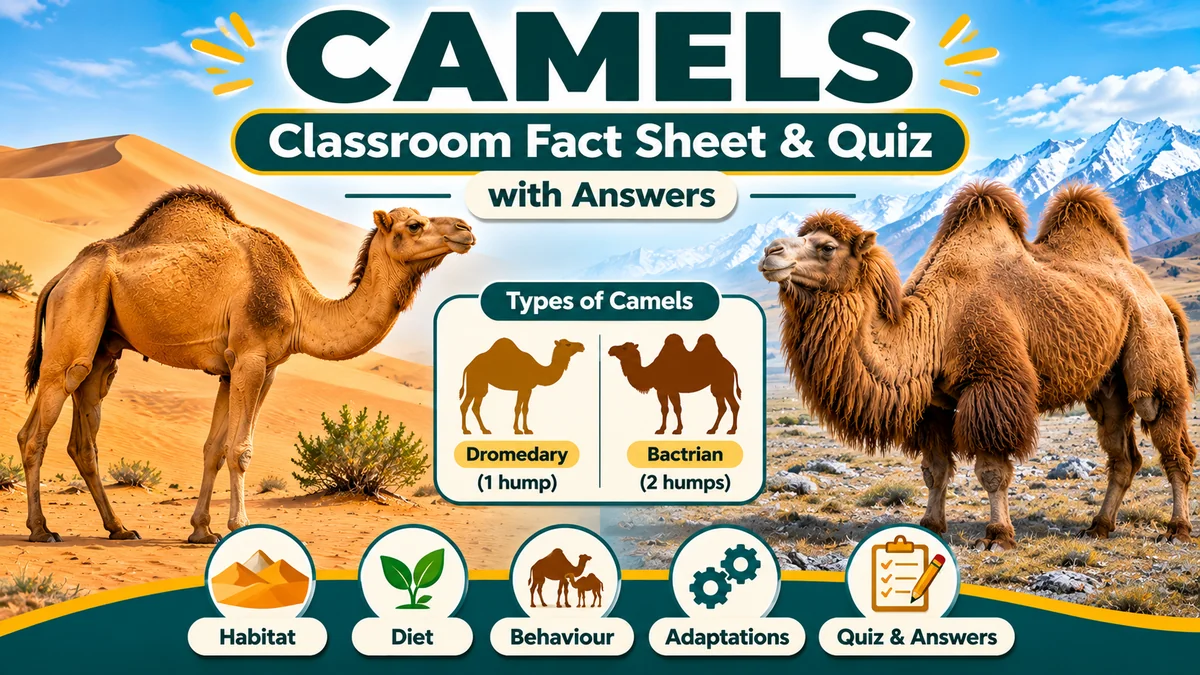
Camels: Classroom Fact Sheet and Quiz with Answers
Why do camels have humps? Can they live in cold deserts? And is a wild camel the same animal as a two-humped domestic camel? This camel classroom fact sheet and quiz with answers helps students explore those questions using reliable zoological sources rather than repeating common myths.
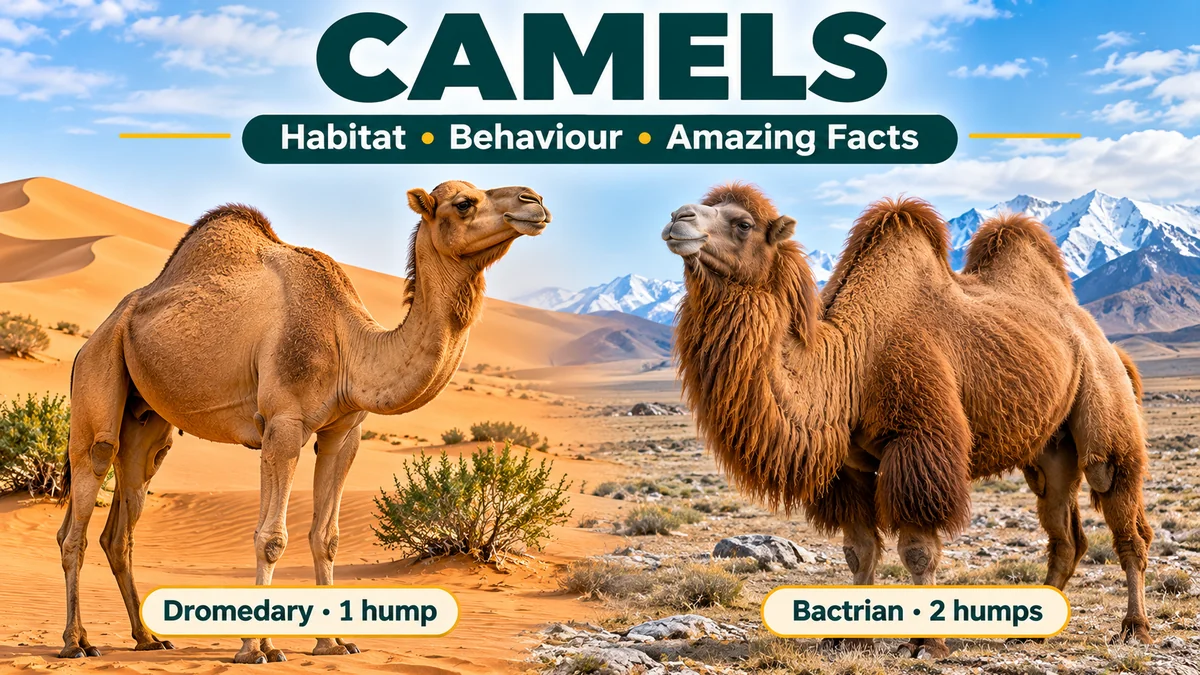
The resource is designed for upper-primary and secondary learners, home educators and curious families. It includes a quick-reference fact sheet, a comparison table, an adaptations worksheet, 15 scored questions worth 20 marks, a separate answer key, discussion prompts and guidance for teachers. For a longer account of camel habitats and behaviour, see SuperEducational’s companion article Camels: Habitat, Behaviour and Amazing Facts , scheduled to appear before this lesson.
Learning objectives and classroom instructions
After completing this resource, learners should be able to identify the three living camel species, describe their main habitats, distinguish fat storage from water conservation, explain at least three adaptations, and interpret a conservation source accurately. The classroom quiz includes recall, comparison and short explanations rather than memorisation alone.
Suggested lesson: 5 minutes for the starter; 12 minutes for the fact sheet; 10 minutes for the adaptations worksheet; 15 minutes for the quiz; 10 minutes to review the answers; and 8 minutes for discussion. Allow longer for younger readers and for students who need extra reading support. Learners should attempt the questions before looking at the answer section.
Printable-style camel fact sheet
| Feature | Essential fact |
|---|---|
| Animal group | Mammal; family Camelidae; genus Camelus |
| Main diet | Plants, including grasses, shrubs, leaves and tough desert vegetation |
| Dromedary | Camelus dromedarius; one hump; associated with hot, arid regions |
| Domestic Bactrian | Camelus bactrianus; two humps; adapted to cold and dry Central Asian environments |
| Wild camel | Camelus ferus; two humps; wild populations in Mongolia and China |
| Humps | Store fat as an energy reserve—not drinking water |
| Feet | Broad padded toes help spread weight on sand and other soft ground |
| Eyes and nose | Long eyelashes help protect eyes; nostrils can narrow against dust |
| Social behaviour | Often live in herds and communicate using posture and calls |
| Young | Usually one calf after roughly 12–14 months of gestation |
| Wild camel status | Endangered in the IUCN’s 2025 assessment; estimated 780–1,380 mature individuals |
These facts reflect the San Diego Zoo Wildlife Alliance taxonomy reference , the zoo’s animal account , the Natural History Museum’s adaptation guide and the IUCN Red List . Individual sizes, lifespan and water needs vary substantially, so this sheet deliberately avoids unqualified “record-breaking” numbers.
Three camel species: compare and contrast
The number of humps is a useful starting clue, but it does not by itself identify the species of every two-humped camel. There are three recognised living species of true camels: dromedary, domestic Bactrian and wild camel.
| Species | Humps | Where it lives | Main distinction |
|---|---|---|---|
| Dromedary (C. dromedarius) | 1 | Domestic populations in Africa and Asia; feral in Australia | Usually slimmer, associated with warmer drylands |
| Domestic Bactrian (C. bactrianus) | 2 | Domestic herds across Central Asia | Thicker seasonal coat; tolerates cold deserts |
| Wild camel (C. ferus) | 2 | Restricted desert areas in Mongolia and China | Distinct wild lineage and conservation concern |
Older books sometimes call C. ferus the “wild Bactrian camel”. That name may confuse students because the genuinely wild species is distinct from the domestic two-humped Bactrian camel. A feral camel, by contrast, descends from domesticated animals that now live freely. For more about classification and mammalian traits, consult Animal Classification Chart: Mammals, Birds, Reptiles, Fish and More .
Where camels live—and why not every desert is hot
Many dromedaries live with people in dry regions of North Africa, the Middle East and elsewhere in Asia. Their environments can include sand dunes, rocky plains and semi-arid grazing land. Domestic Bactrian camels are associated with Central Asian steppes and deserts, where temperatures may fall dramatically in winter. Their shaggy winter coat helps insulate them against cold. The truly wild Camelus ferus survives in limited desert areas of Mongolia and north-western China.
Classroom thinking point: “Desert” primarily refers to a region with very little precipitation; it does not automatically mean a hot place. Deserts can be cold. Learners should connect an animal’s characteristics to the actual conditions of its habitat rather than to a familiar picture of sand dunes.
How camels survive: five adaptations to remember
1. Humps provide an energy reserve
Camel humps contain fat, not stored drinking water. When food is scarce, the camel can draw on this reserve. A hump may change shape as fat is used. The fat is concentrated rather than distributed evenly across the entire body, contributing to the animal’s heat management.
2. Their bodies conserve water
Camels can tolerate periods of dehydration, but they cannot live without water forever. They minimise water loss in several ways, including producing concentrated urine, recovering moisture in the nasal passages and allowing body temperature to vary. These mechanisms help limit water lost through sweating and breathing. A thirsty camel still needs to drink when water is available.
3. Broad feet distribute weight
Camels have two toes on each foot with wide, cushioned pads. The pads spread as a camel steps, helping the animal travel across soft sand and other difficult ground. This explains part of the nickname “ship of the desert”.
4. Eyes and nostrils resist blowing dust
Long eyelashes help protect a camel’s eyes, while nostrils can narrow during dusty conditions. Protective features reduce irritation but do not make an animal immune to injury or severe weather.
5. Tough, flexible lips help with feeding
A camel can grasp coarse grasses, leaves and thorny or salty vegetation that other animals might avoid. Its split upper lip assists selective feeding. Camels are herbivorous in ordinary ecological descriptions, although available food differs among habitats.
The Natural History Museum’s camel explainer gives further evidence for the roles of humps, kidneys, breathing and temperature regulation.
Camel behaviour, communication and family life
Camels are social mammals. Many live or move in groups, but group size and structure vary with species, environment and human management. They communicate through calls, postures and movements. An adult may grunt or bellow, and mothers and calves maintain contact using sound. When frightened or defending themselves, camels may spit or project stomach contents; this behaviour should not be treated as a joke or an invitation to disturb them.
Camels usually spend substantial time feeding on plants. Their digestive system enables them to bring partly digested food back to the mouth and chew it again. Female camels generally carry a pregnancy for approximately 12–14 months, with a single calf being usual. Newborns can often stand and walk relatively soon after birth; they begin life without the large humps seen in well-fed adults. The San Diego Zoo camel guide describes these behaviours and developmental facts.
Domestic camels have supported transport, herding, milk production and other livelihoods in drylands for generations. Their resilience does not remove their need for drinking water, appropriate feed, rest and humane treatment.
Conservation fact-check: what does Endangered mean?
Not all camels have the same conservation status. Dromedaries and domestic Bactrian camels are widespread livestock in many regions. The truly wild species, Camelus ferus, is much rarer. Its 2025 IUCN Red List assessment lists it as Endangered and estimates 780–1,380 mature individuals in the wild. The assessment also reports a declining, severely fragmented population.
Some older websites still call the wild camel “Critically Endangered”, reflecting an earlier assessment. A student should compare the date on a conservation claim against the latest relevant source instead of copying a status without checking. The 2025 change in category does not mean the species is safe: habitat disturbance, fragmentation and other pressures still threaten its survival.
Mini research task: Record three items from the IUCN entry: (1) species name; (2) assessment year; (3) conservation category. Explain in one sentence why each item matters to a factual answer.
Student worksheet: match each adaptation to its purpose
Instructions: Copy each feature in column A and match it with the correct purpose from column B. Use each letter once. The answer key appears after the quiz.
| Column A: camel feature | Column B: possible purpose |
|---|---|
| 1. Broad foot pads | A. Helps reduce dust entering the nose |
| 2. Fat-filled hump | B. Stores energy when food is scarce |
| 3. Narrowable nostrils | C. Helps grasp tough vegetation |
| 4. Tough, flexible lips | D. Spreads weight on soft ground |
| 5. Thick winter coat | E. Provides insulation in cold conditions |
Extension: Choose one adaptation and describe why it is useful in one habitat but does not make the camel independent of food, water or shelter.
15-question camel quiz (20 marks)
Student instructions: Answer without consulting the fact sheet. Questions 1–5 are multiple choice (1 mark each); questions 6–10 are true/false (1 mark each); questions 11–15 require short explanations (2 marks each). The total is 20 marks. Suggested time: 15–20 minutes.
Part A — Multiple choice (5 marks)
- What is stored mainly inside a camel’s hump?
A. Liquid water B. Fat C. Sand D. Air - Which camel has only one hump?
A. Dromedary B. Domestic Bactrian C. Wild camel D. All three - Which is the scientific name of the genuinely wild camel?
A. Lama glama B. Camelus bactrianus C. Camelus ferus D. Camelus dromedarius - What is one function of broad camel foot pads?
A. Storing drinking water B. Making the animal fly C. Spreading its weight on soft ground D. Producing milk - Where do truly wild camels survive today?
A. Antarctica only B. Mongolia and China C. The Amazon rainforest D. Every continent
Part B — True or false (5 marks)
- All deserts are extremely hot throughout the year.
- Camels belong to the mammal family Camelidae.
- A feral camel descended from domestic animals is automatically the same species as the wild camel Camelus ferus.
- Camels can reduce moisture loss through several body mechanisms.
- The IUCN’s 2025 assessment classifies Camelus ferus as Endangered.
Part C — Short answers (10 marks)
- Name two adaptations, apart from humps, that help camels live in dry or dusty habitats.
- Explain one difference between a dromedary and a domestic Bactrian camel, and one similarity.
- Why does a wild camel population estimate tell us more about conservation than the total number of domestic two-humped camels?
- Give two examples of behaviour that show camels are social animals.
- A website written years ago says the wild camel is Critically Endangered. A newer IUCN record says Endangered. What two checks should a student make before using either claim?
Answer key with explanations and mark scheme
Part A — Multiple-choice answers
| Question | Correct answer | Why? |
|---|---|---|
| 1 | B — Fat | The hump stores fat for energy, not a reservoir of water. |
| 2 | A — Dromedary | Dromedaries have one hump; both Bactrian and wild camels have two. |
| 3 | C — Camelus ferus | This is the separate truly wild camel species. |
| 4 | C — Spreading weight | The wide pads make movement on soft ground easier. |
| 5 | B — Mongolia and China | These are the wild camel’s surviving native-range countries. |
Part B — True-or-false answers
| Question | Answer | Explanation |
|---|---|---|
| 6 | False | Deserts can be cold; low precipitation, not heat alone, defines them. |
| 7 | True | Camelidae is the family containing true camels and their camelid relatives. |
| 8 | False | Feral domestic camels are not automatically the distinct wild species. |
| 9 | True | Camels minimise water loss through nasal, renal and temperature-control processes. |
| 10 | True | The IUCN’s 2025 assessment lists the wild camel as Endangered. |
Part C — Model answers (2 marks each)
11. Long eyelashes can help shield the eyes from dust; narrowable nostrils help prevent blowing sand from entering. Marking: one mark per correct adaptation. Other valid answers include broad padded feet and water-saving mechanisms.
12. The dromedary has one hump while the domestic Bactrian camel has two. Both are mammals in the family Camelidae and can live in dry environments. Marking: one mark for a correct difference and one for a valid similarity.
13. The wild camel is a distinct species with a small surviving wild population. Counting numerous domestic Bactrian camels would misrepresent how secure C. ferus is. Marking: one mark for the species distinction, one for linking it to conservation.
14. Camels may live in herds, and mothers and calves communicate using calls. Marking: one mark for each correct social behaviour; alternative valid examples include body-posture communication and interactions in groups.
15. Check the exact species name and the publication or assessment date; use the latest authoritative IUCN status and note why an older description differs. Marking: one mark for a relevant source/species check and one for an assessment-date/current-status check.
Worksheet matching key: 1–D, 2–B, 3–A, 4–C, 5–E. The matching worksheet is practice and does not contribute to the 20-mark quiz unless the teacher chooses a separate score.
Suggested attainment bands: 17–20 excellent understanding; 13–16 secure understanding; 9–12 developing understanding; 0–8 revisit key concepts. These are classroom suggestions, not standardised grades. Encourage learners to correct mistakes with evidence from the sources.
Discussion questions and optional classroom extensions
Discussion prompt 1: Can an adaptation be misunderstood?
Ask learners why the phrase “camels store water in humps” is memorable but inaccurate. Students should correct the claim by describing fat storage and separate water-saving processes, then explain why precision matters in science.
Discussion prompt 2: Is every two-humped camel threatened?
Use the species comparison table to distinguish domestic Bactrian camels from C. ferus. Explain that a conservation status applies to a defined biological unit rather than any animal with a similar appearance.
Discussion prompt 3: Why do habitats matter more than stereotypes?
Contrast a hot desert dromedary with a shaggy Bactrian camel living in a cold steppe. Ask which traits suit each setting, and why not all deserts look or feel the same.
Research extension: compare evidence dates
Provide an older zoo article and the 2025 IUCN listing . Have students identify a difference in the wild camel’s listed category, cite both sources, and state the newer supported answer without dismissing the historical document as worthless. This exercises source evaluation and temporal reasoning.
Teacher notes: adapting the material responsibly
For younger pupils, select the first ten quiz questions and complete the adaptations worksheet together. For older students, use the full quiz and require source citations in questions 13 and 15. The resource can also be used as a home-learning reading exercise or science-club activity.
The fact sheet deliberately avoids asking children to visit, feed or approach camels. Images and observation of reputable zoo footage are safer ways to study behaviour. If using wildlife media, remind learners that an AI-generated illustration is not field evidence. The companion camel habitat guide provides wider ecological and historical context, while SuperEducational’s animal classification chart supports comparative biology lessons.
Frequently asked questions
Are there two or three types of camels?
There are three commonly recognised living species of true camel: the dromedary, domestic Bactrian and wild camel. People often learn about only the first two because they are familiar domestic animals.
Do camel humps hold water?
No. Humps store fat, while a camel’s body conserves water through other adaptations.
Why do Bactrian camels have thick hair?
The coat provides insulation during cold Central Asian winters and is shed seasonally.
Can camels survive indefinitely without water?
No. They can tolerate dry conditions unusually well, but ultimately need suitable drinking water.
Are wild camels Critically Endangered?
The latest IUCN assessment published in 2025 lists Camelus ferus as Endangered. Older documents may still use the previous category. It remains a threatened species.
Conclusion
Camels offer an excellent science lesson because familiar features—humps, eyelashes and broad feet—have clear functions that can be tested against evidence. Students also learn that a camel from a hot desert and one from a cold Central Asian steppe need not share exactly the same adaptations.
Use the fact sheet to study the animals, the worksheet to connect form with function, and the quiz to check understanding. Above all, distinguish domestic and genuinely wild camels, and use up-to-date scientific sources when presenting conservation facts.