A flash lights up the sky.
Several seconds later:
Boom.
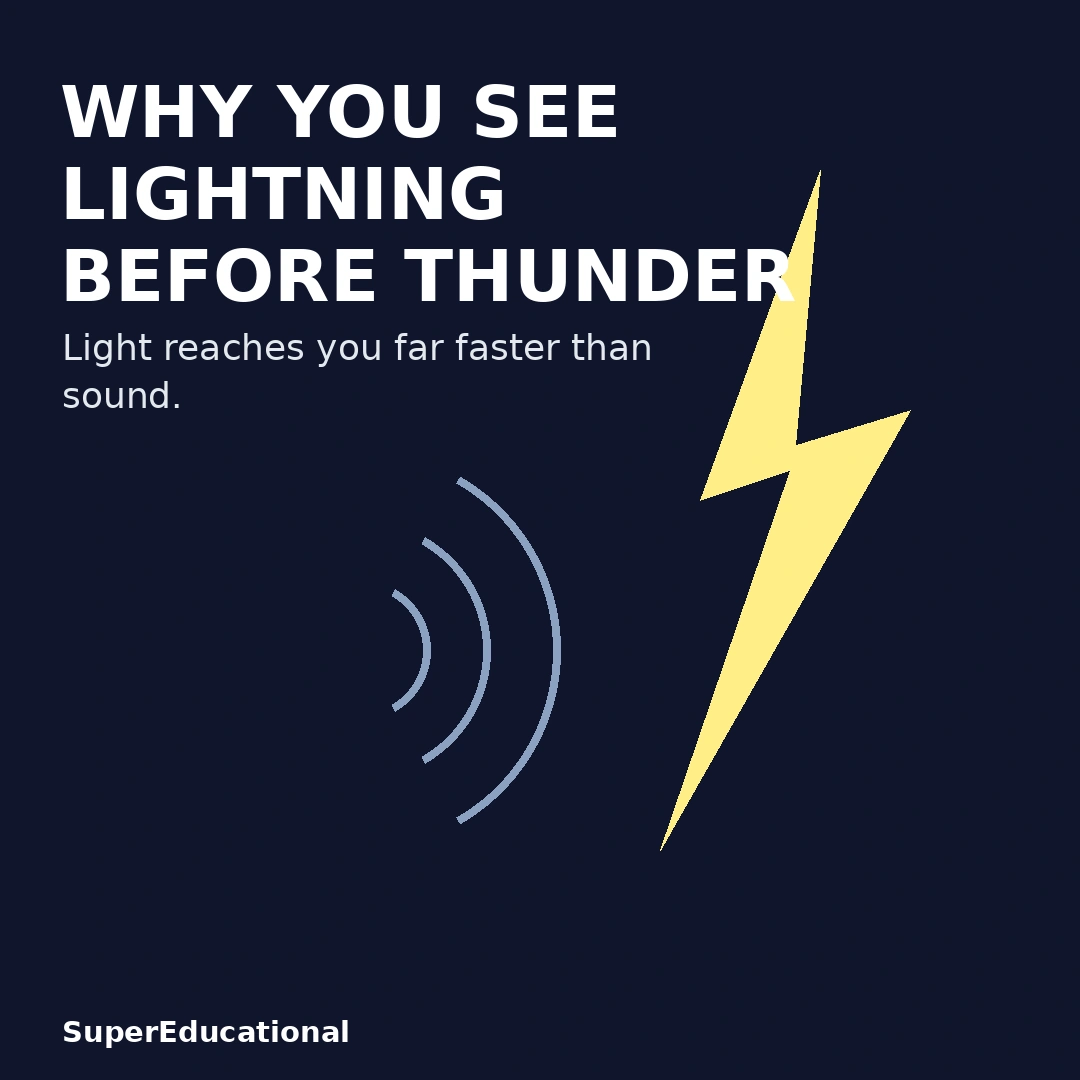
Lightning and thunder are part of the same event, so why don't we see and hear them at the same time?
The answer comes down to one enormous difference:
Light travels much faster than sound.
What Causes Thunder?
Thunder is not a separate event that happens after lightning.
Lightning creates thunder.
When a lightning discharge passes through the atmosphere, it heats the surrounding air extremely rapidly.
According to the National Weather Service, the air inside a lightning channel can reach temperatures of around 50,000°F (about 28,000°C).
The intensely heated air expands suddenly, creating a powerful pressure disturbance.
That disturbance travels through the atmosphere as a sound wave.
What we hear is thunder.
So the sequence is essentially:
Lightning → rapid heating of air → sudden expansion → sound wave → thunder
Why Do You See the Lightning First?
Because light and sound travel at dramatically different speeds.
Light travels through air at close to 300,000 kilometres per second.
Sound in ordinary air travels at only around 340 metres per second, although its exact speed varies with conditions such as temperature.
NOAA's National Severe Storms Laboratory notes that light travels through air roughly a million times faster than sound.
Across the relatively short distances involved in a thunderstorm, the light from a lightning flash therefore reaches your eyes almost instantly.
Thunder takes noticeably longer to reach your ears.
That is why you might see:
⚡ FLASH
...wait several seconds...
🌩️ BOOM
The lightning did not necessarily happen seconds before the thunder was produced.
The sound simply took longer to reach you.
You Can Use the Delay to Estimate Distance
That difference in speed gives us a simple way to estimate how far away a lightning flash occurred.
NOAA guidance says sound travels roughly:
1 mile every 5 seconds
or:
1 kilometre every 3 seconds.
To make a rough estimate, count the seconds between seeing the flash and hearing the thunder.
In miles
Divide the number of seconds by 5.
For example:
15-second delay ÷ 5 = about 3 miles away
In kilometres
Divide the number of seconds by 3.
For example:
15-second delay ÷ 3 = about 5 kilometres away
This is only an approximation because the speed of sound changes somewhat with atmospheric conditions.
Why Does Thunder Sometimes Crack and Sometimes Rumble?
Thunder does not always sound the same.
A nearby lightning strike may produce a sudden, sharp crack or bang.
Distant thunder often sounds like a long rumble.
One reason is that a lightning channel can stretch for many kilometres through the atmosphere.
Sound is produced along different sections of that channel.
The thunder coming from the section nearest you arrives first. Sound from more distant parts arrives slightly later, creating the rolling or rumbling effect we associate with thunderstorms.
The atmosphere can also alter the sound as it travels.
The Distance Trick Is Not a Safety Test
The flash-to-thunder calculation is a useful demonstration of physics.
But it should not be used as an excuse to remain outside during a thunderstorm.
The National Weather Service's advice is simple:
If you can hear thunder, lightning is close enough to pose a danger.
Do not stand outside counting seconds while deciding whether the storm is close enough to worry about.
Move to safe shelter.
Suitable shelter includes a substantial enclosed building or a fully enclosed, hard-topped vehicle with the windows closed. The National Weather Service recommends remaining in shelter for at least 30 minutes after the last sound of thunder.
One Lightning Flash Doesn't Predict the Next One
There is another limitation to the distance calculation.
Suppose your calculation suggests that one lightning flash occurred five miles away.
That tells you approximately where that particular flash happened.
It does not mean the next one will strike at the same distance.
Lightning can occur in different parts of a storm, including several miles away from the area where rain is falling.
So:
“That strike was far away” does not mean “I am safe outside.”
A Simple Demonstration of Physics
The delay between lightning and thunder is something almost everyone has experienced.
But hidden inside those few seconds is a striking physics lesson.
Two signals are produced by essentially the same event.
One travels so quickly that its journey seems instantaneous.
The other moves slowly enough that we can count the difference ourselves.
That makes every thunderstorm an everyday demonstration of the enormous difference between the speeds of light and sound.
Why It Matters
Understanding why lightning appears before thunder turns an ordinary weather event into an easy lesson in physics.
Just remember the two lessons separately:
For science: About 5 seconds of delay equals 1 mile, or about 3 seconds equals 1 kilometre.
For safety: If you can hear thunder, don't stay outside measuring it.
When thunder roars, go indoors.