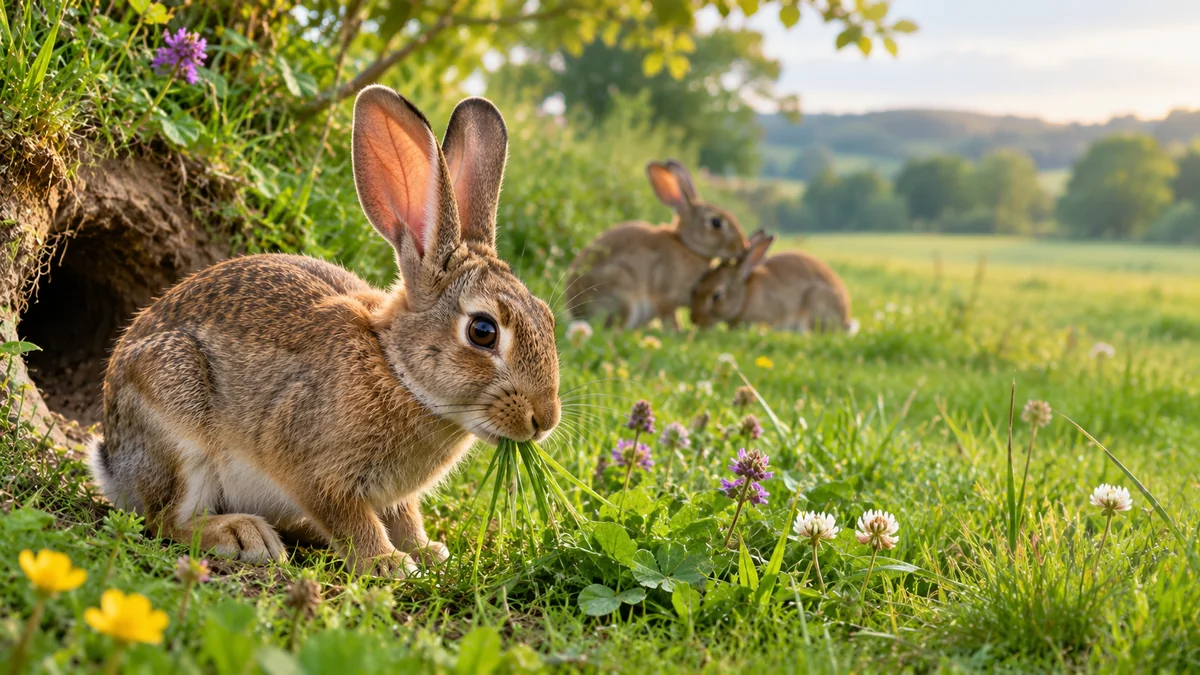
Rabbit facts reveal much more than fluffy fur and long ears. Rabbits are plant-eating mammals with powerful hind legs, continuously growing teeth, highly specialised digestion and complex social behaviour. Wild rabbits use burrows, cover and alertness to survive predators, while domestic rabbits need space, fibre-rich food, companionship and knowledgeable care. Their lives also differ significantly: a well-cared-for pet rabbit can live for 8–12 years, sometimes longer, whereas many wild individuals die young from predation, disease and environmental hazards.
One important distinction is that rabbits are not rodents. They belong to the order Lagomorpha and family Leporidae, alongside hares. The domestic rabbit descends from the European rabbit, Oryctolagus cuniculus, but the everyday word “rabbit” can describe other wild species with different habitats and behaviour. This article primarily discusses European and domestic rabbits and labels differences when they matter.
For an accurate introduction to rabbit diet, habitat, lifespan and behaviour, we draw on the Merck Veterinary Manual , RSPCA rabbit welfare guidance , the Scottish Government's welfare guidance and wildlife resources. The goal is to explain how rabbits actually live, rather than repeat myths about endless carrots or rabbits being easy pets for children.
Rabbit facts at a glance
| Fact | Evidence-based explanation |
|---|---|
| Animal group | Mammal; order Lagomorpha; family Leporidae—not a rodent |
| Domestic rabbit ancestor | European rabbit, Oryctolagus cuniculus |
| Natural diet | Mostly grass, leafy plants and other high-fibre vegetation |
| Recommended adult pet diet | Unlimited quality grass hay or suitable grazing, leafy greens, measured small quantities of suitable pellets, fresh water |
| Special digestive process | Caecotrophy: re-eating nutrient-rich soft caecotrophs |
| Typical pet lifespan | Approximately 8–12 years with suitable care; variation is substantial |
| Wild habitat | Grasslands, scrub, woodland edges, farmland and places with cover and suitable soil |
| Shelter | European rabbits often dig connected burrows called warrens |
| Daily activity | Often crepuscular, especially active around dawn and dusk |
| Social behaviour | Grooming, scent communication, alert thumping, play and companionship |
| Reproduction | Usually about 30–31 days of gestation; young called kits |
As with any animal, these are patterns, not guarantees for every rabbit species, breed or individual. SuperEducational's guide to animal classification explains the wider differences between mammal groups.
1. What exactly is a rabbit?
Rabbits are small to medium-sized mammals known for long ears, strong hind legs, short tails and teeth suited to gnawing plant material. They belong to Lagomorpha, the order that includes rabbits, hares and pikas. Their closest familiar lookalikes are often rodents, but rabbits and rodents have distinct evolutionary histories and anatomical differences, including the characteristic second small pair of upper incisors behind the front pair in lagomorphs.
Domestic rabbits descended from European rabbits, originally native to the Iberian Peninsula and nearby parts of western Europe. They have been bred into many coat colours, ear shapes and body sizes. A lop-eared pet and a wild grey-brown rabbit may look different, but they still share important digestive, social and behavioural needs. Merck's rabbit anatomy overview and Scottish welfare guidance support these distinctions.
The phrase “rabbit” does not mean one identical species worldwide. American cottontails, for instance, have their own ecological adaptations and generally do not live in the same elaborate social warrens typical of European rabbits. That is why reports about a wild rabbit's lifespan or nesting behaviour should name the species whenever possible.
2. Rabbit anatomy: what makes their bodies special?
Rabbits are built for detecting danger and moving rapidly. Their hind limbs are muscular and comparatively long, enabling powerful hopping and sudden changes of direction. Their forelimbs help with landing, digging, grooming and balance. A flexible spine also contributes to the movements needed for running and jumping, but their back can be injured if a frightened animal kicks while unsupported.
The large ears help detect sounds and support heat exchange through blood vessels in the ear tissue. Eye placement toward the sides of the head provides a broad field of view, helpful for monitoring predators, though rabbits have blind areas and do not see every direction equally well. Sensitive noses and whiskers contribute to exploration close to the face.
Rabbit teeth are distinctive. The front incisors and back cheek teeth grow throughout life; chewing fibrous foods helps wear them down. Overgrown or misaligned teeth can cause pain, drooling, poor appetite and digestive problems. The Merck Veterinary Manual's dental-care guide explains why dental health depends on both anatomy and a suitable diet.
Unlike an animal built to climb trees, a rabbit is especially suited to movement across ground, through vegetation and, for European rabbits, into burrows. Its body reflects its role as a prey species: alertness and escape options often matter more than confrontation.
3. What do rabbits eat in the wild?
Wild rabbits are herbivores. They feed mainly on grasses and other available plant material, including herbs, leaves, shoots and sometimes bark or tougher vegetation when conditions change. The exact diet varies with season, local habitat and species. A grazing rabbit often spends substantial time finding food, chewing and returning to secure cover.
Grass contains much structural fibre. Rabbits are adapted to process this material through hindgut fermentation, in which microbes in a specialised part of the large intestine help break down components that the small intestine cannot digest directly. This is not the same digestive arrangement as a cow's multi-chambered stomach. Rabbits have a single stomach and a particularly important caecum, or cecum.
Their natural feeding habits explain why a pet rabbit should not be maintained mainly on colourful commercial mixes, bread, sugary snacks or carrots. A wild rabbit does not normally dig up a pile of cultivated carrots for every meal. The RSPCA's diet guidance and Merck's rabbit diet overview both prioritise fibre.
4. What should a pet rabbit eat every day?
For most healthy adult domestic rabbits, the food foundation is unlimited good-quality grass hay or access to appropriate fresh grazing, plus fresh drinking water. Safe leafy greens provide variety and additional nutrients. Appropriate high-fibre pellets may be offered in limited amounts, adjusted for the animal's age, body condition and health.
The RSPCA provides a practical guide of approximately 85% hay or grass, 10% leafy greens and 5% suitable pellets; other organisations use slightly different proportions, such as 80% hay. These are educational approximations, not an exact prescription calculated by weighing every meal. The overriding principle is that long-stem fibre should dominate, rather than calorie-rich concentrated food.
| Food | Role in a rabbit's diet | Important note |
|---|---|---|
| Grass hay (such as timothy or meadow hay) | Main fibre source; encourages chewing and gut movement | Offer freely; keep it clean and dry |
| Safe fresh grass | Natural grazing food | Introduce gradually; avoid pesticides and contaminated areas |
| Suitable leafy vegetables and herbs | Dietary variety and hydration | Introduce slowly and choose rabbit-safe varieties |
| Measured high-fibre pellets | Supplement according to individual needs | Avoid overfeeding and selecting colourful sugary muesli mixes |
| Carrots and fruit | Occasional small treats | Higher sugar content; not a staple |
| Fresh clean water | Essential hydration | Always accessible in a clean bowl or suitable drinking system |
Young, pregnant, nursing or unwell rabbits can have different nutritional requirements. Alfalfa hay, for example, has higher protein and calcium levels and may be appropriate in some growth or reproductive situations but is not routinely the main hay for all healthy adults. Abrupt diet changes may upset digestion. The RSPCA Australia feeding guidance covers life-stage differences and food transitions.
5. Why do rabbits eat special droppings? The science of caecotrophy
A surprising rabbit fact is that they normally produce two kinds of droppings. One is the familiar dry, round pellet. The other is a soft, moist cluster called a caecotroph (also spelled cecotroph). Rabbits usually collect these directly from the anus and swallow them rather than leaving them scattered around their enclosure.
This behaviour is called caecotrophy. Bacteria and other microbes in the caecum ferment food material and help create nutrient-rich material containing useful microbial products, including some vitamins and protein. By eating caecotrophs, a rabbit moves this material through its digestive tract again, making some nutrients available for absorption. It is a normal adaptation, not evidence of an animal being dirty or badly trained.
However, consistently finding many uneaten soft droppings on a pet rabbit's fur or floor can indicate an unsuitable diet, obesity, mobility limitation, dental disease or another problem. Watery diarrhoea is a different and potentially serious sign. The Merck Veterinary Manual's rabbit nutrition chapter explains the biological function of caecotrophy.
6. Where do wild rabbits live?
Wild rabbits inhabit places where they can find vegetation, shelter and access to suitable breeding or resting sites. European rabbits live in grasslands, farmland, scrub, woodland edges, dunes, parks and some urban green areas. A sheltered patch of ground close to grazing can provide an attractive habitat.
Many European rabbits dig burrows, and a network of connected burrows is known as a warren. These systems can have more than one entrance and provide escape routes and protection for young. Colonies may use underground chambers as well as above-ground feeding areas. Not all rabbit species dig extensive warrens; other wild rabbits may use shallow shelters, dense vegetation or different nesting strategies. The Mammal Society's European rabbit profile and the RSPCA's enrichment guidance describe burrowing behaviour.
European rabbits have spread far beyond their original range through human introduction. Their effects differ greatly by place: in some habitats they are important prey and landscape-shaping grazers; elsewhere, especially certain introduced populations, they can damage vegetation and compete with native wildlife. Australia's history shows why an introduced rabbit can become a major ecological management challenge. Agriculture Victoria describes that environmental impact.
7. How long do rabbits live?
Pet rabbits commonly live around 8–12 years when cared for well, and some live longer. This broad range is used by the RSPCA , which links longevity to food, housing, social companionship, veterinary care and opportunities to express normal behaviour. It is an approximate expectation for domestic pets, not a guarantee for every rabbit.
Wild rabbits face much higher mortality from predators, traffic, weather, starvation, habitat conditions and infectious diseases. Many never survive their first year, while some adults live for several years in favourable conditions. A single worldwide “wild rabbit lifespan” can therefore mislead because species, locality and whether one is measuring a maximum lifespan or average survival all matter. Animal Diversity Web notes large variation in survival among wild lagomorph populations.
| Situation | Lifespan interpretation |
|---|---|
| Well-cared-for pet rabbit | Often approximately 8–12 years; some longer |
| Wild European rabbit or other wild rabbit | Frequently shorter on average; many die young, and survival is highly habitat-dependent |
| Young rabbit or rabbit with a major illness | Cannot reliably be predicted from average lifespan tables |
Breed and size, exercise, appropriate food and avoiding preventable disease all contribute to domestic health. Rabbits are a long-term responsibility rather than a short-lived, low-maintenance gift. For more on why animals age differently, SuperEducational's published guide to animal longevity offers a broader perspective on animal ageing.
8. Are rabbits active during the day or at night?
Many rabbits are most active around dawn and dusk, a pattern called crepuscular activity. European rabbits may feed in the evening, night or early morning and retreat toward shelter when vulnerable. But activity is not fixed like a clock: temperature, predators, human disturbance, food availability and season can change when a rabbit emerges.
Pet rabbits should be able to move and forage when they naturally feel active, including at times when their owners might prefer quiet. Preventing access to exercise space for most of the day can limit hopping, running, digging and social contact. The Scottish Government confirms the tendency toward dawn-and-dusk activity.
9. Rabbit behaviour: binkies, thumping, grooming and digging
Rabbits communicate through posture, movement, scent, touch and sounds. Their behaviour changes with environment, individual personality, social relationships and health. Because they are prey animals, they may hide signs of weakness or pain until a problem becomes severe. Their body language must be read as a whole rather than translated into a fixed human sentence.
| Behaviour | What it may mean |
|---|---|
| Binky—energetic leap with a twist | Often excitement or play in a comfortable setting |
| Hind-foot thump | Alarm, concern, frustration or a warning to others |
| Mutual grooming | Social bonding and cooperative care between compatible rabbits |
| Chin rubbing | Scent marking of objects or familiar areas |
| Digging and chewing | Natural exploration, burrowing-related behaviour or food-seeking |
| Gentle tooth purring | Can accompany relaxation; interpret with posture |
| Loud tooth grinding, crouching, reduced appetite | Possible pain or illness requiring prompt veterinary assessment |
| Freezing or fleeing | Often a response to perceived danger |
RSPCA descriptions of normal rabbit behaviour distinguish joyful leaps from warning thumps and signs of stress. A rabbit that is quiet and motionless is not necessarily relaxed: it may be frightened. Allowing the animal to approach voluntarily often creates safer interactions than repeatedly picking it up.
10. Do rabbits need companions?
Domestic rabbits are highly social. Many benefit greatly from living with a compatible rabbit companion, especially in a bonded pair. They may rest together, groom each other and move around as part of their normal social life. Human affection and play are valuable but usually do not replace the full range of rabbit-to-rabbit communication.
However, putting two unfamiliar rabbits together abruptly can lead to fighting and injury. Safe introductions often require separate spaces, gradual acclimatisation and careful supervision. Veterinary advice about neutering and compatible pairings is important. In some special circumstances, an animal may need to live separately for medical or behavioural reasons.
The RSPCA's rabbit companionship guidance explains why bonds should be planned rather than forced. Rabbits also should not be assumed safe with dogs or cats simply because the animals have appeared together in a social-media photograph. Predatory instincts, fear and accidental injury remain concerns.
11. How do rabbits reproduce?
European rabbits are known for their ability to reproduce rapidly under suitable conditions. Females—often called does—typically carry young for about 30–31 days, although pregnancy length varies. Males are called bucks, and baby rabbits are known as kits or kittens.
Domestic and European-rabbit kits are generally born blind, hairless and dependent in protected nests. The mother typically visits to nurse at relatively infrequent intervals, a pattern that can surprise people accustomed to dogs or cats staying continually with their newborns. Healthy young should not be handled unnecessarily, and a nest that appears temporarily unattended does not automatically mean it has been abandoned.
High reproductive potential helps explain why introduced rabbit populations can increase rapidly, but it also creates serious welfare responsibilities for domestic owners. Neutering can reduce unwanted litters and help with some health and social issues when advised by a rabbit-experienced veterinarian. Animal Diversity Web's European rabbit account describes the species' breeding biology.
12. How are rabbits different from hares?
Rabbits and hares are related members of Leporidae, but they are not simply two names for the same animal. Many hares have longer legs and ears relative to body size and depend on rapid running and concealment in above-ground resting places. European rabbits commonly seek refuge in burrows, and their young have a different developmental pattern.
| Characteristic | European rabbit | Many hares |
|---|---|---|
| Young at birth | Generally blind, hairless and relatively helpless | Often born furred, eyes open, more mobile |
| Young called | Kits | Leverets |
| Common shelter | Underground burrows or warrens | Shallow above-ground forms or vegetation |
| Survival strategy | Use of cover, burrows and rapid dashes | Fast running, concealment and open-terrain movement |
These contrasts are general and do not describe every global rabbit species in exactly the same way. The Oregon Zoo and Utah Division of Wildlife Resources explain the important differences in newborn development and habitat use.
13. Common rabbit health risks and warning signs
Rabbit care is closely tied to biology. A high-fibre diet, enough movement and dental health support normal gut function. If a rabbit stops eating, produces markedly fewer droppings, becomes unusually inactive or shows obvious discomfort, seek urgent advice from a veterinarian experienced with rabbits. These can be warning signs of serious disease, including gastrointestinal stasis or an obstruction. Do not assume the animal will recover simply by waiting overnight. Merck's rabbit illness guidance stresses prompt care.
Rabbit haemorrhagic disease (including disease associated with RHDV variants) and myxomatosis are significant viral threats in some regions. Vaccination availability, schedules and disease prevalence differ by country, so owners should consult a qualified local veterinarian rather than follow an unverified universal vaccine calendar. Other problems include dental disease, parasites, injury, heat stress and painful skin conditions. PDSA's rabbit-health guidance provides a starting point.
Handling matters too. Rabbits can be frightened by restraint and may injure their backs through vigorous kicking. Many prefer gentle interaction at ground level. Children need adult supervision: affection does not remove the need for safe lifting, escape options or appropriate housing.
14. Rabbit homes: why a small cage is not enough
Rabbits need room to hop, run, stand upright, turn, dig, hide, forage and rest. A small cage or hutch cannot meet all these needs as the only living space. An appropriate environment offers an exercise area, shelter from predators and extreme weather, dry bedding, clean water, hay and places to retreat. Safe tunnels, cardboard hideouts, chew materials and digging boxes allow normal behaviour.
Environmental safety also means protecting rabbits from poisonous plants, electrical cables, excessive heat, escape hazards and attacks by other animals. Indoor rabbits require ventilation and enrichment; outdoor rabbits need secure weatherproof housing and predator protection. The RSPCA's rabbit-environment guide explains how space and enrichment support welfare.
Rabbits can often be litter trained, and many learn simple routines through patient, reward-based handling. They remain sensitive prey animals, however; a rabbit's cooperation should not be confused with enjoying repeated lifting or noisy, forced interactions.
15. Why rabbits matter to ecosystems
Wild rabbits are important herbivores and prey animals. Grazing changes vegetation, burrowing can alter soil, and rabbits provide food for predators such as foxes, birds of prey and some carnivorous mammals. In their native range, European rabbits are a key food source for threatened predators, and losses from disease or habitat change can have wider consequences for food webs.
Yet the ecological story changes after introduction. In Australia and some other places, populations introduced by people have contributed to extensive grazing damage, erosion and competition with native species. It is not contradictory for a rabbit to be ecologically valuable in one region and a damaging invasive species in another. Context and native status matter. The BBC Earth rabbit factfile and Agriculture Victoria illustrate these different roles.
Responsible conservation avoids both romanticising rabbits everywhere and treating them as pests in every location. Conservation actions should rely on local ecological evidence and humane, lawful wildlife management.
Safe classroom activity: study rabbit biology without handling animals
Students can investigate rabbits through diagrams, verified videos, photographs and research records rather than using a live rabbit as a teaching object.
| Activity | What to do | Question to answer |
|---|---|---|
| Build a food pyramid | Draw hay or grass as the largest component and compare it with leafy greens, pellets and treats. | Why does long-stem fibre dominate rabbit nutrition? |
| Map rabbit habitats | Compare a European meadow and an introduced Australian environment using reliable maps. | How can one species have different effects across regions? |
| Compare rabbits and hares | Study photos of kits and leverets, without visiting nests. | How does development at birth affect survival strategies? |
| Behaviour observation | Watch welfare-approved footage of grazing, thumping, grooming and binkies. | What can be inferred from behaviour—and what remains uncertain? |
| Lifespan interpretation | Compare the typical pet range with descriptions of wild mortality. | Why is average survival different from maximum age? |
As an extension, ask students to separate measured facts, typical ranges and conditional claims. The 8–12-year figure is a broad pet-care estimate, not the expected lifespan for all wild rabbits. This distinction encourages scientific reasoning rather than memorising numbers without context.
Common rabbit myths explained
| Myth | What the evidence supports |
|---|---|
| “Rabbits are rodents.” | They are lagomorphs, a distinct mammalian order. |
| “Carrots should be a rabbit's main food.” | Grass and hay should dominate a healthy adult pet rabbit's diet. |
| “Eating soft droppings means a rabbit is sick.” | Caecotrophy is a normal digestive process. |
| “All rabbits live only two years.” | Well-cared-for domestic rabbits often live 8–12 years or longer. |
| “A rabbit that stays still must be relaxed.” | Freezing can be a fear response; assess the situation and other signals. |
| “Rabbits are happy alone in a small hutch.” | Social companionship, exercise, hiding and enrichment are important. |
| “All rabbits live in big underground warrens.” | European rabbits commonly do; other rabbit species vary. |
| “Rabbits and hares are the same animal.” | They are related lagomorphs with important biological differences. |
Frequently asked questions about rabbits
What do rabbits eat?
Rabbits are herbivores. Wild rabbits consume grasses and other plants. For most healthy adult pets, unlimited grass hay or suitable grazing should form the dietary foundation, with safe leafy greens, a limited quantity of appropriate pellets and fresh water.
Where do rabbits live?
Different rabbit species occupy different habitats. European rabbits use grassland, scrub, farmland and woodland edges and often live in underground warrens. Domestic rabbits require secure housing with enough space to move and hide.
How long do pet rabbits live?
A commonly cited typical range is 8–12 years with suitable food, exercise, companionship and veterinary care. Some live longer; individual outcomes vary.
How long do wild rabbits live?
Wild rabbits generally face higher mortality, and many die young. There is no single reliable average for every species and habitat because predation, disease and environmental conditions differ.
Why do rabbits eat their own droppings?
They re-ingest special soft droppings called caecotrophs to obtain nutrients produced through hindgut fermentation. This is a normal biological adaptation.
Are rabbits nocturnal?
Many are crepuscular, being particularly active around dawn and dusk. Their actual activity changes with safety, weather, food and environment.
Do rabbits need another rabbit for company?
Many domestic rabbits benefit strongly from a compatible, carefully bonded companion. Introductions should be managed safely, with veterinary advice when needed.
What is a baby rabbit called?
A baby rabbit is a kit, sometimes called a kitten. European-rabbit kits are born relatively helpless; young hares, called leverets, are generally more developed at birth.
How fast do rabbits reproduce?
European-rabbit pregnancy is usually around 30–31 days. Multiple litters can occur under suitable conditions, but reproductive rates vary with age, health, season and environment.
What should I do if my rabbit stops eating?
Contact a rabbit-experienced veterinarian urgently. Loss of appetite or sharply reduced droppings can indicate gastrointestinal stasis, an obstruction, dental disease or another serious illness.
Conclusion: why rabbit facts matter
Understanding rabbit facts means connecting diet, habitat, lifespan and behaviour rather than treating them as isolated trivia. Rabbits are specialised lagomorph herbivores whose continuously growing teeth, high-fibre diet and caecotrophy work together to keep the digestive system functioning. Their powerful hind legs, sharp senses and burrowing behaviour help them respond to danger, while grooming, thumping and play reveal an active social life.
The distinction between wild and domestic rabbits is especially important. Wild individuals face predators, diseases and weather, while well-cared-for pets may live for a decade or more and depend on humans for suitable food, space and companionship. Appreciating those differences leads to better science education, more responsible animal care and a clearer view of how rabbits shape—and are shaped by—their environments.
References and further reading
- Merck Veterinary Manual — Description and Physical Characteristics of Rabbits .
- Merck Veterinary Manual — Diet for Rabbits .
- Merck Veterinary Manual — Dental Care of Rabbits .
- Merck Veterinary Manual — Nutrition of Rabbits .
- Merck Veterinary Manual — Illness of Rabbits .
- RSPCA — Pet Rabbits: Care, Behaviour and Welfare .
- RSPCA — What Do Rabbits Eat? .
- RSPCA — Understanding Natural Rabbit Behaviours .
- RSPCA — Rabbit Companionship and Bonding .
- RSPCA — Creating a Good Home for Rabbits .
- Scottish Government — Pet Rabbit Welfare: Natural Characteristics .
- The Mammal Society — European Rabbit .
- Agriculture Victoria — European Rabbit Ecology and Impacts .
- Oregon Zoo — Old World Rabbit .
- Utah Division of Wildlife Resources — Rabbit and Hare Ecology .
- Animal Diversity Web — European Rabbit .
- Animal Diversity Web — Hares and Rabbits (Leporidae) .
- PDSA — Keeping Your Rabbit Healthy .
- BBC Earth — Rabbit Facts .