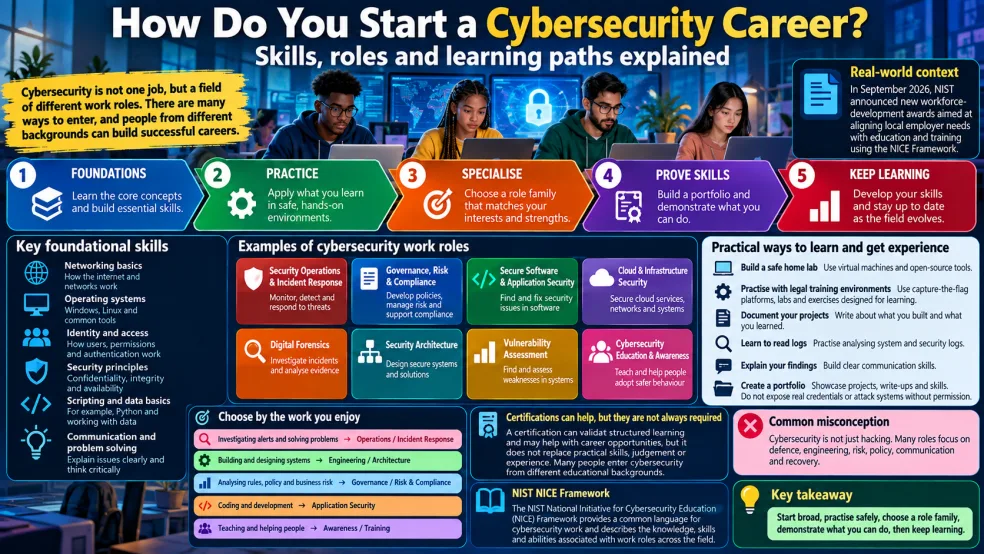
Cybersecurity is often described as if it were a single job. It is not. It is a broad field containing many different kinds of work: monitoring suspicious activity, responding to incidents, designing secure systems, protecting cloud environments, writing safer software, analysing risk, investigating digital evidence, creating policies, and teaching people how to work more securely.
That variety is good news for beginners. You do not have to become an expert in everything before you can begin. A better approach is to build broad foundations, practise safely, explore several role families, then specialise gradually in the kind of work you enjoy and can demonstrate well.
Why cybersecurity careers are broader than “hacking”
The popular image of cybersecurity often focuses on offensive hacking. Real-world cybersecurity work is much wider. Many professionals spend most of their time defending systems, analysing logs, reviewing controls, improving software, investigating incidents, managing identity and access, designing infrastructure, assessing risk, communicating with stakeholders or preparing organisations to recover from disruption.
The NIST NICE Workforce Framework for Cybersecurity exists partly because employers, learners and educators need a common language for talking about this wide range of work. The framework describes cybersecurity through Tasks, Knowledge and Skills, and organises work into roles and competency areas rather than assuming there is one standard “cybersecurity job”.
Step 1: Build strong foundations
Before specialising, learn enough about the systems you will eventually protect. These foundations do not need to be mastered all at once, but they make later learning far easier.
Networking basics
Learn how devices communicate, what IP addresses and ports are, how DNS works, what routers and firewalls do, and how common protocols such as HTTP, HTTPS and SSH are used. Security monitoring and incident analysis are much easier when you understand what normal network communication looks like.
Operating systems
Become comfortable using at least one desktop operating system and one server-oriented environment. Windows and Linux are especially useful. Learn file permissions, users and groups, processes, services, logs, command-line tools and basic system administration.
Identity and access
Security frequently comes down to deciding who or what should be allowed to access a system. Learn authentication, authorisation, passwords, multi-factor authentication, permissions, roles, privileged accounts and the principle of least privilege.
Core security principles
Understand confidentiality, integrity and availability; risk; threats; vulnerabilities; controls; patching; backups; encryption; secure configuration; logging; monitoring and incident response.
Scripting and data basics
You do not need to become a software engineer before entering cybersecurity, but basic scripting is highly useful. Languages such as Python, PowerShell or shell scripting can help automate repetitive tasks, process data and understand how systems behave.
Communication and problem solving
Cybersecurity professionals constantly explain technical findings to people with different backgrounds. Clear writing, structured thinking, teamwork and the ability to explain risk without unnecessary jargon are genuine career skills, not optional extras.
Step 2: Learn by doing — safely and legally
Cybersecurity is practical. Reading is important, but hands-on work helps turn concepts into usable skills.
Good beginner practice can include building a small home lab using virtual machines, learning to inspect logs, configuring user permissions, setting up a simple web server, applying security updates, analysing sample network traffic or working through legal training exercises designed for learners.
Only test systems that you own or have explicit permission to use. Attempting to probe, exploit or access real systems without authorisation can be illegal and harmful. Safe training environments exist specifically so that learners can practise without crossing those boundaries.
Step 3: Explore different cybersecurity role families
You do not need to choose a speciality immediately. Try to understand what different types of work feel like.
Security operations and incident response
This work suits people who enjoy investigating alerts, analysing unusual activity, reading logs and responding when something goes wrong. Common tasks can include triaging alerts, identifying compromised accounts, analysing malware behaviour, containing incidents and helping organisations recover.
Governance, risk and compliance
These roles focus more on policy, risk, controls, standards and business requirements. They suit people who enjoy structured analysis, documentation and understanding how technical security supports organisational goals.
Application and software security
If you enjoy programming, this area focuses on helping developers build safer software. Work can include secure coding, code review, dependency management, threat modelling, application testing and integrating security into development processes.
Cloud and infrastructure security
These professionals secure servers, networks, cloud environments, containers, identity systems and other infrastructure. Strong networking, system administration and configuration skills are especially useful.
Digital forensics
Forensics involves examining digital evidence after suspicious events. Practitioners may analyse devices, logs, files, timelines or other artefacts to reconstruct what happened.
Security architecture
Architecture focuses on designing systems so that security is built in from the beginning. This often requires broad technical knowledge plus an understanding of risk, business requirements and how multiple systems interact.
Vulnerability assessment
This work involves identifying and analysing weaknesses, understanding their likely impact and helping organisations prioritise remediation. It is broader than simply running scanning tools.
Cybersecurity awareness and education
Not every cybersecurity career is centred on deep technical operations. Some professionals specialise in helping employees and communities understand threats, adopt safer habits and respond appropriately to security risks.
How the NICE Framework can help you choose a path
The NICE Framework, maintained by the US National Institute of Standards and Technology, provides a structured vocabulary for cybersecurity work. It describes what work needs to be done and the knowledge and skills required to perform it.
This can help learners move beyond vague job titles. A title such as “security analyst” can mean different things at different organisations. Looking at actual tasks and skills gives you a clearer picture of what you may enjoy and what you still need to learn.
CISA's NICCS Cyber Career Pathways tools also use NICE work roles to help learners compare different pathways and identify related skills.
Choose a speciality by the work you enjoy
A useful starting question is not “Which cybersecurity job pays the most?” but “What type of problems do I enjoy solving?”
- If you enjoy investigating alerts and reconstructing events, explore security operations, incident response or digital forensics.
- If you enjoy building and configuring systems, explore security engineering, cloud security or architecture.
- If you enjoy coding, explore application security, secure software development or DevSecOps.
- If you enjoy analysing rules, controls and business risk, explore governance, risk and compliance.
- If you enjoy teaching and communication, explore cybersecurity awareness, training or policy communication.
Your first role does not lock you into one path forever. Cybersecurity work overlaps, and people often move between role families as they gain experience.
Do you need a university degree?
There is no single universal entry requirement for cybersecurity. Some employers require degrees for particular roles; others accept equivalent technical experience, certifications, apprenticeships, portfolios or demonstrated practical ability.
Formal education can provide valuable depth and structure, especially in computing, engineering, mathematics or related subjects. But it is not the only legitimate route into the field.
The better question is: what evidence can you provide that you understand the work you are applying to do?
Do certifications matter?
Certifications can be useful because they provide structured study objectives and can help employers recognise that you have covered a defined body of knowledge.
But a certification is not a substitute for practical ability, judgement or experience. Memorising terminology without knowing how to troubleshoot a system, interpret evidence or communicate risk will limit your effectiveness.
A sensible approach is to choose certifications that support the role family you are pursuing rather than collecting credentials with no clear purpose.
Build evidence, not just a list of courses
Employers often find it easier to understand your abilities when you can show what you have actually done.
A beginner portfolio might include:
- a documented home-lab setup;
- a short write-up explaining how you investigated a sample security event;
- a script you wrote to process logs or automate a safe administrative task;
- a threat model for a fictional application;
- a secure configuration checklist;
- notes from legal training exercises explaining what you learned;
- a small project showing how you improved permissions, logging or backups.
Never include real passwords, access tokens, private customer data or confidential information in a portfolio. Demonstrating good judgement is itself part of demonstrating security skill.
Learn to read logs
Logs are records of system activity. They can show successful and failed logins, application events, network connections, administrative changes and many other useful clues.
Beginners who learn how to read logs gain a practical understanding of how systems reveal their behaviour. This can support careers in security operations, incident response, forensics, cloud security and system administration.
Learn how to explain your findings
A technically correct finding is not very useful if nobody understands what it means or what to do next.
Practise explaining:
- what happened;
- how you know;
- what the likely impact is;
- what evidence supports the conclusion;
- what should happen next;
- what remains uncertain.
This style of communication is valuable in almost every cybersecurity role.
Current context: workforce programmes are emphasising practical pathways
In September 2026, NIST announced more than $1.7 million in cooperative agreements for nine cybersecurity workforce-development projects across eight US states. The projects are intended to align local employer needs with education and training using the NICE Framework and include practical learning opportunities such as internships, apprenticeships and hands-on projects.
The announcement is useful for learners because it reflects a broader principle: cybersecurity education is most valuable when it connects knowledge to real work, practical tasks and employer needs.
A simple beginner roadmap
- Learn foundations: networking, operating systems, identity, security principles and basic scripting.
- Practise safely: use labs, virtual machines and authorised training platforms.
- Explore role families: try operations, engineering, risk, application security, forensics or awareness work.
- Choose a direction: focus on the type of work you enjoy and can realistically practise.
- Build evidence: document projects, labs and problem-solving exercises.
- Add targeted credentials: use certifications or formal education when they support your chosen path.
- Apply for experience: internships, apprenticeships, junior roles, volunteer technology work and adjacent IT roles can all help.
- Keep learning: technologies, threats and defensive practices continue to evolve.
Common misconception: cybersecurity is just hacking
Offensive security is only one part of the field. Many cybersecurity professionals spend their careers defending networks, building systems, reviewing software, analysing business risk, responding to incidents, improving policies or educating users.
Someone who does not enjoy offensive security may still have many strong career options in cybersecurity.
Key takeaways
- Cybersecurity is a field of many different work roles, not one job.
- Strong foundations in networking, operating systems, identity, security principles and communication make specialisation easier.
- Hands-on practice should take place only in systems you own or are explicitly authorised to test.
- The NICE Framework can help learners understand cybersecurity work through Tasks, Knowledge and Skills rather than vague job titles.
- A degree or certification may be useful or required for some jobs, but requirements vary by employer and role.
- Projects and portfolios can demonstrate practical ability when they are documented clearly and safely.
- Choosing a role based on the kind of work you enjoy can produce a more sustainable learning path.
Frequently asked questions
Can I start cybersecurity with no IT experience?
Yes, but you will usually need to build basic computing, networking and operating-system knowledge before more advanced security concepts make sense. An adjacent IT role such as technical support, networking or system administration can also provide useful experience.
Which programming language should a cybersecurity beginner learn?
There is no single required language. Python is useful for general automation and data handling, while PowerShell and shell scripting are valuable for administration. Application-security learners may benefit from learning the languages used by the software they want to secure.
Which cybersecurity role is best for beginners?
There is no universal best starting role. Security operations, IT support with security responsibilities, junior governance/risk work, system administration and entry-level cloud or security support roles can all provide useful foundations depending on your interests and existing skills.
How long does it take to become job-ready?
There is no fixed timeline. It depends on your starting knowledge, how consistently you practise, the role you are targeting and the standard employers expect. Focus on demonstrable skills rather than an arbitrary number of months.
Do I need to know how to hack?
No. Understanding attacker techniques can be useful in many roles, but cybersecurity includes defensive operations, engineering, architecture, risk, compliance, software security, forensics, education and other specialities.
What should I put in a beginner cybersecurity portfolio?
Use safe, non-confidential projects that demonstrate what you can do: lab documentation, log analysis, scripts, security checklists, threat models, write-ups from authorised exercises and explanations of how you solved technical problems.
Authoritative references
- NIST NICE Framework Resource Center.
- NIST, “NIST Awards More Than $1.7 Million to Support Cybersecurity Workforce Development Across 8 States”, 18 September 2026.
- CISA/NICCS Cyber Career Pathways Roadmap.
- CISA Cybersecurity Education & Career Development resources.