Beyond five senses means recognising that humans detect far more than light, sound, odours, flavours and surface touch. You can reach for a glass without staring at your hand, stay upright when a bus slows down, notice your stomach is full, or sense a temperature change before you consciously decide what to do. These abilities depend on specialised receptors, nerve pathways and brain networks—not on an unspecified “sixth sense.”
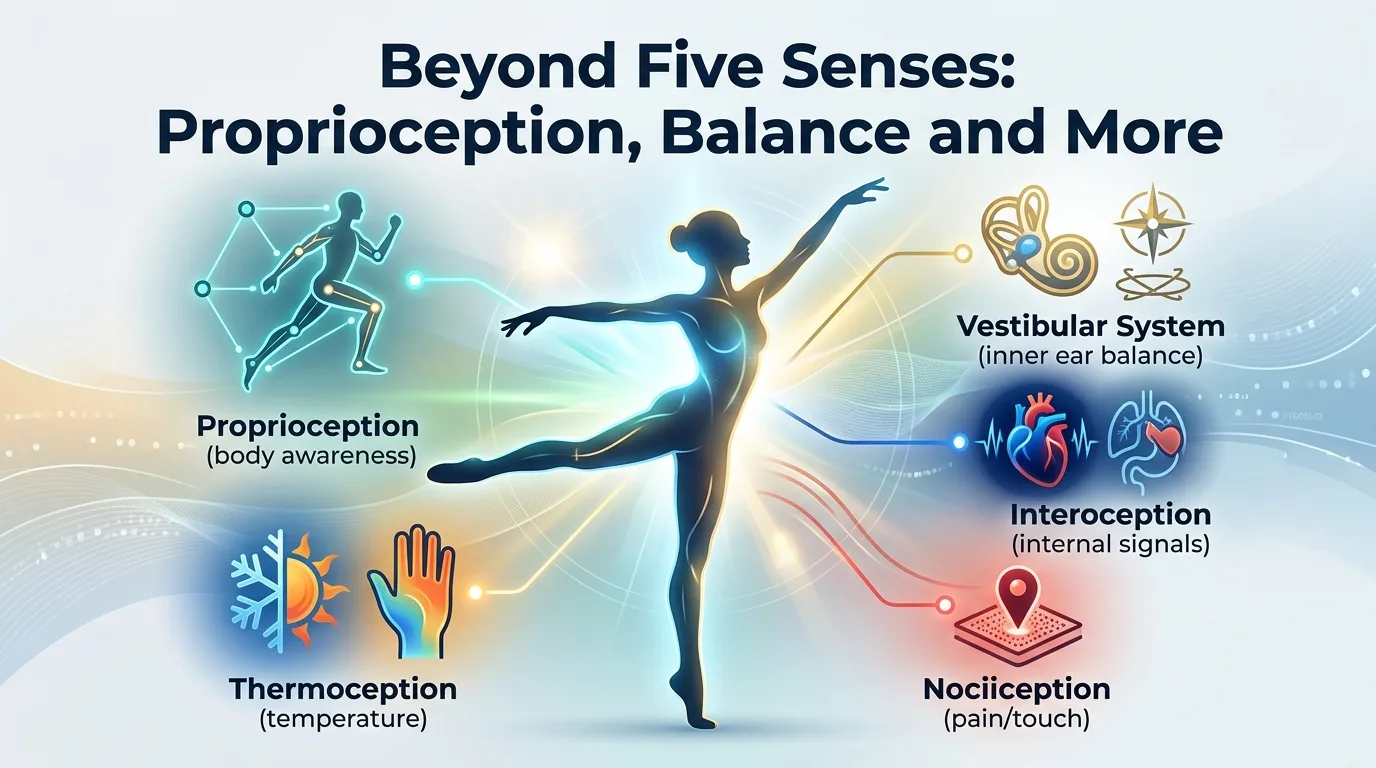
Proprioception provides information about the position and movement of body parts. The vestibular system in the inner ear senses head rotation, linear acceleration and orientation relative to gravity, supporting balance. Interoception involves signals about the body's internal condition, including those associated with hunger, fullness, breathing and heartbeat. Thermoreception and nociception contribute information about temperature and potentially harmful stimuli. The brain combines these streams with vision, touch and other senses to coordinate everyday activity.
So, how many senses do humans really have? There is no universally agreed single number: it depends on whether scientists count broad sensory systems, distinct receptor types or particular perceptual abilities. This evidence-based guide explains the major systems beyond the traditional five, the role of their receptors and the brain, and safe ways to explore them. Sources include the US National Institute on Deafness and Other Communication Disorders (NIDCD) , NCBI Bookshelf , OpenStax Biology and reviews of interoception and pain science.
Beyond the five senses: a simple comparison chart
| Sensory system | What it helps detect | Key receptors or structures | Everyday example |
|---|---|---|---|
| Proprioception | Position and changes in position of limbs and body segments | Muscle spindles, Golgi tendon organs and additional skin/joint signals | Touching your fingertip with eyes closed while seated |
| Kinesthesia | Movement and speed of body parts; often treated as part of proprioception | Proprioceptive sensory pathways and central processing | Knowing your arm is moving without looking |
| Vestibular sensation | Head rotation, acceleration and orientation relative to gravity | Semicircular canals, utricle and saccule in the inner ear | Keeping vision steady while turning your head |
| Interoception | Internal bodily states and changes | Visceral sensors, neural and other body-to-brain signalling | Noticing fullness or a racing heartbeat |
| Thermoreception | Warming and cooling | Temperature-sensitive sensory nerve endings and ion channels | Feeling a cool breeze on your arm |
| Nociception | Potentially tissue-damaging mechanical, chemical or thermal conditions | Nociceptive sensory neurons and central pathways | Rapidly withdrawing from a sharp object |
| Itch-related sensing | Pruritic (itch-producing) stimuli | Specialised, overlapping pathways in sensory nerves and spinal cord | Feeling the urge to scratch an insect bite |
This table is not a claim that every row is an entirely separate, non-overlapping “sixth” or “seventh” sense. For example, kinesthesia is commonly considered an aspect of proprioception, and temperature and nociception are often grouped within somatosensation. The OpenStax sensory-processes chapter explains why classifications vary.
What counts as a sense in biology?
A sense involves detecting some kind of stimulus and converting that information into signals the nervous system can process. Sensory receptors are suited to different inputs: mechanical changes, chemicals, light, temperature or damage-associated signals. The nervous system then organises the information, sometimes generating a conscious feeling and sometimes regulating a response without conscious awareness.
The traditional list—sight, hearing, smell, taste and touch—is useful because it introduces familiar ways of learning about the external world. But it mixes broad categories, organs and perceptual experiences. Touch alone includes several kinds of mechanical and thermal sensing. Meanwhile, balance and internal-organ signals are crucial for everyday survival even though they are not usually taught as part of that list.
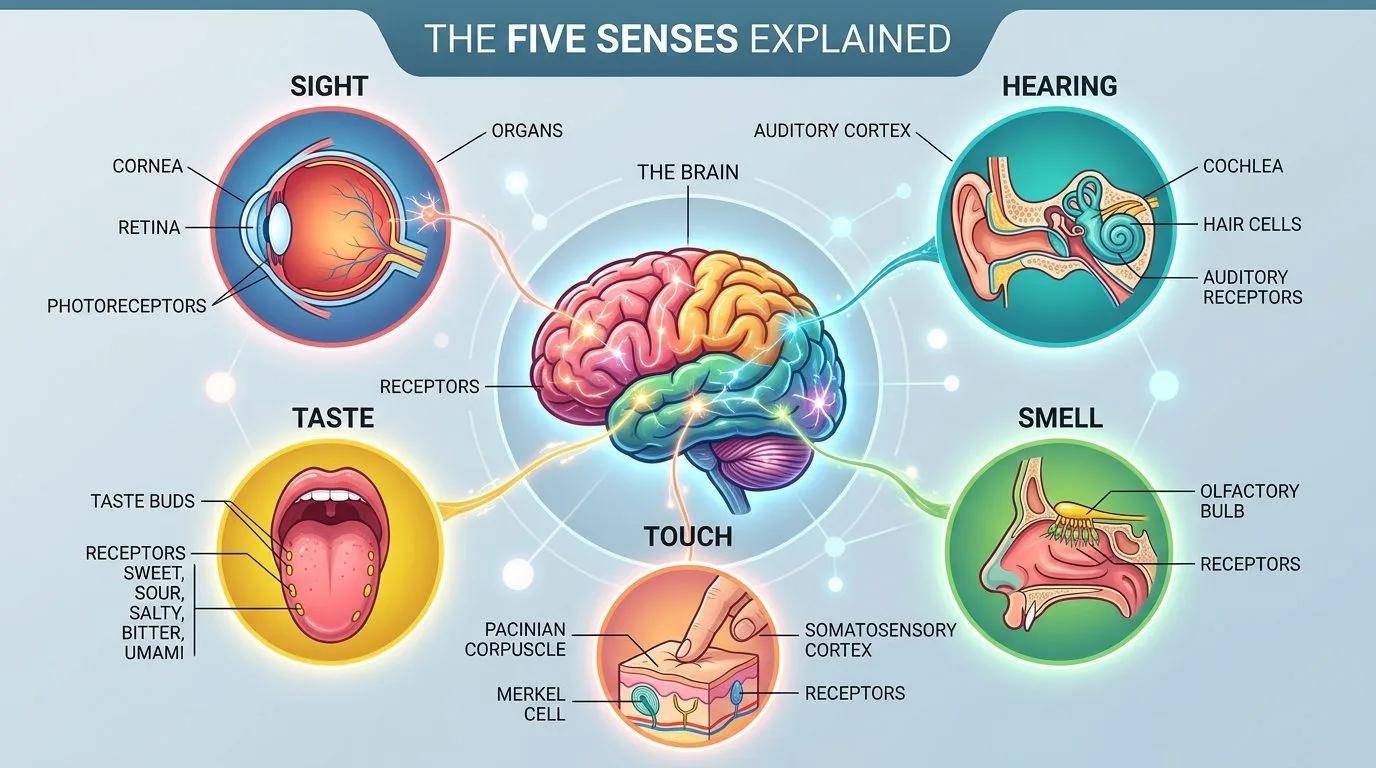
For a basic explanation of the eyes, ears, nose, taste buds, skin receptors and sensory pathways, SuperEducational's companion guide, The Five Senses Explained: Organs, Receptors and the Brain, covers that introductory framework. This article goes further into the systems that track the body itself and help it function.
1. Proprioception: how do you know where your body is?
Close your eyes while sitting comfortably, and move one hand toward the other. Even without looking, you can usually tell where each arm is and how far it has moved. That ability is proprioception, sometimes called the sense of body position. It is essential for reaching, writing, walking, sport, posture and coordinated movement.
Proprioceptive signals arise partly from specialised receptors in muscles and tendons:
- Muscle spindles detect changes in muscle length and the speed of stretch. They supply information useful for sensing movement and for rapid reflex responses.
- Golgi tendon organs respond to tension associated with force transmitted through tendons. Their signals contribute to control of force and movement.
- Signals from joints and skin also contribute to estimating limb position and movement. The nervous system combines multiple sources rather than relying on a single receptor type.
These sensory signals travel through peripheral nerves and the spinal cord into circuits involving the cerebellum, brainstem and cerebral cortex. Some support rapid, largely automatic adjustments; others contribute to conscious awareness of limb position. They also work with vision. NCBI Bookshelf's sensory-system review and a specialist account of proprioceptor development describe the roles of muscle spindles and tendon organs.
Proprioception versus kinesthesia: are they different?
There is no universally sharp division, but a common teaching distinction is that position sense describes where a limb is, while kinesthesia emphasises sensing that it is moving and how it moves. Researchers may use proprioception as an umbrella term covering both. That overlap is a good illustration of why counting senses is not as simple as counting organs.
Proprioception does not require a conscious picture of each muscle. The nervous system continuously estimates positions and forces, uses those estimates to plan movements and updates them with new feedback. People can also use visual information to compensate for less reliable body-position cues; that compensation is helpful but does not turn sight into a muscle receptor.
2. Balance: what does the vestibular system actually measure?
The word balance may describe the outcome of several sensory systems working together, but an especially important source is the vestibular apparatus in the inner ear. It lies near the cochlea, the organ used for hearing, yet performs a different function. Its specialised hair cells respond to mechanical changes within fluid-filled structures when the head moves.
Three semicircular canals are oriented in different planes. They help detect rotational movement of the head, especially changes in rotation. Two otolith organs—the utricle and saccule—respond to linear acceleration and the orientation of the head relative to gravity. The movement of tiny dense particles, or otoconia, contributes to the mechanical response in these organs.
Signals travel through the vestibular nerve to networks in the brainstem and cerebellum and onward to other brain regions. Vestibular circuits help regulate posture and eye movements. The vestibulo-ocular reflex, for example, moves the eyes in a way that helps stabilise the visual scene during head motion. These mechanisms are explained in the NIDCD balance guide .
Balance needs the eyes, muscles and inner ears together
Standing upright is not the job of the inner ear alone. The brain continually combines vestibular information about head motion with vision and somatosensory/proprioceptive signals from the feet, legs and body. It adjusts the muscles needed to maintain orientation. The relative importance of these cues changes with the task: dim lighting reduces helpful visual detail, while an unstable surface changes the reliability of signals from the feet.
This also helps explain some forms of dizziness or vertigo. Conflicting or disrupted information can create a sensation that you or the room is moving. But dizziness has multiple possible causes; it is not proof of an inner-ear condition, and a classroom exercise cannot diagnose it. Persistent, severe or sudden symptoms need appropriate professional assessment.
A crucial distinction is that the vestibular system does not tell the brain the body's exact location on a map. It senses motion and orientation-related forces, and the brain combines those inputs with other cues. It is also distinct from proprioception, which provides information about the body's joints and limbs.
3. Interoception: how do you sense what is happening inside?
We are accustomed to thinking about senses as tools for observing the outside world, but the nervous system also monitors the internal state of the body. This broad set of processes is called interoception. Examples include experiences of hunger, fullness, thirst, breathlessness, nausea, bladder fullness and a noticeable heartbeat.
Internal signals arise in many tissues, not from one dedicated “interoception organ”. Sensors in the cardiovascular, respiratory, digestive and other systems contribute information through visceral nerves, spinal pathways and chemical signals. The brainstem and brain regions including the insula help integrate internal-state information. Some responses happen automatically, while others enter conscious awareness.
For example, after a meal, the gut and other tissues send signals involved in digestive function and energy regulation. Your feeling of fullness is influenced by these bodily signals and by context, learned expectations and central processing. Similarly, the brain and body coordinate breathing continuously even when you are not consciously paying attention to every breath.
A review drawing on a US National Institutes of Health workshop describes interoception as involving sensing, integrating, interpreting and regulating internal signals. A Harvard Catalyst explainer shows how experiences such as hunger and heartbeat awareness relate to this emerging research field.
Does noticing your heartbeat prove your interoception is accurate?
Not necessarily. People differ in their awareness, interpretation and accuracy when judging internal signals. Simply feeling a heartbeat strongly does not automatically mean someone can count heartbeats accurately or has unusually precise internal sensing. Interoception includes multiple processes, so one informal test should not be treated as an overall score.
Researchers are studying connections between interoception, body regulation and emotion. A sensation such as a racing heart can be interpreted differently depending on exercise, excitement, anxiety or other circumstances. These links do not imply that a person can diagnose a medical condition by concentrating harder on internal sensations.
4. Thermoreception: how does the body sense temperature?
Thermoreception involves detecting temperature-related changes. Sensory neurons in the skin respond across ranges of cooling and warming, using molecular machinery that includes several types of temperature-sensitive ion channels. Important examples belong to the transient receptor potential (TRP) family; TRPM8 is associated with cool sensation, while TRPV1 contributes to sensitivity to noxious heat and also responds to capsaicin, the compound responsible for chilli heat.
Different receptor types overlap in their response ranges, and thermal sensation depends on more than one protein. The brain also interprets the rate of temperature change, contact area, previous exposure and local skin condition. A metal object may seem colder than a wooden one at the same measured temperature because of differences in how rapidly heat transfers from your skin.
External temperature sensing overlaps with protective pathways, but thermoreception is not identical to the body's overall temperature-regulation system. Thermoregulation additionally involves internal sensors and central circuits that support sweating, shivering and changes in blood flow. A peer-reviewed review of thermosensitive TRP channels explains the molecular mechanisms behind temperature detection.
5. Nociception and pain: why they are not the same thing
Nociception refers to the nervous system's detection and processing of stimuli that may threaten or damage tissues. Specialised sensory neurons—nociceptors—respond to potentially harmful mechanical, thermal or chemical conditions. Signals can trigger rapid protective actions and can contribute to a conscious pain experience.
But pain is not simply nociceptor activity translated into words. The International Association for the Study of Pain (IASP) defines pain as an unpleasant sensory and emotional experience associated with, or resembling that associated with, actual or potential tissue damage. The organisation explicitly distinguishes pain from nociception. A person may experience pain without clear ongoing activation of peripheral nociceptors, while nociceptive processing can occur without a corresponding conscious pain experience.
A protective withdrawal reflex can occur quickly through spinal circuits before conscious awareness catches up. At the same time, the intensity and meaning of pain can be influenced by injury, nervous-system changes, attention, emotion and other factors. None of this means pain is imaginary. It means that pain is a real experience produced through complex biological processing, rather than a direct measurement of tissue damage.
Because pain and temperature sensing are protective systems, do not test them through pinpricks, electric shocks, extreme cold or hot objects. Safe science learning does not require deliberately creating injury or discomfort.
6. Itch, movement and other candidate senses
Itch is not just a weak form of pain. It involves overlapping but partly specialised sensory pathways and produces a characteristic urge to scratch. Researchers study how peripheral receptors, spinal circuits and the brain generate itch, but scientists do not necessarily list it as a stand-alone sense in every classification.
Likewise, kinesthesia can be counted separately as movement sense or grouped within proprioception. People sometimes name a “sense of time”, but estimating duration relies on distributed neural mechanisms, attention and memory rather than one established dedicated peripheral receptor equivalent to a retinal photoreceptor. Claims about humans having precisely ten, twelve, twenty-one or thirty-three senses usually reflect different ways of dividing broad systems rather than a settled consensus.
Some sensory functions are especially important even though they seldom enter awareness. Internal monitoring contributes to blood-pressure regulation and respiratory control; much of that information supports automatic responses without generating an obvious conscious feeling.
How does the brain combine these senses during everyday movement?
Think of stepping off a curb. Vision helps estimate distance and surface features. Proprioception tracks where your feet and knees are. The vestibular system supplies information about head movement and orientation. Touch provides contact feedback as your foot lands, and the nervous system makes continuous adjustments to muscles and joints. If you misjudge the step, protective mechanisms may respond before you have a fully formed verbal explanation of what happened.
The cerebellum and brainstem contribute substantially to coordination and posture, while other areas of the cerebral cortex participate in movement planning, body awareness and perception. Sensory input and motor output form a continuous feedback system. The brain does not wait for five isolated senses to finish reporting before acting.
Individual sensory streams can be weighted differently. When vision is less reliable, the brain may depend more heavily on other available information, though the degree of adjustment varies. Scientists study these interactions through anatomy, recordings and specialised experiments. SuperEducational's published guide to mapping millions of brain cells provides context for why understanding interconnected cell types is important.
Why do these extra senses matter for daily life?
These senses allow everyday activities that might seem effortless. Musicians adjust finger positions without watching every joint; athletes coordinate rapid movement; people steady themselves when travelling; and internal sensations can help guide basic needs such as drinking or resting. Their importance becomes more obvious when one system provides less reliable information.
Different conditions may affect proprioception, vestibular function or interoceptive processing. For instance, peripheral-nerve disorders can impair position sense, and some inner-ear disorders disrupt balance. But difficulties with coordination or dizziness may have many causes. It would be inappropriate to conclude that someone has a particular disorder from a classroom demonstration or a single failed balance task.
Accessibility matters. Sensory abilities vary among individuals and can change with age, illness, disability, fatigue and context. People may develop useful strategies or use assistive devices, but one sense does not literally turn into another biological receptor system. An inclusive understanding of sensation recognises variation without treating differences as personal shortcomings.
Safe classroom activities to explore senses beyond the five
These activities are intended for supervised, low-risk educational use. All eyes-closed demonstrations should be done while seated, with no sharp objects or obstacles. Avoid spinning, deliberately provoking dizziness, restricting breathing, applying painful stimuli or asking learners to stand on unstable surfaces.
| Activity | Simple procedure | What it demonstrates |
|---|---|---|
| Finger-position sense | While seated, close your eyes briefly and bring the index fingertips toward each other, then open your eyes to compare. | Proprioception supports estimating limb position without sight. |
| Slow arm movement | While seated, move one forearm slowly with eyes closed, then describe whether it is rising or lowering. | Kinesthesia contributes information about movement. |
| Vision and posture discussion | Compare descriptions of walking in a well-lit room and a dimly lit room; do not perform risky balance tests. | Vision works with vestibular and proprioceptive cues. |
| Internal signals after ordinary activity | After a normal seated rest, describe whether breathing feels noticeable; avoid holding your breath or forcing changes. | Awareness of internal signals is one aspect of interoception. |
| Temperature without extremes | Touch two safe, clean, room-temperature materials such as wood and metal, then compare which feels cooler. | Thermal perception depends partly on heat transfer and context. |
Discussion questions: Which signals were consciously noticeable? Which ones probably helped the body automatically? Did closing your eyes change performance? Could two people experience the same activity differently? What safety and accessibility adaptations might be needed?
No student should be required to participate in an exercise that causes discomfort, and these observations are not medical tests. A fair classroom investigation should compare only a small number of conditions and record observations without grading a person's sensory abilities as “normal” or “abnormal”.
Myths and misconceptions about senses beyond five
| Myth | Evidence-based correction |
|---|---|
| “Humans have exactly five senses.” | Five is a traditional framework; many other sensory modalities are recognised. |
| “Proprioception and balance are identical.” | They cooperate, but limb-position signals and vestibular head-motion signals arise from different structures. |
| “The inner ear only helps us hear.” | The cochlea supports hearing; separate vestibular structures help sense head movement and orientation. |
| “Interoception is a supernatural intuition.” | It refers to biological monitoring and interpretation of internal bodily signals. |
| “Nociception and pain always match exactly.” | Nociceptive activity and conscious pain are related but different phenomena. |
| “A strong heartbeat feeling means perfect body awareness.” | Subjective intensity, detection and accuracy are not the same measurement. |
| “Everyone agrees on a fixed number of human senses.” | Counts depend on how investigators define and separate sensory systems. |
| “A balancing exercise can diagnose a vestibular condition.” | Balance has many components and requires professional assessment when a medical concern exists. |
Frequently asked questions
What are the senses beyond the traditional five?
Commonly discussed examples include proprioception (body position), vestibular sensation (head movement and orientation), interoception (internal bodily states), thermoreception (temperature) and nociception (potentially harmful stimuli). Some classifications also discuss itch and kinesthesia separately.
What is the sixth sense in humans?
There is no universally agreed biological “sixth sense.” Proprioception and balance are both frequently given that nickname, but neither is paranormal. They are ordinary, well-studied aspects of human physiology.
Is proprioception the same as kinesthesia?
Kinesthesia usually refers to sensing movement, while proprioception can include awareness of position and movement. Many researchers use proprioception as the broader category.
Where are proprioception receptors located?
Important sources include muscle spindles in muscles and Golgi tendon organs associated with tendons, along with useful information from joint and skin receptors.
Which organ controls balance?
The vestibular system in the inner ear is crucial, but balance is coordinated by the nervous system using vestibular, visual and proprioceptive information. It is not controlled by the ear alone.
What do the semicircular canals detect?
They detect rotational head movement, particularly changes in rotational velocity. The utricle and saccule provide information about linear acceleration and orientation relative to gravity.
Is hunger an example of interoception?
Yes. Hunger and fullness involve internal bodily signals and brain processing. They are not produced by one simple on–off receptor, and experiences vary across individuals and circumstances.
Is pain a sense?
Pain is a conscious sensory and emotional experience. Nociception is the neural process of detecting and responding to potentially harmful stimuli. Because they are related but not identical, scientific discussions often distinguish them.
How many senses do humans actually have?
There is no settled fixed total because scientists can group or separate sensory modalities in different ways. It is more informative to name the receptor system and the type of information it detects than to repeat an exact number without a definition.
Conclusion: the body is sensing itself all the time
Learning about senses beyond five changes the picture of how humans experience the world. Proprioception helps us locate our limbs, vestibular receptors track head movement and orientation, and interoceptive pathways communicate information about internal bodily conditions. Thermoreception, nociception and related sensory functions add important information for protection and regulation.
These systems do not operate in isolation. The brain integrates body-position signals with vision, inner-ear motion cues, touch and internal feedback to support movement, balance and everyday decisions. Instead of searching for a magical sixth sense or a rigid number, understanding receptors, pathways and perception reveals a richer and more accurate picture of human biology.
References and further reading
- NIDCD (National Institutes of Health) — Balance Disorders and Vestibular Function .
- NCBI Bookshelf — Physiology, Sensory System .
- The Making of a Proprioceptor: A Tale of Two Identities — Scientific Review .
- NCBI Bookshelf — Sensation: Proprioception and Vibration .
- OpenStax Biology 2e — Sensory Processes .
- The Emerging Science of Interoception — Review of an NIH Workshop .
- Harvard Catalyst — Making Sense of Interoception .
- TRP Channels in Thermosensation — Peer-Reviewed Review .
- International Association for the Study of Pain — Pain Terminology .
- The Coding Logic of Interoception — Review .
- NIDCD — How Do We Hear? (Cochlea and Inner-Ear Structures) .
- NCBI Bookshelf — Anatomy and Physiology of the Spinal Cord .