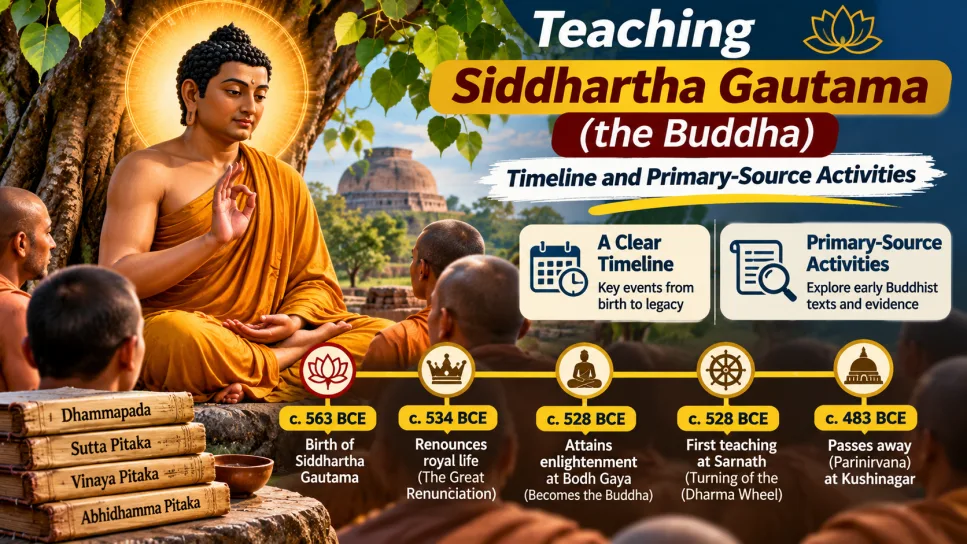
Teaching Siddhartha Gautama (the Buddha) offers a way to connect world history, religious literacy and evidence-based thinking. Students can learn the traditional journey from Lumbini to Bodh Gaya, Sarnath and Kushinagar while asking a historian's central question: what do our sources actually prove? Ancient Buddhist discourses, Ashoka's Lumbini inscription and later sacred monuments preserve different kinds of knowledge. They should not be treated as interchangeable eyewitness records.
This classroom-ready guide includes a carefully qualified Buddha timeline, four-source investigation, 75-minute lesson plan, student worksheet, eight-question quiz and teacher answer key. It is intended for teachers, older primary learners and secondary-school students. The goal is to understand a major religious tradition respectfully, not to require anyone to participate in Buddhist worship or affirm religious beliefs.
Lesson at a glance: aims, age and materials
| Item | Suggested plan |
|---|---|
| Audience | Upper-primary extension and lower-secondary history or religious education |
| Timing | 75 minutes or two 40-minute lessons |
| Materials | Timeline cards, notebook, map of South Asia, linked documents, optional projector |
| Core skills | Chronology, comparison, sourcing, interpretation, evidence and respectful discussion |
| Assessment | Document table, one evidence paragraph and eight-question exit quiz |
By the end of the lesson, students should be able to identify Siddhartha Gautama as the teacher known as the Buddha; locate the four places traditionally associated with his life; outline the life narrative without fabricating exact dates; explain the difference between a transmitted religious discourse and a dated ancient inscription; and distinguish what a document claims from what it independently establishes.
Who was Siddhartha Gautama?
Buddha means awakened one. Siddhartha Gautama (also Siddhattha Gotama) is associated with the Shakya community in the northern Indian subcontinent and is central to the origins of Buddhism. Buddhist traditions say he left a comfortable household life to investigate suffering, undertook a spiritual search, attained awakening and taught a path of ethical living, wisdom and meditation.
The story is important, but its dates are debated. The Stanford Encyclopedia of Philosophy places the historical Buddha broadly around the fifth century BCE and notes disagreement over the year of his death. Traditional dates such as 563–483 BCE or 623–543 BCE are not universal scholarly conclusions. Nor should the familiar four sights of old age, illness, death and renunciation be presented as independently verified eyewitness incidents.
For a broad life narrative, SuperEducational has separately scheduled Siddhartha Gautama (the Buddha): Origins, Timeline and Legacy. This lesson instead focuses on how students investigate the evidence.
Siddhartha Gautama timeline: traditional events and later evidence
| Order | Event | Place | Evidence note |
|---|---|---|---|
| 1 | Birth and early life among the Shakyas | Lumbini region, present-day Nepal | Birthplace tradition later commemorated by Ashoka; precise birth year uncertain |
| 2 | The “four sights” and concern with suffering | Traditional accounts of youth | Religious biography, not an independently dated event |
| 3 | Renunciation and spiritual search | Northern Indian subcontinent | Recounted in early Buddhist discourses, including MN 26 |
| 4 | Ascetic practice and turn from extremes | Before awakening | Part of early Buddhist teaching narratives |
| 5 | Awakening beneath the bodhi tree | Bodh Gaya, present-day India | Traditional sacred association supported by later commemorative monuments |
| 6 | First discourse and early Sangha | Sarnath near Varanasi, India | Associated with SN 56.11 and later site commemoration |
| 7 | Years of teaching and community growth | Ganges plain | Described in transmitted discourses and monastic literature |
| 8 | Final passing, or parinirvana | Kushinagar, India | Traditional account; exact death year uncertain |
| 9 | Ashoka commemorates Lumbini | Third century BCE | Later, materially attested imperial commemoration |
Teaching caution: The timeline is ordered by traditional narrative sequence, not by invented exact calendar years. The third-century BCE Ashokan monument came after the Buddha's life, even if some older traditional chronologies place the latter centuries earlier. In BCE dating, the third century came after the fifth.
Four places for a map activity
Lumbini, Nepal: UNESCO's World Heritage description records Ashoka's pillar and archaeological remains at a place traditionally associated with Gautama's birth.
Bodh Gaya, Bihar, India: The Mahabodhi Temple Complex commemorates the Buddha's awakening. Its present monuments have been built and renewed across later centuries.
Sarnath, Uttar Pradesh, India: The Ancient Buddhist Site of Sarnath is associated with the first sermon and the early community; it was added to the UNESCO World Heritage List in July 2026.
Kushinagar, Uttar Pradesh, India: Buddhist tradition associates it with the Buddha's final passing.
Ask learners to locate each place on a present-day map and draw arrows in traditional sequence. Explain that today's countries and borders did not exist in their present form during the Buddha's lifetime. Modern geography tells us where sites are located, not a historical individual's modern nationality.
What is a primary source when studying the Buddha?
A primary source relates directly to the community, period or development being investigated. Whether it is primary depends on the question. An inscription made under Ashoka is direct evidence of what his government commemorated in the third century BCE; it is not a birth certificate for a teacher who lived earlier. An early Buddhist discourse is direct evidence for a textual religious tradition, yet it was transmitted orally and copied long after the events it narrates. It is not a recording of a speech delivered in Gautama's lifetime.
UNESCO pages and modern encyclopedias are generally secondary interpretations of ancient texts, sites and objects, although they may display images or translations of primary materials. This distinction encourages careful evidence-based reasoning. The Library of Congress recommends asking students to observe, reflect and question sources rather than immediately accept the most dramatic claim.
Primary-source activity pack: four evidence stations
The descriptions below are teacher-written paraphrases, not purported verbatim ancient quotations. Students should open the linked materials to inspect the source context. Assign one station to each group, or rotate groups through all four.
Station A: MN 26, The Noble Search
Source: Majjhima Nikaya 26 ; compare the SuttaCentral translation . The discourse presents the Buddha reflecting on birth, ageing and death, recounting a departure from household life and a search for liberation.
Questions: Who is presented as the speaker? What motivates his search? What details suggest how the Buddhist community remembered renunciation? Why can the text not confirm the exact year of departure? Expected insight: the narrative helps us understand the tradition's account of spiritual seeking, but textual transmission limits its value as an independently dated autobiography.
Station B: SN 56.11, Setting the Wheel of Dhamma in Motion
Source: Samyutta Nikaya 56.11 ; compare another English translation . The text presents a Middle Way between extremes, the Four Noble Truths and the Noble Eightfold Path, with the teaching placed at the Deer Park near Varanasi.
Questions: What extremes does the discourse reject? Which kinds of conduct and mental training appear? What makes the text relevant to Buddhist teachings? Does its content establish the speech's precise date? Expected insight: it is a key witness to early Buddhist teachings without serving as a datable sound recording.
Station C: Ashoka's Lumbini pillar
Source: UNESCO's Lumbini World Heritage record , describing the third-century BCE pillar and inscription. In classroom paraphrase, the inscription marks the location as associated with the Buddha's birth and records imperial commemoration.
Questions: Who erected or commissioned the pillar? What century does it belong to? What can we say about the royal recognition of Lumbini by then? Could an inscription commissioned later establish the Buddha's exact birth date? Expected insight: the pillar is strong evidence for Ashokan commemoration, not for every detail of the Buddha's infancy.
Station D: the archaeology of Sarnath
Source: UNESCO's description of the ancient Buddhist site of Sarnath . The physical monuments offer evidence of a later and lengthy Buddhist religious presence; the modern description contextualising them is a secondary source.
Questions: What kinds of remains exist at the site? Which are later than the Buddha's lifetime? What do those remains demonstrate about pilgrimage and patronage? Why do they not independently establish a day and year for the first sermon? Expected insight: the site can be historically important without furnishing an eyewitness account of the event it commemorates.
Activity 1: timeline-card sorting (15 minutes)
Prepare nine cards: birth at Lumbini; the four sights; renunciation; austerities; awakening at Bodh Gaya; first sermon at Sarnath; community growth; final passing at Kushinagar; Ashoka's Lumbini pillar. Students sort them into traditional sequence. Then label the evidence associated with each event:
- T — traditional narrative: an episode told in Buddhist biography.
- D — discourse tradition: a teaching or account transmitted in early Buddhist textual collections.
- M — material evidence: a monument or inscription from a later historical period.
There may be more than one useful label. For example, the awakening is told in religious tradition (T), while the surviving Mahabodhi complex represents later commemorative material (M). Students should explain the distinction rather than forcing every claim into one rigid category.
Activity 2: source detective worksheet (20 minutes)
For every source, record the answer to each question in a notebook or table:
| Investigation question | Student response prompt |
|---|---|
| Who produced or transmitted it? | Identify a ruler, community, translator or heritage organisation |
| When did it originate? | Give a known approximate period or explain the uncertainty |
| What type of evidence is it? | Religious text, ancient inscription, monument or modern description |
| What does it say or show? | Describe one observation without making an extra inference |
| What does it support? | Make a limited claim that the evidence genuinely supports |
| What does it not prove? | Explain one missing detail or source limitation |
A model answer is: “The Lumbini pillar provides dated evidence that Ashoka's government commemorated this location as the Buddha's birthplace in the third century BCE. It does not give a reliable contemporary birth certificate.” Extend the skill with SuperEducational's guide to verifying information online .
Activity 3: tradition versus historical certainty (10 minutes)
Compare two claims: (A) “The Buddha was definitely born in 623 BCE.” (B) “A pillar erected under Ashoka shows that Lumbini was publicly commemorated as the Buddha's birthplace in the third century BCE.” Ask which claim is supported more directly by the surviving inscription and why.
Explain that some religious chronologies and heritage descriptions give a precise traditional year, while historical scholarship remains divided about Gautama's lifetime. Read the Stanford Encyclopedia or Internet Encyclopedia of Philosophy for the historical dating debate. Invite students to rewrite claim A: “Traditional accounts supply various dates, but the Buddha's exact birth year is uncertain.”
Activity 4: understand the first teaching (10 minutes)
Have students read a short section of SN 56.11 and summarise the Four Noble Truths in neutral language: life involves dukkha or dissatisfaction; craving is one cause; its cessation is possible; and a path of training is presented. Then group the Eightfold Path into three areas:
| Area | Associated path factors |
|---|---|
| Wisdom | Right view; right intention |
| Ethical conduct | Right speech; right action; right livelihood |
| Mental training | Right effort; right mindfulness; right concentration |
Point out that English translations of Pali terminology vary. The term dukkha is broader than everyday pain, and Buddhist teachings should not be reduced to the claim that all experiences are miserable or every form of desire is morally wrong. Students are learning what the discourse teaches, not being asked to become Buddhist practitioners.
Teacher's answer key: what should students conclude?
Timeline: birth → four sights → departure → austerities → awakening → first sermon → community development → final passing → Ashoka's later pillar. This order is based on tradition with a clearly later datable monument, not a verified day-by-day biography.
| Document | Strong supported conclusion | Key limitation |
|---|---|---|
| MN 26 | Buddhist tradition preserves a narrative of spiritual searching and renunciation | Later transmission is not an authenticated contemporary interview |
| SN 56.11 | Buddhist communities transmit a teaching on the Middle Way, Four Noble Truths and Eightfold Path | Does not independently date the first sermon |
| Lumbini pillar | Ashoka's government commemorated Lumbini as the Buddha's birthplace in the third century BCE | Later memorial, not a contemporary birth record |
| Sarnath remains | Religious monuments document the site's long significance and patronage | Physical remains and modern site descriptions do not give the sermon’s precise date |
Eight-question quiz with answers
- What does Buddha mean? Answer: “Awakened one.”
- Where is Lumbini today? Answer: Nepal.
- Which place is associated with awakening? Answer: Bodh Gaya, India.
- Which discourse is linked to the first sermon? Answer: SN 56.11.
- Name one reason the Buddha's exact dates are debated. Answer: Competing traditional chronologies and a lack of contemporary dated records.
- Why is Ashoka's inscription valuable? Answer: It is direct evidence of later royal commemoration of Lumbini.
- Does that inscription prove an exact birth year? Answer: No; it was created later.
- What is one respectful classroom practice? Answer: Distinguish tradition from historical evidence and do not require religious observance.
Assessment rubric: Score four elements from 0 to 2 points each—chronology, source identification, evidence-based justification and recognition of uncertainty. Award 2 for a correct and explained response, 1 for a partly correct or unexplained response and 0 for an unsupported or inaccurate response.
Teaching respectfully in a diverse classroom
Buddhism is a living and varied religious tradition. Present its texts and beliefs without mockery, romanticisation or pressure to agree. Students may examine the Four Noble Truths, compassionate conduct and meditation as subjects of knowledge without being asked to chant, pray or participate in spiritual exercises. Cultural and religious diversity is part of the subject, not an obstacle to it.
For younger pupils, focus on a four-location map and one source-limit question. For older students, compare two English translations of SN 56.11, contrast an archaeological claim with a traditional story or investigate why textbook chronology differs. Related classroom reflection material is available in SuperEducational's teaching kindness activities , which should remain distinct from teaching religious doctrine.
Frequently asked questions
Are Buddhist texts primary sources?
They are sources for Buddhist teaching and textual tradition, but their oral transmission and manuscript history mean they should not automatically be called verbatim documents from Gautama's lifetime.
Was the Buddha definitely born in 623 BCE?
No universally accepted exact birth year exists. Traditional dates and modern scholarly reconstructions differ.
What does the Ashoka pillar prove?
It demonstrates that Lumbini was commemorated as the Buddha's birthplace under Ashoka, centuries after the period in which the Buddha probably lived.
How should this topic be taught to students from different religions?
Use descriptive, evidence-aware language; distinguish religious belief from historical attestation; and assess students' understanding rather than their personal convictions.
Conclusion
Teaching Siddhartha Gautama (the Buddha) is most valuable when students examine both a historical timeline and the evidence behind it. The traditional journey from Lumbini through Bodh Gaya and Sarnath to Kushinagar can be studied alongside early Buddhist discourses and Ashoka's later inscription. By considering what each source can and cannot establish, learners practise chronology, thoughtful interpretation and respectful religious literacy.