Race and Ethnicity: Meaning, History and Real-World Examples
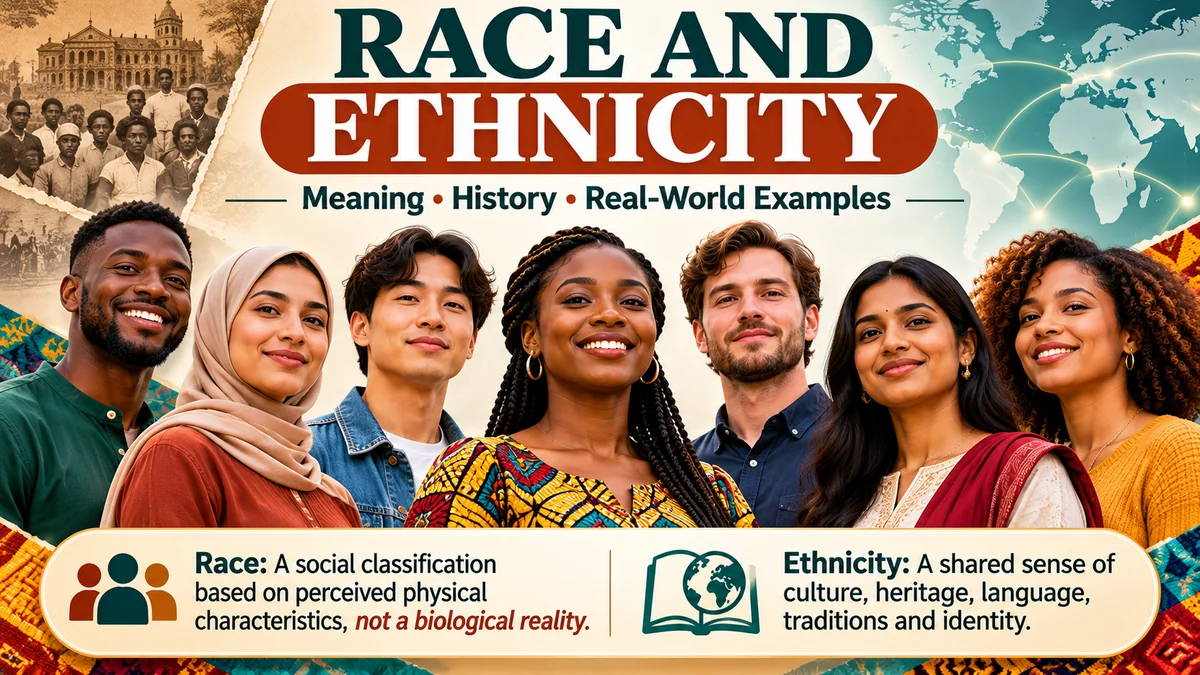
Race and ethnicity are closely connected terms, but they do not mean exactly the same thing. Race usually refers to socially defined groupings associated with perceived physical traits or ancestry, while ethnicity refers more broadly to shared culture, heritage, history and identity. Both concepts are shaped by society, and neither can tell us everything about an individual. Understanding their differences is essential in history, sociology, education, public policy and everyday life.
This guide explains how the terms are used, why scientific thinking about human diversity has changed, how racial categories developed historically and what examples from Nigeria, the United States, Britain, Brazil and South Africa reveal. It also offers a practical framework for reading census questions and discussing identity respectfully.
What do race and ethnicity mean?
Race: a social classification with real consequences
Race refers to ways societies group people, often using perceived physical characteristics such as skin colour, hair texture or facial appearance and ideas about ancestry. The categories, their boundaries and their social meanings differ across places and periods. Race is therefore a social construct, not a reliable map of distinct biological types. Yet racial classifications have shaped laws, identity, discrimination and access to opportunity, so their social effects are real. The American Association of Biological Anthropologists makes this distinction explicit in its 2019 statement.
Ethnicity: cultural heritage, belonging and shared history
Ethnicity generally describes an identity associated with shared cultural heritage. This can involve language, traditions, family history, regional origins, collective memories, religion or practices, but no single trait is required for every ethnic group. Individuals may identify with an ethnicity through family and community ties even if they do not speak a particular heritage language. Ethnicity is not fixed by an appearance test. Groups can change their names, customs and boundaries over generations.
The UK Office for National Statistics emphasises that ethnic identification is subjective and may combine culture, family background, identity and appearance. Importantly, an ethnic group does not have one universal political view, language level or set of beliefs.
Race vs ethnicity: the key differences
The terms overlap in everyday conversation and in official forms. A useful distinction is that race usually refers to socially interpreted ancestry and appearance, whereas ethnicity centres on cultural belonging and historical connections. Neither offers a complete description of a person.
| Question | Race | Ethnicity |
|---|---|---|
| What is emphasised? | Social classification based on perceived ancestry or appearance | Shared culture, heritage and group identity |
| Are categories biologically fixed? | No; racial groups are not discrete genetic divisions | No; membership and boundaries are social and historical |
| Examples | Black or White in certain national classification systems | Igbo, Yoruba, Kurdish or Māori in relevant contexts |
| Can a person identify in more than one way? | Yes, including multiracial identification | Yes, including multiple ethnic heritages |
| Does meaning change across countries? | Yes, often considerably | Yes, including language and official categories |
For example, someone may be Nigerian by nationality, Igbo by ethnic heritage and categorised as Black in a US racial context. These descriptions address different questions and should not be treated as interchangeable. A person may accept some labels and reject others.
Is race biological? What genetics actually tells us
Visible human differences are real. Skin pigmentation, for instance, is influenced by inherited variation and environments across human history. However, visible traits do not divide all humans into a few clear, uniform biological races. Human variation is overlapping and shaped by migration, adaptation, shared ancestry and gene flow. Genetic differences exist both within and among populations; socially assigned racial categories are not reliable substitutes for individual genetic information.
The US National Human Genome Research Institute (NHGRI) specifically distinguishes race, ethnicity and genetic ancestry, warning against using one as a stand-in for another in genomics or healthcare. Genetic ancestry describes statistical patterns of inheritance related to ancestors and reference populations. It can be scientifically informative, but is not the same as a person's culture or a fixed racial label.
Two people who are categorised as the same race need not share the same detailed family histories, and people placed in different race categories can share ancestry. DNA tests also depend on their reference datasets and analysis methods; ethnicity estimates are not permanent verdicts about identity. For background on biological inheritance, SuperEducational's guide to branches of biology and genetics provides a useful companion reading.
Why does this matter? A clinician should not assume that a patient's genetic risks, behaviour or response to treatment follow automatically from a broad racial label. Family history, specific variants, environment and access to care often give more useful information. For an example of an inherited condition that is frequently oversimplified in racial discussions, read Sickle Cell Disease Explained: Genetics, Symptoms and Modern Care . The condition is related to particular inherited variants, not membership in a biological race.
How the modern idea of race developed
Before modern racial classifications
Human communities have long distinguished insiders from outsiders through kinship, language, religion, territory and political allegiance. These older boundaries should not automatically be equated with modern race. The racial categories now used in many states grew through particular historical processes rather than emerging from an unchanging natural scheme.
Colonial expansion, slavery and classification
From the early modern period onwards, European colonial expansion, the transatlantic slave trade and systems of forced labour were closely tied to classifications that ranked populations by supposed inherited qualities. Colonial authorities and institutions used changing ideas about race to defend unequal rights, dispossession and exploitation. The AABA's statement traces the development of the Western race concept alongside colonialism and discrimination. That history helps explain why racial terms can carry political meanings far beyond physical description.
The misuse of science
In the eighteenth and nineteenth centuries, some writers and scientists tried to divide humanity into ranked 'types' using skull measurements, body measurements and other methods. These hierarchies reflected prejudices and flawed assumptions rather than sound evidence that groups differed in inherent worth or intelligence. Such claims became part of what is commonly called scientific racism. Modern population genetics and anthropology reject the idea of discrete, superior and inferior biological races.
Challenges to racial hierarchies
Anti-colonial movements, abolitionists, civil-rights advocates and scholars challenged racial hierarchies from many directions. After the devastation of the Second World War, UNESCO issued a statement on race in 1950 as part of its work against racist pseudoscience. In 1965 the United Nations adopted the International Convention on the Elimination of All Forms of Racial Discrimination. These milestones did not end racism, but they shaped an increasingly influential international language of equal dignity and rights.
Real-world examples from five national settings
Nigeria: one nationality, many ethnic identities
Being Nigerian identifies a nationality, not a single race or ethnicity. Nigeria includes numerous ethnic communities, including Yoruba, Igbo, Hausa, Fulani, Ijaw, Tiv, Kanuri and many others. People may have mixed ethnic heritage, speak multiple languages, and relate to identity through family, religion, region and diaspora experience. A person of Igbo heritage living in Lagos can be Nigerian by nationality and Igbo by ethnicity; a US form may also classify that person using a broad race label such as Black.
These labels should not be used to predict someone's religion or personal characteristics. Nor do they imply that every member of an ethnic community shares identical customs or political loyalties.
The United States: official categories change
American forms demonstrate that racial and ethnic categories are administrative and social choices, not universal natural divisions. The 2024 revision of federal race and ethnicity standards introduced a combined question and seven co-equal minimum categories: American Indian or Alaska Native; Asian; Black or African American; Hispanic or Latino; Middle Eastern or North African; Native Hawaiian or Pacific Islander; and White. Respondents can select multiple identities. The Census Bureau has planned implementation in the 2027 American Community Survey and 2030 Census; not all older datasets or forms already use the revised system.
Historically, Hispanic or Latino origin was often asked separately from race on federal questionnaires. The change illustrates why comparisons across census years must account for differences in question design.
England and Wales: ethnicity as self-identification
The 2021 Census in England and Wales asked residents to identify their ethnic group. The classification used broad groups with detailed options, including White, Asian or Asian British, Black or Black British, Mixed or Multiple ethnic groups, and Other ethnic group. Responses may reflect culture, ancestry, family ties and identity. The approach does not mean that everyone in one category shares the same experiences; the census groups are tools for statistical comparison.
Brazil: colour and race terminology follows a different pattern
Brazil's statistics agency, IBGE , uses self-declared cor ou raça ('colour or race') categories: branca, preta, parda, amarela and indígena. Their meanings belong to Brazil's particular social history; translations do not always capture every local implication. Brazil's 2022 Census reported parda as the largest self-declared category. The contrast with US terminology shows why a person's identity cannot be translated mechanically from one country's form to another.
South Africa: how classifications can be embedded in law
Under apartheid, the South African state used racial classification to determine rights, residence and access to resources. The transition to democratic government culminated in the country's first non-racial national elections in 1994. Modern Statistics South Africa still reports population-group data for social analysis, but those categories are historically specific and should not be mistaken for scientific divisions. Studying this history shows that social classifications can have concrete legal and economic consequences even when they lack a basis as biological races.
Race, ethnicity, nationality, religion and ancestry are not synonyms
Many misunderstandings arise because forms or conversations mix together different kinds of identity. Consider the following distinctions:
- Nationality: a legal or civic connection to a country, such as Nigerian, British or Brazilian citizenship.
- Ethnicity: an identification connected to cultural history or heritage, such as Igbo or Yoruba.
- Race: a social category based on perceived physical features or ancestry, such as categories used in certain national surveys.
- Religion: faith, practice or affiliation; people of any race or many ethnicities may share a religion.
- Genetic ancestry: patterns of inherited DNA that can provide information about biological relationships and population histories.
- Language: a means of communication that may connect people across different ethnic groups.
These dimensions often interact. A child with parents from different ethnic backgrounds may belong to more than one heritage community. A migrant may retain their ethnicity while changing nationality. Someone may speak a language without identifying with the ethnic group often associated with it. No single box captures the whole person.
Why distinctions matter in education, health and public policy
Schools and workplaces
Accurate language helps educators discuss history without reducing individuals to stereotypes. Asking people how they identify, instead of guessing from their appearance or surname, is more respectful. In workplaces, ethnicity and race data may help identify disparities in recruitment or progression, but only if confidentiality, relevant laws and the limits of categories are recognised.
Healthcare and research
Differences in disease outcomes may reflect discrimination, environmental exposure, income, unequal healthcare access, specific inherited variants or combinations of factors. A broad race label rarely identifies the cause. The NHGRI and National Academies recommend specifying exactly what researchers mean by race, ethnicity and ancestry, and avoiding misleading genetic interpretations. Good research uses the appropriate measurements rather than treating category labels as explanations.
Censuses and social statistics
Governments collect population data to understand their communities and monitor unequal outcomes. But categories can change, be contested or exclude identities. A trend may reflect changes in question design as well as population change. Researchers should document whether categories are self-reported, externally assigned or based on another method. They should also avoid comparing categories across countries without explaining differences.
Common misconceptions about race and ethnicity
Myth 1: Race is a precise genetic division
Fact: Human genetic variation does not fit neatly into socially recognised racial boxes. Ancestry patterns can be studied, but they are not the same as race.
Myth 2: Ethnicity is just another word for skin colour
Fact: Ethnicity can involve shared culture, language, history and identity. People with similar appearances may have very different ethnic backgrounds.
Myth 3: Everyone in an ethnic group has the same beliefs
Fact: Communities include varied religions, politics, social positions and life experiences. Ethnic identity is not a personality profile.
Myth 4: Social constructs have no real effects
Fact: Laws, discrimination, segregation and social opportunities can be shaped by race even though racial categories are not discrete biological divisions.
Myth 5: Official race categories are the same worldwide
Fact: Comparing the United States, Brazil, England and Wales, and South Africa shows that classification systems differ substantially.
Frequently asked questions
What is the simplest difference between race and ethnicity?
Race is generally a social grouping linked to perceived ancestry or appearance. Ethnicity is more closely connected to cultural heritage and a sense of belonging. The distinction is useful, though real-world categories overlap.
Can someone have more than one ethnicity?
Yes. People may have mixed family backgrounds, identify with several communities or describe their heritage differently depending on context.
Is African an ethnicity or a race?
African primarily refers to a continent or continental connection. Depending on context it may describe geographic origin or a broad ancestry category, but it does not identify one ethnicity or a precise biological race. Africa contains extraordinary cultural and genetic diversity.
Is nationality the same as ethnicity?
No. Nationality concerns membership of a nation or state, often legally defined by citizenship. Ethnicity refers to cultural or historical identity, and one country may contain many ethnic groups.
Does a DNA test establish someone's ethnicity?
No. Genetic testing estimates patterns of biological ancestry using available reference populations. Cultural identity involves family, community, history and personal identification that a genetic result cannot fully determine.
Why do researchers still collect race and ethnicity data?
Such data can help study representation, discrimination and unequal outcomes. Their value depends on precise definitions, ethical collection and careful interpretation rather than treating the labels as biological explanations.
Conclusion
Race and ethnicity are related but different ways of describing human identity. Race involves social categories shaped by history and perceived ancestry or appearance; ethnicity concerns heritage, shared culture and belonging. Neither is a complete description of a person or a reliable shortcut to individual ability, behaviour or genetic risk.
The most useful approach is to examine where a category came from, what it is intended to measure, who applies it and how it affects the people described. That allows students and general readers to understand both the history of inequality and the richness of human identities without confusing social labels with biological destiny.