Work can support mental health by providing livelihood, purpose, routine, social connection and a sense of achievement. But poorly designed or managed work can also create risks to mental and physical health.
These are often called psychosocial hazards or psychosocial risks.
This article explains the concept in general educational terms. It does not diagnose mental-health conditions or replace professional care.
What are psychosocial hazards?
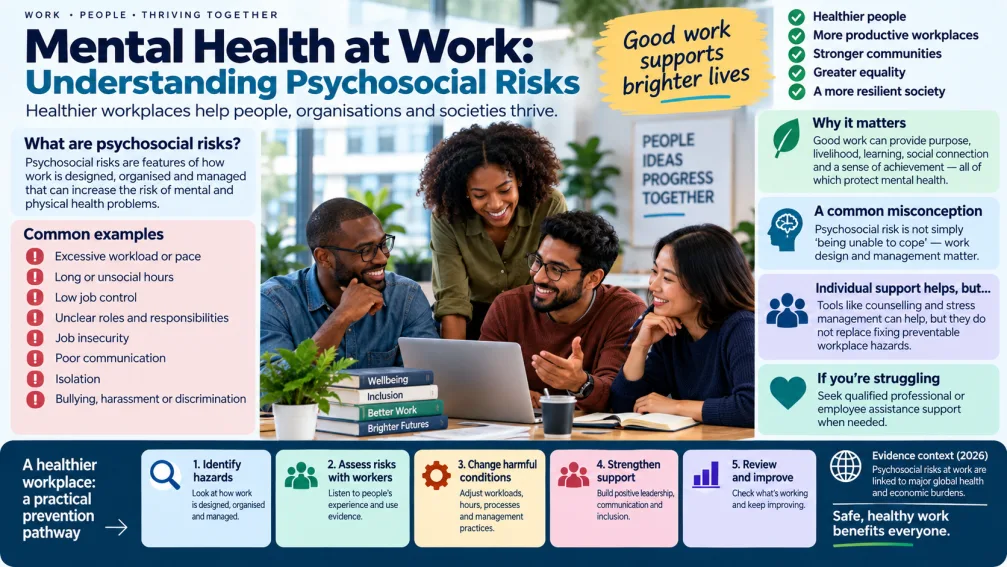
Psychosocial hazards are features of how work is designed, organised or managed that can increase the risk of harm.
They are not simply about whether an individual is “resilient enough”. Workload, autonomy, working hours, support, role clarity, organisational culture and employment conditions all matter.
Common examples
- Excessive workload or unrealistic pace.
- Long or unsocial working hours.
- Low control over how work is done.
- Unclear roles or conflicting responsibilities.
- Job insecurity.
- Poor communication or inadequate support.
- Isolation.
- Bullying, harassment or discrimination.
The job itself
Task design, physical environment, resources and skill requirements can affect wellbeing. A job can become harmful when demands consistently exceed available resources or when workers have little ability to influence how tasks are performed.
How work is organised
Workload, staffing, schedules, autonomy, management practices and role clarity shape how pressure is experienced.
A temporary busy period is different from a system in which excessive workload is normal and recovery is impossible.
Policies and workplace culture
Fair processes, respectful behaviour, job security, anti-harassment measures and meaningful worker participation can reduce risk.
A policy on paper is not enough if people do not trust the reporting process or harmful behaviour is tolerated in practice.
Why prevention should start with working conditions
Individual supports such as counselling, stress-management education or employee-assistance programmes can be helpful. But they should not replace action on preventable hazards.
If workload is structurally excessive, telling workers to become more resilient does not solve the underlying problem.
A practical prevention pathway
- Identify hazards: examine how work is designed, organised and managed.
- Assess risks with workers: listen to experience and use available evidence.
- Change harmful conditions: adjust workload, staffing, schedules, processes or management practices where needed.
- Strengthen support: improve communication, leadership, inclusion and access to support.
- Review: check whether changes are working and improve them over time.
Work can protect mental health too
Good work can provide purpose, income, learning, social connection and structure. The goal is not to portray work itself as harmful, but to reduce preventable risks and strengthen protective conditions.
Common misconception
“Psychosocial risk means some workers cannot cope with normal pressure.” That framing is incomplete. Psychosocial risk management examines the interaction between job demands, control, support, organisation and culture.
If you are struggling
If work-related distress is affecting your wellbeing or safety, consider speaking with an appropriate workplace contact or qualified health professional. In an emergency or immediate danger, seek local emergency support.
Key takeaways
- Psychosocial risks arise from how work is designed, organised and managed.
- Examples include excessive workload, low control, unclear roles, insecurity and harassment.
- Prevention should prioritise changes to harmful working conditions.
- Individual wellbeing support can help but does not replace organisational prevention.
- Good work can also support mental health.
Frequently asked questions
Is stress itself a psychosocial hazard?
Stress can be a response to hazards. The hazard may be excessive workload, bullying, low control or another feature of the work environment.
Are psychosocial risks only about mental health?
No. Chronic stress and harmful work conditions can also affect physical health and safety.
Can employers eliminate all work pressure?
No. The aim is to manage preventable risks and create reasonable, supportive working conditions, not to remove every challenge from work.
Authoritative references
- World Health Organization — Mental health at work.
- International Labour Organization — psychosocial risks and occupational safety and health.