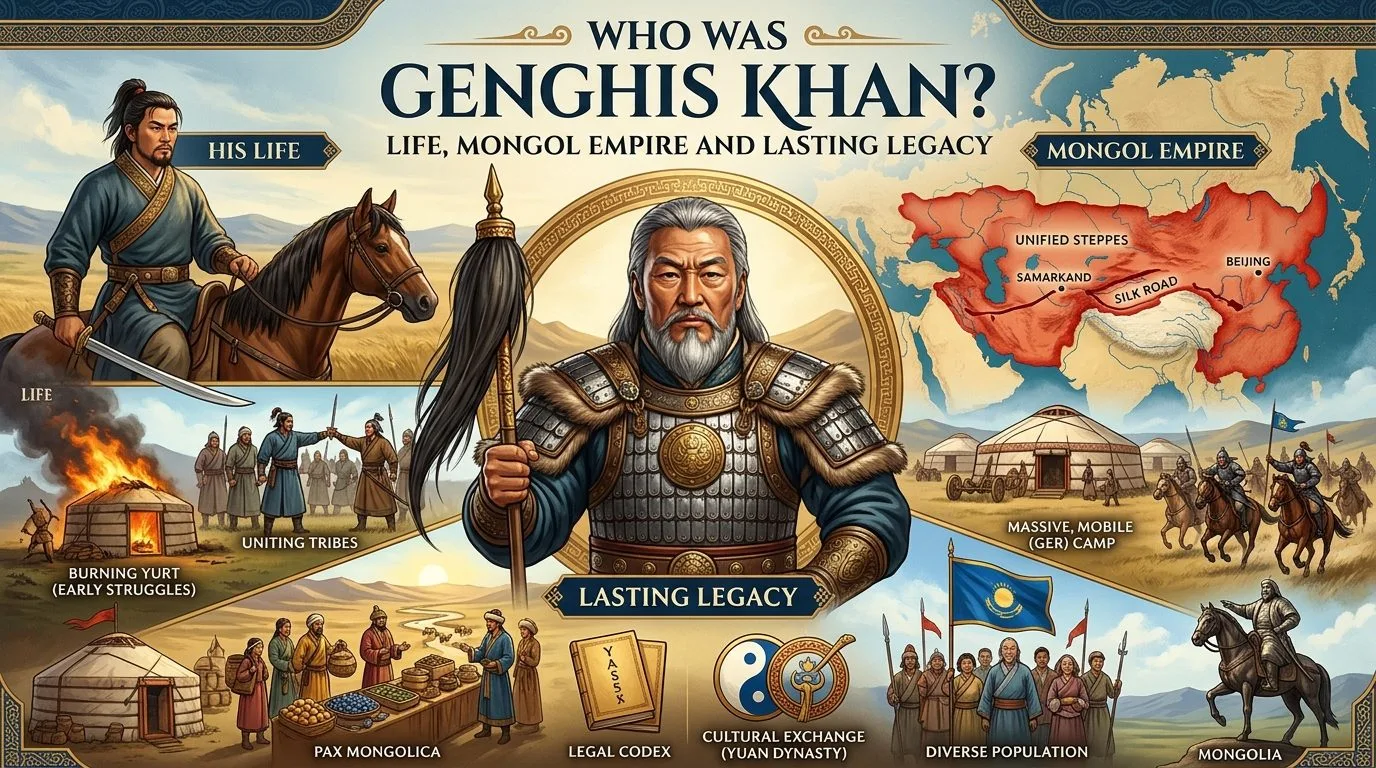
Who was Genghis Khan? Genghis Khan, born Temüjin in the twelfth century, was the Mongol leader who united many rival steppe peoples and founded the Mongol Empire in 1206. Over the following two decades, armies under his command conquered enormous territories across northern China and Central Asia. He died in 1227, but his descendants continued the conquests and built what became the largest contiguous land empire in recorded history.
His life presents a difficult historical legacy. He was an effective organiser and military strategist who reshaped Eurasian politics, developed a durable imperial military structure, and encouraged long-distance communication and the employment of specialists from many backgrounds. His campaigns also involved the destruction of cities, mass killings, forced displacement and severe damage to agricultural communities. Later Mongol governments facilitated trade and cultural exchange, but those developments must not erase the violence of conquest or be attributed exclusively to him.
To understand who Genghis Khan was, the Mongol Empire and his lasting legacy, it helps to distinguish what contemporary or near-contemporary sources record from legends and later claims. His often-quoted birth year is uncertain, the precise reason for his death remains unclear, and historians question whether his alleged Great Yasa survived as a comprehensive written legal code. This guide separates established events from disputed details using Encyclopaedia Iranica , OpenStax World History , museum scholarship and historical research.
Genghis Khan facts at a glance
| Question | Evidence-based answer |
|---|---|
| Original name | Temüjin (also written Temujin or Temuchin) |
| Known as | Genghis Khan; Chinggis Khan or Chinggis Khaan in alternative spellings |
| Birth | Twelfth-century Mongolia; commonly c. 1162, but 1155 and 1167 also appear in sources |
| Father and mother | Yesügei and Hö'elün (also spelled Hoelun) |
| Key turning point | Acclaimed supreme ruler at a kurultai in 1206 |
| Major theatres of conquest | Mongolian steppe, Western Xia, northern China under the Jin, and Central Asian territories of Khwarazm |
| Death | 1227, during the campaign against Western Xia; precise cause disputed |
| Successor as great khan | His son Ögedei, chosen in 1229 |
| Historical significance | Founder of the Mongol imperial state; his successors expanded it further |
The familiar date “1162–1227” is a useful shorthand, but 1162 is not a proven birthday. Historian David O. Morgan in Encyclopaedia Iranica favours about 1167, while other historians follow Mongolian and Chinese sources suggesting 1162. That uncertainty does not affect the much better-established dates of his rise and death.
1. Temüjin's early life: hardship on the Mongolian steppe
Temüjin was born into a world of pastoral nomadic societies in what is now Mongolia. Communities moved with their herds, relied on horses for travel and warfare, and formed alliances through kinship, marriage and political agreements. The steppe was not an empty wilderness: it was a socially complex region with established tribes, trade connections and competition over grazing lands and leadership.
His father, Yesügei, was a local leader. According to The Secret History of the Mongols, he was poisoned by enemies while Temüjin was still a child. His family's allies subsequently abandoned his mother, Hö'elün, and her children, leaving them in difficult circumstances. Stories of hardship, hunger and family violence became important features of Temüjin's biography.
Historians use these stories cautiously. The Secret History is a central near-contemporary account, probably composed not long after Genghis Khan's death, but its narrative also contains political messages, stylised speeches and episodes whose details cannot be independently confirmed. It is strong evidence of how Mongol elites remembered their founder, not a modern eyewitness transcript of every childhood event.
Temüjin gradually attracted supporters and acquired allies, some unrelated to him. This ability to build loyalty beyond immediate lineage was crucial in a steppe environment where alliances could shift rapidly. His marriage to Börte, and the struggle to recover her after she was abducted by the Merkit, formed another important episode in the traditional account. Encyclopaedia Iranica discusses both the biography and the limits of its sources.
2. How did Temüjin unite the Mongol tribes?
Temüjin did not inherit a unified Mongol nation. He confronted powerful confederations and individual rivals while creating coalitions of followers. Two especially important relationships were with Toghril—also called Wang or Ong Khan—of the Kereit, and Jamukha, a former sworn companion who became his opponent.
Over years of fighting and diplomacy, Temüjin defeated rival leaders, including major opponents among the Kereit and Naiman. Defeated fighters could be incorporated into his forces rather than always remaining separate tribal armies, although some campaigns also involved severe reprisals. He rewarded loyalty and military usefulness and increasingly reduced the ability of rival aristocratic families to mobilise independent power.
In 1206, a kurultai—an assembly of leaders and supporters—recognised his supremacy and established him as the ruler known to history as Chinggis or Genghis Khan. The exact meaning and derivation of the title have been debated; “universal ruler” is a familiar traditional rendering, not an indisputable linguistic translation. National Geographic's account of the Mongol khans and the Metropolitan Museum's chronology confirm the 1206 turning point.
This was the beginning of the imperial Mongol state, but not yet the creation of every territory later shown on maps of the Mongol Empire.
3. What made the Mongol military so effective?
The Mongol conquests depended on more than fearless horsemen. Genghis Khan built upon sophisticated steppe warfare and combined it with organisation, intelligence, discipline and the practical use of conquered specialists.
Mobility and mounted archery
Many Mongol soldiers were experienced riders who could travel long distances with remount horses and fight with composite bows. Horse archers could harass enemies, withdraw and return, and exploit weaknesses in heavier or less mobile forces. Flexible formations helped commanders coordinate movement across large areas, although the effectiveness of any tactic depended on terrain and opponents.
Organisation and command
The imperial army was organised using a decimal system, often described as groups of ten, one hundred, one thousand and ten thousand soldiers. This made it easier to assemble units, transmit commands and integrate men from different backgrounds. Promotions were influenced by loyalty and ability, but the empire was not a modern equality-based meritocracy: family ties, hierarchy and personal favour still mattered.
Intelligence and psychological warfare
Reconnaissance, local information and rapid communication helped commanders plan campaigns. They sometimes used feigned retreats, coordinated attacks from different directions and pressure on enemy rulers to surrender. Threats of devastating retaliation could encourage submission; where resistance continued, the consequences could be catastrophic for civilians.
Sieges and technical expertise
Cavalry alone could not conquer fortified cities. Mongol armies employed experienced engineers, siege crews and other specialists, including people taken from territories under Mongol control. Their military system changed as they encountered new defensive techniques in northern China and Central Asia. Encyclopaedia Iranica describes both the cavalry organisation and the importance of siege resources.
4. Which lands did Genghis Khan conquer?
His main campaigns affected the steppe, states in what is now northern and north-western China, and Central Asian lands reaching into the Iranian world. The full Mongol Empire later extended much farther under his descendants.
| Date | Event | Why it matters |
|---|---|---|
| c. 1204–1206 | Final defeats of major steppe rivals and recognition at the 1206 assembly | Creation of a unified political and military leadership |
| 1209 | Major campaign against Western Xia (Xi Xia) | Expansion toward the north-western Chinese frontier |
| 1211 onward | War against the Jurchen-led Jin dynasty | Expansion into northern China; war continued after his death |
| 1218 | Mongol victory in the Qara Khitai realm | Control extended westward toward the Khwarazmian frontier |
| 1219–1221 | Invasion of the Khwarazmian Empire | Conquest and devastation across major Central Asian urban regions |
| 1223 | Mongol commanders defeated a coalition of Rus' and allied forces at the Kalka River | Illustrates wide-ranging operations under Genghis Khan, not the later conquest of Rus' |
| 1226–1227 | Renewed campaign against Western Xia | His final campaign and death in 1227 |
These dates outline overlapping military campaigns rather than a single uninterrupted march. The Iranica biography and National Geographic historical timeline provide the main sequence. The Jin dynasty was not fully conquered until 1234, after Genghis Khan died; the same is true of the later major Mongol conquests in eastern Europe, Baghdad and southern China.
5. Why did the Mongols invade the Khwarazmian Empire?
The war with the Khwarazmian Empire was one of the most destructive phases of Genghis Khan's career. The Khwarazmshah ruled territories spanning important Central Asian cities and parts of the Iranian world. In 1218, a Mongol-linked merchant caravan was seized at Otrar, and merchants were killed. A subsequent diplomatic crisis included the killing of a Mongol envoy in accounts of the period.
Historians disagree about whether the Mongols had already intended to conquer the region or whether the diplomatic outrage decisively changed Genghis Khan's plans. It is safer to explain that the caravan incident and diplomatic breakdown were major immediate triggers, without claiming to know his private intentions. David O. Morgan's analysis discusses this uncertainty.
Mongol forces launched their invasion in 1219. Cities including Bukhara and Samarkand fell, and the campaigns continued into Khurasan. Chronicles describe mass killing, deportation, destruction of infrastructure and the devastation of settlements and farmland. The effects were not identical in every city, but the violence and disruption were extensive.
How many people were killed? Some medieval chronicles give extraordinarily high figures—sometimes millions for individual cities—but scholars caution that the numbers cannot simply be accepted as accurate counts. Record-keeping was incomplete, narratives could be rhetorical, and later retellings often repeat estimates without reliable demographic evidence. The historical conclusion is that severe massacres occurred, while exact totals remain uncertain. Avoid presenting a sensational number as a verified death toll.
6. How did Genghis Khan govern the empire?
Conquest created a problem: a ruler could control armies over enormous distances, but administering diverse settled societies required taxation, correspondence, interpreters and officials. Genghis Khan adopted elements of existing steppe governance while relying increasingly on people with administrative and literate skills from different regions.
He ordered the use of a script based on Uyghur writing for the Mongolian language, a crucial development for administration and recording information. The Mongol state also promoted communication through messenger and relay arrangements that later governments expanded. Administrators and skilled workers from conquered societies were employed or forcibly relocated, producing cultural exchange under deeply unequal conditions.
Did he create a written “Great Yasa” law code?
The term Yasa or Jasaq refers to orders, rules and legal traditions associated with Genghis Khan and his successors. Popular accounts sometimes describe a single complete, fixed written law book covering every aspect of life. Historians dispute that reconstruction.
In Encyclopaedia Iranica's specialist account , historian Peter Jackson explains that much of the description of a unified code comes from later writers, some repeating earlier material. An authentic complete text has not survived, and various provisions attributed to Genghis Khan may be later inventions. It is reasonable to say that he issued commands and helped shape imperial governance; it is not sound to reproduce a long list of alleged laws as unquestionably authentic.
7. Did Genghis Khan allow religious freedom?
Mongol imperial practice is often described as religiously tolerant relative to some contemporary states. Genghis Khan's regime and later Mongol courts included contact with Buddhists, Muslims, Christians, Daoists and followers of steppe religious traditions. Leaders valued religious figures, prayers, diplomatic relationships and skills useful to government.
Yet this should not be confused with modern equality of rights. Religious communities could receive privileges under particular rulers while political coercion, warfare and taxation continued. Policies differed among successors, territories and periods. Religious tolerance under Mongol control does not mean conquered peoples experienced freedom from violence or discrimination.
Columbia University's Mongols in World History explores how Mongol rulers supported different religious communities and trading networks. The National Geographic account of the Pax Mongolica connects religious plurality to later imperial communication and commerce.
8. When and how did Genghis Khan die?
Genghis Khan died in 1227 during his renewed campaign against Western Xia, also called Xi Xia or Tangut. That setting and year are historically well established. The exact cause of death is not.
Stories attribute his death variously to illness, an injury after falling from a horse or other circumstances, but surviving accounts do not permit a definitive diagnosis. It would therefore be misleading to write that he was certainly killed in battle or died from a specific wound. His burial place was not publicly documented in a way that modern archaeologists have conclusively verified, and numerous stories about a secret tomb remain unsubstantiated.
His death did not end the empire. After a period of transition, his son Ögedei became great khan in 1229, and Mongol expansion continued. National Geographic's succession overview distinguishes the conquests of his sons and grandsons from campaigns undertaken in his own lifetime.
9. How big was the Mongol Empire under Genghis Khan?
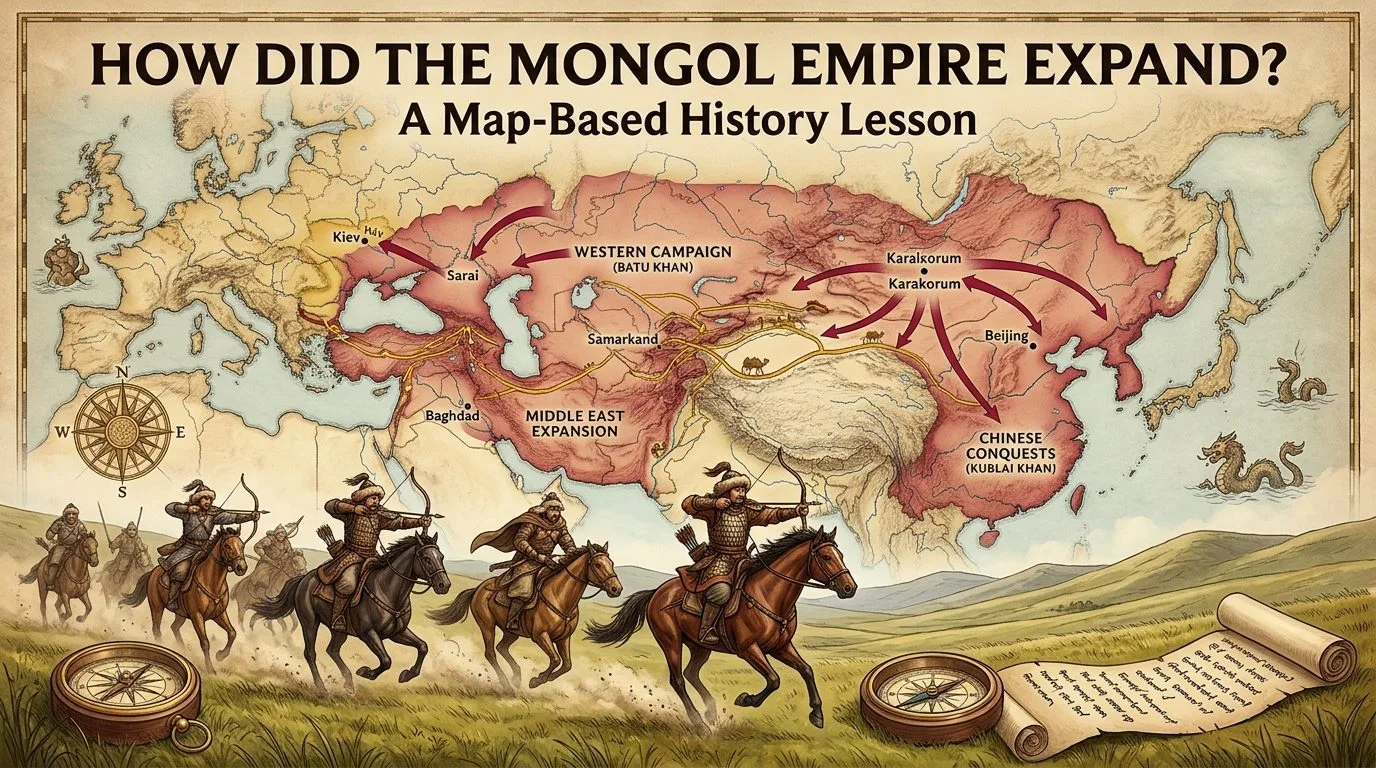
Maps of the Mongol Empire frequently show lands stretching across much of Eurasia, sometimes from East Asia into eastern Europe and the Middle East. Not all those territories were conquered during Genghis Khan's life. He established the imperial state and its crucial military foundations, but the empire reached its greatest extent during the reigns of later Mongol leaders.
Under his descendants, the Mongol world eventually developed several powerful centres: the Yuan dynasty in China, the Chagatai Khanate in Central Asia, the Golden Horde across parts of the Eurasian steppe and Rus' lands, and the Ilkhanate in Iran and neighbouring regions. Their political relationships were complex, and the empire increasingly fragmented.
Several famous events occurred after 1227: the completed conquest of the Jin in 1234; the large Mongol campaigns into eastern and central Europe under his successors; the capture of Baghdad in 1258 by forces of his grandson Hülegü; and Kublai Khan's consolidation of the Yuan dynasty, proclaimed in 1271, followed by the defeat of the Southern Song in 1279. These are central to the Mongol imperial legacy, but they should not be incorrectly credited as Genghis Khan's personal victories.
The Metropolitan Museum of Art's historical essay and Mongol Khans reference document this expansion and division.
10. What was the Pax Mongolica?
Pax Mongolica, or “Mongol Peace”, is a modern scholarly label for a period of relative order across important Eurasian corridors under Mongol rule, especially in parts of the thirteenth and fourteenth centuries. It describes conditions that could help merchants, envoys, scholars and travellers move across jurisdictions that had previously been divided among competing powers.
Existing Silk Roads trade networks predated the Mongols by centuries. Mongol authorities supported merchants, expanded relay systems, protected selected routes and enabled exchanges of objects, techniques, diplomatic information and artistic styles. Yet this security was not universal, and different regions experienced war, high demands for tribute or exploitation.
In some areas the movement of craftspeople, officials and knowledge contributed to hybrid artistic traditions. The Met's assessment of Mongol-era art describes how Chinese and Islamic visual traditions interacted under successor dynasties, while National Geographic explains the commercial networks.
Greater connectivity also had costs. Overland trade and travel could help diseases circulate, although historians and scientists continue to investigate the precise geographical pathways of medieval epidemics. It is not accurate to credit Genghis Khan personally with every commercial benefit or later public-health disaster associated with the Mongol period.
11. What was Genghis Khan's lasting legacy?
A transformed map of Eurasia
He created a new imperial centre of power on the Mongolian steppe, broke several existing political structures and established a ruling family whose descendants shaped regions across Asia and eastern Europe. Even after separate khanates emerged, the Mongol conquest influenced later state formation, taxation, military methods and diplomacy.
Greater movement of people and knowledge
Trade routes and elite patronage under later Mongol rulers linked distant societies. Artisans and experts moved between regions—some voluntarily, others by force—and left marks on architecture, manuscripts, ceramics and government practices. As the Metropolitan Museum's catalogue demonstrates, the cultural effects of Mongol rule were extensive and often regionally distinctive.
Human devastation and social disruption
Conquest also destroyed lives and communities. Massacres, enslavement, damaged irrigation and displacement had deep effects in parts of Central Asia and Iran. A balanced account must avoid excusing atrocities as the unavoidable price of later trade or celebrating military success without considering the civilian population. The full scale and long-term demographic consequences differ among places and remain subjects of historical study.
Memory and national identity
In modern Mongolia, Genghis Khan is widely commemorated as a founder of political unity and an important historical figure. Elsewhere, especially in societies that suffered Mongol campaigns, his memory can be associated with invasion and loss. Neither memory should replace evidence-based history; they show how one ruler can hold different meanings in different cultural settings.
12. How do historians know what happened?
Genghis Khan's biography is reconstructed from sources written from different perspectives and at different times. The Secret History of the Mongols is unusually important for early Mongol political traditions, while Persian historians such as Rashid al-Din, accounts from conquered societies, Chinese records and later chronicles preserve other details. These sources can complement one another, but may also contain political propaganda, exaggeration or retrospective interpretation.
For example, The Secret History presents an insider narrative about the founding leadership, whereas Persian accounts often describe terrible suffering during the conquests. Both perspectives matter. Historians compare chronology, authorial purpose, language, archaeological evidence and independent testimony before deciding how confidently a claim can be repeated.
Three examples illustrate the method: (1) the 1206 unification is firmly established across scholarship; (2) the birth year remains debated; (3) dramatic casualty totals and full lists of alleged Yasa laws are much less secure. Learning to distinguish these claims is more informative than treating every detail in a popular biography as equally proven.
See Encyclopaedia Iranica's source discussion and the Metropolitan Museum's account of the Jami' al-tavarikh , an influential later historical manuscript tradition.
Myths and facts about Genghis Khan
| Popular claim | What the historical evidence supports |
|---|---|
| “He was born in exactly 1162.” | 1162 is common, but sources also suggest other years, especially 1167. |
| “He founded the Mongol Empire in 1206.” | Yes. His supremacy was recognised in 1206 following steppe unification. |
| “He personally conquered all of China and Russia.” | No. Major conquests in these regions were completed by his successors. |
| “He left a complete written law book.” | A definitive surviving Great Yasa text does not exist; its nature is debated. |
| “Every massacre figure in chronicles is exact.” | No. Major atrocities are documented, but many figures are unreliable. |
| “He was only a destroyer and changed nothing else.” | His empire also transformed military organisation and political connections. |
| “Mongol rule was universally peaceful and tolerant.” | Some later regions had greater connectivity; conquest and coercion continued. |
| “His grave has been conclusively identified.” | No verified, universally accepted location is established. |
Frequently asked questions
What was Genghis Khan's real name?
His birth name was Temüjin. Genghis or Chinggis Khan is the title by which he became known after his rise to supreme Mongol leadership.
When was Genghis Khan born?
He was born in the twelfth century in the region of present-day Mongolia. Many modern works use around 1162, but alternative dates including 1167 appear in historical scholarship. His precise birth year is unresolved.
What did Genghis Khan accomplish?
He united rival steppe peoples under a single imperial leadership in 1206, organised a powerful army and established the Mongol Empire. His campaigns conquered large parts of northern China and Central Asia, although further conquests were carried out after his death.
Why was Genghis Khan feared?
His armies' mobility and organisation were formidable, and Mongol campaigns sometimes involved massacres, destruction of cities and extreme punishment of resistance. Threats of such violence could influence diplomatic decisions and surrender.
Was Genghis Khan a good or bad ruler?
That is partly a moral judgement, but any assessment should account for both state-building and the severe human consequences of conquest. He shaped Eurasian political history while directing campaigns that caused mass death and destruction.
Who succeeded Genghis Khan?
His son Ögedei became great khan in 1229. Later descendants, including Möngke, Hülegü and Kublai, helped extend or govern different parts of the Mongol imperial world.
How did Genghis Khan die?
He died in 1227 during the Western Xia campaign. The cause is uncertain, and competing stories about injuries or illness are not securely established.
Was Genghis Khan the ruler of the largest empire ever?
He founded the state that later became the largest contiguous land empire in history. Its greatest extent came under his successors, not within his own lifetime.
Did Genghis Khan create the Silk Road?
No. The Silk Roads existed long before him. Mongol rule later supported travel and commerce across parts of these established networks, but the experience varied by region.
Conclusion: understanding the founder and the consequences of empire
Genghis Khan was Temüjin, a twelfth-century steppe leader who united competing peoples, founded the Mongol Empire in 1206 and directed conquests that transformed northern China and Central Asia. His military organisation, political alliances and use of administrative expertise helped lay foundations for an empire that expanded enormously after his death in 1227.
His lasting legacy is not a simple story of either progress or destruction. The Mongol imperial world reshaped trade, diplomacy, artistic exchange and political structures across Eurasia. It also inflicted deep violence and suffering on conquered populations. The best historical account recognises both realities, keeps the achievements of his descendants separate from his own career, and is candid when famous stories exceed the surviving evidence.
References and further reading
- Encyclopaedia Iranica — Čengīz Khan, David O. Morgan .
- Encyclopaedia Iranica — Yāsā, Peter Jackson .
- OpenStax World History — Chinggis Khan and the Early Mongol Empire .
- National Geographic Education — The Mongol Khans .
- The Metropolitan Museum of Art — Central and North Asia, 1000–1400 A.D. .
- The Metropolitan Museum of Art — The Legacy of Genghis Khan .
- The Metropolitan Museum of Art — Folios from the Jami' al-tavarikh .
- The Metropolitan Museum of Art — The Legacy of Genghis Khan: Courtly Art and Culture in Western Asia, 1256–1353 .
- National Geographic Education — The Pax Mongolica .
- Columbia University, Asia for Educators — Mongols in World History .
- Oxford Research Encyclopedia of Asian History — Pax Mongolica: Trade and Traders in the Mongol Empire .
- Bulletin of SOAS — The “Great Yāsā of Chingiz Khān” and Mongol Law in the Īlkhānate .