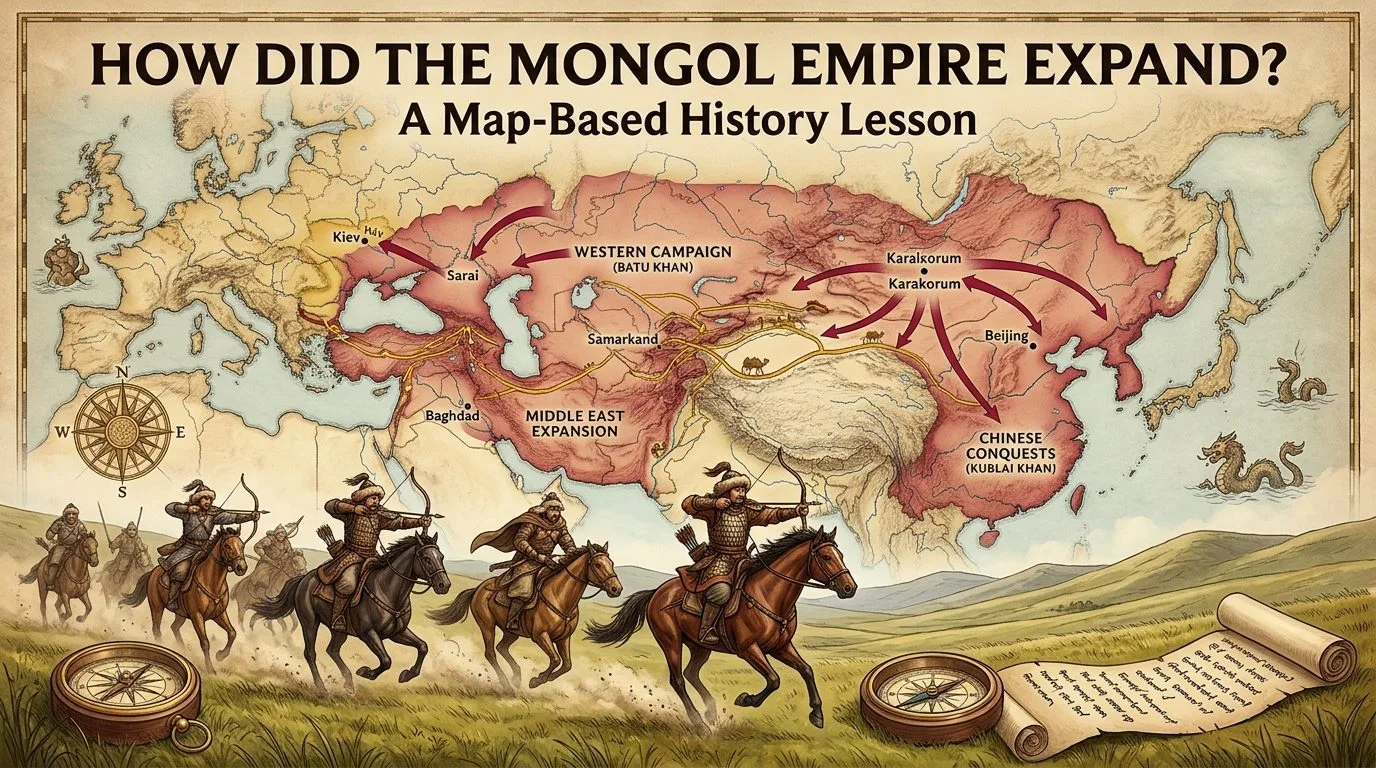
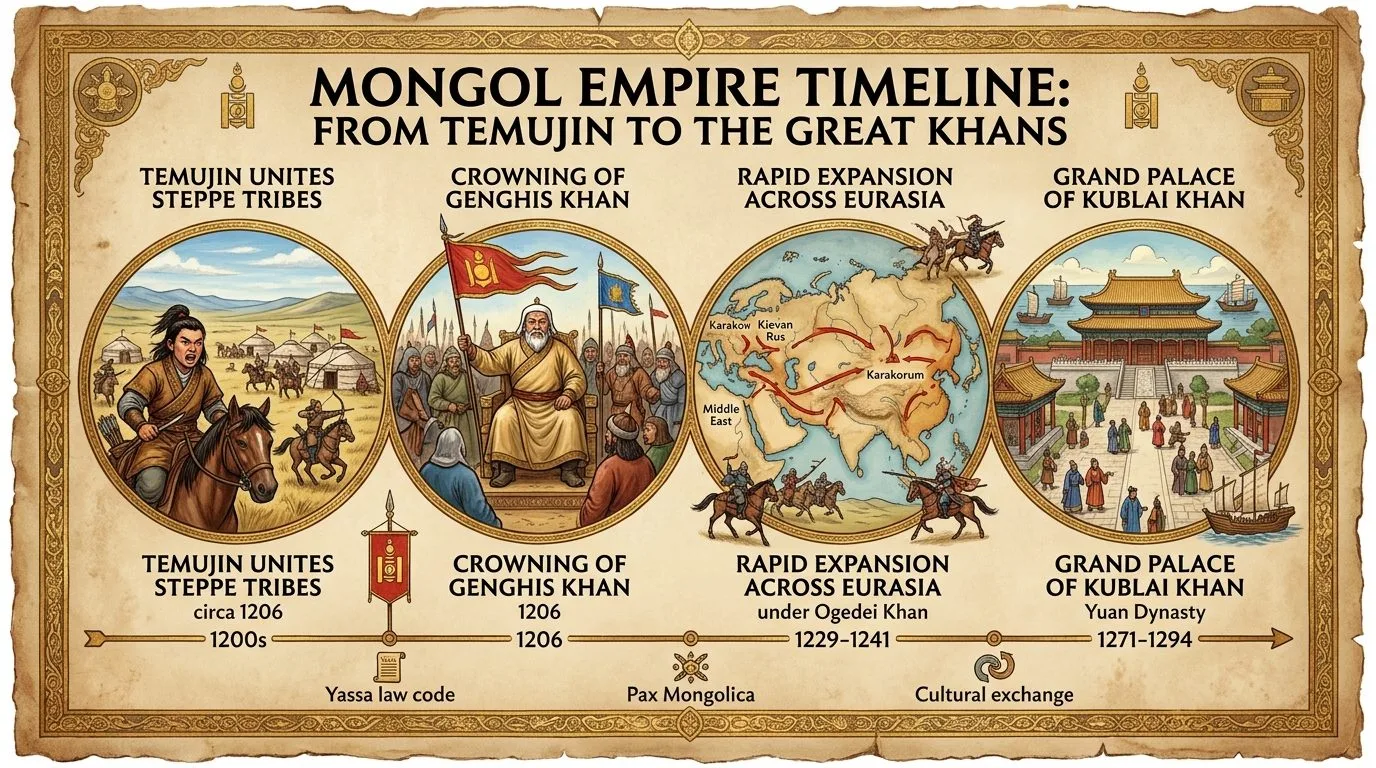
The Mongol Empire timeline begins with Temüjin, the steppe leader who united rival peoples and was proclaimed Genghis Khan in 1206. It follows the great khans who ruled after his death in 1227, the conquests stretching from northern China to eastern Europe and Iraq, the succession war of 1260–1264, the rise of Kublai Khan's Yuan dynasty, and the empire's division into powerful successor states. The date 1368 marks the Yuan dynasty's loss of its Chinese capital to the Ming, not the end of every Mongol state or dynasty.
Unlike a list of military victories, a useful chronology must answer three questions: who ruled, what happened, and which events occurred after Genghis Khan was already dead? It also needs to recognise powerful regents, including Töregene Khatun and Oghul Qaimish, and the contested claim of Ariq Böke. Otherwise, the history appears to be a neat succession from one ruler to the next when it was often shaped by rival royal lineages and assemblies.
This original guide draws on the Royal Armouries' family chronology , Columbia University's account of the successors , the Cambridge History of the Mongol Empire , and the Metropolitan Museum of Art . Readers can use it as a reference timeline, a quick revision sheet or a classroom source-analysis activity.
Mongol Empire timeline: the most important dates
| Year | Event | Why it matters |
|---|---|---|
| c. 1160s | Temüjin is born on the Mongolian steppe; his exact birth year is disputed. | The future founder emerges in a divided political world. |
| 1206 | Temüjin is recognised as Genghis Khan at a kurultai. | Foundation of the Mongol imperial state. |
| 1209 | Major campaign against Western Xia. | First major steps into the states bordering northern China. |
| 1211–1215 | War against the Jin; Zhongdu falls in 1215. | Pressure on northern China; the Jin state survives until 1234. |
| 1218 | Qara Khitai comes under Mongol control. | Western frontier approaches the Khwarazmian world. |
| 1219–1221 | Major conquest of Khwarazmian lands and cities. | Expansion and devastation across Central Asia. |
| 1223 | Mongol force wins the Battle of the Kalka River. | Long-range operation; not the full conquest of Rus'. |
| 1227 | Genghis Khan dies during the Western Xia campaign. | His son Tolui serves as regent while succession is arranged. |
| 1229 | Ögedei becomes great khan. | The empire continues under a new supreme ruler. |
| 1234 | Jin dynasty is defeated. | Major conquest of northern China completed. |
| 1236–1240 | Western campaigns led by Batu and other commanders; Kyiv falls in 1240. | Mongol domination reaches the Rus' principalities. |
| 1241 | Legnica and Mohi victories; Ögedei dies. | Western campaigns and succession crisis coincide. |
| 1241–1246 | Töregene Khatun governs as regent. | Political authority continues without a newly elected great khan. |
| 1246–1248 | Güyük reigns as great khan. | Short rule during disputed family politics. |
| 1248–1251 | Oghul Qaimish serves as regent. | Another prolonged succession struggle. |
| 1251–1259 | Möngke reigns; major campaigns resume. | Strengthening of central administration and renewed expansion. |
| 1258 | Hülegü's armies take Baghdad. | Abbasid political rule in Baghdad ends. |
| 1259 | Möngke dies. | A new succession crisis destabilises imperial unity. |
| 1260–1264 | Kublai and Ariq Böke dispute the great khanship in civil war. | The authority of the central empire fractures. |
| 1271 | Kublai proclaims the Yuan dynasty. | Mongol rule in China assumes a new dynastic form. |
| 1274, 1281 | Yuan-led attempts to invade Japan fail. | Limits to Mongol maritime expansion. |
| 1279 | Southern Song resistance is defeated at Yamen. | The Yuan conquest of China is completed. |
| 1294 | Kublai Khan dies. | End of the best-known later great khan's reign. |
| 1335 | Ilkhan Abu Sa'id dies without an accepted direct successor. | The united Ilkhanate disintegrates amid competing regimes. |
| 1368 | Ming forces drive the Yuan court from its Chinese capital. | End of Yuan rule over China proper, not of all Mongol dynasties. |
Dates for short-lived claims, the start of campaigns and the formal surrender of a dynasty can vary between chronological sources. The major framework above follows the Royal Armouries , National Geographic's overview of the khans , and the Met's Chinese dynastic chronology .
Before 1206: how Temüjin rose to power
Temüjin was born in the twelfth century in what is now Mongolia. Many popular timelines give 1162, while scholarly reconstructions suggest alternative dates, including 1167. His childhood is largely known through traditions preserved in The Secret History of the Mongols, an important near-contemporary account that combines historical memory, political themes and narrative storytelling. Historians therefore distinguish its broad outline from details that cannot be independently checked.
His father, Yesügei, died while Temüjin was still young; the family lost vital alliances and reportedly endured severe hardship. As an adult, Temüjin built a network of allies and followers through marriages, diplomacy, war and redistribution of rewards. He faced former associates as well as major steppe confederations, including the Kereit and Naiman. These conflicts were not simply a struggle of a single ethnic group against outsiders; the steppe contained competing lineages and political relationships.
By 1206, his most important rivals had been defeated or subordinated. A kurultai, an elite assembly, confirmed his position as supreme ruler. The title Chinggis or Genghis Khan is often interpreted as “universal ruler”, although its exact origin remains debated. The foundation of a united Mongol state is a well-supported historical turning point, even where stories of his early life remain uncertain. See the specialist biography in Encyclopaedia Iranica .
1206–1227: Genghis Khan builds the empire
Genghis Khan reorganised military allegiance, drawing fighters from different groups into a more coordinated command system. Units often operated through decimal groupings, and mounted archery, intelligence gathering, rapid movement and flexible strategy were central to campaigns. The empire also relied on specialists, negotiators and people with administrative skills taken from, recruited in or transferred from conquered regions. It was not built by horses alone.
1209–1215: expansion toward northern China
From 1209, Mongol armies pressed Western Xia in north-western China. Beginning in 1211, they fought the Jurchen-led Jin dynasty, taking its major city of Zhongdu, near modern Beijing, in 1215. This did not mean all China had fallen; the Jin continued fighting until 1234, and the Southern Song survived much longer. Timelines that credit Genghis Khan with personally conquering all China confuse his reign with campaigns completed by later rulers.
1218–1221: expansion through Central Asia
The Mongols brought the Qara Khitai realm under their influence in 1218. Conflict with the Khwarazmian Empire intensified following the seizure of a trading caravan and a diplomatic breakdown at Otrar. Genghis Khan launched a major invasion in 1219. Cities including Bukhara and Samarkand were captured, and campaigns devastated important urban and agricultural regions.
Medieval chronicles describe massacres, destruction and forced movement of people. However, dramatic numbers quoted for deaths in individual cities are not reliable modern population counts. A sound chronology acknowledges extensive violence without presenting uncheckable totals as settled facts. Royal Armouries' campaign account places these events within the larger expansion.
1223–1227: long-range operations and death
In 1223, a force operating under Mongol commanders defeated a Rus' and allied coalition at the Kalka River. This was a major expedition, not the full conquest of the Rus' lands later undertaken under Genghis Khan's successors. Genghis Khan returned to campaigning against Western Xia and died in 1227. The precise medical cause of his death and the location of his tomb remain uncertain.
Key distinction: Genghis Khan founded and expanded the empire, but he did not live to see the conquest of Kyiv, Baghdad, the Southern Song or the empire's eventual maximum territorial reach.
1227–1241: Tolui's regency and Ögedei's great khanship
Genghis Khan's fourth son Tolui acted as regent from 1227 to 1229 while the royal family arranged the succession. A regent exercised power during a vacancy or transition but was not necessarily regarded as a separately elected great khan. In 1229, Temüjin's third son Ögedei was confirmed as great khan. This distinction matters in any accurate list of Mongol rulers.
Ögedei's reign is associated with an enormous extension of imperial reach. Mongol armies completed the conquest of the Jin dynasty in 1234, advanced into the Caucasus and Iranian regions and conducted major western operations. Batu Khan, a grandson of Genghis Khan descended from Jochi, directed the western campaigns alongside other commanders. Volga Bulgaria and many Rus' principalities were attacked, culminating in the capture of Kyiv in 1240.
In April 1241, Mongol forces defeated major opponents at Legnica in Poland and Mohi in Hungary. These campaigns reached far into Europe but did not establish enduring Mongol rule over all European lands encountered. Mongol forces withdrew from Hungary during 1242. Ögedei's death in late 1241 and the need to manage succession have often been cited as factors; scholars also discuss logistics, environment and the difficulty of sustaining an occupation. The withdrawal should not be reduced to one unquestioned explanation.
Ögedei also developed Karakorum as an imperial centre and expanded administrative communication, including the mounted relay system later associated with the yam. Columbia University and the Royal Armouries family chronology describe the continued expansion under his rule.
1241–1251: regencies, Güyük and a contested succession
1241–1246: Töregene Khatun's regency
After Ögedei's death, his widow Töregene Khatun exercised authority for several years. Her regency was not a blank interval while men decided what to do: she played an active political role, built support and influenced administration and succession. Her son Güyük was eventually selected as the next great khan in 1246.
1246–1248: Güyük Khan
Güyük was the son of Ögedei and Genghis Khan's grandson. His short reign was marked by imperial administration, diplomacy and tensions within the ruling family. Papal envoys led by John of Plano Carpini travelled to the Mongol court during this period; their accounts help historians understand European perceptions and imperial diplomacy. Güyük died in 1248.
1248–1251: Oghul Qaimish's regency
His widow, Oghul Qaimish, became regent. The leadership contest increasingly involved different branches of the royal family. Sorghaghtani Beki, Tolui's widow and mother of Möngke and Kublai, was an influential political figure whose alliances helped the Toluid branch gain power. In 1251, Möngke was chosen as great khan. Some defeated rivals suffered severe punishment, demonstrating that succession could be dangerous and divisive.
Regents should be included in a classroom timeline because the empire did not stop governing between elected khans. Their importance is documented in the Royal Armouries' account of Genghis Khan's family .
1251–1259: Möngke Khan and renewed imperial campaigns
Möngke Khan, a son of Tolui and grandson of Genghis Khan, took power in 1251. His reign sought to strengthen imperial authority through administrative oversight, taxation and census-related measures while directing new military expeditions. The state depended increasingly on multiple centres and specialists from conquered societies.
Möngke's brother Hülegü led major operations in western Asia, defeating Nizari Ismaili strongholds in 1256 and capturing Baghdad in 1258. The destruction associated with the siege was immense, but specific casualty claims should be evaluated critically. Another brother, Kublai, conducted campaigns and political work in China. These events occurred generations after Genghis Khan had died.
Möngke died in 1259 during a campaign in China. His death reopened the question of who would hold supreme authority. In 1260 Mongol forces in the Levant were defeated by the Mamluks at Ain Jalut, an important check on an advancing army. That battle did not eliminate all Mongol power in the Middle East, where Hülegü's descendants established the Ilkhanate. See the Royal Armouries and Metropolitan Museum's Ilkhanid history .
1260–1294: Kublai Khan, Ariq Böke and a divided empire
1260–1264: rival claimants to the title of great khan
After Möngke's death, his brothers Kublai and Ariq Böke received support from competing assemblies and fought a civil war over the supreme title. Kublai claimed the great khanship in 1260, but his victory was not secured until Ariq Böke surrendered in 1264. The war weakened the idea that every branch of the empire would obey a single centre.
The Cambridge History of the Mongol Empire treats the civil war as a critical break in the united imperial structure. Kublai remained the recognised great khan in his own court and held a powerful central role, but rulers in the western khanates increasingly pursued independent interests. The term great khan therefore requires more qualification for the later period than for the relatively united empire under earlier rulers.
1271: the Yuan dynasty is proclaimed
Kublai based his rule increasingly in China and proclaimed the Yuan dynasty in 1271. He adopted Chinese imperial institutions while maintaining Mongol traditions and drawing on officials from different backgrounds. His court patronised art, religion and scholarship; its policies also involved hierarchy and unequal burdens among subject populations. As with earlier rulers, governance and conquest cannot be separated from their human costs.
1274, 1279 and 1281: successes and limits
Yuan-led invasions of Japan in 1274 and 1281 failed. Campaigns against the Southern Song in China, however, continued to succeed. Hangzhou, a major Song centre, fell in 1276, and the dynasty's last major resistance was defeated at Yamen in 1279. This completed the conquest of the Southern Song, not the conquest of every remaining territory in Asia. Kublai died in 1294; Yuan emperors succeeded him in China.
For these dates, see the Metropolitan Museum's Yuan dynasty history and National Geographic's biographies of the great khans .
Who were the Mongol great khans? A ruler-by-ruler chart
| Leader | Dates | Role | Important contribution or issue |
|---|---|---|---|
| Genghis Khan (Temüjin) | 1206–1227 | Great khan | Founded the imperial state; conquered areas of northern China and Central Asia. |
| Tolui | 1227–1229 | Regent | Managed the transition after Genghis Khan's death. |
| Ögedei | 1229–1241 | Great khan | Major expansion into northern China and western Eurasia. |
| Töregene Khatun | 1241–1246 | Regent | Exercised authority and shaped Güyük's succession. |
| Güyük | 1246–1248 | Great khan | Short reign amid elite rivalries and international diplomacy. |
| Oghul Qaimish | 1248–1251 | Regent | Led a contested transition before Möngke's election. |
| Möngke | 1251–1259 | Great khan | Oversaw administration and renewed campaigns under his brothers. |
| Kublai | 1260–1294 | Contested, then victorious claimant; Yuan ruler | Won civil war in 1264; founded Yuan in 1271; completed Song conquest in 1279. |
| Ariq Böke | 1260–1264 | Rival claimant | Challenged Kublai's claim and surrendered in 1264. |
Important: This table distinguishes rulers from regents and a rival claimant. Some charts count only the five better-known great khans—Genghis, Ögedei, Güyük, Möngke and Kublai—while more complete political chronologies identify interim governments. The Royal Armouries royal-family account is especially useful for checking this distinction. Later Yuan emperors continued to use Mongol imperial titles, but their practical authority across the wider former empire was uneven.
After 1260: the four major Mongol successor states
As the central government weakened, the empire developed into several related but politically distinct khanates. They were not simply four provinces governed harmoniously by Kublai.
| Successor state | General region | Historical point |
|---|---|---|
| Yuan dynasty | China and Mongolia | Founded by Kublai in 1271; lost its Chinese capital to the Ming in 1368. |
| Golden Horde (Jochid ulus) | Western steppe and parts of the Rus' lands | Descendants of Jochi and Batu shaped eastern European and steppe politics for centuries. |
| Chagatai Khanate | Central Asia | Descended from Chagatai's line; experienced internal divisions and political changes. |
| Ilkhanate | Iran, Iraq and adjoining regions | Founded under Hülegü's branch; central unity collapsed after Abu Sa'id's death in 1335. |
The Metropolitan Museum explains how these successor states generated different political and artistic traditions. A single large coloured area on a historical map may show the Mongol dynastic world without proving that one great khan could issue commands and expect compliance everywhere.
1294–1368: what happened after Kublai Khan?
After Kublai's death in 1294, Yuan emperors ruled China, while the western Mongol khanates followed their own trajectories. Periods of diplomacy and commercial exchange alternated with disputes and wars. Historians use the phrase Pax Mongolica for conditions of relative security across some Eurasian routes, especially during parts of the thirteenth and fourteenth centuries, but the term should not imply universal peace. Existing Silk Roads were centuries older than the Mongol conquests.
In 1335, the Ilkhan Abu Sa'id died without an accepted direct successor, and the united Ilkhanid political structure broke into competing authorities. The Golden Horde and Chagatai domains had their own prolonged histories; their chronologies cannot be reduced to the Yuan dynasty's dates.
In 1368, armies of the emerging Ming dynasty drove the Yuan court from its capital at Dadu (Beijing). Mongol rulers continued in Mongolia, and other Chinggisid states and successor polities survived elsewhere. Thus, it is useful to date the Yuan dynasty in China to 1271–1368, but inaccurate to say every Mongol political state vanished in 1368. The Met's China chronology and Royal Armouries' account of fragmentation make this distinction.
Why did the united Mongol Empire fragment?
The united empire depended on cooperation among branches of Genghis Khan's family. Leadership decisions had to balance military power, personal alliances, inherited territories and the authority of assemblies. There was no universally accepted automatic succession rule ensuring that a single heir would inherit undisputed power.
Geography and administration also mattered: ruling northern China required different institutions from controlling the Central Asian steppe or cities in Iran. Regional elites developed independent military resources, economic interests and alliances. The 1260–1264 civil war made these competing claims especially clear, but fragmentation was a process rather than one event occurring overnight.
The Cambridge History of the Mongol Empire emphasises how struggles over the great khan's authority and the royal family's territorial claims helped bring conflict. A useful classroom distinction is dynastic relationship versus effective political unity: being related to the same founder did not guarantee obedient regional governments.
How should students read historical timelines critically?
A timeline can be misleading if every date looks equally certain. 1206, 1227, 1258, 1271 and 1279 are central milestones strongly supported by scholarship. By contrast, Genghis Khan's exact birth year is unresolved, the reported cause of his death is uncertain, and some medieval casualty totals cannot be verified.
Readers should also ask whether a date marks the beginning of a campaign, a battlefield victory, a ruler's recognition, a city's surrender or the final collapse of a state. For example, Mongol attacks on the Jin started in 1211, Zhongdu fell in 1215, and the Jin dynasty ended in 1234. All three statements may be correct without referring to the same event. The Royal Armouries timeline demonstrates these overlapping phases.
Classroom revision exercise: six timeline questions
- Place in order: Baghdad falls; Temüjin becomes Genghis Khan; Southern Song defeat; Ögedei becomes great khan. Answer: 1206, 1229, 1258, 1279.
- Who ruled during the interval 1241–1246? Answer: Töregene Khatun governed as regent after Ögedei's death.
- What happened in 1260–1264? Answer: Rival claimants Kublai and Ariq Böke fought for the great khanship; Kublai prevailed.
- Did Genghis Khan conquer Baghdad? Answer: No. Hülegü's armies took the city in 1258, more than 30 years after Genghis Khan died.
- Why are 1271 and 1279 different? Answer: Kublai proclaimed the Yuan dynasty in 1271; the Southern Song's final defeat followed in 1279.
- Does 1368 mean every Mongol khanate ended? Answer: No. It marks the Yuan court's loss of China, while other Mongol polities continued.
Frequently asked questions
When did the Mongol Empire begin?
The empire was founded in 1206, when Temüjin was recognised as Genghis Khan after uniting major steppe groups.
How many great khans ruled the united Mongol Empire?
The usual five-name sequence is Genghis, Ögedei, Güyük, Möngke and Kublai, but Kublai's authority was contested and the united empire was fracturing during his reign. An accurate account should also mention Tolui, Töregene and Oghul Qaimish as regents, plus Ariq Böke as a rival claimant.
Who succeeded Genghis Khan in 1227?
Tolui initially served as regent after Genghis Khan's death. Ögedei was elected great khan in 1229.
Who was the greatest Mongol khan?
“Greatest” depends on the measure. Genghis founded the empire; Ögedei presided over major territorial expansion; Möngke oversaw reforms and campaigns; and Kublai completed the conquest of Southern Song China. Those accomplishments must be assessed alongside the violence of conquest and the effects on subject societies.
When was the Mongol Empire largest?
The Mongol dynastic world reached its greatest geographic reach after Genghis Khan's lifetime, during the period of his descendants. Exact size depends on whether a map includes tributary relationships and how independently ruled khanates are counted. It is often described as the largest contiguous land empire in history.
When did the Mongol Empire split?
Division developed over decades, with the 1260–1264 succession war as an important turning point. The Yuan, Golden Horde, Chagatai and Ilkhanid states became increasingly independent.
Did the Mongol Empire end in 1368?
Not in every sense. The Yuan rulers lost their Chinese capital to the Ming in 1368, but Mongol rule continued elsewhere, including among successors in Mongolia and the western steppe.
Conclusion: from Temüjin to a divided imperial world
The Mongol Empire timeline is best understood as a sequence of unification, conquest, succession, renewed expansion and fragmentation. Temüjin became Genghis Khan in 1206 and established the imperial state. Ögedei, Güyük and Möngke led or oversaw the empire through new campaigns and political struggles. Kublai became great khan after a civil war, founded the Yuan dynasty and completed the conquest of Southern Song China.
The empire that emerged was both militarily transformative and deeply destructive in many conquered regions. Its successor states also influenced commerce, government and cultural exchange across Eurasia. A careful timeline names the correct ruler for each event, includes the women who exercised regency power, and recognises that the Yuan dynasty's loss of China in 1368 did not mean every Mongol state disappeared.
References and further reading
- Royal Armouries — The Family of Genghis Khan .
- Royal Armouries — Rise of the Mongols .
- Royal Armouries — Fall of an Empire .
- Columbia University, Asia for Educators — Expansion Under Chinggis's Successors .
- Cambridge University Press — The Rise of Chinggis Khan and the United Empire, 1206–1260 .
- The Metropolitan Museum of Art — The Legacy of Genghis Khan .
- The Metropolitan Museum of Art — Yuan Dynasty (1271–1368) .
- The Metropolitan Museum of Art — The Art of the Ilkhanid Period (1256–1353) .
- The Metropolitan Museum of Art — China, 1000–1400 A.D. .
- National Geographic Education — The Mongol Khans .
- Encyclopaedia Iranica — Čengīz Khan .