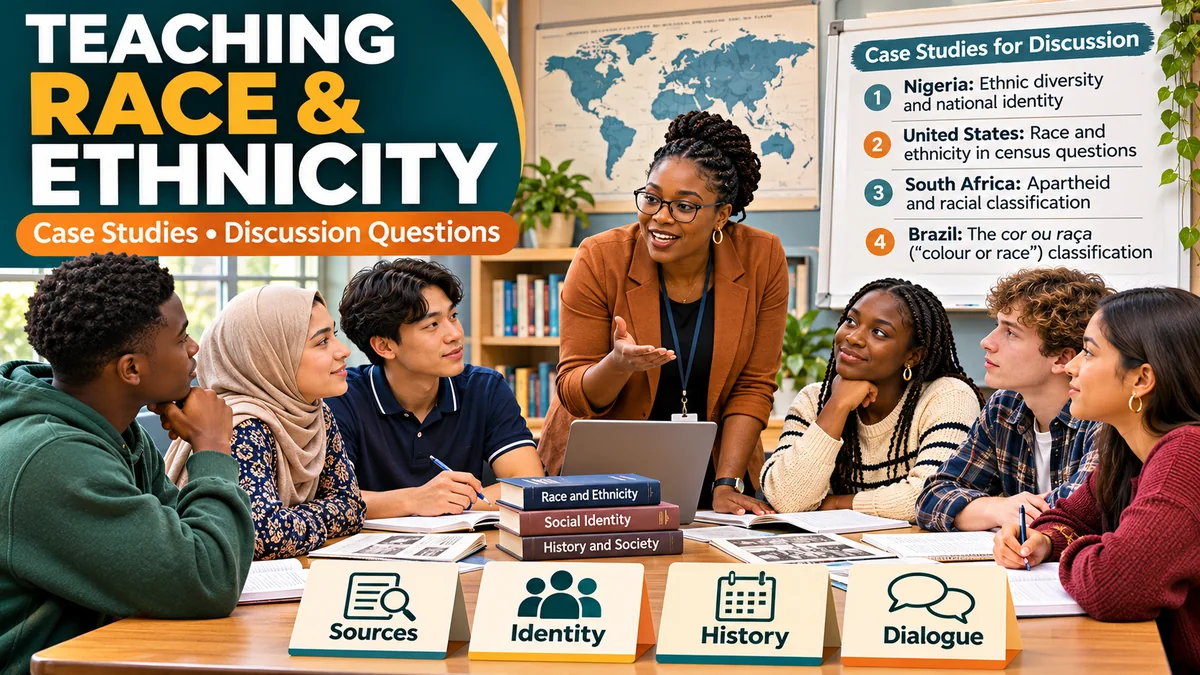
Teaching Race and Ethnicity: Case Studies and Discussion Questions
Teaching race and ethnicity works best when students compare evidence, explore how identities are described in different societies and practise asking respectful questions. These terms shape history and public policy, but they are often confused with nationality, culture and biology. This lesson-ready guide provides five case studies, source-based discussion prompts, model answers, activities and a straightforward assessment rubric for secondary schools, families and community learning groups.
It is deliberately different from a general definition article: rather than repeating a glossary, it shows how teachers can use primary sources and historical context to develop evidence-based thinking. The international examples are documented; the school-based scenario is explicitly fictional.
Learning goals and essential concepts
By the end of the lesson, learners should be able to: (1) distinguish race, ethnicity, nationality and genetic ancestry; (2) explain why social categories change across societies; (3) analyse an official source in its historical context; (4) recognise a stereotype and propose a fair response; and (5) support an interpretation with evidence rather than assumptions.
Race is a social classification often linked to perceived appearance and ancestry. It has shaped institutions and lived experiences, but does not divide humanity into discrete biological types. The American Association of Biological Anthropologists explains why human variation does not map neatly onto racial labels. Ethnicity concerns shared or claimed cultural heritage, history and identity; language and traditions may be important, but none is a universal test of membership. The UK Office for National Statistics distinguishes socially assigned race categories from self-defined ethnicity.
Nationality concerns connection to a country, often citizenship. Genetic ancestry refers to patterns of inherited relationships; neither DNA results nor appearance can establish a person's complete cultural identity. For a deeper explanation of these terms, read Race and Ethnicity: Meaning, History and Real-World Examples , the companion article scheduled to appear before this classroom guide.
Before the lesson: create a respectful evidence-based classroom
Teach the topic through carefully chosen sources rather than asking students to speak for an entire group. Share discussion agreements in advance: challenge claims without insulting people; distinguish a source's words from your own position; avoid generalising from a single example; protect privacy; and allow learners to pass on personal disclosures. Never require students to state their race, ethnicity, family history or migration status publicly.
The Smithsonian's Talking About Race project offers resources for guided conversations, while Learning for Justice's shared inquiry guidance recommends developing participation agreements. UNESCO's guidance on educational materials advises against stereotypes and prejudicial portrayals.
Do not use mock segregation, racial sorting, forced identity disclosure or role-play designed to make students 'experience' persecution. The United States Holocaust Memorial Museum cautions against historical atrocity simulations and recommends primary sources and careful contextualisation. Apply the same care when teaching other traumatic histories.
A practical 60-minute lesson plan
| Minutes | Task | Evidence of learning |
|---|---|---|
| 0–8 | Anonymous entry question: how are race, ethnicity and nationality different? | Two short definitions; no personal disclosure |
| 8–15 | Teacher mini-lesson using definitions and one example | Students identify an accurate distinction |
| 15–35 | Small groups compare two or more country case studies | Source notes: claim, evidence, context and limitation |
| 35–48 | Facilitated whole-class discussion | Questions and counterexamples supported by sources |
| 48–56 | Short written response to a fictional school scenario | Reasoned and respectful proposed action |
| 56–60 | Exit ticket | One concept learned, one question to investigate |
For younger learners, use fewer cases and concrete language. For older students, introduce historical documents, data comparability and the difference between correlation and cause. Educators can extend the plan across two lessons or assign the model answers as independent revision material.
Case study 1 — Nigeria: nationality is not ethnicity
Evidence and context
The Nigerian Ministry of Foreign Affairs describes Nigeria as home to many ethnic communities. Yoruba, Igbo, Hausa, Fulani, Ijaw, Tiv and numerous others are among the identities represented. Nigerian describes a national connection, while labels such as Igbo and Yoruba name ethnic identities. Language, religion, place of residence and ethnicity may intersect, but are not interchangeable.
Classroom source task
Display a short passage from the ministry's description of Nigeria. Ask learners to underline references to nationality and circle references to ethnic communities. Explain that the country is diverse within as well as across regions.
Discussion questions
- Why is 'Nigerian' not the name of a single ethnic group?
- Can a person belong to more than one ethnic heritage? Give a hypothetical example.
- What would be misleading about assuming someone's language or religion from an ethnic label?
Suggested answer: Citizenship and nationality connect people to a state, while ethnicity concerns cultural identification and background. Someone may have mixed heritage, speak languages beyond their family's heritage languages and practise any or no religion. Treating ethnic identities as fixed predictions about individuals creates stereotypes.
Teaching caution: Do not demand that students identify their own ethnic group or describe 'typical' members. In a Nigerian classroom, use fictional examples and let learners choose whether to discuss personal experiences.
Case study 2 — United States: census categories are revised
Evidence and context
In March 2024, the US Office of Management and Budget revised federal standards for collecting race and ethnicity data. As the US Census Bureau explains , the revisions include a combined race-and-ethnicity question, allow multiple selections and add Middle Eastern or North African as a minimum category. The seven minimum categories include American Indian or Alaska Native, Asian, Black or African American, Hispanic or Latino, Middle Eastern or North African, Native Hawaiian or Pacific Islander, and White. Implementation across agencies and surveys is phased, so older data need not use the new standard.
Classroom source task
Compare the Census Bureau's explanation of the earlier separate-question approach with the revised combined-question approach. Students should not complete a real government form about themselves for this exercise; they can analyse the published descriptions.
Discussion questions
- What changed in the 2024 standards and why might a government change categories?
- Does creating a new census category establish a new biological race?
- Why must researchers check whether two datasets use the same questions before comparing them?
Suggested answer: Category design is intended to improve how people report identity and how information is collected. The creation or revision of a category changes an administrative system, not human biology. Different questions can affect responses, missing data and comparisons over time.
Extension: Ask students to write a two-sentence caution for a chart that compares historical census data with data collected under revised standards.
Case study 3 — South Africa: the consequences of legal classification
Evidence and context
The Apartheid Museum's Race Classification exhibition explains how apartheid authorities classified people and how the Population Registration Act of 1950 formed part of that system. The museum notes that by 1966 approximately 11 million people had been classified. Legal classification could affect where people lived and their access to opportunities and rights. These policies were part of a broader system of racial domination rather than evidence of fixed human biological divisions.
Classroom source task
Read the museum's exhibition explanation and make a cause-and-consequence chart: law or administrative rule → classification practice → effects on daily life. Use documented evidence instead of inventing the experiences of affected people.
Discussion questions
- How did state classification differ from someone's personal identity?
- What made these categories powerful despite having no sound biological foundation?
- How should historians document the experiences of people who were affected?
Suggested answer: A government classification can be imposed and enforced through institutions even when it misrepresents people's identities. Laws and policies give social categories material effects. Historical analysis should draw on legislation, archives, credible testimony and scholarship, not simulated humiliation or simplistic comparisons.
Teaching caution: Do not assign students 'racial' roles, separate them into unequal groups or recreate oppressive experiences as a classroom game. Study the documents and consequences directly.
Case study 4 — Brazil: why translation and context matter
Evidence and context
Brazil's statistics agency, IBGE , asks about cor ou raça ('colour or race'). The self-declared categories include branca, preta, parda, amarela and indígena. According to IBGE's 2022 Census educational material , the self-reported parda category accounted for 45.3% of the population. These categories are situated within Brazil's particular history and should not be mechanically equated with categories in other countries.
Classroom source task
Present the original Portuguese names alongside neutral explanatory translations. Compare Brazil's list with the current US minimum categories, noting that one-to-one matching is not warranted. Provide context before showing percentages, including the census year and self-reporting method.
Discussion questions
- Why might translating parda into one English label be incomplete?
- What does the 45.3% statistic describe—and what does it not prove?
- Why do nationality, history and local social practice matter when interpreting a census category?
Suggested answer: Category names carry meanings specific to a society. The statistic measures how respondents identified in one census using that questionnaire, not a fixed genetic group or universal identity. Interpretation requires attention to translation, time and method.
Case study 5 — A fictional classroom scenario about stereotyping
Fictional teaching scenario: During a group project, one pupil says, 'You come from that community, so you must think the same way as everyone from there.' Another pupil looks uncomfortable and stops contributing. No named group or identifiable student is intended in this scenario.
Discussion questions
- Which assumption is being made?
- Why can even a supposedly positive generalisation be unfair?
- How could a peer or teacher respond without pressuring anyone to disclose personal information?
Suggested answer: The comment treats a community as if all members share the same beliefs. A suitable response might be: 'People within any group have different experiences and opinions. Let's ask what each person wants to contribute to the project.' The teacher can reinforce the group agreement and make space for the affected student without asking them to educate everyone else.
Note: This example is illustrative, not a report of an actual incident.
Discussion questions for deeper learning
The following can be used as written homework, small-group prompts or assessed short answers. Ask students to cite one case-study source in each response.
- Definitions: How does ethnicity differ from nationality? Explain with the Nigeria case.
- History: How could a classification system affect opportunities and rights, as the South Africa example shows?
- Data: What might change when a government redesigns its race and ethnicity questions?
- Comparisons: Why is it risky to translate a Brazilian census category directly into a US category?
- Biology: Why is race an inadequate substitute for genetic ancestry?
- Evidence: Which source offers the strongest evidence for each case study, and what are its limitations?
- Ethics: How can teachers discuss group identities without turning learners into representatives of those groups?
- Action: What respectful sentence could interrupt a stereotype in a classroom discussion?
Model answer: evidence and interpretation
A strong answer identifies the specific claim, cites an appropriate source and distinguishes what the document says from what the student infers. For example, the 2024 US revision shows that official classifications can change; it does not by itself prove that any individual has changed identity. Similarly, South Africa's apartheid laws demonstrate enforceable consequences of classification but do not show that racial categories are biological realities.
Printable-style activities and assessment
Activity A: four-source comparison grid (15–20 minutes)
Provide groups with one short document or institutional web page for each country. Use a grid with the columns: country; who defines the category; term or rule; purpose; limitation or historical context. Students should quote or paraphrase responsibly and distinguish data-collection systems from laws of exclusion.
Activity B: optional identity vocabulary map (10 minutes)
Offer fictional profiles showing nationality, language, religion, ethnicity and family background as separate dimensions. Learners label which term describes which dimension. Participation must never require the public disclosure of anyone's own heritage. Avoid suggesting that any real combination of ethnicity and religion is compulsory.
Activity C: rewrite the claim (10 minutes)
Give students an invented headline, such as 'Everyone from Community X shares the same beliefs'. Have them rewrite it into a testable, careful statement—for example, 'A survey of a defined sample asked respondents about a particular view'. Discuss why sample, date and method matter.
Assessment rubric (12 points)
| Criterion | Available points |
|---|---|
| Correct understanding of identity terms | 0–3 |
| Accurate source use and historical context | 0–3 |
| Thoughtful comparison without stereotyping | 0–3 |
| Clear, respectful argument and response to questions | 0–3 |
For each criterion, award 3 for accurate, specific and well-supported work; 2 for mostly correct work; 1 for limited or unclear work; and 0 when evidence is absent. Feedback should focus on reasoning and evidence, not the identity or personal experience of the student.
Frequently asked questions for teachers and families
At what age can students discuss race and ethnicity?
Age-appropriate lessons can begin with fair treatment, belonging, different family backgrounds and respectful language. Older learners can examine historical classification systems and statistics. Teachers should follow local curricula and safeguard students' wellbeing.
Should students debate whether a racial group is naturally superior?
No. Scientific evidence does not support a hierarchy of inherent human worth by race. Students can critically examine where such claims originated, how they were used and why evidence contradicts them. Harmful claims need not be presented as equally credible positions.
How should a teacher respond when a student reports discrimination?
Listen, take the concern seriously, protect privacy and follow the school's safeguarding and reporting procedures. Do not demand a public account or turn the experience into spontaneous classroom material.
Can educators use statistics to discuss unequal outcomes?
Yes, with care. Name the dataset, year, population and category definitions. Distinguish patterns from explanations; differences may reflect institutions, environment and historical circumstances. Never imply a group average tells you an individual's ability.
Conclusion
Teaching race and ethnicity is most effective when students learn how to ask questions about categories, not merely memorise labels. Nigeria illustrates the difference between nationality and ethnic belonging; the United States and Brazil demonstrate how official categories are designed and revised; and South African history shows how classifications can be backed by coercive power. A fictional school scenario helps students practise respectful responses to everyday stereotyping.
Use sources with dates and context, protect students' dignity, avoid harmful simulations, and assess the quality of their reasoning. The outcome should be informed, careful discussion—not assumptions about the people in the classroom.