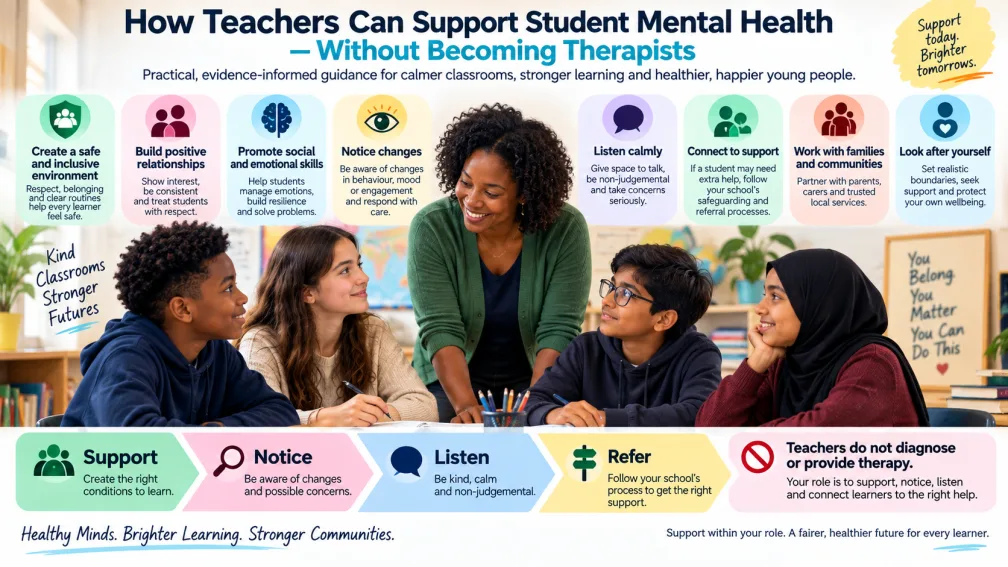
Teachers can make an important difference to student mental health without becoming therapists. Their role is to create a safe and inclusive learning environment, build respectful relationships, notice meaningful changes, listen calmly, teach useful social and emotional skills, and connect learners to appropriate support when needed.
That boundary matters. Teachers are not expected to diagnose mental-health conditions, provide specialised treatment or replace trained counsellors, psychologists, social workers or health professionals. The 2026 Teaching with care guide from the World Health Organization (WHO), UNESCO and UNICEF describes teachers as important frontline adults in learners’ everyday lives while emphasising that their role is essential but bounded.
This article provides general educational guidance. Schools should follow their own safeguarding, child-protection and referral procedures, and urgent safety concerns should be handled through the appropriate local emergency or safeguarding pathway.
Why student mental health belongs in the classroom conversation
Mental health affects more than how a student feels. It can influence concentration, attendance, motivation, relationships, behaviour and the ability to participate in learning. A classroom cannot replace clinical care, but it can either increase stress or provide predictability, connection and a sense of belonging.
WHO’s 2026 guidance on school health services describes schools as important platforms for promoting health and well-being. UNESCO similarly emphasises that learners are better able to benefit from education when schools are safe, inclusive and supportive.
For teachers, this means mental-health support is often less about delivering a special programme and more about how everyday classroom life is organised.
1. Create a safe and inclusive learning environment
A psychologically safer classroom is one where learners know what to expect, understand the rules, feel respected and are less afraid of humiliation or exclusion.
Practical classroom habits can include:
- clear and consistent routines;
- respectful correction rather than public shaming;
- predictable expectations;
- active prevention of bullying and discrimination;
- reasonable opportunities for learners to ask for help;
- inclusive examples and materials that do not stigmatise difference;
- calm transitions between activities where possible.
These practices do not treat a mental-health condition. Instead, they reduce unnecessary stress and help create the conditions in which more learners can participate and feel that they belong.
2. Build positive teacher–student relationships
A supportive relationship does not require a teacher to become a student’s therapist or friend. It means being consistent, respectful, interested and fair.
Small interactions can matter: greeting a learner by name, noticing effort, checking in after an absence, listening without ridicule and following through on reasonable promises. A student who trusts that a teacher will respond calmly may be more likely to ask for help when something is wrong.
At the same time, good professional boundaries remain important. Teachers should avoid becoming the only person a distressed learner relies on. When additional help is needed, support should widen to include the school’s designated safeguarding staff, counsellors, health professionals, family or other appropriate services.
3. Teach social and emotional skills as part of learning
Students can benefit from age-appropriate opportunities to practise skills such as identifying emotions, solving problems, communicating needs, resolving conflict and managing frustration.
These skills can be integrated into ordinary teaching rather than presented as therapy. Examples include:
- using group work to practise respectful disagreement;
- teaching students how to break a large task into smaller steps;
- modelling how to pause and think before responding to conflict;
- helping learners name different emotions accurately;
- using reflection questions after challenging activities;
- teaching simple help-seeking language such as “I am struggling with this and need support”.
The aim is not to force students to disclose private experiences. It is to strengthen skills that support learning, relationships and everyday coping.
4. Notice changes without jumping to a diagnosis
Teachers often see students regularly, so they may notice changes before other adults do. The important word is change.
A learner who is suddenly withdrawing, repeatedly falling asleep, missing school, becoming unusually irritable, struggling to concentrate or showing a sharp decline in participation may need support. But none of these observations proves a specific mental-health condition.
The same behaviour can have many possible explanations, including illness, family stress, bullying, grief, hunger, sleep problems, learning difficulties, safety concerns or ordinary developmental changes.
A useful approach is to describe what you have actually observed rather than assign a label. For example:
“I’ve noticed you have been quieter than usual and have missed several assignments. I wanted to check how things are going.”
This is safer and more respectful than saying, for example, “You seem depressed,” when the teacher is not qualified to make that assessment.
5. Listen calmly when a student talks
When a learner chooses to talk, a teacher does not need to have the perfect answer. Listening can itself be useful.
Helpful responses often include:
- giving the student time to speak;
- remaining calm;
- avoiding ridicule or disbelief;
- acknowledging that what they are describing matters;
- asking simple, non-leading questions when clarification is necessary;
- explaining what will happen next if the concern needs to be shared with another adult.
Teachers should be careful about promising complete secrecy. If a learner may be at risk of harm, safeguarding rules may require the teacher to share the concern with designated professionals.
A better approach is to be honest about confidentiality: listen respectfully, protect the student’s privacy as far as possible, and explain that some information may need to be passed to the right person to keep them safe.
6. Know when support needs to move beyond the classroom
Some concerns can be handled through ordinary classroom support. Others require a referral.
A referral does not mean the teacher has failed. It means the teacher has recognised the limit of their role and is connecting the learner to someone with the appropriate responsibility or expertise.
Depending on the school and local system, the next step might involve a:
- designated safeguarding lead;
- school counsellor or psychologist;
- school nurse or health service;
- social worker;
- child-protection service;
- parent or caregiver, where appropriate and safe;
- qualified mental-health professional.
Schools should make these pathways clear before a crisis occurs. Teachers are better able to respond when they already know whom to contact, what information to record and what the school’s procedures require.
7. Treat urgent safety concerns differently
If a student indicates that they may be in immediate danger, may harm themselves or someone else, or is experiencing abuse or another serious safeguarding concern, the situation should not be managed as an ordinary classroom conversation.
The teacher should follow the school’s safeguarding and emergency procedures promptly and involve the designated professionals responsible for student safety.
The exact process varies by country, school and legal system, which is why teachers should know their local policy rather than rely on generic internet advice.
8. Work with families and wider support systems
WHO, UNESCO and UNICEF emphasise that learner well-being is strengthened when schools work with families, communities and support services rather than expecting one teacher to carry the entire responsibility.
When appropriate, communication with parents or caregivers can help adults compare observations, understand changes and coordinate support. However, schools should consider safeguarding, privacy and the learner’s circumstances before sharing sensitive information.
Not every family situation is simple or safe. Teachers should therefore use established school procedures rather than improvise when there are concerns about abuse, neglect, violence or other risks.
9. Avoid common mistakes
Teachers can support mental health while still avoiding several common problems.
- Do not diagnose. Observing distress is not the same as identifying a disorder.
- Do not provide therapy unless that is your professional role. Classroom support and specialised treatment are different activities.
- Do not force disclosure. A student should not be pressured to reveal private experiences in front of peers.
- Do not promise absolute secrecy. Safeguarding duties can require information to be shared.
- Do not dismiss concerns as attention-seeking. Behaviour may be communicating a need even when the cause is unclear.
- Do not make yourself the student’s only support. Appropriate support networks are safer and more sustainable.
10. Protect teacher wellbeing too
Supporting students can be emotionally demanding. Teachers may be exposed to distressing disclosures, high workloads, difficult behaviour and pressure to solve problems that are outside their professional control.
The Teaching with care guide includes teacher well-being for a reason. A sustainable approach may include realistic boundaries, peer support, supervision where available, rest, workload management and seeking professional help when the teacher themselves is struggling.
Teacher self-care is not a substitute for adequate staffing, sensible workloads or effective school systems. Individual coping strategies work best when organisations also take responsibility for working conditions and access to support.
A simple classroom framework: Support, Notice, Listen, Refer
Teachers can remember four practical actions:
- Support: create predictable, inclusive conditions in which students can learn and belong.
- Notice: pay attention to meaningful changes in behaviour, participation, attendance or functioning without assuming a diagnosis.
- Listen: respond calmly and respectfully when a learner raises a concern.
- Refer: connect the learner to the appropriate safeguarding, counselling, health or family support when the concern exceeds the classroom role.
This framework is intentionally simple. It helps teachers act without pretending that they are mental-health clinicians.
Common misconceptions
- “Supporting mental health means teachers must become counsellors.” No. Teachers can promote well-being and notice concerns while referring specialised needs to appropriate professionals.
- “A student who is smiling cannot be struggling.” Emotional distress is not always obvious. Teachers should avoid judging mental health from appearance alone.
- “Poor behaviour always means poor discipline.” Behaviour has many possible causes. Boundaries still matter, but curiosity and context can improve the response.
- “If a teacher asks about well-being, they must solve the problem.” Listening and connecting a learner to the right support can be an appropriate outcome.
- “Teacher wellbeing is separate from student wellbeing.” A chronically overwhelmed teacher may find it harder to provide calm, consistent support, which is why staff well-being matters too.
Key takeaways
- Teachers can support student mental health without diagnosing or providing therapy.
- Safe, inclusive classrooms and positive relationships are part of mental-health promotion.
- Changes in behaviour or learning can be signs that a student needs support, but they do not establish a diagnosis.
- Listening calmly and without judgement can help a learner feel safe enough to seek further help.
- Clear referral and safeguarding pathways are essential when concerns exceed the teacher’s role.
- Teacher well-being and realistic professional boundaries are part of sustainable student support.
Frequently asked questions
Should teachers ask students about their mental health?
Teachers can make simple, supportive enquiries when they notice meaningful changes, but they should not conduct clinical assessments unless that is part of their professional role.
What should a teacher say to a distressed student?
A calm statement such as “I’ve noticed things seem difficult at the moment. Would you like to tell me what would help?” can open a conversation without assuming a diagnosis.
Should a teacher keep everything a student says confidential?
No. Privacy should be respected, but safeguarding concerns may need to be shared with designated staff or services. Teachers should explain this honestly.
What if the school has no counsellor?
The school should still have a safeguarding or referral process that identifies appropriate local health, child-protection or community services. The exact pathway depends on the local system.
Can classroom strategies replace therapy?
No. Classroom support can promote well-being and make learning safer, but students who need specialised mental-health care should be connected to qualified professionals.
Authoritative references
- WHO, UNESCO and UNICEF — Teaching with care: a practical guide for teachers to support mental health and well-being in schools
- World Health Organization — Making every school a health-promoting school: implementation guidance for school health services
- UNESCO — Strategy on education for health and well-being
- UNICEF — Ways teachers can support students’ mental health
Suggested next learning step: schools can turn these principles into a simple staff flowchart showing who to contact for ordinary wellbeing concerns, safeguarding concerns and urgent safety situations.