Evolution by natural selection is the process through which heritable traits that influence reproductive success can become more or less common in a population over generations. Individuals vary, some variation can be inherited, and organisms with certain traits may leave more surviving offspring in particular environments. Over time, these differences can change the genetic makeup of a population.
The evidence is not limited to a story about Charles Darwin. Scientists have measured changes in the beaks of Galápagos finches, studied the camouflage genes of desert mice, tested predator responses to peppered moths and observed bacteria evolving antibiotic resistance. This guide explains how natural selection works, what evidence supports it, why it matters and which popular misconceptions get the science wrong.
What is evolution by natural selection?
Biological evolution means change in the inherited characteristics of populations over generations. In modern population genetics, it can be described as changes in the frequencies of inherited gene variants, called alleles. Natural selection is one mechanism that can produce such change: some heritable variants are associated with greater reproductive success than others under particular conditions.
A bird does not grow a larger beak simply because it wishes to eat harder seeds. Instead, if beak sizes already vary and part of that variation is inherited, birds whose beaks work better with the available food may survive and reproduce more. Their offspring tend to inherit some of those characteristics, potentially shifting the population's average beak size. The Stanford Encyclopedia of Philosophy examines the role of heritable variation and differential reproduction in the process.
Evolution is the broader outcome; natural selection is one of its causes. Mutation, genetic drift, gene flow and other population processes also contribute to evolutionary change. Natural selection can produce adaptations, but not every evolutionary change is an adaptation.
How natural selection works: five essential steps
- Variation exists. Individuals within a population are not genetically identical. For example, beetles may vary in colour, size and tolerance of heat.
- Some variation is heritable. Offspring receive genetic material from their parents. A difference caused only by an individual's injury or diet will not necessarily be transmitted genetically.
- Organisms encounter different conditions. Food supply, climate, disease, predators and competition influence opportunities to survive and reproduce.
- Reproductive success differs. If an inherited trait improves the number of offspring that contribute to future generations, that trait can become more common.
- Populations change over generations. Repeated differences in reproduction can shift allele frequencies and observable characteristics.
Imagine a population of insects where some inherited colour variants blend into dark tree bark. If visual predators catch more conspicuous insects, those better camouflaged may leave more offspring. In a later generation, the camouflage-associated variants could become more frequent. But the result depends on actual predation, reproduction, genetics and environmental conditions; colour alone does not guarantee an advantage.
The scientific process is usually not purposeful. Mutations are not produced because organisms consciously need a solution. The resulting differences may then be filtered non-randomly by survival and reproduction in a given environment. A detailed peer-reviewed teaching review, Understanding Natural Selection: Essential Concepts and Common Misconceptions , explains this important distinction.
Charles Darwin, Alfred Russel Wallace and the origins of the idea
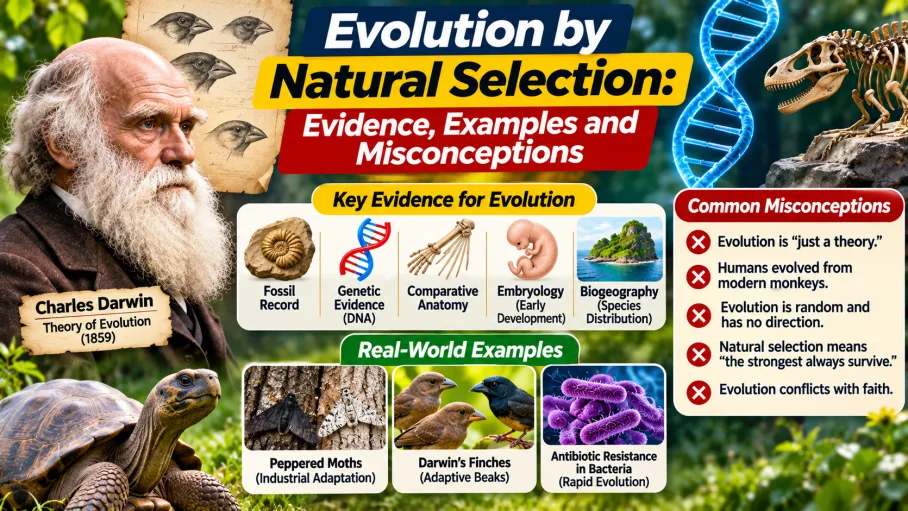
Charles Darwin and Alfred Russel Wallace independently developed explanations of evolution by natural selection. Their ideas were presented together to London's Linnean Society on 1 July 1858. Darwin then developed his case in On the Origin of Species, published in 1859. The original 1858 Darwin–Wallace paper and its transcribed historical edition provide direct documentary evidence.
Darwin drew on breeding practices, the distribution of organisms, fossils and observations made during and after the voyage of HMS Beagle. Wallace's studies in the Malay Archipelago helped him reach a related explanation. Neither scientist knew the molecular structure of DNA. Later genetic discoveries strengthened and refined the explanation by identifying ways heritable differences arise and are transmitted.
It is also important not to treat evolution as the invention of a single individual. Earlier thinkers discussed changing species, and modern evolutionary biology has been developed by many researchers since the nineteenth century. Darwin and Wallace's distinctive contribution was a powerful causal account of adaptation through differential reproductive success.
Evidence example 1: Galápagos finches during drought
On Daphne Major in the Galápagos Islands, researchers Peter and Rosemary Grant and colleagues measured wild finches over many years. During the severe 1977 drought, small, soft seeds became scarce. Larger and harder seeds remained more available, favouring some medium ground finches with larger, deeper beaks and body sizes. Survival was unequal, and the traits of surviving birds affected subsequent population characteristics.
This is unusually valuable evidence because scientists measured real animals before and after environmental changes. The peer-reviewed study in Nature and the Open University's teaching account explain why changing food conditions altered the direction of selection.
The lesson is not that finches decided to grow bigger beaks. Different finches already had different beak characteristics, and those variations affected their ability to feed and reproduce. Further fieldwork also found that selection can favour different beak characteristics under different conditions. There is no permanently “best” beak independent of an environment.
Evidence example 2: rock pocket mice and camouflage
Rock pocket mice live in the deserts of the southwestern United States. Their coat colours vary: pale mice blend with light sand and rocks, while darker mice can be less conspicuous on dark volcanic lava flows. Visual predators, such as owls, may be more likely to catch mice whose fur contrasts strongly with the ground.
Researchers have linked some dark-colour adaptations to changes in pigmentation-related genes such as Mc1r. Importantly, dark colour did not necessarily arise through the same genetic mutation in every mouse population. This provides evidence that similar adaptations can evolve through different genetic routes. Study the HHMI BioInteractive rock pocket mouse resource and the primary genetics study on melanism in pocket mice .
What is selected here is not “darkness” in every setting. On pale ground, dark fur can make a mouse easier for predators to see. On lava rock, it may provide camouflage. Fitness depends on the environment.
Evidence example 3: peppered moths and industrial melanism
The peppered moth (Biston betularia) became a classic example of environmental change affecting camouflage. In parts of industrial Britain, soot and pollution darkened tree surfaces and altered the background against which moths rested. Dark-coloured forms became more common in polluted regions; after pollution fell, pale forms increased again in several places.
Scientists have investigated whether birds can see and preferentially attack different moth forms on different backgrounds. Later field studies, including research using avian-vision models and predation experiments , support the camouflage explanation. The scientific review of industrial melanism puts the history of the case study in context.
Textbook pictures sometimes imply that the whole phenomenon was established by one photograph of a moth sitting on a tree trunk. The evidence is stronger and more complicated: it comes from field observations, changing population frequencies, genetics and repeated experimental tests. The principle is differential survival and reproduction of existing inherited colour variants, not intentional colour change by individual moths.
Evidence example 4: antibiotic resistance in bacteria
Antibiotic resistance shows evolution on timescales that humans can observe. Bacterial populations can contain cells with resistance-associated mutations or acquire resistance genes from other bacteria, including through horizontal gene transfer. When an antibiotic is present, susceptible bacteria may die or stop multiplying while resistant cells survive and reproduce, increasing the proportion of resistant bacteria.
The US Centers for Disease Control and Prevention (CDC) explains how resistant germs survive and how resistance traits spread. A peer-reviewed study of resistance evolution also describes the interaction of selection, genetic history and chance.
The key correction is that individual bacteria do not become resistant simply because they “try hard” after exposure. Genetic changes can arise independently of the need for resistance; antibiotic exposure then changes which bacterial variants are likely to persist. Resistance can also spread through gene exchange, so the process is not always as simple as one new mutation in one lineage.
Human behaviour matters because the selection pressure depends partly on how antimicrobial medicines are used. This is not a reason to avoid medically indicated treatment; rather, it underlines the importance of appropriate prescribing, infection prevention and following qualified medical advice.
What other evidence supports evolution?
Natural selection is one well-documented mechanism of evolutionary change. More broadly, evidence for the history of life comes from multiple independent scientific fields:
| Evidence type | What researchers examine | What it helps explain |
|---|---|---|
| Fossils | Preserved organisms, tracks and traces in dated rock layers | Extinction, older forms of life and changes through geological time |
| Genetics | DNA sequences, inherited variants and genetic relationships | Common ancestry, variation and mechanisms of inheritance |
| Comparative anatomy | Shared body structures and differences among organisms | Relationships, modified features and adaptation |
| Biogeography | Where species and their relatives live, including islands | Patterns shaped by ancestry, isolation and environmental change |
| Direct observation | Population changes, breeding studies and experimental evolution | How evolutionary processes occur under measurable conditions |
The Smithsonian Institution's Human Origins evidence collection illustrates how fossils, genetics and archaeological records can be combined. The Khan Academy evidence summary provides a useful student-level introduction across fields.
One caution: evidence for evolution and evidence for natural selection are related but not identical. A fossil sequence can reveal change and relationships without, by itself, identifying precisely which selective pressure caused a particular feature. Direct studies of differential survival, reproduction and heritability help establish natural selection as the mechanism in a given case.
What is adaptation, and does natural selection always produce it?
An adaptation is an inherited characteristic shaped by natural selection because it improved reproductive success in a relevant environment. Examples include the camouflage of some pocket mice on lava flows and beak forms suited to particular food sources.
But evolution does not always produce what people would call improvement. A trait can be beneficial in one environment, neutral in another and disadvantageous in a third. Physical constraints, trade-offs and changing conditions mean evolution does not create a perfect organism. An adaptation that helps an animal survive may also have costs, such as energy expenditure or reduced performance in a different habitat.
Nor is every trait an adaptation. Some inherited differences are neutral or change in frequency by chance through genetic drift. Biologists use comparisons, experiments and models to investigate whether selection offers the best explanation for a particular pattern.
Natural selection versus mutation, genetic drift and gene flow
| Mechanism | How it changes populations | Simple example |
|---|---|---|
| Natural selection | Heritable differences influence reproductive success | Camouflaged mice produce more offspring where predators favour concealment |
| Mutation | Changes in DNA produce new genetic variants | A novel coat-colour variant arises in a lineage |
| Genetic drift | Chance changes in allele frequency, especially important in small populations | An allele becomes rare after a random population bottleneck |
| Gene flow | Migration and reproduction move alleles between populations | Individuals from neighbouring populations breed with one another |
These processes are not mutually exclusive. A new mutation might spread by selection, be lost by drift or enter another population through migration. In microbes, horizontal gene transfer can additionally move genetic material between cells without ordinary parent-to-offspring reproduction. Distinguishing mechanisms helps explain why a population changed rather than merely noticing that it changed.
Three patterns of natural selection
Natural selection can shift the distribution of traits in several ways. These are simplified teaching categories rather than separate forces:
- Directional selection: one end of a trait distribution has relatively higher reproductive success, such as the larger beaks favoured during the 1977 finch drought.
- Stabilising selection: intermediate trait values outperform extremes under particular conditions, narrowing variation over time.
- Disruptive selection: individuals at different extremes outperform intermediate types, potentially favouring multiple forms.
Scientists test these patterns by measuring traits, inheritance and reproductive outcomes. Merely looking at a graph of survivors is not always enough to separate selection from other processes or to establish long-term genetic change.
Eight common misconceptions about evolution by natural selection
- “Individuals evolve because they need to.” Individual organisms can develop, learn or acclimatise, but evolution refers to inherited changes across generations in populations.
- “Natural selection gives organisms useful mutations on demand.” Mutation is not directed towards what a particular organism needs. Selection acts on the resulting heritable variation.
- “Survival of the fittest means the physically strongest wins.” In evolutionary biology, fitness concerns reproductive contribution to future generations, not simply body size or aggression.
- “Evolution always makes life more advanced.” Evolution has no built-in ladder of progress or predetermined endpoint. Simpler traits can be favoured when they work better.
- “Natural selection is completely random.” Chance influences mutations and other processes, but selection involves systematic differences in reproductive success associated with heritable traits.
- “Every useful-looking feature must have evolved by selection.” Some features have neutral histories, developmental constraints or other explanations. Evidence is needed.
- “If scientists call evolution a theory, it is only a guess.” A scientific theory is a tested explanatory framework supported by evidence, not a synonym for an unsupported opinion.
- “Evolution is only about animals in the distant past.” Evolution also occurs in plants, fungi and microorganisms, and researchers can measure it in contemporary populations.
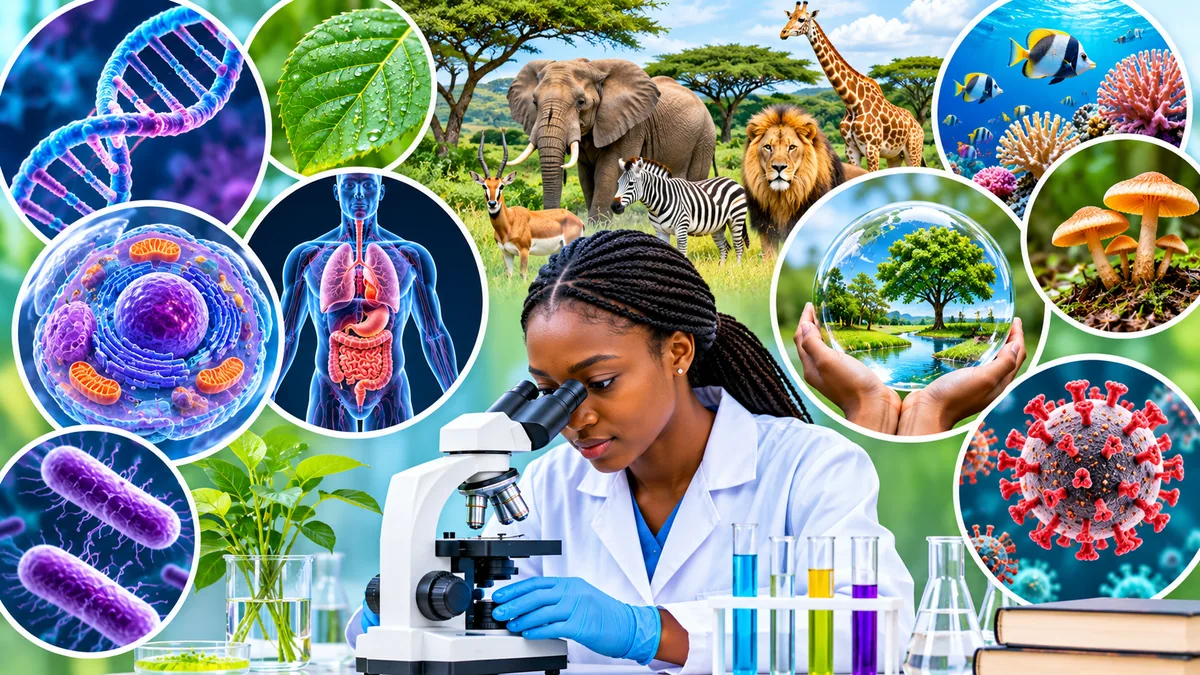
A peer-reviewed analysis of natural-selection misconceptions shows why learners often conflate purposeful change, survival and inheritance. SuperEducational's guide to the branches of biology offers context for the roles of genetics, ecology and evolutionary biology in answering these questions.
Can natural selection explain the origin of new species?
Over long periods, populations may become separated and accumulate genetic, ecological and behavioural differences. If they become reproductively isolated, scientists may recognise the emergence of separate species. Natural selection can contribute to this process, but speciation may also involve genetic drift, geographic barriers, changes in mating patterns and other mechanisms.
Natural selection itself is not a complete account of life's earliest origin. Evolution explains changes and diversification of life once reproducing systems exist; research on how life first arose is a distinct scientific question. This distinction prevents the theory from being credited with claims it was not designed to answer.
Classroom activity: model natural selection without harming animals
Prepare two colours of paper dots and place equal numbers on a contrasting background. Have students acting as “predators” collect dots they can easily see for a short, fixed interval. Record the numbers of each colour remaining. Then simulate reproduction by adding more dots in proportion to the surviving colour types and repeat for several rounds.
Example: Suppose the start has 20 pale and 20 dark dots. On a dark background, students might collect 15 pale and 5 dark, leaving 5 pale and 15 dark. If each remaining dot is copied once for the next round, the next round has 10 pale and 30 dark. The dark fraction increases from 50% to 75% in this illustrative classroom model.
This is not published experimental data and does not prove that all colour changes result from selection. Students must describe the assumptions: paper-dot colour represents inherited variation; students' visibility determines collection; and surviving dots reproduce at equal rates. Ask whether the result might change if the background becomes pale, collection is random or colours are not inherited.
For a real biological counterpart, teachers can use the HHMI rock pocket mouse data investigation . Related SuperEducational material on observing onion cells under a microscope can help students distinguish cell observation from population-level evolutionary processes.
Why natural selection matters outside the classroom
Understanding selection helps researchers investigate changing pests, resistance to medicines, conservation problems and the ability of species to respond to environmental shifts. In agriculture, resistance to pesticides can spread if insects with heritable resistance survive treatments and reproduce. In medicine, bacterial resistance affects how antimicrobial medicines should be managed. In conservation, preserving diverse populations and suitable habitats helps species cope with changing conditions, although genetic variation alone cannot guarantee survival.
The principle is broadly useful: environmental conditions affect reproductive success, and inherited variation determines how populations may respond. Effective responses require real data on the organisms, genes, environments and timescales involved.
Frequently asked questions
What is evolution by natural selection in simple words?
It is the process by which inherited characteristics linked to greater reproductive success become more common in a population over generations.
Who proposed natural selection?
Charles Darwin and Alfred Russel Wallace developed closely related explanations independently and presented them jointly in 1858. Darwin elaborated his theory in his 1859 book On the Origin of Species.
Is natural selection random?
The genetic variation available to a population includes chance elements, but natural selection is not random with respect to the influence of heritable traits on reproductive success in a given environment.
Can an individual organism evolve?
An individual's body can change during its lifetime, but biological evolution is normally measured as inherited changes across generations in a population.
Does evolution by natural selection always lead to a new species?
No. Selection may alter a population without causing speciation. New species can form when multiple evolutionary processes lead to reproductive isolation over time.
Is antibiotic resistance an example of evolution?
Yes. Resistance-associated genetic variants can spread through bacterial populations when antibiotic exposure favours their survival and multiplication. Gene transfer between bacteria is also important.
What is the strongest evidence for natural selection?
Evidence is especially persuasive when scientists can measure inherited variation, an environmental pressure and differences in survival or reproduction, then track population changes. Long-term finch studies, pocket-mouse genetics and experimental resistance research provide complementary examples.
Conclusion
Evolution by natural selection is not a story of organisms choosing to change or of nature working towards perfection. It is a testable biological process: populations contain heritable variation, conditions influence reproductive success, and traits associated with greater success can become more common over generations.
From Galápagos finches to desert mice, peppered moths and bacteria, scientists have documented this process using observations, experiments, genetics and historical records. Understanding the evidence—and the distinction between mutation, natural selection and other mechanisms—makes evolutionary biology clearer, more accurate and more relevant to the living world.