

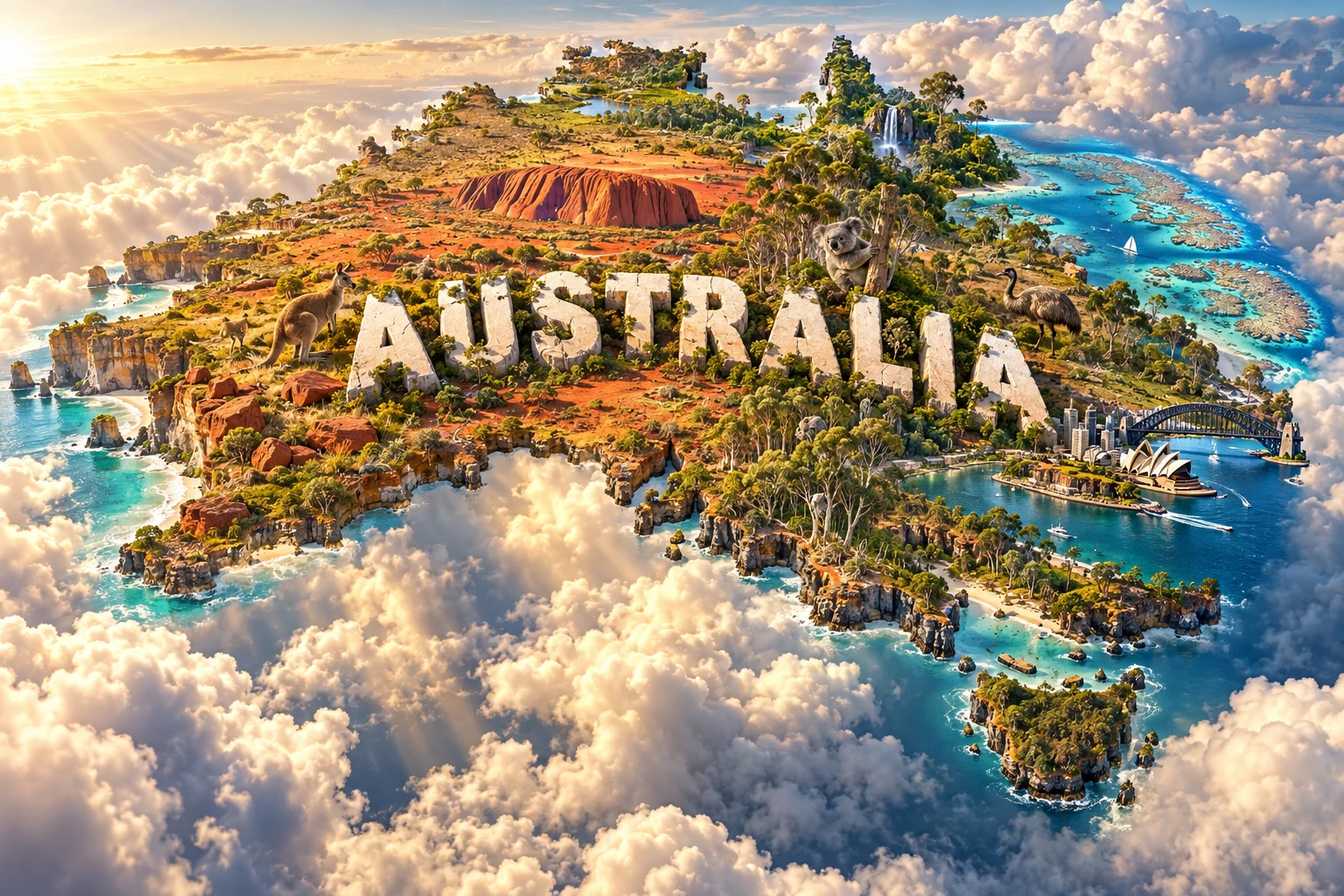
Australia is both a country and the smallest continent. Its ancient, relatively low landmass contains a dry interior, tropical north, temperate south, eastern highlands and extraordinary marine environments. Long isolation helped marsupials, monotremes and many plants evolve in distinctive ways.
The familiar image of a flat red desert tells only part of the story. Australia also contains alpine areas, tropical rainforest, vast savannas, wetlands, eucalyptus woodland, coral reefs and some of the world's largest urban coastal regions. Its landscapes record billions of years of geological change and tens of thousands of years of Aboriginal and Torres Strait Islander stewardship.
1. Where Is Australia?
Australia lies in the Southern Hemisphere between the Indian and Pacific oceans. It includes the Australian mainland, Tasmania and many smaller islands. Indonesia, Timor-Leste and Papua New Guinea lie to the north, New Zealand to the southeast and island countries of the Pacific to the northeast and east. No other country shares Australia's mainland borders.
The country has six states and two principal mainland territories. Canberra, in the Australian Capital Territory, is the national capital. Sydney is the largest city, while Melbourne, Brisbane, Perth, Adelaide, Gold Coast, Newcastle and Canberra are other major urban centers.
Most Australians live near the coast, especially in the east, southeast and southwest. The interior is much more sparsely populated because water is limited and distances are enormous. “The Outback” is an informal term for remote inland regions, not one precisely bounded desert.
2. Quick Country Facts
- Official name: Commonwealth of Australia
- Capital: Canberra
- Region: Oceania
- Area: Approximately 7.69 million square kilometers
- Population: Approximately 27.9 million in March 2026, according to the Australian Bureau of Statistics
- Currency: Australian dollar (AUD)
- National language in practice: English; Australia has no constitutionally declared official language
- Other languages: Hundreds of Aboriginal and Torres Strait Islander languages and many languages used by migrant communities
- Time zones: Three principal standard zones on the mainland, with regional daylight-saving differences and additional external-territory zones
- Highest mainland point: Mount Kosciuszko, 2,228 meters
- Longest river: Murray River
- Largest river basin: Murray–Darling Basin
3. Geography and Landscape
Australia is the lowest continent by average elevation. Its broad physical divisions are the Western Plateau, Central Lowlands and Eastern Highlands. The Western Plateau covers much of the continent and contains ancient rock surfaces, sandy deserts, stony plains and isolated ranges. The Great Victoria, Great Sandy, Gibson, Simpson and Tanami are separate deserts rather than one continuous sea of dunes.
The Central Lowlands include the Lake Eyre, or Kati Thanda–Lake Eyre, basin and the Murray–Darling Basin. Many inland rivers are intermittent: they may carry floodwater after distant rain but shrink into channels and waterholes during dry periods. Kati Thanda–Lake Eyre is Australia's lowest natural point and usually holds little or no surface water.
The Great Dividing Range and associated eastern highlands run near the east coast. They influence rainfall and divide short rivers flowing toward the Pacific from inland drainage. The Snowy Mountains contain Mount Kosciuszko and Australia's largest alpine area.
Northern Australia includes tropical savannas, monsoon forests and extensive wetlands. Tropical rainforest survives along parts of northeastern Queensland. Tasmania is cooler, more mountainous and relatively well watered. Offshore, the Great Barrier Reef extends along Queensland's coast as a vast connected system of reefs, islands, seagrass, mangroves and deeper-water habitats.
4. Why Does Australia Look Like This?
Australia's landscapes are unusually old because the continent has experienced long periods without recent continent-scale mountain building or ice-sheet erosion. Ancient stable blocks called cratons underlie much of the west. Weathering and erosion acted on these surfaces for millions of years, lowering mountains and redistributing sediment into basins.
Australia was once part of Gondwana, joined to Antarctica, India and other southern lands. As Gondwana broke apart, Australia separated from Antarctica and moved north. Uplift along the eastern continental margin helped create the Eastern Highlands and Great Divide. Erosion cut valleys and escarpments into the elevated edge.
Uluru is an eroded remnant of sandstone deposited about 500 million years ago from material shed by ancient mountains. Later earth movements tilted its sedimentary layers almost vertically. Softer surrounding rocks eroded, leaving the resistant formation exposed. Uluru is much larger below ground than the part visible above the plain.
The Great Barrier Reef developed on the northeastern continental shelf through repeated changes in sea level. Reef-building corals grow where light, temperature, salinity and water quality are suitable. Modern reef structures grew as seas rose after the last ice age, but the ecosystem includes far more than coral.
5. Climate
Australia's climate ranges from tropical in the north to temperate in much of the south, with arid and semi-arid conditions across most of the interior. Northern Australia usually has a hot wet season and a drier winter season as the tropical rain belt and monsoon shift. Tropical cyclones can affect northern and western coasts.
The southern coast experiences cooler winters. Southwestern and parts of southern Australia have Mediterranean-type patterns with wetter winters and dry summers. Eastern coastal climates range from tropical to temperate, with rainfall influenced by the ocean and highlands.
Subtropical high-pressure systems and distance from reliable moisture help make the interior dry. The Great Dividing Range creates rain-shadow effects west of parts of the east coast. El Niño and La Niña shift rainfall, drought, heat and flood risks from year to year. Bushfire is a natural ecological process in many environments, but extreme heat, drought, fuel conditions and settlement patterns can turn fire into disaster. Climate change is intensifying heat and affecting fire weather, rainfall extremes and coral bleaching.
6. Wildlife and Ecosystems
Australia's long isolation produced high endemism: many species occur nowhere else. Marsupials give birth at an early developmental stage and usually continue development in a pouch. Kangaroos and wallabies occupy many habitats, but individual species have specific ranges. The platypus and echidnas are monotremes—mammals that lay eggs.
Koalas live patchily in suitable eucalyptus forests and woodlands of eastern and southern mainland Australia. They do not occur naturally across the interior, Tasmania or every eucalyptus forest. Koala populations in Queensland, New South Wales and the Australian Capital Territory are federally listed as endangered, with habitat loss, climate change, fire, disease and urban hazards among their threats.
Emus range across much of mainland Australia but are absent from dense urban areas and some very arid or forested habitats. The tropical north supports saltwater and freshwater crocodiles, while Tasmania is home to the Tasmanian devil. Australia's marine ecosystems shelter dugongs, whales, sea turtles, sharks and diverse reef life.
Introduced predators, invasive plants, altered fire regimes, habitat loss and climate change threaten native biodiversity. Aboriginal land-management knowledge, including carefully planned cultural burning, contributes to contemporary conservation. Protected areas include national parks, Indigenous Protected Areas, marine parks and state reserves.
7. Famous Landmarks and Natural Features
Uluṟu–Kata Tjuṯa
Uluru and Kata Tjuta rise from Central Australian plains within a living cultural landscape. The park is Aboriginal land, owned by Aṉangu Traditional Owners and jointly managed. Uluru's geology is important, but its cultural meaning cannot be reduced to its rock type or appearance.
Great Barrier Reef
The Great Barrier Reef is the world's largest coral reef system, containing more than 3,000 reefs as well as islands, seagrass beds, mangroves and deeper habitats. It holds great ecological and cultural importance. Climate change is its most serious threat because warmer seas can cause mass coral bleaching.
Sydney Harbour
Sydney Harbour is a drowned river-valley system around which Australia's largest city developed. The Sydney Opera House and Harbour Bridge are internationally recognized structures, but Sydney represents only one part of the country's urban and architectural history.
Kakadu National Park
Kakadu in the Northern Territory contains wetlands, savanna, stone country and important Aboriginal cultural sites. Bininj/Mungguy people have cared for the region across many generations. Seasonal flooding supports waterbirds, fish and crocodiles.
Great Dividing Range and Australian Alps
The eastern highlands influence rainfall, river directions and habitats. The Australian Alps contain mainland Australia's highest mountains, alpine grasslands and winter snow, challenging the idea that the entire continent is permanently hot.
Purnululu and the Tasmanian Wilderness
Purnululu National Park in Western Australia's Kimberley is known for banded sandstone towers sculpted by erosion. The Tasmanian Wilderness World Heritage Area protects extensive temperate ecosystems and cultural sites in a cooler island environment.
8. People, Languages and Culture
Aboriginal and Torres Strait Islander peoples belong to many distinct nations, language groups and cultural traditions. Their continuous connections to Country extend back at least 65,000 years according to archaeological evidence. “Country” can include land, waters, law, kinship, ancestors and responsibilities; it is more than property or scenery.
British colonization began in 1788 and caused dispossession, violence, disease and disruption of Indigenous societies. Australia later developed as a federation in 1901. Modern educational accounts must recognize both national institutions and the continuing sovereignty, cultures and rights of First Peoples.
English is dominant in government and public life, but Australia is highly multilingual. Aboriginal and Torres Strait Islander languages include many separate families and isolates. Migration has also made Mandarin, Arabic, Vietnamese, Cantonese, Punjabi, Greek, Italian and many other languages part of daily life.
Australian music, literature, film, visual art and sport reflect Indigenous traditions, British and Irish histories, Asia-Pacific connections and global migration. Indigenous art is not one uniform style: desert painting, Arnhem Land bark painting, Torres Strait Islander printmaking and urban contemporary practice arise from different peoples and contexts.
9. Food
Indigenous food knowledge includes regionally specific use of native plants, seeds, fruits, seafood and game. Foods marketed broadly as “bush tucker” should be understood through the cultures and Country from which knowledge comes.
Modern Australian food draws on British and Irish traditions and successive migration. Meat pies, barbecues and seafood are familiar, while Greek, Italian, Lebanese, Chinese, Vietnamese, Indian and other cuisines are deeply embedded. Regional products include tropical fruit in the north, grains and livestock from inland farming areas, wine from southern regions and seafood from long coastlines. No one dish represents every Australian community.
10. Economy and Major Industries
Australia has a high-income, service-led economy. Health care, education, finance, professional services, retail, transport, construction and tourism are important employers and sources of output. Universities and international education connect Australia strongly with the Asia-Pacific region.
Mining is a major export industry. Australia produces iron ore, coal, liquefied natural gas, gold, bauxite, lithium and other minerals. Mining regions are concentrated rather than spread evenly, and projects raise questions about environmental effects, water and Indigenous land rights.
Agriculture includes livestock, wheat, barley, canola, sugarcane, cotton, fruit and wine, depending on climate and water. Drought and variable rainfall strongly influence production. Manufacturing includes food processing, machinery, pharmaceuticals and specialized technologies, while renewable energy and critical-mineral industries are expanding.
11. What the 3D Visual Represents
The artwork combines Uluru, the Great Barrier Reef, tropical rainforest, Outback deserts, eucalyptus forest and Sydney-inspired harbor architecture. Kangaroos, koalas and emus represent distinctive native wildlife.
These features are separated by great distances. Uluru lies in the arid center, the Great Barrier Reef follows the northeastern coast, tropical rainforest occurs mainly in the north and northeast, and Sydney is on the southeastern coast. Koalas have a patchy eastern and southern distribution and do not inhabit the central deserts. Coral reefs cannot be positioned inside the mainland outline as literal geography.
The image is a conceptual artistic composition. The landmarks, wildlife and landscapes are combined for educational visualization and are not shown at their true geographic positions or scale. It is not a satellite map.
12. Interesting Facts About Australia
- Australia is both a sovereign country and the smallest continent.
- It is the lowest continent, averaging about 330 meters above sea level.
- Some Australian rocks and mineral crystals are among Earth's oldest known materials.
- Mount Kosciuszko is the highest point on the mainland at 2,228 meters.
- Australia's ten largest named mainland deserts cover about 18 percent of the mainland.
- The Outback is a broad cultural-geographic term, not one officially bounded desert.
- Uluru's sandstone layers were tilted almost vertically by ancient earth movements.
- The Great Barrier Reef includes mangroves, seagrass and deep water as well as coral reefs.
- Koalas naturally occur only in parts of eastern and southern mainland Australia.
- Platypuses and echidnas are egg-laying mammals.
- Northern Australia has a monsoonal wet and dry seasonal pattern.
- The Murray–Darling is the country's largest river basin.
- Aboriginal and Torres Strait Islander peoples belong to hundreds of distinct cultural and language groups.
- Nearly one-third of Australia's residents in 2025 were born overseas.
- The Australian Alps receive seasonal snow.
13. Short Quiz
-
What is Australia's highest mainland point? A. Uluru B. Mount Kosciuszko C. Mount Wellington D. Kata Tjuta
-
Why is much of inland Australia dry? A. Subtropical high pressure and distance from reliable moisture B. It has no atmosphere C. Coral reefs block rain D. Glaciers absorb all clouds
-
What type of rock forms Uluru? A. Marble B. Sandstone C. Coal D. Modern lava
-
Where do koalas naturally occur? A. Across every Australian desert B. In suitable eastern and southern mainland forests C. Only in Tasmania D. On the Great Barrier Reef
-
What does the 3D visual show? A. Exact locations and scale B. A satellite image C. A conceptual combination of distant features D. One ecosystem near Sydney
Answer Key
- B
- A
- B
- B
- C
14. Related Learning
- Indonesia Explained: Islands, Volcanoes and Biodiversity
- Papua New Guinea Explained: Mountains, Rainforest and Culture
- New Zealand Explained: Tectonics, Glaciers and Wildlife
- Why Is Australia's Interior So Dry?
- How Uluru Formed
- How the Great Barrier Reef Developed
- Why Australia Has So Many Unique Animals
- What Is a Marsupial?
- How Aboriginal Cultural Burning Works
- How the Great Dividing Range Shapes Australia's Rivers
15. Sources
- Australian Bureau of Statistics — National population — current population estimates and migration context
- Geoscience Australia — Australian landforms and their history — landscape evolution and the Great Divide
- Geoscience Australia — Significant rock features — Uluru geology
- Geoscience Australia — Deserts — desert definitions and areas
- Geoscience Australia — Highest mountains — Mount Kosciuszko and alpine relief
- Australian Government — About the Great Barrier Reef — reef scale, habitats and threats
- Australian Government — Koala — distribution, status and threats
- UNESCO World Heritage Centre — Australia — cultural and natural heritage properties
- Parks Australia — Uluṟu–Kata Tjuṯa National Park — Aṉangu ownership, culture and joint management
- Australian Bureau of Statistics — Australian economy — industry and economic context